
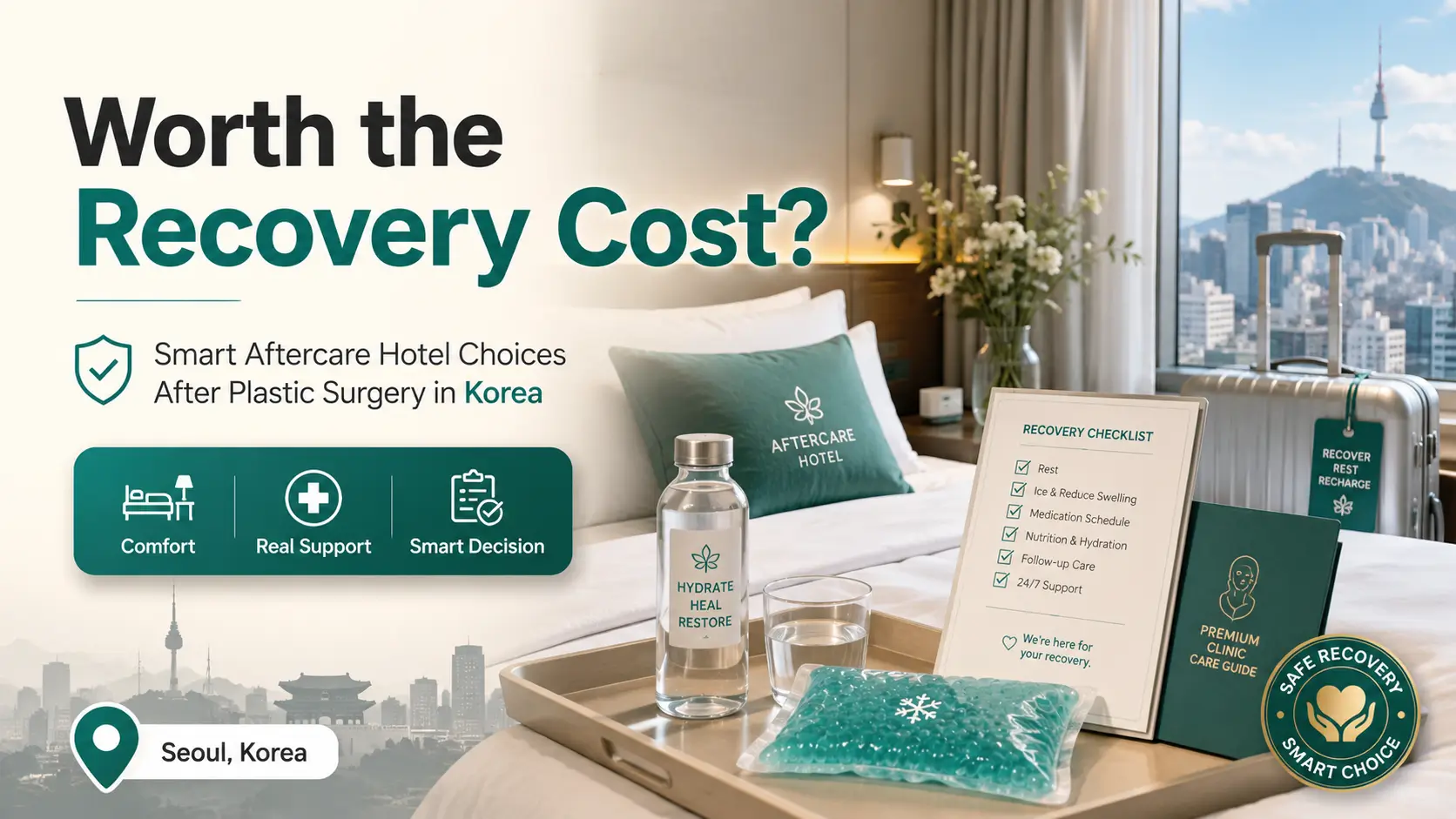
Medical tourism decision guide
Korea Plastic Surgery Aftercare Hotels:
Are They Worth the Recovery Cost?
A Korea plastic surgery aftercare hotel can sound wonderfully simple: a soft room near the clinic, someone to help with translation, rides to follow-up visits, recovery meals, ice packs, and a quiet place to disappear while your face behaves like an overfilled suitcase. For a tired international patient, that structure can feel like oxygen.
But aftercare hotels are not hospitals, and comfort is not the same thing as clinical supervision. The real question is not whether the room is pretty. It is whether the lodging choice reduces recovery gaps, communication problems, mobility stress, missed follow-up visits, and expensive planning mistakes.
This guide gives you a clear way to compare aftercare hotels, regular hotels, Airbnb-style stays, and clinic-linked packages before you pay. Think of it as your pre-surgery lantern: not dramatic, just bright enough to keep you from stepping into the wrong alley.
Compare lodging safely
See when structure is worth paying for and when a regular hotel may be enough.
Avoid hidden costs
Plan for rides, extra nights, meals, translation, supplies, and schedule changes.
Build a recovery plan
Create one page with clinic, hotel, emergency, flight, medication, and US follow-up details.
The safest recovery plan is rarely the fanciest one. It is the one with fewer gaps, clearer contacts, and less guessing. 🧭
Snapshot
This article is for US and UK readers considering cosmetic surgery in South Korea who need to compare aftercare hotels with regular hotels, Airbnb-style stays, and clinic support. You will learn what aftercare hotels can and cannot do, what questions to ask before booking, what hidden costs to expect, and how to build a safer recovery plan before you pay.
Table of Contents
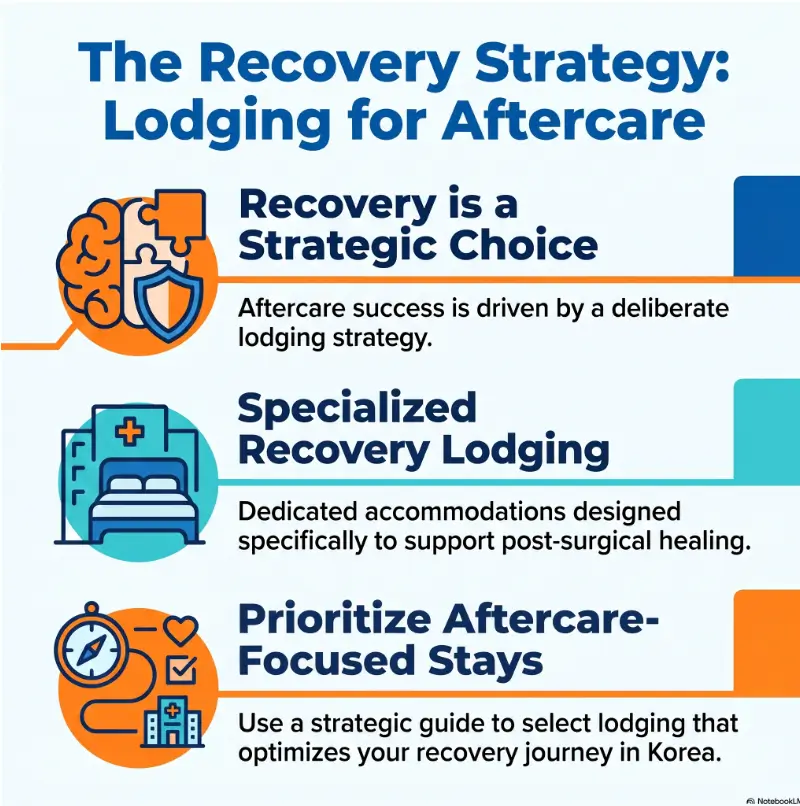
Safety First: An Aftercare Hotel Is Not a Mini Hospital
Korea plastic surgery aftercare hotels sit in a tempting middle space. They may feel more supportive than a regular hotel, more recovery-aware than a vacation rental, and less lonely than being dropped in a room with a paper bag of prescriptions and a swollen face.
That can be valuable. Still, an aftercare hotel is not a substitute for a licensed surgeon, nurse, emergency department, pharmacist, or local follow-up doctor. It should support your recovery plan, not become the recovery plan.
Before you act
This article is educational and cannot tell you whether surgery, travel, a specific clinic, or a specific aftercare hotel is safe for you. Confirm your plan with qualified medical professionals, ask your surgeon what symptoms require urgent care, and arrange follow-up care before traveling. Cosmetic surgery is still surgery, even when the airport lounge is nice and the hotel slippers are excellent.
What “aftercare” usually means in Korea plastic surgery tourism
In this context, “aftercare” usually means non-emergency support around the recovery period. Depending on the property or service package, that may include clinic transportation, English-speaking staff, help scheduling follow-up visits, recovery meals, medication reminders, ice packs, garment assistance, and quieter rooms near cosmetic surgery districts.
Some services are linked closely to clinics. Others are independent hotels or apartments that market to medical tourists. The label can be fuzzy, so the service list matters more than the name on the website.
What it does not mean
An aftercare hotel generally should not be making medical decisions, diagnosing complications, changing medication instructions, removing drains without clinical authorization, or deciding whether you are safe to fly. If the staff speaks with calm authority but cannot tell you who is medically responsible after hours, pause before booking.
The one sentence to ask is simple: “Who handles medical decisions after hours, and how do I reach them?” If the answer is vague, glossy, or wrapped in concierge perfume, keep asking.
Key takeaway
An aftercare hotel may reduce travel stress, but it should never blur who is responsible for clinical decisions. Comfort is helpful. Clear medical escalation is essential.
For official medical tourism safety guidance, start with the CDC’s medical tourism page and use it as a sober planning checklist rather than a scare pamphlet.
Worth It? Use the 3-Part Recovery Value Test
The best way to decide if a Korea plastic surgery aftercare hotel is worth it is not to ask, “Is it luxurious?” Ask, “What risk or friction does it reduce that I cannot safely handle another way?”
Think of the room rate as buying structure. Sometimes structure is priceless. Sometimes it is just anxiety wearing a robe.
Test 1: Does it keep you close enough for real follow-up?
Distance matters after surgery. A hotel that is “in Seoul” may still be too far from your clinic when you are bruised, tired, medicated, swollen, and moving slowly. “Near Gangnam” is not the same as “near my clinic entrance.”
Check the walking distance, taxi time during traffic, elevator access, and whether the hotel can help with unscheduled clinic visits. If your surgeon wants you nearby for dressing changes, drain checks, stitch removal, or swelling review, your lodging should make that easy.
Test 2: Does it solve a problem you cannot safely DIY?
A regular hotel may be fine for a confident traveler having a minor procedure with a companion and clear clinic follow-up. But an aftercare hotel may be worth considering if you are traveling alone, have multiple appointments, need translation, or expect limited mobility after facial, body, or multi-area surgery.
For example, a solo patient recovering after facial surgery may need help with rides, medication timing, meal texture, cold packs, and translation. Paying for that structure may prevent a dozen tiny problems from becoming one large midnight panic.
Test 3: Does it reduce friction, or just wrap anxiety in nicer sheets?
Some paid services are genuinely useful. Others are decorative. A room with filtered lighting, quiet hallways, and elevator access can matter. A marble lobby does not help you manage a fever, a wound concern, or a missed follow-up visit.
Before booking, split the service list into “need to have” and “nice to have.” Need-to-have items affect safety, logistics, communication, and follow-up. Nice-to-have items affect mood, comfort, and convenience.
The 3-Part Recovery Value Test
1. Follow-up access
Can you reach the clinic quickly for scheduled and unscheduled visits?
2. Support gap
Does it solve translation, transport, mobility, meals, or medication friction?
3. Total cost
Do the included services reduce real risk enough to justify the extra price?
If a package fails all three tests, it may be comfort marketing rather than recovery support.
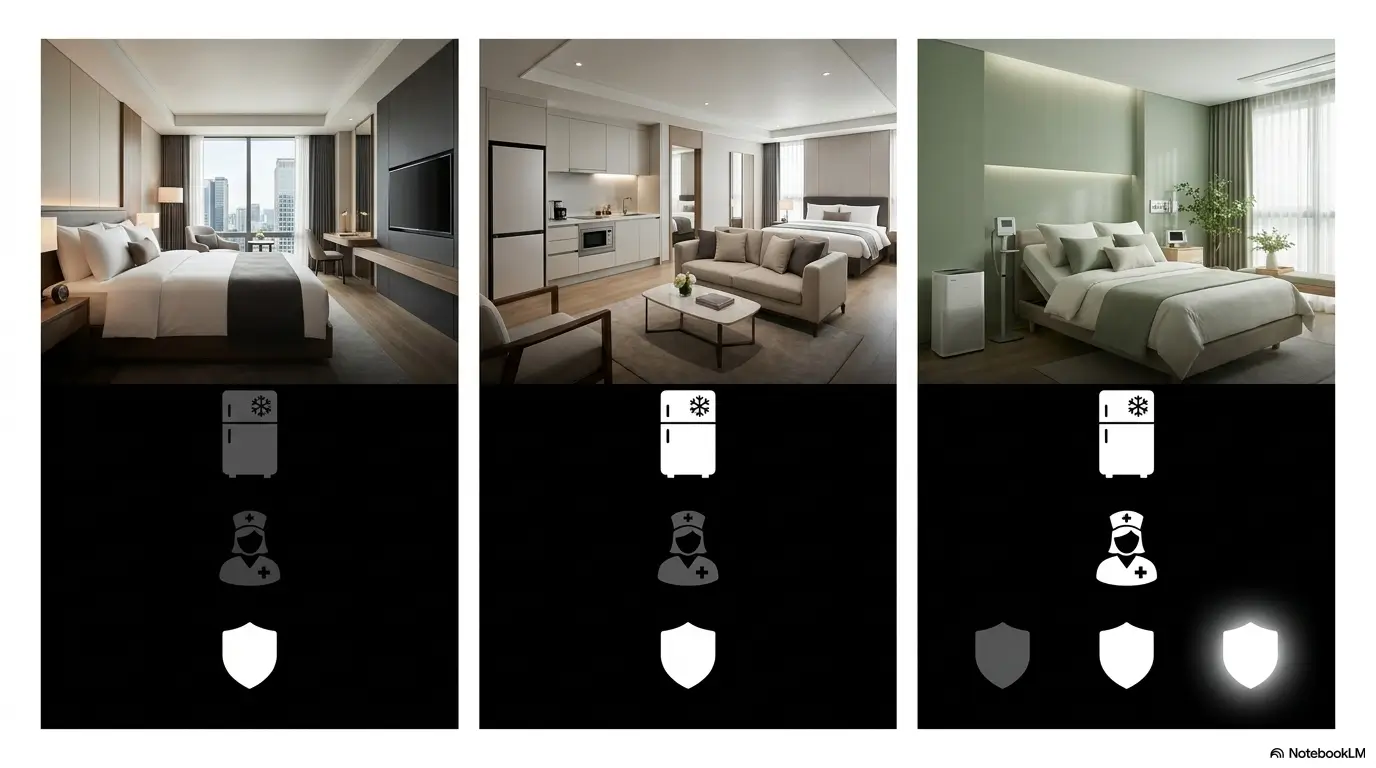
Who This Is For, and Who Should Be More Cautious
Not every international patient needs an aftercare hotel. Also, not every patient should travel for surgery in the first place. The useful question is where you sit on the support spectrum.
An aftercare hotel may make sense for these travelers
Aftercare lodging may be worth comparing if you are a first-time Korea medical tourist, traveling alone, having surgery that affects vision or mobility, or juggling multiple clinic appointments in the first week. It can also help if you are anxious about Korean medical communication and want a structured bridge between the clinic and your room.
For foreign visitors who are new to Korean apps, pharmacy routines, and hospital flow, planning the basics before surgery is kind to your future self. Guides on medical translation in Korea, Korean pharmacies for foreigners, and Korean hospital admission can help you understand the practical texture of the system before you are recovering inside it.
A regular hotel may be enough for lower-support plans
A regular hotel near the clinic may be enough if your procedure is minor, your surgeon’s follow-up plan is simple, you have a reliable companion, and you feel confident using taxis, translation apps, pharmacies, and clinic communication on your own.
In that case, spend your money on proximity, elevator access, flexible cancellation, quiet rooms, and a realistic buffer before flying home. A plain room two blocks from the clinic can beat a dreamy suite thirty minutes away.
Be more cautious if your plan is rushed or medically unclear
Do not use an aftercare hotel to make a risky plan feel organized. If you have unclear health risks, limited time in Korea, no written post-op instructions, no US follow-up plan, or no idea who to call after hours, your lodging upgrade is not solving the core problem.
Medical tourism is easier to market than it is to recover from. Your itinerary should serve your recovery, not the other way around.
Quick self-check
- I know the clinic address, not just the neighborhood.
- I know my required follow-up dates before booking lodging.
- I know who handles medical concerns after hours.
- I know where I would go for urgent care in Korea.
- I have a plan for follow-up after returning home.
The Recovery Gap: What Happens After You Leave the Clinic
The fragile part of medical tourism is not always the surgery day. It is the gap after discharge, when you are technically “fine,” but still swollen, tired, unfamiliar with the city, and one confusing symptom away from spiraling through search results at 2:11 a.m.
Day 0 to 2: swelling, sleep position, and medication timing
The first couple of days can involve swelling, bruising, wound care instructions, medication timing, drainage questions, sleep positioning, and appetite changes. Your surgeon’s instructions are the boss here. The hotel’s job is to help you follow them, not remix them.
Ask whether the hotel provides extra pillows, cold packs if approved by the clinic, easy access to water, soft food options, a quiet room, and a simple way to contact staff without walking to the front desk.
Day 3 to 7: clinic visits, stitch checks, and infection watch
The first week often includes follow-up visits, dressing changes, swelling checks, stitch or drain questions, and infection watch. This is where distance and translation matter. A vague shuttle promise is less useful than a clear plan: who books the car, how long it takes, and what happens if the clinic asks you to come in unexpectedly.
If your clinic provides its own follow-up visits, you may not need a separate aftercare hotel. But you still need lodging that makes those visits easy to attend.
Day 8 onward: flying home and delayed anxiety
Many patients feel emotionally better once the worst swelling starts to settle. That does not mean the travel risk has vanished. Long-haul flying, luggage, dehydration, sleep disruption, and sitting still for hours can all make recovery more demanding.
Before you fly, ask your surgeon what symptoms should delay travel and what movement, compression, medication, and hydration guidance applies to your specific procedure. The American Society of Plastic Surgeons has warned that traveling soon after cosmetic surgery can increase risks, so treat the flight home as part of recovery planning, not the vacation finale.
Show me the nerdy details
The lodging decision has three hidden variables: time-to-clinic, communication latency, and recovery friction. Time-to-clinic means how fast you can get reviewed if something changes. Communication latency means how many steps stand between your symptom and a qualified response. Recovery friction means all the small tasks that become harder after surgery: elevators, food, laundry, pharmacy trips, taxi apps, translation, and sleep setup. A good aftercare hotel reduces at least two of these. A weak package mainly sells atmosphere.
Service Menu: What Actually Deserves Your Money
The best aftercare hotel is not the one with the largest adjective collection. “Premium,” “luxury,” and “VIP” can mean everything or nothing. Ask for a written service list and compare it against your procedure schedule.
Services that can genuinely reduce recovery stress
- Clinic transportation: timed around follow-up visits, not just airport arrival.
- Medical translation support: especially for medication instructions, wound-care questions, and appointment changes.
- Recovery-aware meals: easy-to-eat foods, hydration support, and options that fit clinic instructions.
- Room setup: elevator access, low noise, easy bathroom access, comfortable sleep positioning, and good lighting control.
- Basic supplies coordination: laundry, approved cold packs, pillows, garment help, humidifier access, and pharmacy assistance.
Services that need extra scrutiny
Be careful with services that sound clinical but are not clearly supervised by licensed professionals. If a package mentions wound care, drain care, injections, medication changes, or complication monitoring, ask exactly who performs the task, what their credentials are, and whether your surgeon has authorized it.
A recovery hotel can help you get to the clinic. It should not become a shadow clinic with mood lighting.
| Service | Worth paying for when… | Question to ask |
|---|---|---|
| Clinic rides | You have multiple follow-ups or limited mobility | Are unscheduled clinic visits included or extra? |
| Translation | You do not speak Korean confidently in medical settings | Is support available during clinic visits or only at check-in? |
| Meals | Your procedure affects chewing, appetite, swelling, or medication timing | Are meals included, optional, or billed separately? |
| Recovery supplies | You are traveling light or alone | Which supplies are included and which must I buy? |
| After-hours support | You are anxious, alone, or early in recovery | Who decides when I need the clinic or emergency care? |
Key takeaway
Pay for services that make follow-up, communication, mobility, medication routines, and rest easier. Do not pay extra for vague “care” unless the provider explains exactly what is included and who is qualified to do it.
Aftercare Hotel vs Regular Hotel vs Airbnb: The Practical Comparison
There is no universally best lodging option after plastic surgery in Korea. The right choice depends on your procedure, follow-up schedule, travel confidence, companion support, budget, and risk tolerance.
Use the comparison below as a sober shopping lens. It is not about status. It is about recovery friction.
| Option | Best for | Main advantage | Main risk |
|---|---|---|---|
| Aftercare hotel | Solo travelers, first-timers, patients with frequent follow-up visits | More structure, translation, transport, and recovery-aware setup | Higher cost and possible dependence on non-clinical staff |
| Regular hotel near clinic | Confident travelers with clear instructions and a companion | Flexible, familiar, often easier to compare by location and cancellation terms | Less recovery support and less help with medical communication |
| Airbnb or apartment stay | Longer stays, patients wanting kitchen and privacy | More space, laundry, and meal control | Stairs, poor elevator access, hard beds, host rules, and less front-desk support |
| Hospital stay | Cases where the surgeon recommends clinical observation | Clinical supervision and direct medical access | Different purpose, different cost, and usually not a hotel replacement |
Good, better, best lodging logic
If your budget is tight, “good” may mean a clean regular hotel within a short taxi ride of the clinic, with elevator access and flexible cancellation. “Better” may mean a recovery-aware hotel with translation and transport. “Best” may mean a plan your surgeon has reviewed, with lodging, follow-up, emergency instructions, and US care arranged before you leave home.
Notice the pattern: best is not always the most expensive room. Best is the fewest unsafe gaps.
The quiet dealbreaker: stairs, distance, and late-night help
Stairs can turn a bargain stay into a daily negotiation with gravity. A faraway room can make follow-up visits harder. No front desk can become a problem if you need help calling a taxi, finding the entrance, receiving deliveries, or contacting the clinic.
For practical Korea travel basics, especially if you will be moving between airports, clinics, pharmacies, and hotels, it may also help to prepare with guides on T-money in Korea, Korean mobile apps, and prescription filling in Korea.
Hidden Costs and Mistakes That Turn Recovery Into a Stress Opera
The room rate is only the visible part of the bill. The rest hides in airport transfers, clinic rides, extra nights, translation add-ons, meal packages, laundry, recovery supplies, companion fees, cancellation terms, currency conversion, and flight changes.
Recovery has a way of charging fees in whispers. Listen early.
Costs to compare before you pay
| Cost item | Why it matters | What to verify |
|---|---|---|
| Airport transfer | You may arrive tired or swollen after consultation travel | One-way, round-trip, included, or extra? |
| Clinic rides | Follow-up visits may not fit tourist shuttle schedules | Number of rides included and after-hours policy |
| Extra nights | Swelling or surgeon guidance may delay flying | Nightly extension rate and room availability |
| Translation | Medical details need more than polite tourist English | Hours, setting, and whether clinic visits are covered |
| Meals and supplies | Small items add up quickly when you cannot shop easily | Meal price, laundry fee, ice pack policy, garment help |
| Cancellation terms | Surgery dates can shift after consultation or labs | Refund deadline, deposit rule, and date-change fee |
Mistakes to avoid
- Choosing based on Instagram interiors. Pretty rooms do not answer post-op questions.
- Assuming “near Gangnam” means near your clinic. Map the exact clinic entrance.
- Flying home before your surgeon’s minimum follow-up window. Ask before buying the flight.
- Not asking who coordinates complications after business hours. This is not a tiny detail.
- Packing like a tourist instead of a recovering patient. Comfortable clothes, documents, medications, and phone access matter more than outfits.
Real-world example: the cheaper room that was not cheaper
A traveler books a lower-cost apartment twenty-five minutes from the clinic because it has a kitchen and looks peaceful. The first follow-up visit is easy. The second visit is not. Traffic is bad, the elevator is slow, the taxi drop-off is confusing, and the patient is too swollen to explain the address comfortably.
Then the clinic asks for one extra check the next morning. The apartment saves money on paper, but the patient now pays for extra taxis, translation help, delivery meals, and a late checkout. More importantly, the plan creates stress at the exact moment the body needs boring, quiet repetition.
The lesson is not that apartments are bad. The lesson is that recovery logistics must be priced honestly.
Key takeaway
A cheaper room can become expensive if it creates missed visits, extra rides, poor sleep, difficult stairs, weak communication, or flight changes. Compare total recovery cost, not just nightly price.
When to Seek Help: Signs That Need the Clinic or Emergency Care
Your surgeon should give you procedure-specific warning signs. Keep those instructions in your phone, not buried in a suitcase or an email thread with a subject line you cannot remember.
The examples below are general safety prompts, not a diagnosis tool. When in doubt, contact your clinic or seek urgent medical help.
Call the clinic promptly for concerning changes
- Worsening pain that does not match your instructions
- Unusual swelling, especially if sudden or one-sided
- Bleeding, wound opening, drainage changes, or odor
- Fever, chills, or feeling unusually unwell
- Medication reactions, rash, vomiting, severe dizziness, or confusion about dosing
Seek urgent help for emergency symptoms
- Breathing trouble, chest pain, or fainting
- Severe one-sided leg swelling or calf pain
- Confusion, severe weakness, or loss of consciousness
- Uncontrolled bleeding
- Any symptom your surgeon identifies as urgent
For travelers in South Korea, emergency services are commonly reached through 119. Before surgery, ask your clinic what local emergency department they recommend if you need urgent care, and confirm how translation would work.
Phone-note template
Save this in your phone before surgery: “Procedure: ____. Clinic: ____. Surgeon/contact: ____. After-hours medical contact: ____. Hotel address in Korean: ____. Emergency hospital: ____. Allergies: ____. Medications: ____. Symptoms that should delay flight: ____.”
The Booking Checklist: Questions to Ask Before Paying
Before you book an aftercare hotel, ask boring questions. Boring questions are the little bolts holding the bridge together.
Send your questions in writing, especially if you are booking from another country. Screenshots are not a recovery plan, but written answers can prevent misunderstandings.
Clinic relationship and medical responsibility
- Is the aftercare hotel owned by, partnered with, recommended by, or independent from the clinic?
- Does my surgeon know I am staying there?
- Who handles medical decisions after hours?
- What happens if I need an unscheduled clinic visit?
- Will staff call the clinic, arrange transport, or simply advise me to contact the clinic myself?
Language, services, and billing
- Who speaks English, and during what hours?
- Is medical translation included at clinic visits?
- Are airport transfers, clinic rides, meals, laundry, supplies, and garment help included?
- Can I cancel or change dates if my surgery schedule changes?
- What deposit is required, and what refund rules apply?
Records and return-home planning
- Will the clinic provide operative notes, medication lists, implant details if relevant, and follow-up instructions in English?
- Can the hotel or coordinator help send records to my US or UK doctor?
- What symptoms should delay flying?
- Who should I contact after returning home if swelling, wound changes, or medication questions appear?
Provider comparison scorecard
- 2 points: clear written answer with specific times, costs, names, or process.
- 1 point: partial answer that sounds helpful but lacks details.
- 0 points: vague promise, pressure to book, or “don’t worry” without a process.
Score clinic rides, translation, after-hours support, cancellation, extra nights, supplies, and record handling. If a provider scores poorly on the essentials, the décor does not rescue the offer.
Insurance, Records, and the Better Recovery Itinerary
Insurance and records are not glamorous. They are the plain umbrella you are grateful for when the weather changes.
Elective cosmetic surgery complications may not be simple to cover through ordinary health or travel insurance. Coverage varies by policy, country, procedure, timing, and whether treatment is considered elective, emergency, corrective, or medically necessary. Read the documents before travel, and ask direct questions.
What records to request before leaving Korea
- Operative notes or procedure summary
- Medication list with dose and timing
- Implant details, if implants were used
- Post-operative instructions in English
- Emergency contact instructions
- Before and after clinical photos if medically relevant and provided by the clinic
Build recovery before sightseeing
Arrive early enough for consultation, labs, sleep reset, and calm decision-making. Keep the first week boring on purpose. Place clinic visits before shopping, cafés, sightseeing, and photo plans. Add buffer days before long-haul flying.
The tiny luxury that matters is doing less without guilt. Seoul will still have cafés when your surgeon clears you. The city is patient. Your incisions may not be.
| Timeline | Better plan | Avoid |
|---|---|---|
| Before booking | Ask clinic for follow-up schedule and travel restrictions | Booking flights and lodging first |
| Before flying to Korea | Arrange lodging, translation, insurance review, and US follow-up | Assuming the clinic will solve every travel issue |
| First week after surgery | Stay close, rest, attend follow-ups, follow written instructions | Shopping days, long subway transfers, nightlife, heavy luggage |
| Before return flight | Ask what symptoms should delay travel | Flying because the ticket says so |
| After returning home | Keep records ready and know who will see you if symptoms change | Waiting until a problem appears to find care |
The CDC explains that travel health insurance, medical evacuation insurance, and trip disruption coverage can serve different purposes. Review policy language carefully, and do not assume a regular travel plan covers elective cosmetic surgery complications abroad.
For plastic surgery-specific safety framing, the American Society of Plastic Surgeons offers patient education on medical tourism and cosmetic surgery travel risks. Use that information to shape your questions, especially around follow-up care and flying home.

FAQ
Are Korea plastic surgery aftercare hotels safe?
They can be helpful when they provide clear non-clinical support, such as transportation, translation, recovery-friendly meals, and proximity to follow-up care. They are not automatically safe just because they market to medical tourists. Ask who handles medical concerns, what services are included, and how the hotel coordinates with your clinic.
How much do Korea plastic surgery aftercare hotels usually add to the trip?
The added cost can vary widely depending on location, length of stay, included rides, meals, translation, room type, and clinic partnerships. Instead of relying on a single average, compare the full package cost against a regular hotel plus taxis, meals, translation help, laundry, supplies, and possible extra nights.
Is an aftercare hotel better than staying near the clinic?
Not always. A regular hotel very close to the clinic may be better than an aftercare hotel farther away with vague services. The better choice is the one that supports your surgeon’s follow-up schedule, reduces communication gaps, and gives you a clear plan if symptoms change.
Do I need an aftercare hotel if my clinic provides follow-up visits?
Maybe not. Clinic follow-up is the clinical core. The hotel is the logistical shell around it. If your clinic follow-up is strong and your lodging is close, accessible, quiet, and easy to manage, a regular hotel may be enough. If you are alone or need translation and transport, aftercare lodging may still be worth comparing.
Can I recover alone in Korea after plastic surgery?
Some patients do, but recovering alone raises the importance of planning. Ask your surgeon whether solo recovery is appropriate for your procedure, how long you should stay near the clinic, what symptoms require urgent care, and whether you need a companion or structured aftercare support.
How many nights should I stay after surgery in Korea?
That depends on the procedure, your health, your surgeon’s follow-up schedule, and how you recover. Do not choose dates based only on cheap flights. Ask your surgeon for a minimum stay, recommended follow-up window, and signs that should delay travel.
What should I ask before booking a plastic surgery recovery hotel?
Ask whether the hotel is connected to the clinic, who speaks English and when, what happens after hours, which rides and meals are included, how unscheduled clinic visits work, what the cancellation policy is, and whether they can help coordinate records for your doctor at home.
Can an aftercare hotel help if I have a complication?
It may help you contact the clinic, arrange transport, translate basic logistics, or reach emergency services. It should not replace medical evaluation. Before booking, ask exactly what staff do if you report fever, bleeding, severe pain, breathing trouble, or sudden swelling.
Is it better to bring a friend instead of booking aftercare support?
A reliable friend or family member can be extremely helpful, especially for emotional support, meals, errands, and watching for changes. But a companion may not speak Korean, know the clinic route, or understand medical instructions. Many travelers compare both: companion support plus simple hotel, or solo travel plus structured aftercare lodging.
Build a One-Page Recovery Plan Before You Book
The best next step takes fifteen minutes and costs nothing. Open a note on your phone and make a one-page recovery plan before booking the aftercare hotel, regular hotel, apartment, or flight.
Write down your procedure, clinic address, surgeon or coordinator contact, after-hours instructions, follow-up dates, hotel address in English and Korean, emergency hospital, medication schedule, translation contact, flight date, and US or UK follow-up doctor. Then compare three lodging options against that same page.
15-minute recovery plan
- Paste your clinic address and hotel address into the same map.
- Mark every required follow-up appointment before booking lodging.
- Write the after-hours medical contact in your phone.
- Ask what symptoms should delay flying.
- Request the records you will need before leaving Korea.
- Choose the option that creates the safest recovery path, not the prettiest room.
A Korea plastic surgery aftercare hotel can be worth it when it buys real structure: easier follow-up, better communication, recovery-aware logistics, and fewer lonely decisions during a tender week. It is less worth it when it sells ambience without answering practical questions.
Let the final choice be quiet and firm. Not “Which room looks most soothing?” but “Which plan leaves me with the fewest unsafe gaps?” That is the kind of luxury recovery can actually use.
Last reviewed: 2026-07