

Korea study planning guide
Korean Language Program Visa:
Tuition, Insurance, and Housing Without the Expensive Guesswork
Studying Korean in Korea can feel wonderfully simple at first: choose a university language program, pay tuition, book a room, fly in, start saying 안녕하세요 with slightly too much courage. Then the paperwork opens its little cabinet of tiny knives. Visa timing, tuition receipts, bank statements, housing proof, insurance start dates, and residence registration all begin whispering different deadlines.
This guide is for US and UK readers who want the real planning map, not a postcard version of student life. It explains how a Korean language program visa plan usually fits together, why one term may not be enough for D-4 paperwork at some schools, how to compare tuition and housing risk, and what to verify before money leaves your account.
Think of the article as a tidy folder before the airport: not legal advice, not a magic stamp, just the practical order of operations that helps you avoid panic-buying flights, overpaying deposits, or discovering your insurance begins after your first sore throat.
Visa sequence
Understand school admission, tuition payment, D-4 paperwork, consulate filing, and residence card timing.
Full cost stack
Budget beyond tuition: housing deposits, books, insurance bridges, transport, phone setup, and delay cushions.
Housing proof
Compare dorms, goshiwons, sharehouses, and one-rooms through contract clarity and document usefulness.
A good Korea plan is not dramatic. It is simply boring in all the right places: paid, documented, insured, and address-ready. 🧳
Snapshot
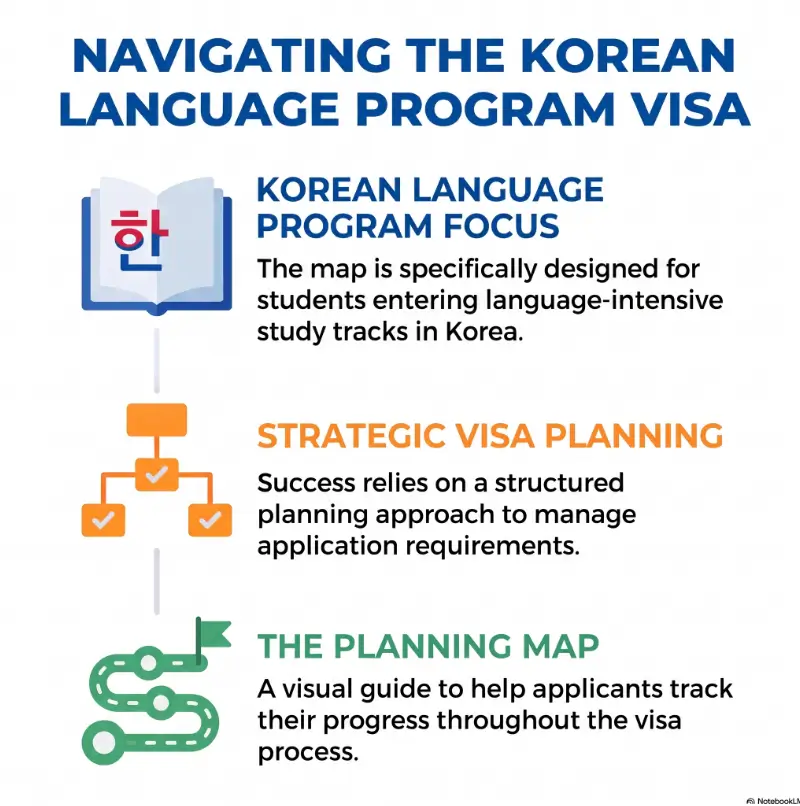
This article is for future Korean language students comparing schools, D-4 visa timing, tuition prepayment, insurance coverage, and first-month housing choices. By the end, you will be able to build a one-page Korea cost sheet, ask sharper questions before paying tuition, and avoid the common gaps that turn a study plan into an expensive scavenger hunt.
Table of Contents
Before You Pay: What This Guide Can and Cannot Do
A Korean language program visa plan touches immigration, money, housing contracts, school rules, and health coverage. That means the safest answer is rarely “just apply.” The safer answer is “confirm the sequence before each payment.”
This guide gives general planning help for students comparing Korean language programs, especially university-affiliated language institutes. It does not replace advice from a Korean embassy or consulate, Korea Immigration, a qualified immigration professional, your school’s international office, an insurer, or a housing professional.
Rules and documents can change. Schools also differ. One university may issue D-4 paperwork after one set of steps, while another may require registration for multiple terms, tuition payment, or original documents before releasing the standard admission letter. Treat every school page as a living checklist, not a museum label.
Key takeaway
Before paying tuition, ask the school this exact question: “After I complete registration and payment, when will you issue the documents needed for a D-4-1 Korean language trainee visa, and how many terms must I register for?”
Use this as a planning map, not a promise
Visa outcomes depend on your nationality, consulate jurisdiction, school, documents, timing, financial proof, and personal history. A clean plan can reduce friction, but it cannot guarantee approval.
The goal here is to help you build a file that makes sense: why you are studying, where you will study, how you will pay, where you will sleep, and how you will handle health coverage during the awkward first weeks.
Official sources should win arguments
If a blog, agent, group chat, or video says one thing and your consulate says another, follow the consulate. If a student on Reddit says a document was not needed, that does not mean your case will be treated the same way. Immigration files are not group projects, mercifully.
Use school pages for admission and tuition rules. Use your Korean embassy or consulate for visa filing requirements. Use Korea Immigration and HiKorea for in-country residence registration and extension tasks. Use NHIS or your school for health insurance timing.
Pick the Visa Door Before You Pick the Campus
The first quiet mistake is treating all Korean language study as the same thing. It is not. A two-week summer course, a one-term cultural study trip, a six-month university language institute plan, and a degree pathway all create different visa questions.
For many students who plan to study Korean at a university-affiliated language institute for more than three months, the D-4 general training route is the visa category that enters the conversation. More specifically, language trainees often see D-4-1 language training terminology in school and consulate materials.
That does not mean every student needs the same route. Your nationality, length of stay, school type, and purpose of stay all matter. The trick is to choose the correct door before you send money through it.
Short programs may not need the same path
If you are taking a brief Korean course during a vacation, the D-4 path may not be the right frame. Depending on your nationality and length of stay, a short-stay or visa-free entry option may be relevant. That belongs in the “confirm with the consulate” bucket, not the “my friend did it once” bucket.
Short programs are often easier financially because you may not need a long housing contract, multiple tuition terms, or long-term residence registration. But they also may not support the same student status, extension plan, or future academic pathway.
The six-month signal hiding in plain sight
Many D-4 planners should think in terms of multiple terms, not one experimental semester. Some university language programs may require students to register for at least two terms, or a similar multi-month period, before issuing the documents needed for D-4 language training paperwork.
This changes your budget. A student who expected to “try Seoul for one term” may discover that visa paperwork, tuition payment, refund policy, and housing timing all make more sense when planned as a six-month runway.
Degree students usually need a different lane
If you are already admitted to a Korean university degree program, you may be looking at a D-2 student visa route rather than a Korean language program visa. Language training can be part of a bigger education plan, but the visa category should match the actual activity.
For future degree applicants, language school can be a bridge. It may help with Korean ability, campus familiarity, TOPIK preparation, and daily confidence. Still, do not assume D-4 automatically turns into D-2. Treat the language stage and degree stage as connected but separate paperwork projects.
Mini decision filter
Ask yourself three questions before comparing schools:
- Am I studying for less than 90 days, one term, or multiple terms?
- Do I need the school to issue D-4 language trainee documents?
- Is this a standalone language experience or preparation for a future Korean degree program?
Tuition Math: The Website Number Is Only the Opening Note
The tuition number on a school website is useful, but it is not the number your bank account will feel. A Korean language program budget is a layered thing: tuition, application fees, books, housing deposit, arrival costs, insurance, meals, transport, and the little daily costs that appear between class and the convenience store.
For a US or UK student, exchange rates can also turn a tidy spreadsheet into a mildly caffeinated creature. Build your plan in both your home currency and Korean won. Update the estimate before major payments.
Tuition is only the first line
Most students begin with tuition because it is visible. That is sensible. But the practical question is not “Can I afford the class?” It is “Can I afford the class, the visa sequence, the first housing payment, the insurance gap, and the first 30 days before life becomes normal?”
Textbooks, placement tests, school activity fees, document mailing, passport photos, notarization, apostille costs, or translation costs can appear depending on school and consulate requirements. None of these may be shocking alone. Together, they become the quiet chorus of the budget.
Two terms can change everything
If your school requires registration for more than one term before issuing D-4 paperwork, your upfront cost may be much higher than the single-term tuition shown on the first page you read. This is where many students get caught.
Before paying, ask whether the school requires one term, two terms, or a specific study period for visa document issuance. Also ask whether tuition must be paid in full before the school issues the standard admission letter, tuition receipt, or business registration copy often requested for visa filing.
Refund rules deserve a slow read
The refund policy is not boring. It is the small wooden bridge between “visa delay” and “financial headache.” Read it before paying tuition, before paying a housing deposit, and before booking flights.
Look for the refund deadline, what happens after the term begins, whether application fees are refundable, what proof is required if a visa is denied, and whether deferral is possible if visa processing takes longer than expected.
| Cost Item | What to Ask Before Paying | Why It Matters |
|---|---|---|
| Application fee | Is it refundable if I am not admitted or cannot get a visa? | Small fees add up across several schools. |
| Tuition | How many terms must I register for to receive D-4 documents? | One-term planning may not match visa paperwork reality. |
| Textbooks | Are books included, required separately, or bought after placement? | Books can affect first-week cash needs. |
| Housing deposit | What is refundable if my visa is delayed or denied? | Non-refundable deposits can sting. |
| Document shipping | Will original documents be mailed, emailed, or issued through a portal? | Shipping delays can affect visa filing. |
Proof of Funds: Make the Money Story Look Believable
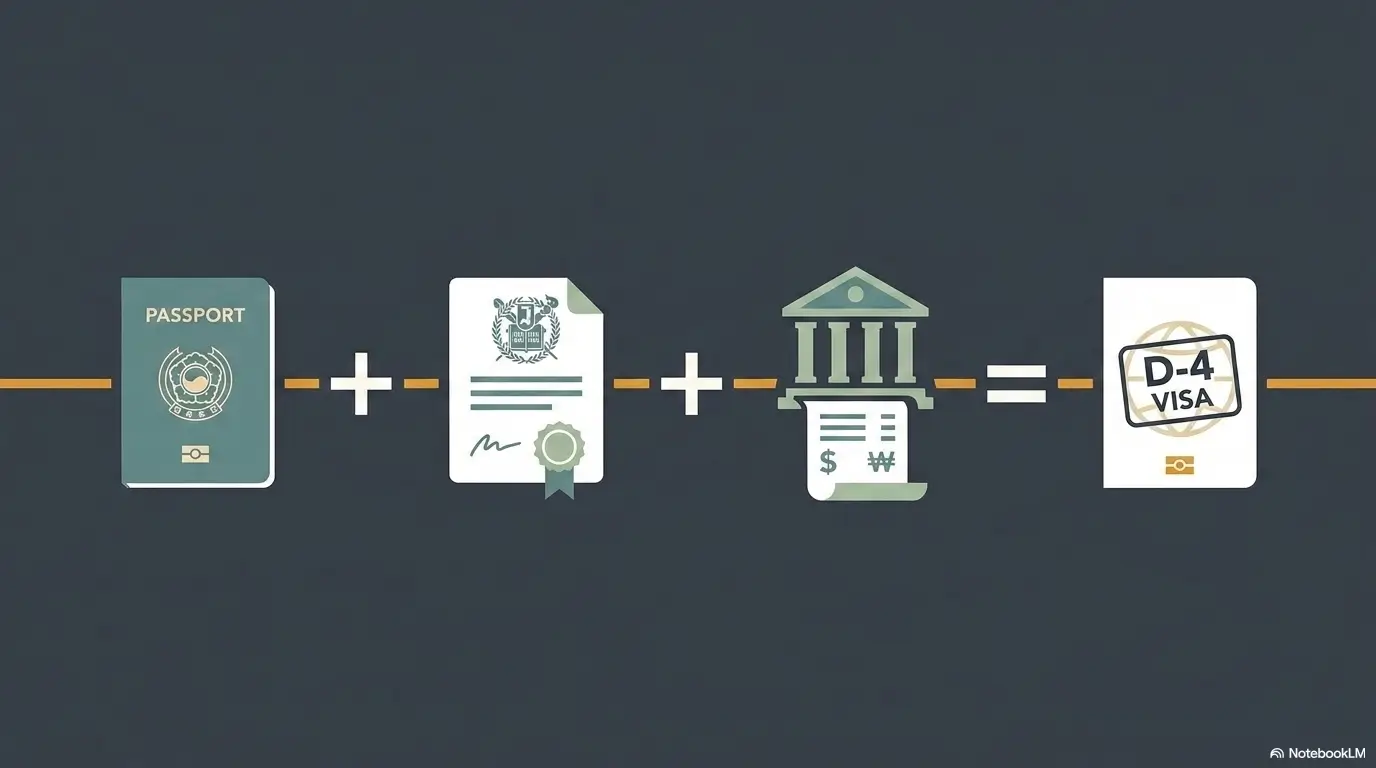
Proof of funds is not only about having a balance large enough to satisfy a requirement. It is about showing that the plan is financially coherent. A sudden theatrical deposit can raise more questions than a steady, ordinary balance.
Schools and consulates may ask for bank statements, sponsor documents, relationship proof, income evidence, or other financial materials depending on the case. Requirements can vary, so avoid copying another student’s checklist unless their school, nationality, consulate, and circumstances match yours.
Stable money looks better than dramatic money
A bank statement should tell a calm story. Tuition has been paid or is ready to be paid. Housing is realistic. Living expenses remain available after arrival. The student has enough cushion to handle delays.
If your funds come from a parent or sponsor, make the relationship clear. A consulate officer should not need detective music to understand why someone else’s account supports your study plan.
Sponsor documents need a family bridge
When a parent or other sponsor is paying, schools or consulates may ask for a sponsorship letter, proof of relationship, sponsor bank statement, income document, notarization, or other support. The exact list depends on the institution and jurisdiction.
Build the bridge early. If your sponsor’s last name differs from yours, or if documents are in different languages, ask what translation, notarization, or official relationship proof may be required.
The file should look like a living plan
A “big enough” balance may not be enough if the rest of the file looks fuzzy. The strongest version of your application usually makes the whole stay believable: school confirmed, tuition accounted for, housing realistic, insurance planned, and emergency funds still available.
For remote-career planners, be especially careful. A D-4 language training plan is for study. Do not frame the visa as a work base unless you have confirmed work rules with the school and immigration. Part-time work permission has conditions and is not automatic.
Proof-of-funds readiness checklist
- Your name matches the bank statement, or sponsor documents explain the connection.
- The balance covers tuition, housing, living expenses, insurance, and a delay cushion.
- Large recent deposits can be explained with documentation if asked.
- The statement date is recent enough for the school or consulate requirement.
- All currency conversions are estimated conservatively, not with fairy dust.
Insurance Timing: Cover the Gap Between Landing and Registration
Insurance is where many careful students suddenly become optimistic poets. They see “student insurance,” “NHIS,” or “school coverage” and assume everything begins the moment the plane wheels kiss the runway. Sometimes it does not.
Longer-term foreign residents and international students may become enrolled in Korea’s National Health Insurance system depending on visa status, residence registration, and applicable rules. Once enrolled, foreign residents generally receive covered benefits under the Korean system. The planning problem is the timing before that enrollment feels real in daily life.
National Health Insurance is not always instant comfort
Korean National Health Insurance can be extremely important for students staying long term. But your practical coverage timeline may depend on arrival, residence card application, school reporting, visa type, and administrative processing.
Do not plan as though coverage is active just because you intend to register. Confirm with your school when NHIS enrollment is expected, when premiums may begin, and how you should handle care before everything is active.
Private insurance can be the bridge
Private travel or student insurance can be useful for the arrival window, especially before residence registration, NHIS enrollment, or school insurance is confirmed. This is not glamorous spending. It is umbrella money.
Compare plans by start date, emergency care, hospital network, reimbursement rules, prescription coverage, pre-existing condition limits, mental health coverage, evacuation coverage, and whether Korean clinics or hospitals can provide the documents needed for claims.
School insurance is not the same as full protection
Some schools may require or offer student insurance. That can help, but you still need to read what it covers. A plan that looks sufficient for routine care may not feel sufficient during an emergency, specialist visit, prescription issue, or reimbursement dispute.
Ask for the insurance start date in writing. Ask whether you pay first and claim later. Ask which documents hospitals should issue. If you have ongoing medication, therapy, or a medical condition, ask specific questions before departure.
| Coverage Option | Good For | Watch Out For | Questions to Ask |
|---|---|---|---|
| Private travel or student insurance | Arrival window, emergencies, trip disruption, early uncertainty | Exclusions, reimbursement paperwork, pre-existing conditions | What is the exact start date and claim process in Korea? |
| School insurance | Students who want school-aligned guidance | Limited benefits, narrow claim rules, unclear hospital access | What hospitals are covered and what is excluded? |
| Korean National Health Insurance | Longer-term residents once enrolled | Timing, premiums, registration dependencies | When will my enrollment begin after arrival and residence registration? |
Housing Proof: Your Room Is Part of the Visa Story
Housing is not just lifestyle. It is documentation. The place where you sleep can affect your arrival comfort, address proof, residence card application, extension tasks, and daily sanity.
For first-time students, the best housing choice is often the one that is boringly document-friendly. A gorgeous room with unclear paperwork can be less useful than a smaller, plain room with a clear contract and responsive office.
Dormitory is simple, until it is full
University dorms can be the easiest first landing spot. They are close to campus, usually familiar with student paperwork, and may be easier to explain in a visa or residence registration context.
The catch is availability. Dorms may fill early, follow semester-based schedules, require separate applications, impose curfews or guest rules, and offer limited move-in flexibility. If you need dorm housing, treat the deadline like a second visa deadline.
Goshiwon, one-room, and sharehouse mean different risks
A goshiwon may offer lower deposits and fast move-in, but rooms can be small, walls can be thin, and kitchen or bathroom arrangements vary. A sharehouse may be more social and flexible, but contracts and address registration support should be checked carefully.
A one-room studio can offer privacy, but deposits, utility setup, contract language, agent fees, and move-in timing can be harder for a new arrival. If you do not speak Korean well yet, a housing mistake can become expensive quickly.
For related Korea housing basics, you may also find this guide to officetel leases in Korea useful, especially if you are comparing one-room or officetel-style options after your first term.
The address must be document-friendly
Before paying a deposit, ask whether the housing provider can issue or provide the documents you may need for residence registration, address reporting, school records, or visa extension. Save the lease, dorm confirmation, payment receipt, landlord or office contact, move-in date, and exact Korean address.
If you move after arrival, confirm reporting deadlines and required documents. In Korea, address administration is not decorative. It is one of those quiet systems that works best when you respect it early.
Planning flow
The tidy-folder framework for a Korean language program visa plan
1
School paperwork
Confirm D-4 eligibility, term requirement, admission letter timing, and tuition receipt process.
2
Money proof
Show stable funds, sponsor connection, tuition plan, housing costs, and a realistic buffer.
3
Insurance timing
Bridge the arrival gap until school insurance or NHIS enrollment is confirmed.
4
Housing proof
Choose a room that supports address paperwork, receipts, and flexible arrival timing.
School Comparison: Four Filters That Beat Pretty Brochures
Campus photos are not useless. They help you imagine the life: trees, coffee, library steps, the first crisp morning with a new notebook. But a pretty campus does not protect your refund, issue your visa documents faster, or find you a room when dorms are full.
For a Korean language program visa plan, compare schools like a careful buyer. You are not only purchasing classes. You are choosing an administrative partner for one of the most paperwork-heavy seasons of your life.
Filter 1: Visa paperwork clarity
A strong school page should clearly explain who can apply, when documents are issued, what must be paid first, whether D-4 language trainee documents are available, and how far ahead students should apply.
If the page is vague, email the office. Keep the reply. A fast and clear answer before payment is a good sign. Silence before payment is a small weather report.
Filter 2: Refund policy under visa delay or denial
Ask what happens if your visa is delayed beyond the start date, if the visa is denied, or if original documents arrive too late. Some schools may allow deferral. Others may apply refund deadlines strictly.
The best refund policy is not always the most generous. It is the one you understand before paying.
Filter 3: Housing support
Some language institutes offer dorm applications, partner housing, or basic guidance on residence-friendly documents. Others expect students to arrange everything privately.
If you are new to Korea, a school with practical housing guidance may be worth more than a slightly cheaper tuition bill. This is especially true if you arrive close to the term start date.
Filter 4: Student office responsiveness
A responsive student office is not a luxury feature. It is a safety rail. You may need help with certificate reissue, attendance records, residence card questions, insurance proof, class placement, or extension documents.
When comparing schools, send one polite email with three specific questions. Notice the reply speed, clarity, and tone. The answer may tell you more than ten glossy brochures.
| Choice Level | Best For | What You Get | What to Verify |
|---|---|---|---|
| Good | Budget-conscious students with flexible timing | Lower tuition or simple program structure | D-4 paperwork timing, refund terms, housing support |
| Better | First-time Korea students who need admin support | Clear language institute procedures and student office guidance | Response speed, document reissue process, insurance timing |
| Best | Students building a 6 to 12 month Korea plan | Clear visa support, dorm or housing guidance, strong extension support | Term commitment, attendance requirements, future D-2 pathway fit |
Key takeaway
The best Korean language school for a visa-minded student is not automatically the most famous school. It is the school that gives you clear deadlines, clear documents, clear refund rules, and clear housing guidance.
If you are still building your daily-life plan, this guide to Korean phone plans for Americans can help you think through SIM cards, identity verification, and early arrival logistics.
Timeline: From School Application to First Class
A calm timeline is one of the cheapest tools you have. It costs nothing, weighs nothing, and saves you from learning the phrase “urgent document reissue” at midnight.
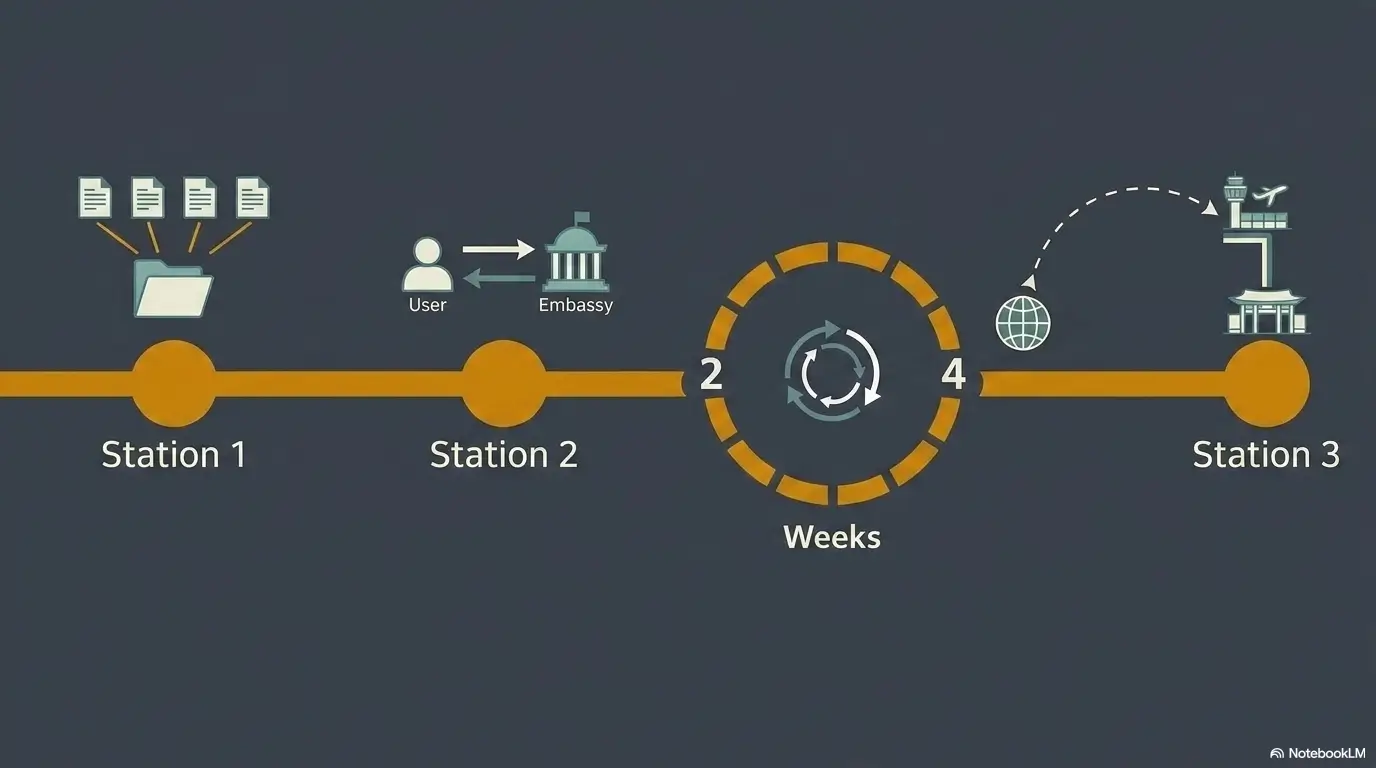
Start earlier than you think. Many students underestimate the time required for document collection, school screening, tuition transfer, document issuance, consulate appointments, shipping, and housing decisions.
90 to 120 days out: shortlist by visa support, not campus photos
At this stage, compare schools by term dates, application deadline, tuition, required registration period, D-4 document policy, refund rules, dorm availability, class schedule, location, and student office responsiveness.
Create a shortlist of three schools. For each one, write down the earliest payment date, latest application date, document issuance timing, and housing deadline.
60 to 90 days out: submit application and financial documents
This is when your folder should begin to look serious. Gather passport scans, school application forms, academic documents, financial proof, sponsor documents if needed, photos, and any required translations or notarized materials.
International document workflows move at the speed of real paper when you least want them to. If original documents must be mailed, give yourself margin.
30 to 60 days out: visa filing, housing hold, insurance bridge
Once the school issues the necessary admission and payment documents, prepare your consulate file. Confirm the exact requirements for your jurisdiction, because consulates can ask for different supporting documents.
At the same time, make housing decisions carefully. Avoid non-refundable commitments until you understand visa timing. If you must hold a room, get cancellation rules in writing.
Arrival week: residence card, address, bank, SIM, school office
After arrival, the administrative baton passes from consulate filing to Korean daily-life setup. Long-term students usually need to handle residence registration within the required period, and many essential services become easier after receiving a residence card.
Confirm your school’s orientation schedule, address documents, health insurance instructions, bank account support, phone setup, and class placement. Keep copies of everything. Your future self will write a tiny thank-you note in the margins.
Show me the nerdy details
The planning risk is not one deadline. It is dependency order. A school may need tuition before issuing admission documents. A consulate may need those school documents before accepting a visa file. Housing providers may want payment before holding a room. Insurance may need a start date before departure. Residence registration may require proof of residence after arrival.
A useful spreadsheet should track dependencies, not only dates. Add columns for “I cannot do this until,” “who confirms it,” “money at risk,” and “backup option.” That small structure turns vague anxiety into task management.
Cost Stack: A Practical Budget Table for US and UK Readers
A good budget is not pretty. It is useful. It includes the boring lines, the awkward lines, and the “I hope I never need this” lines.
For a Korean language program visa plan, build your budget by category rather than vibes. Then add a delay cushion of 10 to 20 percent if you can. This protects you from exchange-rate movement, visa timing, housing changes, medical surprises, and document reissues.
Budget by category, not vibes
Tuition is the headline number, but housing deposit is often the emotional number. First-month purchases also arrive quickly: bedding, transit card, phone plan, groceries, laundry, adapters, and small household items.
If you plan to study in Seoul, expect housing and café life to tempt your budget with charming regularity. If you study outside Seoul, tuition or housing may be lower, but transport, program fit, and future degree plans still matter.
| Category | What to Include | Why It Matters |
|---|---|---|
| Tuition | One to two terms, application fee, textbooks | Some schools may require multiple terms for D-4 paperwork. |
| Visa costs | Application fee, mailing, photos, document copies | Consulate-specific expenses can stack quietly. |
| Insurance | Private bridge coverage, school plan, NHIS timing | Coverage gaps can be expensive and stressful. |
| Housing | Deposit, first month, utilities, bedding | Move-in costs can surprise new arrivals. |
| Daily life | Food, transit, phone, laundry, cafés | Language life is lived between classes. |
| Emergency fund | Medical issue, housing change, flight change | A buffer protects the whole plan. |
Free checklist vs paid help: when each makes sense
Many students can manage the process themselves using school pages, consulate instructions, and official government sites. That is the free route, and it can work well for organized applicants with straightforward documents.
Paid help may be worth considering if your documents are complex, you are applying close to the deadline, you need translation or notarization support, your sponsor situation is unusual, or you are anxious enough that mistakes are becoming more likely. Paid help should reduce confusion, not create dependence.
| Approach | Best For | Cost Level | Red Flags |
|---|---|---|---|
| DIY with official pages | Organized students with straightforward documents | Lowest | Relying on outdated forum posts instead of consulate rules |
| School office guidance | Accepted students who need program-specific answers | Usually included | Expecting the school to give legal advice |
| Document service or translator | Students needing translations, notarization, or apostille support | Low to medium | Unclear pricing or no delivery timeline |
| Immigration professional | Complex cases or prior visa issues | Higher | Guarantees of approval or pressure to pay quickly |
Add a delay cushion
A delay cushion is not pessimism. It is respect for calendars, flights, housing, banks, and government offices. Build it into your plan before you feel rushed.
If your budget is tight, reduce uncertainty before reducing the cushion. Choose refundable flights, flexible housing, a school with clear deferral rules, and insurance that starts when you need it.
Key takeaway
The cheapest plan is not always the lowest tuition. The cheapest plan is the one that avoids duplicate document fees, lost deposits, uninsured medical care, and last-minute flight changes.
Common Mistakes That Turn Small Paper Cuts Into Visa Bruises
Most expensive mistakes in this process are not dramatic. They are small, ordinary assumptions made too early. A deposit paid before reading the cancellation policy. A flight booked before visa timing is clear. An insurance plan purchased without checking the start date.
The cure is not fear. It is sequencing.
Mistake 1: Paying tuition before checking the D-4 paperwork policy
Some schools may accept students for language study but issue D-4 admission documents only after specific registration and payment conditions are met. Others may have different processes for short-term students, current Korea residents, and overseas applicants.
Before payment, ask for the exact document sequence. Save the answer. If the policy is on the website, screenshot or save the page for your records.
Mistake 2: Booking housing before reading refund and cancellation rules
Housing providers may ask for deposits before your visa is approved. Sometimes that is unavoidable. But do not pay until you know what happens if your visa is delayed, your arrival date changes, or the room is not as described.
Use written messages, receipts, and clear contract terms. A friendly voice note is not a contract. It is mist with a ringtone.
Mistake 3: Assuming insurance starts when the plane lands
Coverage start dates matter. School insurance, private insurance, and NHIS enrollment may operate on different clocks. Confirm what happens during the first week, first month, and before residence registration is complete.
If you take medication, need regular care, or have a condition that requires continuity, build a more detailed health plan before departure. You may also want to read this guide to Korean pharmacies for foreigners so routine medicine questions feel less mysterious after arrival.
Mistake 4: Treating attendance as optional
Language programs are not decorative visa wallpaper. Attendance can affect school standing, visa extension support, and future status changes. If you are coming to study, build a life that lets you actually attend.
Choose housing with a realistic commute. Avoid stacking remote work, nightlife, travel, and classes until your schedule has proven itself. Korean language study is more marathon than montage.
Real-world example
A student chooses a Seoul language program, pays tuition, and books a private room because the photos look peaceful. The visa documents take longer than expected. The housing deposit is non-refundable. The insurance policy begins on the original arrival date, but the flight must move. Nothing is catastrophic, yet every small mismatch costs money.
A cleaner version would have asked three questions before paying: When are visa documents issued? What housing costs are refundable if the visa is delayed? What date does insurance coverage begin if the flight changes?
FAQ: Korean Language Program Visa, Tuition, Insurance, and Housing
Do I need a D-4 visa for a Korean language program?
If you plan to study Korean at a qualifying institution for more than a short stay, the D-4 general training route may be relevant. For language training, many schools refer to D-4-1 paperwork. Your nationality, stay length, school, and consulate rules determine the correct path.
How much tuition should I budget?
Budget for at least the tuition period required by your school for visa document issuance. Then add application fees, textbooks, document costs, housing deposit, insurance, daily living costs, and a delay cushion. The one-term tuition figure is only a starting point.
Can I get the visa before paying tuition?
Often, students need school-issued admission and payment documents before visa filing, and some schools issue those only after registration and tuition payment steps are complete. Confirm the exact order with the school before sending money.
Do US and UK students need Korean health insurance?
Longer-term students should plan for health coverage in Korea. Depending on visa status and residence registration, NHIS may apply, and schools may also provide insurance guidance. Confirm the start date and consider private bridge coverage for the arrival window.
Is dorm housing better than renting a room?
Dorms are often easier for first arrivals because they are close to campus and may be more document-friendly. Private rooms can offer more flexibility and privacy, but require more contract caution, especially around deposits, address proof, and cancellation rules.
What housing documents should I save?
Save your lease or dorm confirmation, exact Korean address, landlord or housing office contact, payment receipts, move-in date, and any document that proves where you live. These may help with school records, residence registration, address changes, or extensions.
Can I work while studying Korean in Korea?
Do not assume work is allowed automatically. Work permission depends on visa status, time in Korea, school approval, immigration rules, attendance, and current policy. Ask your school and confirm with immigration before accepting any job.
What happens if my visa is delayed?
You may need to delay flights, adjust housing, request school deferral, review refund deadlines, and update insurance dates. This is why flexible bookings and a delay cushion are not luxuries. They are the soft padding around a hard deadline.
Your 15-Minute Next Step: Build the One-Page Korea Cost Sheet
Do not begin with a perfect plan. Begin with a one-page plan. In 15 minutes, create five rows: school tuition, visa documents, insurance start date, housing proof, and 90-day cash buffer.
For each row, add three columns: source, deadline, and amount. The source is where you confirmed the information. The deadline is when action is needed. The amount is the money at risk or required.
If any row is blank, that is not failure. That is the plan politely showing you where to look next.
15-minute Korea cost sheet
- School tuition: term count, payment deadline, refund rule.
- Visa documents: school document issue date, consulate checklist, passport validity.
- Insurance start date: private bridge, school insurance, NHIS timing.
- Housing proof: dorm confirmation, lease, address document, deposit rule.
- 90-day cash buffer: food, transit, phone, medical, document reissue, flight change.
Once the sheet is complete, you can apply with a quieter mind. Not because Korea becomes predictable, because no country ever fully is, but because your folder begins to speak in complete sentences: I know why I am here. I know where I am sleeping. I know how I am paying. I know what I need to confirm next.
That is the real beginning of a Korean language program visa plan. Not the stamp. Not the plane ticket. The first honest spreadsheet, humming softly beside your passport.
Last reviewed: 2026-07