
Healthcare in South Korea
Korea Telemedicine Rules
for Foreigners and Digital Nomads
You are in Seoul, Busan, or a quiet officetel somewhere between time zones. Your regular medication is running low, your Korean is not ready for a medical conversation, and an app promises a doctor in minutes. The booking screen looks simple. The rules underneath it are not.
Foreign nationality does not automatically block telemedicine in South Korea, but a passport, digital nomad visa, or foreign insurance card does not guarantee access either. The clinic must be participating, the physician must consider remote care medically appropriate, and the prescription you want must fit Korean rules.
This guide separates the current pilot system from the permanent law scheduled for late 2026, explains why your physical location matters to a U.S. doctor, and gives you a practical way to check eligibility before paying for an appointment that may end with the words, “Please come in.”
Know which rules apply
Separate today’s pilot from the December 2026 and May 2027 frameworks.
Avoid prescription dead ends
Prepare generic drug names, records, dosage details, and a pharmacy plan.
Spend money more carefully
Compare clinic participation, language support, fees, and follow-up options first.
The fastest appointment is not always the fastest route to treatment. Five minutes of checking can save an afternoon of digital paperwork. 🩺
Snapshot
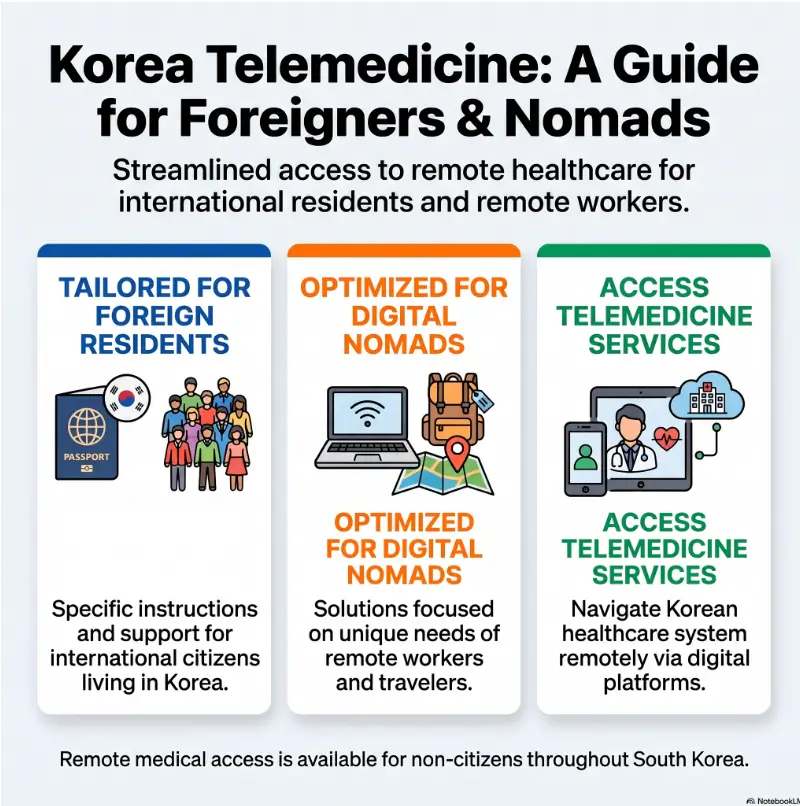
This article is for foreigners physically staying in South Korea, including tourists, students, employees, expatriates, and digital nomads. It explains how to screen a Korean telemedicine option, prepare for an English-language visit, compare likely costs, and recognize when in-person care is the safer route.
Table of Contents
Before You Act: What This Guide Can and Cannot Tell You
Telemedicine sits at the intersection of medical judgment, clinic operations, insurance rules, identity verification, prescribing law, and changing government policy. A tidy yes-or-no answer would be comforting, but it would also be misleading.
This article provides general information for readers comparing options. It cannot determine whether a particular clinic will accept you, whether a physician will prescribe a specific medicine, whether your insurer will reimburse the visit, or whether your symptoms can be assessed safely by video.
Safety and legal notice
Confirm current eligibility directly with the clinic before relying on remote care. Do not delay emergency treatment while comparing apps, prices, insurance benefits, or prescription policies. A physician may stop a remote consultation and recommend an in-person examination whenever the available information is not sufficient.
App access is not medical approval
A platform may let you create an account, upload a passport, choose a specialty, and pay. None of those steps require the doctor to diagnose or treat you remotely.
The physician may decide that your symptoms require palpation, imaging, laboratory work, neurological testing, an eye examination, or another physical assessment. In that case, a responsible telemedicine visit becomes a bridge to in-person care rather than a prescription vending machine wearing a white coat.
The answer can change from one visit to the next
A clinic might accept a remote follow-up for stable allergy medication but decline a first-time consultation for severe abdominal pain. The same clinic might treat an established patient by video and ask a new patient to attend in person.
Think of eligibility as a series of gates: legal framework, participating provider, patient verification, clinical suitability, prescription suitability, and pharmacy fulfillment. Passing the first gate does not open all the others.
The Date Trap: Korea Has Rules Now, but New Laws Are Coming
South Korea’s telemedicine story currently runs on more than one clock. This matters because search results, clinic pages, and older travel guides may use “legalized” to describe a law that has passed but is not yet operational.
What applies before December 24, 2026
Until the permanent Medical Service Act provisions take effect, domestic telemedicine continues under the government’s pilot framework. A major revision took effect on October 27, 2025, returning the system to an emphasis on clinic-level providers after the health-crisis alert was lifted. The revision also retained limited hospital-level exceptions and capped each participating institution’s monthly telemedicine share at 30 percent of its total visits. :contentReference[oaicite:0]{index=0}
For a foreign patient inside Korea, the practical question is not merely whether telemedicine exists. You need to know whether the clinic participates under the current framework, whether your patient history fits its operating rules, and whether the requested care is suitable for remote assessment.
What changes on December 24, 2026
Korea’s permanent telemedicine provisions are scheduled to take effect on December 24, 2026. The framework keeps in-person care as the primary model, emphasizes clinic-level institutions and returning patients, restricts telemedicine-only operations, and preserves a physician’s ability to decline or end remote care when an in-person examination is needed. :contentReference[oaicite:1]{index=1}
Important details remain dependent on implementing regulations. These may define qualifying time periods, geographic limits, patient categories, video requirements, prescription duration, and restricted medicines. A law’s broad architecture is the building; the regulations decide where the doors and staircases go.
A second clock starts on May 27, 2027
A separate framework for foreign-patient telemedicine is scheduled to take effect on May 27, 2027. It is designed around registered foreign-patient-attracting medical institutions and can support pre-treatment and post-treatment care, including certain first-time foreign patients. Providers must also consider the law of the patient’s country of residence. :contentReference[oaicite:2]{index=2}
Do not assume this future system is simply a broader digital nomad benefit. It is connected to Korea’s regulated foreign-patient medical-services framework, which is different from an ordinary foreign resident opening a domestic app while sitting in a Seoul apartment.
Key takeaway
Use three labels when researching: current pilot rules, December 24, 2026 domestic law, and May 27, 2027 foreign-patient framework. Treat a page without an effective date as incomplete.
Show me the nerdy details
Enactment means lawmakers have passed the legal text. Promulgation means it has been formally published as law. Effective date is when its operative provisions begin to govern actual conduct.
Between promulgation and implementation, ministries may prepare regulations, systems, provider guidance, transition periods, and enforcement procedures. That is why “the bill passed” and “you can use it today” are not interchangeable statements.
1. Locate yourself
Are you physically inside Korea or outside the country during the appointment?
2. Date the rule
Is the information about the current pilot, December 2026, or May 2027?
3. Check the provider
Does the clinic participate, serve foreigners, and support your language?
4. Check the medicine
Can the condition and requested prescription be handled remotely?
Three Patients, Three Rulebooks: Which One Are You?
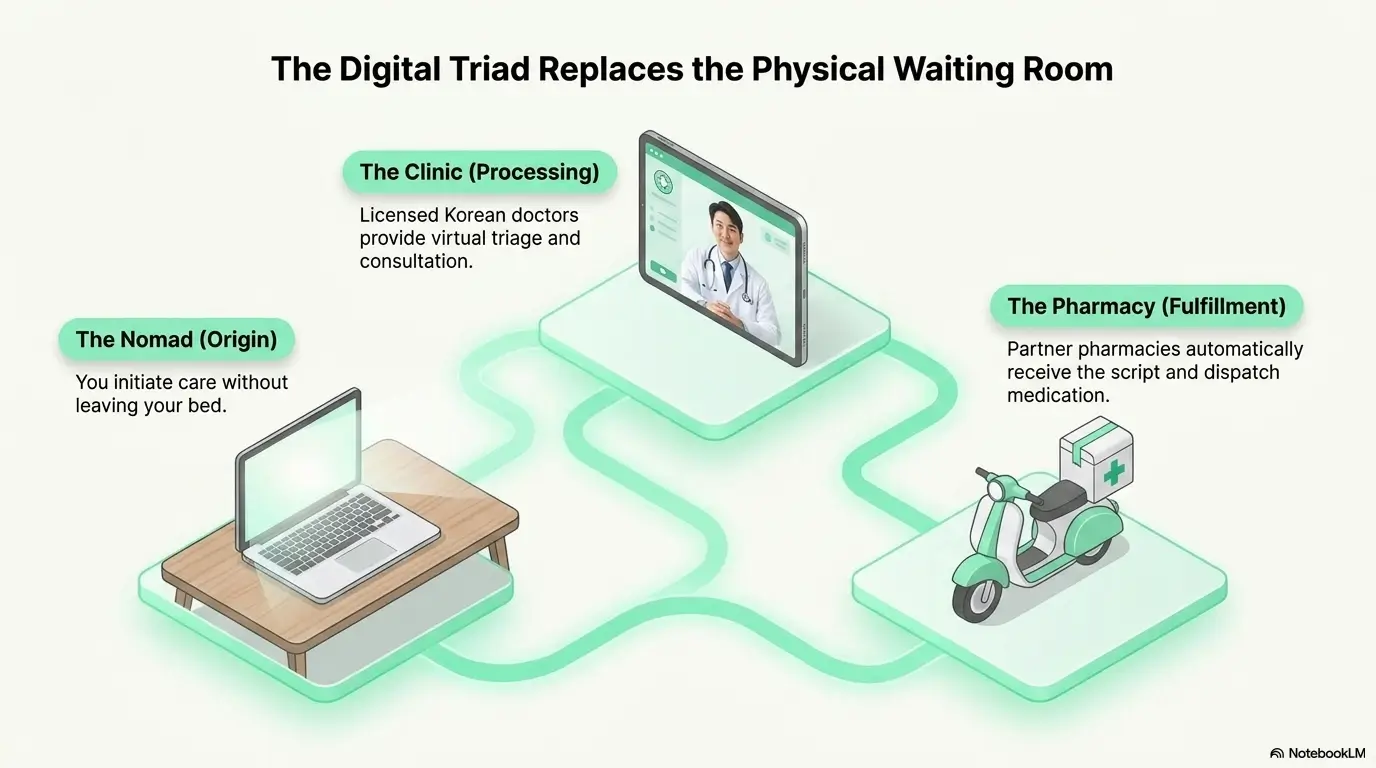
“I am a foreigner using telemedicine in Korea” can describe three legally different situations. Begin with the patient’s physical location, then identify the provider’s location and licensing authority.
A foreigner physically inside South Korea
This category includes tourists, international students, employees, expatriates, exchange visitors, and digital nomads contacting a Korean clinic while staying in Korea.
Your visa may influence identification, residency documentation, insurance enrollment, and the practical ease of using Korean apps. It does not by itself decide whether a physician can treat your condition remotely.
A traveler in Korea calling a U.S. doctor
You may still have an active relationship with a U.S. physician, a familiar patient portal, and insurance coverage at home. Yet the provider must consider where you are physically located when delivering individualized care.
A home-state license does not automatically authorize diagnosis or prescribing for a patient sitting in another country. A doctor may still provide records, a medication history, general information, or care coordination, but the permissible boundary depends on applicable licensing and prescribing rules.
A patient abroad contacting a Korean hospital
This may involve pre-arrival consultation, specialist review, surgical planning, or post-treatment follow-up through a registered institution serving foreign patients. It should not be confused with domestic telemedicine for someone currently living or traveling in Korea.
| Patient situation | Main question | Likely next step |
|---|---|---|
| Inside Korea, contacting a Korean clinic | Does the current Korean system and clinic policy allow the visit? | Verify participation, prior-care requirements, language support, and prescription limits. |
| Inside Korea, contacting a U.S. doctor | Can the U.S. provider legally treat a patient located abroad? | Disclose your Korean location and ask what care or coordination the provider can offer. |
| Outside Korea, contacting a Korean institution | Does the foreign-patient framework cover this service? | Confirm the institution’s registration, scope, and the laws applicable where you live. |
Foreign Status Is Not the Main Gatekeeper
Visa status and medical eligibility solve different problems
A tourist, student, employee, spouse, and digital nomad may each present different documents and insurance arrangements. Those differences can affect administrative access, but clinical eligibility still depends on the provider, patient history, symptoms, and treatment requested.
A digital nomad visa is not a telemedicine membership card. It authorizes an immigration status, not a particular medical pathway or prescription entitlement.
Passport, residence card, phone number, and identity verification
A clinic or platform may request a passport, foreign resident card, Korean address, date of birth, local phone number, payment card, and contact information. The exact set varies by service.
The legal service may be available while the app remains frustratingly inaccessible. Korean mobile systems often depend on local phone authentication or identity databases. The practical workarounds and common failure points are explained in this guide to Korean identity verification for foreigners.
No Korean health insurance does not always mean no care
Not being enrolled in Korean National Health Insurance may mean you must pay the clinic’s self-pay rate. It does not necessarily prevent a clinic from treating you.
Foreign residents who are enrolled generally receive the same categories of national health insurance benefits as Korean citizens, although enrollment, contribution, and dependent rules vary by status. :contentReference[oaicite:3]{index=3}
For a broader explanation of enrollment and coverage, see Korean National Health Insurance for foreigners.
Foreign-patient account checklist
- Passport or foreign resident card
- Current address in South Korea
- Korean phone number, if available
- Email address you can access immediately
- Insurance details or a self-pay payment method
- Emergency contact and local accommodation details
Prior Care and Prescriptions: Where Remote Convenience Narrows
The six-month question is a screening question, not a promise
Under the current operating approach, recent in-person care at the same institution can make a remote follow-up more straightforward. Clinics may ask whether you have visited them in person within a recent period, whether the visit concerned the same condition, and whether sufficient records are available.
Do not treat “I visited six months ago” as automatic approval. The physician may still need an examination, and different exceptions may apply to specific patients, regions, conditions, or institutions.
The same clinic does not always mean the same doctor
A medical institution may have your chart even when the original physician is unavailable. Another doctor may be able to review those records, but acceptance remains a clinical and operational decision.
When contacting the clinic, ask whether prior care must have been with the same physician or merely within the same institution. That one sentence can prevent a beautifully scheduled appointment from dissolving on arrival.
The appointment may be easier than the medicine
Korean telemedicine rules restrict certain medicines, particularly drugs with abuse, dependency, or patient-safety concerns. The permanent framework also bars telemedicine prescribing of narcotic drugs and allows additional limits on drug type and prescription duration when the physician lacks sufficient patient information.
A valid U.S. prescription does not compel a Korean physician to continue the same medicine. The drug may have a different approval status, brand name, formulation, dosage convention, monitoring requirement, or prescribing restriction in Korea.
Key takeaway
Ask whether the doctor can evaluate the condition, whether the medicine can be prescribed remotely, and whether a local pharmacy can dispense the exact ingredient and formulation. Those are three separate questions.
Prepare the ingredient, not just the brand
- Generic ingredient name
- Brand name used in your home country
- Strength and formulation
- Current daily dosage
- Reason it was prescribed
- How long you have taken it
- Known allergies or previous adverse reactions
- Recent laboratory monitoring, if relevant
- Photograph of the labeled package
- Copy of a recent prescription or medical summary
After the consultation, confirm how the prescription will reach the pharmacy and whether substitution is permitted. The guides to filling a prescription in Korea and using Korean pharmacies as a foreigner explain what happens after the video call ends.
English-Language Care: What the Booking Page May Not Reveal
An English interface is not an English medical encounter
The app’s menus may be translated while the physician, pharmacy, customer-support team, or follow-up instructions remain Korean-first. Ask which parts of the process are available in English.
A clinically useful answer sounds like this: “The doctor can conduct the consultation in English, the prescription instructions are available in English, and the pharmacy has been told that you need language support.” A vague “foreigners welcome” label is less informative.
When professional interpretation is worth paying for
A friend or partner may be adequate for arranging an appointment or confirming an address. Professional interpretation becomes more valuable when the conversation involves complex symptoms, informed consent, psychiatric care, pregnancy, surgery, significant test results, medication risks, or a disputed medical history.
Interpretation is not only about translating nouns. It protects chronology, uncertainty, dosage, negation, and the tiny verbal hinges on which medical decisions swing. For preparation tips, read the guide to medical translation in Korea.
Build a one-page record before the call
- Your full name exactly as shown on your identification
- Date of birth and current location
- Main symptom and when it began
- Relevant diagnoses and previous treatment
- Medication list using generic names
- Allergies and serious adverse reactions
- Recent test results with dates and reference ranges
- Questions you want answered
- Preferred nearby pharmacy
- Insurance or self-pay billing details
Screenshots can help, but crop carefully. A photograph of a test result may omit the patient name, collection date, units, laboratory reference range, or ordering physician. A pill-bottle image may show the brand while hiding the ingredient and dosing instructions.
Real-world example: The refill that became a records problem
Maya, an American graduate student in Daejeon, tried to replace a medication she had taken for two years. She uploaded a photograph of the bottle and booked an English-language video appointment.
The physician could read the brand name but could not confirm the exact formulation or why Maya’s dose had changed six months earlier. The consultation paused while she searched three patient portals, none of which displayed the complete history on a single screen.
She eventually requested a one-page medication summary from her U.S. clinic, returned with the generic ingredient, diagnosis, previous dose changes, and monitoring results, and completed the Korean evaluation.
The lesson was not that telemedicine failed. The missing bridge was documentation. A ten-minute records packet would have saved two appointments and a great deal of fluorescent waiting-room light.
Insurance and Cost: One Video Call Can Produce Several Bills
The advertised consultation price may represent only the physician’s time. Interpretation, certificates, laboratory testing, medication, pharmacy charges, platform fees, and an eventual in-person visit may be separate.
Korean insurance versus self-pay
An enrolled foreign resident may receive covered care under Korean National Health Insurance when the provider, service, and billing conditions qualify. A tourist, short-term visitor, or uninsured resident may be quoted a self-pay rate.
Ask whether the quoted amount is the insured copayment, the full self-pay charge, or merely an initial platform estimate. Also ask what happens financially if the doctor determines that an in-person visit is necessary.
Travel and international insurance may reimburse, but paperwork rules
Reimbursement can depend on territorial coverage, whether outpatient telemedicine is included, provider recognition, preauthorization, deductibles, exclusions, and whether the condition is considered pre-existing.
Before the visit, ask the insurer what documents it needs. After the visit, request an itemized receipt, diagnosis or visit summary, prescription record, proof of payment, and provider details. A credit-card notification is rarely an adequate medical claim file.
Good, better, best: Choose the support level your case needs
| Setup | Best for | What to confirm | Possible extra costs |
|---|---|---|---|
| Good Direct self-pay consultation | Simple, non-urgent follow-up with clear records | English ability, total visit fee, prescription process | Medication and pharmacy charges |
| Better Consultation plus language support | Moderate complexity or limited Korean | Interpreter qualifications, confidentiality, written instructions | Interpretation and longer appointment time |
| Best Coordinated Korean and home-country care | Complex conditions, long-term medication, specialist follow-up | Secure records transfer, named Korean provider, follow-up plan | Records, interpretation, specialist, testing, and in-person care |
Key takeaway
The lowest consultation price is not always the lowest total cost. Compare the likely full path: video visit, interpretation, prescription, pharmacy, testing, and possible in-person follow-up.
Five questions to ask before paying
- Is this clinic currently participating in the applicable telemedicine program?
- Is the displayed fee an insured rate, self-pay rate, or platform estimate?
- Does the price include English interpretation?
- Are prescriptions, medical certificates, and records charged separately?
- Will any part of the fee be credited if I am redirected to an in-person visit?
The U.S.-Doctor Loophole That Usually Is Not a Loophole
Telehealth authority commonly follows the patient’s location
U.S. telehealth guidance generally treats the appointment as occurring where the patient is physically located. Providers must consider the rules where they are licensed and where the patient is located, which makes international treatment more complicated than calling from another U.S. state. :contentReference[oaicite:4]{index=4}
Tell your provider that you are in South Korea. Hiding your location can create licensing, documentation, insurance, emergency-response, and professional-liability problems for everyone involved.
Health education, diagnosis, and prescribing are not interchangeable
A U.S. clinician may be able to explain previous results, provide general information, prepare a care summary, or coordinate with a Korean doctor. Giving a new diagnosis, directing individualized treatment, or prescribing across an international border may raise different restrictions.
Ask a precise question: “What support can you legally provide while I am physically in South Korea?” This invites an honest boundary instead of forcing the provider into a blunt yes or no.
The cleaner handoff between a U.S. doctor and a Korean clinic
- Request a concise medical summary from the U.S. provider.
- Include diagnoses, medication history, allergies, major test results, and current treatment goals.
- Identify a Korean clinic that can communicate in English or accept interpretation.
- Ask how records should be transmitted securely.
- Confirm Korean medication equivalents before the consultation.
- Ask the Korean physician to document the local plan for future follow-up.
Mistakes to Avoid and When to Skip Telemedicine
Four cross-border mistakes that create real problems
| Common mistake | Why it fails | Safer alternative |
|---|---|---|
| Hiding your Korean location from a U.S. provider | The provider cannot assess licensing, prescribing, or emergency duties accurately. | State your exact physical location at the start. |
| Assuming a U.S. prescription can be filled in Korea | Korean pharmacies generally need a prescription valid under Korean practice rules. | Bring the U.S. prescription as evidence and seek a Korean evaluation. |
| Importing medication without checking restrictions | Controlled drugs, quantities, and documentation can trigger customs or legal issues. | Check Korean import requirements before shipping or carrying medicine. |
| Booking telemedicine for emergency symptoms | Remote care can delay examination, imaging, monitoring, or lifesaving treatment. | Call emergency services or go directly to an emergency department. |
Call 119 when time matters
South Korea’s emergency number for ambulance, fire, and medical emergencies is 119. Seek urgent help for severe chest pain, stroke symptoms, major trauma, uncontrolled bleeding, serious breathing difficulty, loss of consciousness, a severe allergic reaction, or immediate risk of self-harm. :contentReference[oaicite:5]{index=5}
If communication is difficult, ask a hotel employee, coworking host, employer, university office, neighbor, or local contact to help state your address. Keep your Korean address written in Hangul where you can reach it quickly.
Choose an in-person clinic when examination is central
Telemedicine may be a poor fit for suspected fractures, significant abdominal pain, new neurological deficits, severe eye symptoms, rapidly spreading infections, dehydration, major wounds, or conditions likely to require imaging, laboratory testing, or immediate procedures.
Foreign patients who may need admission, observation, or hospital documentation can prepare by reviewing this guide to hospital admission in Korea.
For non-emergency mental health care, remote options may be useful, but crisis symptoms need immediate local support. The guide to mental health visits in Korea for foreigners explains what to expect from local care.
Key takeaway
Telemedicine is valuable when it shortens the road to appropriate care. It becomes dangerous when it is used to postpone an examination that the symptoms clearly require.
Run the Five-Minute Telemedicine Eligibility Check
Contact the clinic before spending time creating an account. A brief written reply gives you something more useful than a platform’s marketing page and something easier to save than a rushed phone conversation.
Send these five questions
- Do you currently provide telemedicine to foreign patients physically located in South Korea?
- Do I need a previous in-person visit at your clinic for this condition?
- Can the consultation and follow-up instructions be provided in English?
- Can a physician evaluate this condition and medication request through telemedicine?
- What identification, records, insurance details, fees, and payment method should I prepare?
Use a provider-comparison scorecard
| Comparison factor | Clinic A | Clinic B | Clinic C |
|---|---|---|---|
| Currently participates in applicable program | Confirm | Confirm | Confirm |
| Accepts foreign patients inside Korea | Confirm | Confirm | Confirm |
| First visit or follow-up only | Record rule | Record rule | Record rule |
| English-speaking physician | Yes / No | Yes / No | Yes / No |
| Interpreter available | Fee | Fee | Fee |
| Total consultation estimate | Record amount | Record amount | Record amount |
| Prescription process explained | Yes / No | Yes / No | Yes / No |
| In-person backup available | Location | Location | Location |
Keep one travel-health folder
- Clinic eligibility reply
- Appointment confirmation
- Passport or residence-card copy
- Medication list
- One-page medical summary
- Insurance policy and claim instructions
- Itemized receipts
- Nearest pharmacy and clinic addresses
- Emergency contact information
- Your Korean address written in Hangul
Store an offline copy on your phone. A cloud folder is elegant until the café Wi-Fi decides it has entered a period of silent reflection.
Frequently Asked Questions
Can tourists use telemedicine in South Korea?
Possibly, but tourist status does not guarantee eligibility. The clinic must participate under the applicable framework, accept foreign patients, verify your identity, and determine that your condition can be assessed remotely. First-time remote care may be more limited than follow-up care.
Does a Korean digital nomad visa include telemedicine access?
No automatic medical entitlement comes from the visa itself. It may help establish lawful stay and provide documentation, but telemedicine eligibility is determined separately by medical rules, provider participation, clinical judgment, identity verification, and insurance status.
Can a Korean pharmacy fill my U.S. prescription?
Do not assume it can. Bring the prescription and medication history as supporting records, but expect that a Korean-licensed clinician may need to evaluate you and issue a locally valid prescription. Availability and permitted substitutions also depend on the ingredient and formulation.
Can telemedicine refill controlled or psychiatric medication?
Some narcotic, psychotropic, and other high-risk medicines are prohibited or restricted in remote prescribing. Psychiatric care itself is not automatically excluded, but the condition, drug class, records, monitoring needs, and physician’s assessment all matter. Contact the clinic before booking and name the generic ingredient.
How do I know whether the doctor actually speaks English?
Ask whether the physician personally conducts the consultation in English, whether a professional interpreter is available, and whether prescriptions and follow-up instructions can be explained in English. An English-language app does not answer those questions.
Will prescribed medicine be delivered to my accommodation?
Do not assume broad home delivery. Telemedicine eligibility and medicine-delivery eligibility are separate. The permanent framework provides delivery pathways for specified patient groups and circumstances, but many patients will still need to arrange pharmacy pickup.
What happens if the doctor refuses to treat me remotely?
Ask for the recommended level of care, nearby in-person options, any warning signs that require urgent attention, and the clinic’s fee policy. A refusal to continue remotely may be a safety decision rather than a service failure.
Your 15-Minute Next Step Before Booking
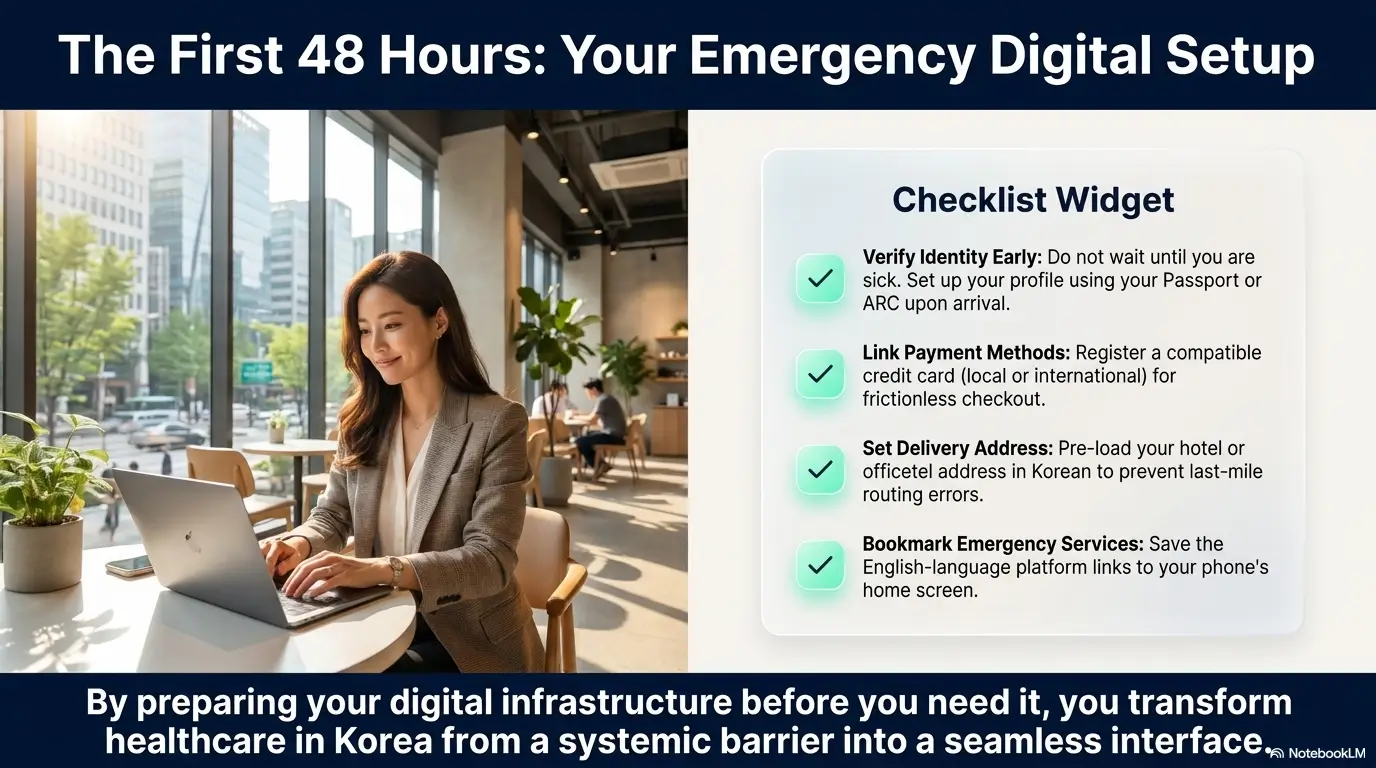
Open a note on your phone and write four lines: your exact location in Korea, the condition you need assessed, the generic name of any requested medication, and the date of your most recent in-person visit for that condition.
Next, choose one clinic and send the five eligibility questions from this guide. Attach a one-page medication or medical summary, not a shoebox of mysterious screenshots. Save the reply beside your passport copy, insurance information, and Korean address.
That small packet turns a vague search for “English telemedicine Korea” into a decision you can document: eligible or not, remote or in person, insured or self-pay, prescription possible or uncertain. The rules may be complicated, but your next move does not need to be.
Last reviewed: 2026-08