
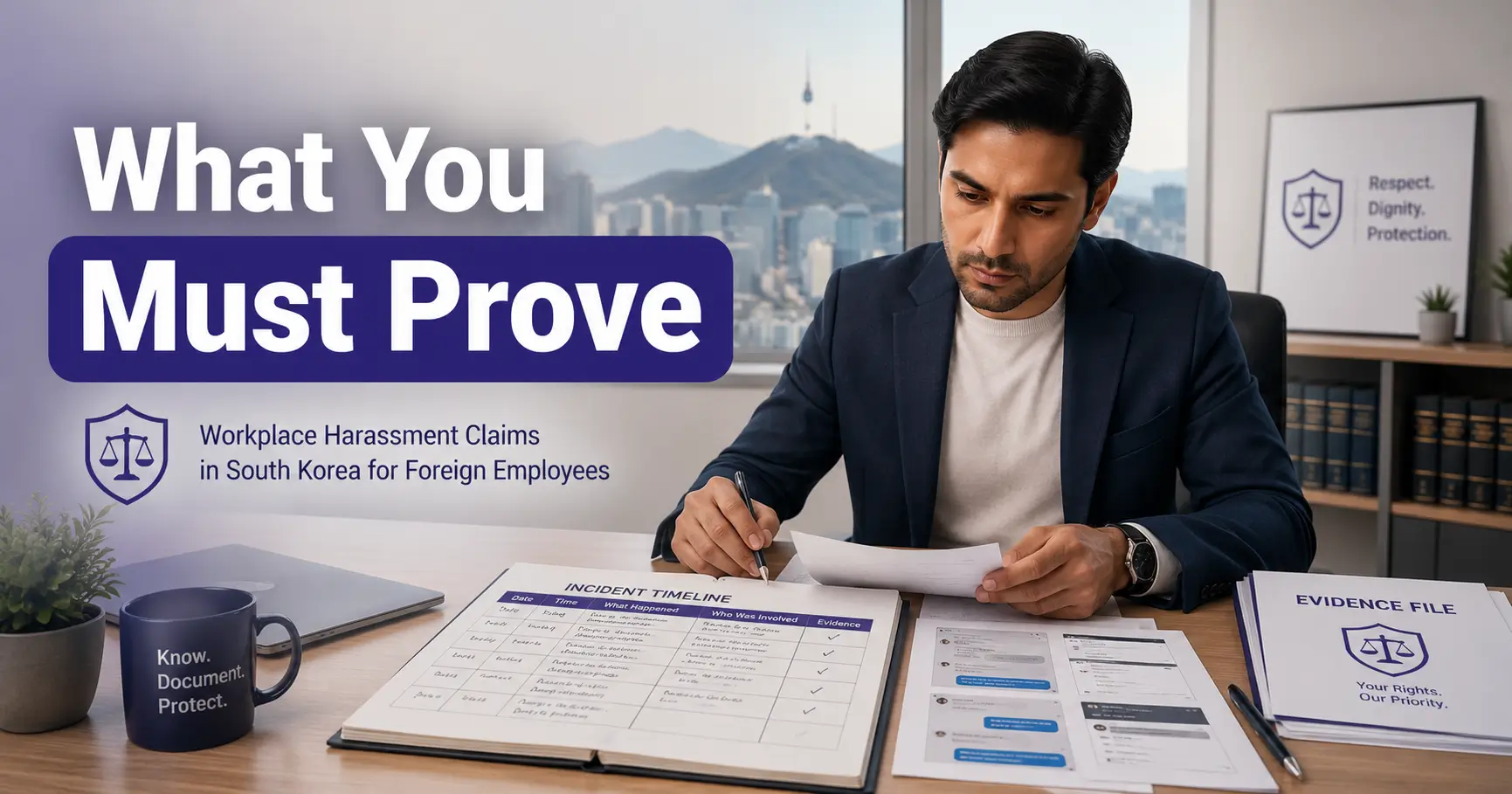
Employment Rights in South Korea
Korea Workplace Harassment Claims for Foreign Employees:
What You Must Prove
A cruel remark, an impossible assignment, and a threat involving your visa may feel like parts of the same storm. Legally, however, each fact has a different job. Some facts establish workplace power. Others show that management crossed the reasonable boundary of work. Still others prove harm, discrimination, retaliation, or an immigration risk that needs its own response.
That distinction matters because a complaint built only from conclusions such as “my boss is toxic” can be easy to dismiss. A complaint built from dated incidents, original messages, witnesses, inconsistent explanations, requested protection, and a clear legal route is much harder to wave away.
This guide helps foreign employees in South Korea organize the facts before memories blur, system access disappears, or an unwanted transfer is described as a favor. It also explains when an internal report may be enough, when a labor petition may be appropriate, and when independent labor or immigration advice may justify its cost.
Your first goal is not to write a dramatic story. It is to build a record that still makes sense when read by a stranger. 🧭
Snapshot
This article is for English-speaking employees in South Korea who suspect workplace harassment, nationality discrimination, or retaliation. You will learn how to test legal coverage, build an incident matrix, request protection, compare reporting routes, and choose one useful next step without treating every workplace conflict as the same claim.
Table of Contents
Before You Act: Protect Your Job, Visa, Health, and Evidence
Legal and safety note
This article provides general legal information based on Korean law and official guidance available in July 2026. It cannot determine your employee status, immigration consequences, filing deadlines, evidence law, or likely outcome. Confirm high-impact decisions with a qualified Korean labor professional, immigration adviser, medical professional, or emergency service as appropriate.
Separate urgent danger from the employment dispute
Workplace harassment procedures are not a substitute for immediate safety measures. Physical violence, confinement, passport seizure, stalking, threats against family members, or a credible risk of self-harm may require emergency, police, medical, shelter, or consular assistance before an internal investigation begins.
Do not wait for HR to schedule an interview while an immediate threat continues. Record what happened, move to a safer place when possible, and contact appropriate local assistance.
Do not let one complaint swallow every issue
A foreign employee’s situation may involve several overlapping tracks: workplace harassment, nationality discrimination, unpaid wages, sexual harassment, unfair dismissal, occupational injury, assault, defamation concerns, and immigration status.
These facts can share one chronology, but they should not be compressed into one vague accusation. Each route may have different legal elements, authorities, remedies, and deadlines.
Avoid irreversible decisions made in panic
Resignation, a signed Korean statement, a settlement waiver, or the deletion of company data can alter your position quickly. Before agreeing, ask for time to review the document, request a translation, keep a copy, and confirm whether the decision could affect wages, severance, housing, health coverage, system access, or immigration status.
If the situation is affecting sleep, concentration, or your ability to remain safe, consider obtaining clinical support. Our guide to mental health visits in Korea for foreigners explains practical access issues without treating medical records as a courtroom prop.
Does Korean Workplace Harassment Law Cover You?
Employee status matters more than nationality
Korea’s Labor Standards Act defines an employee by the reality of providing labor to a business or workplace for wages. A foreign passport, English job title, fixed-term contract, or managerial label does not automatically remove ordinary labor protections.
The harder cases involve people described as freelancers, contractors, partners, directors, visiting professionals, or independent instructors. The contract label is relevant, but the working relationship may matter more. Questions commonly include who controlled the schedule, whether work could be refused, who supplied tools, how payment was calculated, and whether the worker was integrated into the business.
The five-worker threshold can change the route
The Labor Standards Act generally applies to workplaces that regularly employ at least five employees. Selected protections apply to smaller workplaces, but the statutory workplace-harassment chapter is generally not among the provisions extended to workplaces with four or fewer regular employees.
Do not assume that the number of people standing in the office today settles the question. Calculating “regularly employed” workers can require attention to employment patterns, affiliated locations, part-time staff, and the actual business unit.
Key takeaway
Before arguing about whether conduct was harassment, confirm two gateway facts: whether you are legally an employee and whether the relevant workplace ordinarily employs at least five workers.
A small workplace does not mean “no rights”
If the statutory workplace-harassment procedure does not apply, other routes may still matter. These can include contractual claims, unpaid wages, assault or threats, occupational safety duties, nationality discrimination, sexual harassment protections, civil claims, or a human-rights complaint.
The route should be chosen after examining the conduct, not by forcing every harmful event into the workplace-harassment label.
You can review the current English text of the Korean Labor Standards Act, including Articles 6, 11, 76-2, and 76-3.
The Three-Part Test: Power, Excessive Conduct, and Harm
Korean workplace harassment is not defined simply as rude, unfair, or unpleasant conduct. The legal definition connects three ideas: workplace superiority, conduct beyond the appropriate scope of work, and physical or mental suffering or deterioration of the working environment.
| Element | Questions to ask | Useful evidence |
|---|---|---|
| Workplace superiority | What formal or practical power could the employee not easily resist? | Reporting lines, schedules, visa sponsorship, seniority, group influence, language control |
| Beyond reasonable work scope | Was there a legitimate business purpose, and was the method proportionate? | Instructions, policies, comparison employees, repeated wording, timing, location |
| Harm or deterioration | How did the conduct affect health, duties, access, reputation, pay, or ability to work? | Medical records, removed assignments, messages, evaluations, witness accounts |
Power is not limited to a manager title
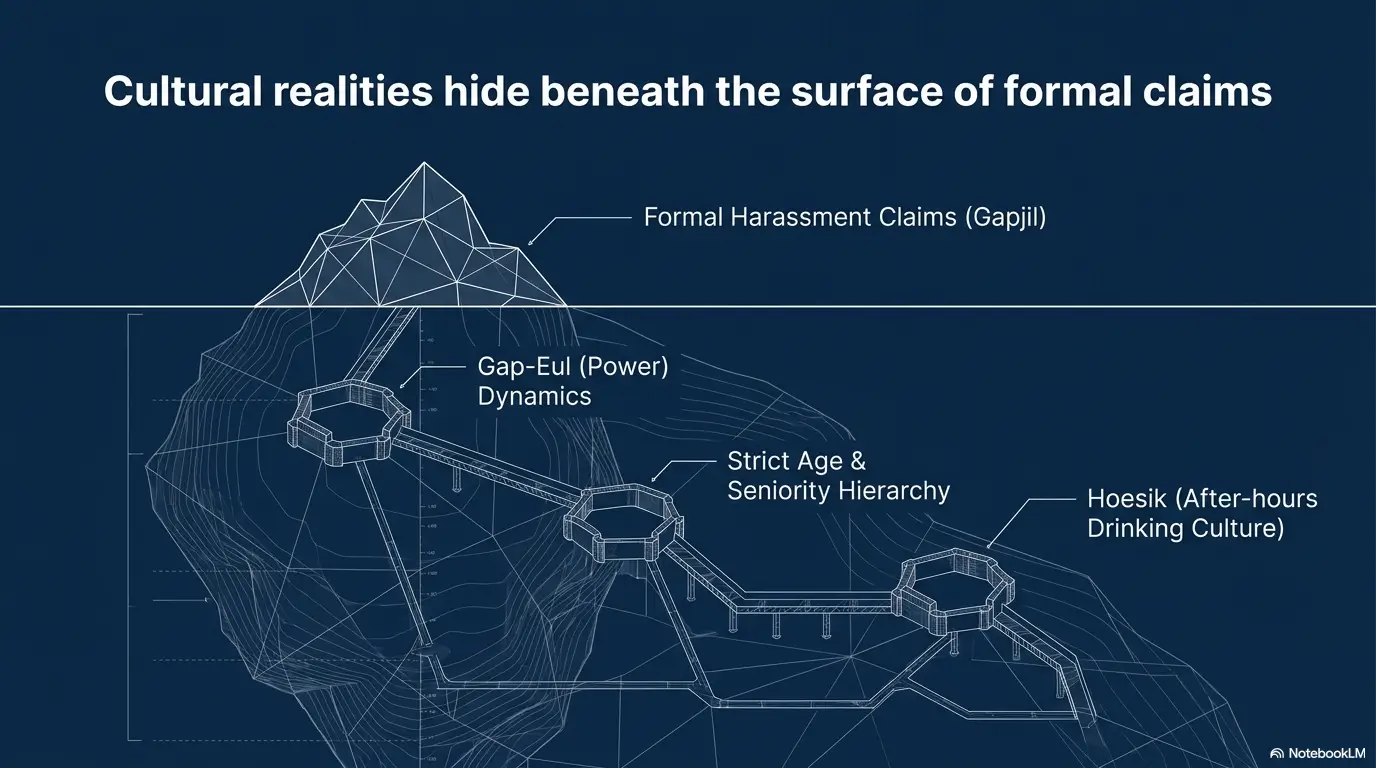
Formal authority is the clearest example. A supervisor may control evaluations, shifts, renewal, promotion, housing, access to projects, or recommendations needed for future employment.
Relational superiority can also arise from seniority, specialist knowledge, group loyalty, control over Korean-language information, or the coordinated actions of several coworkers. A colleague without a grand title may still possess practical power that a foreign employee cannot readily resist.
Harsh management is not automatically harassment
A demanding deadline, negative evaluation, reassignment, or disciplinary meeting can serve a lawful business purpose. Investigators may examine whether the instruction was necessary, whether the method was proportionate, whether comparable employees were treated similarly, and whether the stated reason remained consistent.
Public degradation is different from private performance feedback. Repeatedly assigning knowingly impossible work as punishment is different from an urgent but achievable deadline. Removing all meaningful duties to force resignation is different from a documented operational reassignment.
Connect the conduct to a workplace effect
Do not stop at “I felt bad.” Explain what changed. Were you removed from meetings, denied information, unable to sleep, afraid to enter the workplace, treated medically, given fewer shifts, excluded from projects, or professionally discredited?
Medical evidence can support a claim, but it is not the only way to prove harm. Work records, witness observations, abrupt access restrictions, and a pattern of exclusion may also show deterioration of the working environment.
Real-world example: performance management or harassment?
An English-speaking engineer receives a written warning after missing a project deadline. Standing alone, that may be ordinary performance management.
The surrounding facts change the analysis. The manager had removed the engineer from the project chat, withheld specifications given to Korean colleagues, ordered completion overnight, mocked the employee’s accent during a team meeting, and later threatened to “cause visa trouble” if the warning was challenged.
The strongest complaint would not merely call the warning unfair. It would identify the manager’s authority, the withheld information, the inconsistent treatment, the public language, the immigration threat, the impossible instruction, and the resulting exclusion. Each fact performs a different legal function.
Key takeaway
A persuasive claim does not ask, “Was this boss mean?” It asks who held power, why the conduct exceeded legitimate work management, and how the workplace or employee was harmed.
The Evidence Clock: What Usually Disappears First
Write the chronology before writing the complaint
A polished narrative can wait. Start with a plain chronology while dates, locations, witnesses, and exact wording are still recoverable.
- Date and approximate time
- Physical location or communication channel
- Exact words or conduct
- People present or copied
- Work task and stated business reason
- Immediate response
- Later effect on duties, health, access, pay, or status
- Who was informed afterward
Preserve originals, not only screenshots
Screenshots are useful, but they may omit timestamps, participants, attachments, surrounding messages, or metadata. Where lawful and permitted, preserve complete emails, message exports, schedules, meeting invitations, evaluations, policy documents, complaint acknowledgments, and investigation notices.
Keep a record of where each item came from and when it was saved. Do not alter files, impersonate another user, enter an account without authorization, or remove customer data and confidential business material simply because it might become evidence.
Keep Korean text and translation together
A translation should not erase the original wording. Retain the Korean message, a literal English translation, and a short note explaining hierarchy, slang, honorifics, sarcasm, or cultural context where necessary.
If the translation may be used formally, record who translated it and how. Machine translation can be a useful first pass, but an ambiguous insult, threat, or disciplinary phrase may need human review.
Build a six-column incident matrix
| Date and place | Exact conduct | Power used | Why excessive | Evidence | Effect and remedy |
|---|---|---|---|---|---|
| 2026-07-10, team meeting | Manager said the employee should leave Korea if unable to “obey Korean seniors” | Manager controlled evaluation and renewal | Public nationality-linked degradation unrelated to work quality | Three witnesses, meeting notes, follow-up message | Fear of nonrenewal; request neutral investigator and no direct contact |
| 2026-07-12, group chat | Employee removed from project channel without explanation | Team lead controlled information access | Required information remained available to comparable coworkers | Removal notice, coworker screenshots, project schedule | Missed task information; request restored access |
Key takeaway
Context often decides the claim. A harmless-looking sentence may carry different weight when placed beside repeated exclusion, changing explanations, nationality remarks, and threats tied to employment status.
Foreign-Employee Pressure Points That Need Separate Files
Nationality discrimination is a related but distinct theory
The Labor Standards Act prohibits discriminatory treatment concerning working conditions on the ground of nationality. The Act on the Employment of Foreign Workers also prohibits unfair discrimination merely because a person is a foreign worker within that Act’s scope.
A nationality insult may support the context of a harassment claim, but discrimination should still be organized separately. Identify the working condition involved, the comparison group, the different treatment, and the employer’s stated reason.
Language control can become workplace power
Language difficulty is not automatically unlawful. It becomes more significant when the company selectively withholds policies, refuses interpretation during a serious investigation, asks an employee to sign an unreadable Korean statement, or records an English complaint inaccurately in Korean.
Request interpretation or translation in writing. After a meeting, send a calm summary explaining what you understood, what remains disputed, and which Korean document you have not yet verified.
Readers navigating indirect replies, hierarchy, and workplace formality may also find our guides to Korean business communication and Korean office culture useful for interpreting context without excusing abusive conduct.
Visa, housing, and sponsorship require their own plan
Threats involving visa renewal, workplace transfer documents, immigration reporting, employer-provided housing, or immediate departure can intensify the power imbalance. They do not create one universal immigration outcome.
The consequences of resignation, dismissal, nonrenewal, or workplace transfer vary by status of stay and factual situation. Keep immigration communications in a separate evidence folder and seek visa-specific advice before changing employment where status may be affected.
Public posting can create a second legal problem
Posting names, screenshots, accusations, customer information, or private conversations online may create risks unrelated to the original complaint. Preserve evidence privately and consider legal review before publishing identifying allegations.
For background on the separate risks, read our guide to defamation law in Korea for foreigners.
The Reporting Ladder: HR, MOEL, Human Rights, and Other Routes
Make an internal report that triggers clear duties
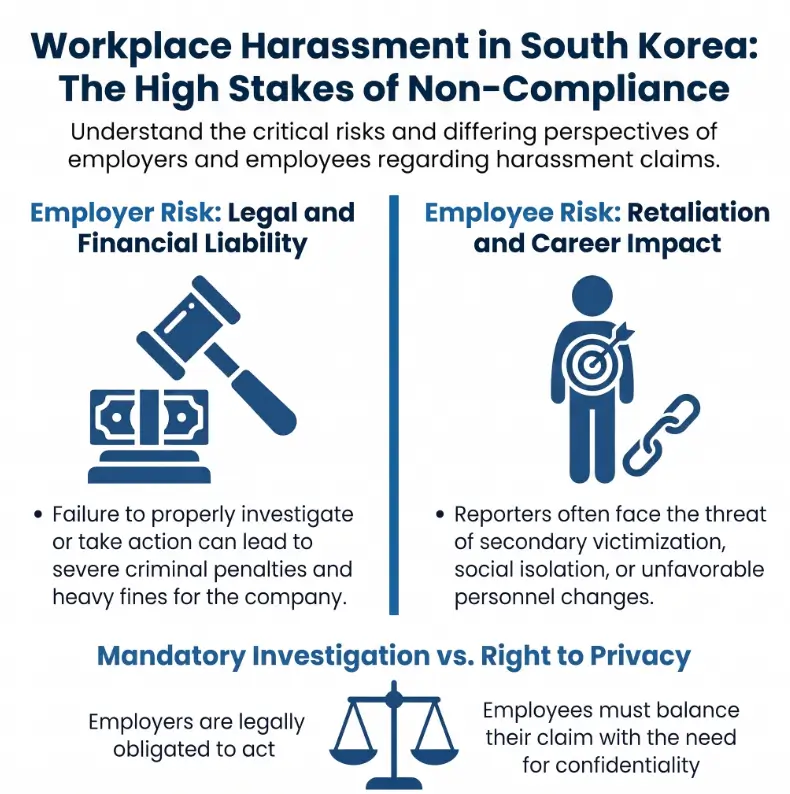
Anyone who learns of possible workplace harassment may report it to the employer. Once an employer receives a report or otherwise becomes aware of the conduct, the employer must conduct an objective investigation without delay.
A strong internal report should identify the accused person, dated conduct, witnesses, relevant evidence, workplace power used, reason the conduct exceeded legitimate management, resulting harm, and protective measures requested.
- Preserve specified emails, chat channels, access logs, schedules, and recordings of meetings
- Appoint an investigator without a reporting conflict
- Provide interpretation and translated documents
- Prevent direct contact where necessary
- Do not change duties, schedule, housing, or employment status without written reasons
- Provide written confirmation that the complaint was received
Why report internally when HR feels compromised?
An internal report establishes when the employer received notice. It can trigger investigation and protection duties, preserve your requested remedies, and create a baseline against which later transfers, discipline, nonrenewal, or dismissal can be evaluated.
This does not mean you must rely on HR alone. It means the employer cannot easily claim it never knew what was happening.
Escalate employer failures to labor authorities
Contact with the Ministry of Employment and Labor may be appropriate when an employer refuses to investigate, delays without reason, conducts an obviously conflicted process, breaches confidentiality, ignores confirmed harassment, or retaliates against the reporting employee.
MOEL provides labor counseling through 1350, with an overseas number listed on its English site. Labor petitions concerning Labor Standards Act violations can also be submitted through the government’s e-People system.
Use the human-rights route when discrimination is central
A complaint to the National Human Rights Commission of Korea may be relevant where nationality, national origin, race, ethnicity, disability, religion, age, medical history, or another protected characteristic is central to the conduct.
The Commission’s role, process, and available outcomes differ from a workplace-harassment investigation or unfair-dismissal case. Use one factual chronology, but state each legal theory and requested remedy separately.
| Route | Best suited to | What to prepare | Important caution |
|---|---|---|---|
| Internal employer report | Triggering investigation, protection, evidence preservation, and corrective action | Incident matrix, witnesses, requested safeguards | Check for conflicts and keep proof of submission |
| MOEL or labor inspector | Employer failures, retaliation, and Labor Standards Act violations | Complaint, employment records, employer response | Identify the precise violation, not only the underlying mistreatment |
| Human Rights Commission | Discrimination and equality issues | Protected ground, comparison, conduct, harm | Remedies and procedure differ from labor litigation |
| Labor Relations Commission | Unfair dismissal, suspension, transfer, or other qualifying personnel action | Notice, reasons, dates, employment contract, retaliation chronology | Filing periods can be short |
| Police, court, or specialist route | Violence, threats, stalking, civil damages, or other separate wrongs | Safety evidence and professional advice | Do not assume an HR complaint pauses another deadline |
For a broader explanation of Korea’s administrative petition channel, see our practical guide to the Korea public complaint system.
Key takeaway
Reporting is not a single door. Internal investigation, labor enforcement, unfair-dismissal remedies, human-rights procedures, immigration advice, and criminal safety routes solve different problems.
Investigation, Protection, Confidentiality, and Retaliation
An objective investigation means more than two interviews
A credible investigation should test both accounts against documents, electronic communications, witnesses, comparable treatment, operational reasons, inconsistencies, and credibility factors. Merely asking the accused person whether the allegations are true is not a meaningful process.
Ask who will investigate, what evidence will be preserved, whether witnesses may submit information confidentially, how translations will be verified, and how the company will communicate its findings.
When the owner is accused, self-investigation is the crack
MOEL’s revised workplace-harassment prevention and response manual, announced on July 2, 2026, recommends excluding an accused employer from the investigation. It also addresses challenge and recusal procedures and recommends explaining the investigation result and reasoning to the reporting employee.
If the owner, chief executive, HR director, or investigator participated in the alleged conduct, request an independent investigator in writing. State the conflict plainly rather than accusing everyone of corruption.
Protective measures should not become punishment
During an investigation, an employer may use measures such as workplace separation or paid leave when necessary to protect the affected employee. Measures for the reporting employee should not contradict that employee’s wishes.
A transfer to a remote location, removal of meaningful work, loss of client contact, or reduced schedule may be described as “protection” while functioning as punishment. Respond in writing. Explain the concrete disadvantage, propose a less harmful alternative, and ask the company to identify its reason and duration.
Retaliation can create a more serious second claim
Korean law prohibits dismissal or unfavorable treatment of an employee who reports workplace harassment or is affected by it. A violation of this anti-retaliation provision may carry criminal penalties of up to three years’ imprisonment or a fine of up to ₩30 million.
Investigation, corrective-action, and confidentiality failures can also carry administrative fines. An employer who personally commits workplace harassment may face an administrative fine of up to ₩10 million.
- A negative evaluation appearing immediately after the report
- Reduced shifts, pay, duties, or access without a documented reason
- Transfer away from normal work or clients
- Pressure to resign or sign a broad waiver
- Nonrenewal soon after reporting
- Discipline based on the act of complaining
- Rumors or disclosure of confidential investigation information
If dismissal, suspension, transfer, or another significant personnel action occurs, check the Labor Relations Commission route promptly. A request for remedy from unfair dismissal or similar action generally must be filed within three months of the action, so waiting for an internal investigation to finish can be costly.
Show me the nerdy details
Article 76-3 separates the employer’s duties into stages. The employer must investigate objectively without delay after receiving a report or learning of possible harassment. Interim protection may be used while the investigation continues.
If harassment is confirmed, the affected employee may request measures such as transfer, reassignment, or paid leave. The employer must also take necessary action concerning the perpetrator and hear the affected employee’s opinion before deciding those measures.
Confidential information learned during the investigation generally must not be disclosed against the affected employee’s wishes, subject to limited reporting and agency-request exceptions. Retaliation is treated separately and more severely than an ordinary procedural failure.
Key takeaway
After reporting, start a second chronology. Record every change in evaluations, duties, schedule, pay, access, housing, renewal discussions, and treatment by coworkers.
Free Checklist or Paid Professional Help?
When a careful DIY report may be enough
A self-prepared internal report may be reasonable when the employment relationship is clear, the workplace has a credible procedure, the conduct is well documented, the accused person does not control the investigation, and no immediate visa, dismissal, safety, or settlement issue is present.
Free official counseling can help you identify the correct authority and basic procedure. It may not provide strategic representation, review every document, or coordinate labor and immigration consequences.
When a fixed-scope consultation may save money
A limited consultation can be useful before resigning, signing a Korean statement, responding to discipline, accepting a transfer, submitting a labor petition, or making a public accusation.
To avoid paying a professional to organize a cardboard box of screenshots, prepare your chronology, contract, visa information, employer policies, key messages, requested outcome, and a one-page question list first.
When ongoing representation may be worth considering
Broader help may be justified when retaliation has begun, dismissal is threatened, the owner is accused, the employment relationship is disputed, witnesses are being coordinated, a settlement is proposed, significant health harm exists, or labor and immigration risks must be managed together.
| Level | Best for | Likely cost profile | What to verify |
|---|---|---|---|
| Good: Free official resources | Understanding basic rights, agencies, and filing channels | No professional fee | Language access, office jurisdiction, documents required |
| Better: Fixed-scope review | Checking a complaint, resignation, warning, transfer, or settlement before acting | One-time or limited professional fee | Deliverable, review time, included documents, labor and visa scope |
| Best for complex cases: Ongoing representation | Retaliation, dismissal, owner conflict, multiple legal tracks, or formal proceedings | Higher and continuing cost | Fee structure, strategy, communication language, excluded work, likely next stages |
Questions to ask before paying a professional
- Do you regularly handle workplace-harassment and retaliation matters?
- Can you advise on employee-status and small-workplace coverage?
- Will you coordinate with an immigration specialist if needed?
- Which documents should I translate professionally?
- What is included in the quoted fee?
- Will you draft, review, negotiate, attend interviews, or formally represent me?
- Which deadlines should I protect immediately?
- What outcome is realistically available through each route?
Common Mistakes That Quietly Weaken Strong Claims
Reporting labels instead of facts
“My boss is toxic” tells the investigator how you feel but not what to verify. Replace labels with dates, exact language, witnesses, work context, unequal treatment, resulting harm, and the remedy requested.
Resigning before checking collateral damage
Resignation can affect visa status, housing, system access, final pay, severance, health coverage, and the employer’s later description of events. It may still be the right decision, particularly where safety or health is deteriorating, but it should be informed rather than impulsive.
Showing the accused your entire evidence file
A premature confrontation can lead to deleted messages, coordinated witness accounts, new performance records, or restricted access. Preserve evidence first and disclose it strategically through an appropriate process.
Assuming every recording or export is lawful
Do not access another person’s account, secretly install monitoring tools, export customer files, or remove confidential company databases. Recording and privacy questions can depend on who participated, how information was obtained, and how it is later used.
| Weak move | Safer alternative |
|---|---|
| Send an emotional accusation to the entire company | Submit a dated report to the designated recipient and preserve proof |
| Demand only that the accused be fired | Request neutral investigation, evidence preservation, separation, interpretation, and written reasons |
| Combine harassment, wages, discrimination, and dismissal in one paragraph | Use one chronology with separate headings for each claim |
| Sign a Korean statement immediately | Request a copy, translation, correction process, and review time |
| Post accusations publicly | Preserve privately and assess defamation, privacy, and confidentiality risks |
| Wait for HR before checking deadlines | Confirm external filing periods as soon as retaliation or dismissal occurs |
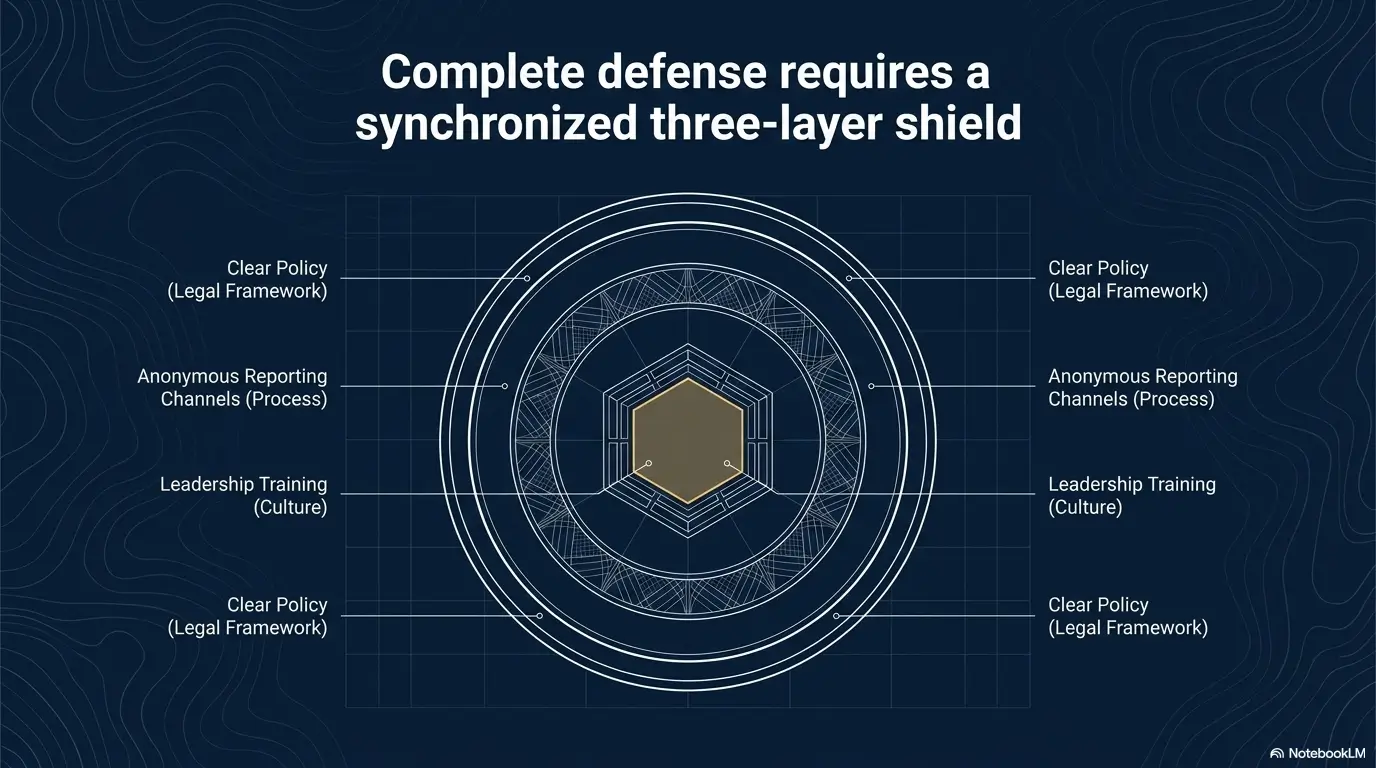
FAQ: Practical Questions Foreign Employees Ask First
Does Korean workplace-harassment law protect foreign employees?
Foreign nationality does not remove ordinary labor protections. The main gateway questions are whether the person is legally an employee and whether the relevant workplace falls within the statutory scope, including the general five-worker threshold.
Does harassment have to happen repeatedly?
Repetition can strengthen the context, particularly for exclusion, insults, surveillance, or punitive assignments. A serious single incident may also matter depending on the power imbalance, lack of work justification, severity, and resulting harm.
Can a coworker be a harasser without being a manager?
Potentially. Workplace superiority can arise from seniority, group influence, specialist authority, language control, access to information, or another relationship that the affected employee cannot easily resist.
What if the company calls it performance management?
Test the business purpose, proportionality, consistency, method, location, wording, frequency, and treatment of comparable employees. Performance management can be lawful, but the label does not excuse public degradation, personal errands, threats, deliberate isolation, or knowingly impossible punishment assignments.
Can the employer transfer me during the investigation?
A protective measure may include workplace separation, but measures imposed on the reporting employee should not contradict that employee’s wishes. Object in writing if a transfer causes disadvantage, and propose a less harmful protective option.
What if the workplace has fewer than five employees?
The statutory workplace-harassment chapter generally may not apply, but other labor, discrimination, contract, safety, civil, criminal, or human-rights routes may remain available. Confirm how the regular employee count is calculated before abandoning the claim.
Can I submit a complaint in English?
Ask the employer or agency which languages and formats it accepts. Preserve your original English complaint, request interpretation, and verify any Korean translation before signing or relying on it.
Should harassment and nationality discrimination be filed together?
A coordinated chronology can help readers understand the full pattern. Each theory should still identify its own legal elements, supporting evidence, responsible person, authority, and requested remedy.
What if I am fired after reporting?
Preserve the dismissal notice, stated reasons, timing, evaluations, complaint record, and any earlier threats. Seek prompt labor and immigration advice because retaliation and unfair-dismissal routes may overlap, while filing periods can continue running during the company investigation.
Your 15-Minute Next Step: Build the Claim’s Spine
Open a blank document and create six columns: date and place, exact conduct, power used, reason it exceeded reasonable work scope, evidence and witnesses, and effect plus requested remedy.
- Add the three clearest incidents, not every unpleasant memory.
- Attach one original record to each incident where available.
- Mark any visa, housing, safety, health, wage, or dismissal issue that needs a separate track.
- Write one immediate protection request.
- Choose one next action: preserve, report internally, contact MOEL, seek human-rights guidance, or obtain professional advice.
The document does not need courtroom polish. It needs clean joints. When each fact is connected to power, excessive conduct, harm, and a requested response, the complaint stops drifting and starts pointing somewhere.
Final practical promise
You do not need to solve the entire case today. Preserve what may disappear, separate the legal tracks, and make the next decision before someone else writes the official version of events for you.
Last reviewed: 2026-08