

The Art of the Envelope: Mastering Korean Wedding Etiquette
The only “hard” part of a Korean wedding isn’t the ceremony—it’s the lobby, where everyone moves like they’ve rehearsed and you’re holding an envelope like it might beep. Korean wedding cash gift etiquette is simple once you stop chasing a magic number and start thinking in tiers.
축의금 (chugui-geum) is the Korean wedding cash gift: money placed in a plain envelope, handed to attendants at a reception desk, then recorded with the giver’s name. It’s not a tip or a bribe—it’s a practical, reciprocal way of “covering the welcome,” especially if you’re eating at the reception.
Guess wrong and you don’t “ruin” anything—but you do buy yourself a lingering, avoidable awkwardness. This guide provides a relationship-based decision tree, the amount “bands” people actually use, and the exact envelope writing that looks native (front and back)—plus what changes when you have a plus-one or can’t attend.
It’s built for clean execution: clean bills, clear handwriting, and zero panic.
For most Korean weddings, cash (축의금) is standard and the “right” amount depends on closeness, meal cost, and whether you’re attending the reception. As a US guest, think in tiers: acquaintance, friend/coworker, close friend, family. Bring clean bills, use a white envelope, write the recipient’s name + “축의,” and sign clearly. When unsure, match your relationship tier—not your anxiety. For broader context, see this Korean wedding guide for first-time guests.
Table of Contents
1) Who this is for / not for (so you don’t overthink the wrong problem)
For you if…
- You’re a US-based guest attending a wedding in Korea or a Korean-American wedding.
- You want a relationship-based tier that feels normal, not vague “just be generous.”
- You need envelope writing that won’t look like you guessed at the last minute.
Not for you if…
- You’re part of the wedding party with separate expectations (often different, sometimes negotiated quietly).
- You’re inside a family obligation situation where etiquette is the starting point, not the finish line.
I’ve watched smart, confident adults become suddenly shy at Korean weddings—because there’s a system, but nobody hands you the manual. One friend (New York, very capable, runs a team of 12) whispered, “Where do I put the envelope?” like we were smuggling diamonds. You’re not alone. This post is the calm version of a friend leaning over and saying, “Here’s what works. You’ll be fine.”
2) The number everyone whispers: what “normal” actually means in 2026 terms
Start with this mental model (the “two costs” rule)
- Your relationship (how close you are, socially and practically)
- Your plate (the reception meal + venue expectations you’re stepping into)
Here’s the honest translation: in many Korean settings, cash gifts are less “buying a toaster” and more “covering the welcome.” If you attend the meal, the gift often functions like participation plus respect. That’s why the amount feels socially “coded.”
A small personal note: the first time I attended a wedding in Seoul, I brought a pretty card (because… America). It was sweet. It was also useless. The reception desk wanted an envelope, and my “aw” moment turned into a “please don’t perceive me” moment. Lesson learned: format beats sentiment at the door.
The quiet truth: you’re paying for belonging
In US culture, a gift can be intensely personal (“I saw this and thought of you”). In Korean wedding culture, a gift is often intensely legible (“I showed up correctly”). It’s not cold—just practical. And once you accept that, your stress drops by about 70% (yes, I’m estimating, but you’ll feel it).
Curiosity gap: why the same wedding can have two “right” amounts
Because “right” changes with attendance, social circle, and city/venue. A lunch wedding in a smaller city and an evening wedding in a glossy Seoul venue can feel like two different planets. The trick isn’t chasing a single magic number—it’s choosing the correct tier, then adjusting gently for circumstances. (If you want to understand how format changes expectations, skim modern vs traditional Korean wedding differences.)
Show me the nerdy details
Think of it as a signaling system with constraints. The “plate” acts like a public baseline cost; the “relationship” acts like a private closeness signal. Your goal as a guest is to avoid outlier behavior (too low for the context, or weirdly high in a way that changes the social meaning). Tiers help you stay inside the normal band without needing insider gossip.
3) Your “how much to give” decision tree (US brain-friendly, Korea-accurate)
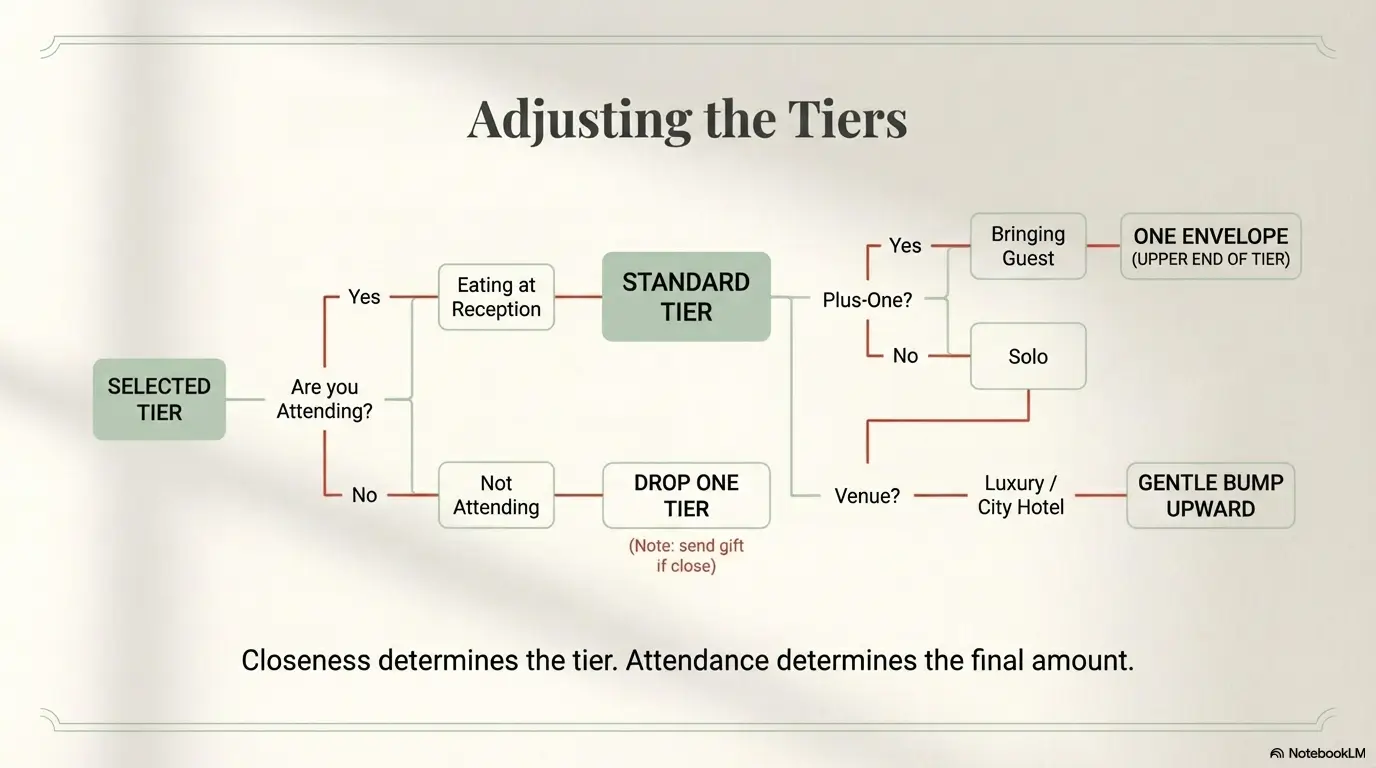
Step 1: Are you attending in person?
- Yes (you’ll eat at the reception) → use standard tiers.
- No (you can’t attend) → reduce by one tier (but still send something if you’re close).
Step 2: How close are you—really?
- Coworker / acquaintance
- Friend / close colleague
- Close friend
- Family / inner circle
Step 3: Is this a high-cost venue or major city?
Venue expectations can bump a tier without anyone saying it out loud. When in doubt, you don’t need to “double” anything—you just nudge upward inside your tier. (I once over-corrected and gave an amount that made my friend laugh—not offended, just amused. Humor is not the worst outcome, but we aim for smooth.)
- Attending the meal matters.
- Closeness matters more than your personal guilt.
- City/venue can justify a gentle bump.
Apply in 60 seconds: Decide “attending or not” and circle one tier before you think about any number.
Use this as a tier selector, not a precise price tag.
- Relationship: Acquaintance / Friend-Coworker / Close Friend / Family-Inner Circle
- Attendance: Eating at reception? Yes / No
- Plus-one: Bringing a guest? Yes / No
Output rule: Pick the tier. If “No attendance,” drop one tier. If “Plus-one,” stay in the same tier but choose the upper end of what feels normal for that tier.
Neutral next step: Write your tier choice in your notes app before you talk yourself into chaos.
4) Practical tiers (what US guests usually choose without offending anyone)
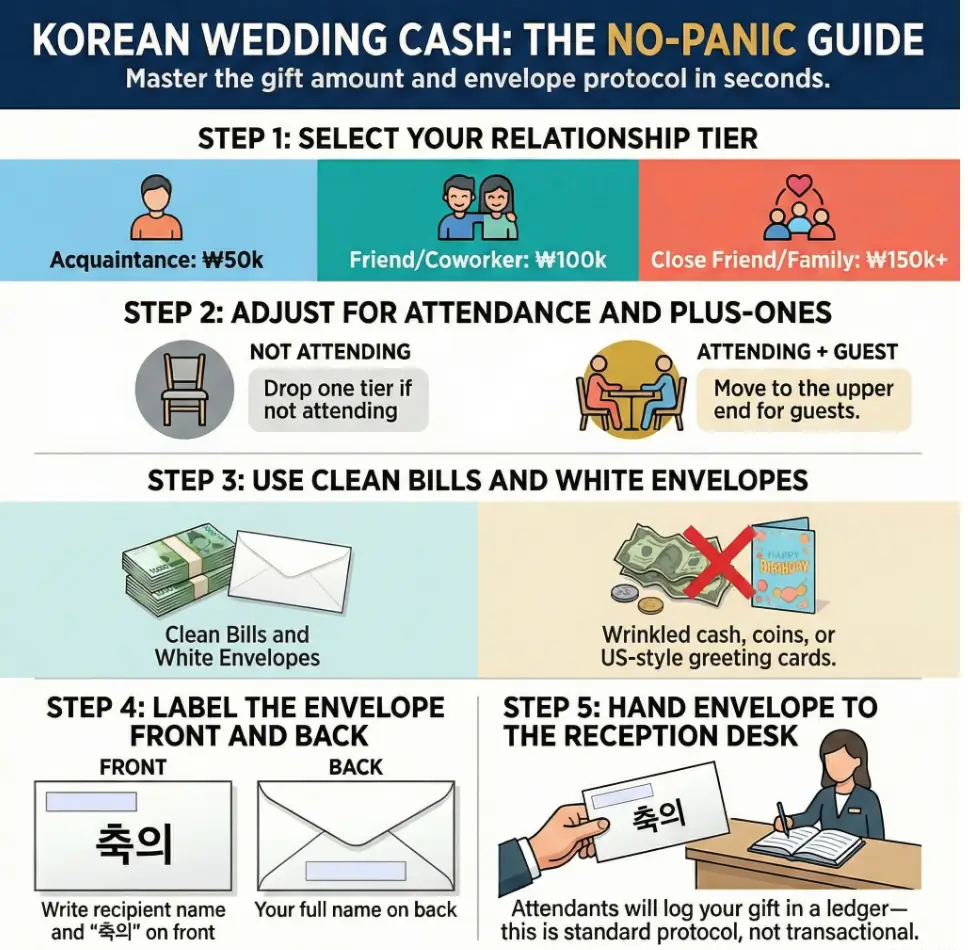
Let’s talk about the reality: US guests often want a single “typical amount.” But Korean etiquette works better as bands—and the bands often use round, clean numbers (because the desk logs it, and because humans love tidy systems). You’ll commonly hear people reference amounts like ₩50,000 / ₩100,000 / ₩150,000+ as cultural “anchors,” but your goal is not to memorize a chart. Your goal is to land in the right tier for your relationship.
Tier A: Acquaintance / light coworker
This is the “I respect you” tier—minimal awkwardness, maximal correctness. If you mostly know them through work, or you’re connected through a friend group but not close, keep it simple. I once attended as a “friend-of-a-friend” in a huge hall and realized: nobody wanted me to perform intimacy I didn’t have. They wanted me to show up cleanly, smile, and not make it weird.
Tier B: Friend / regular coworker you actually like
This is the most common peer tier: you have history, you’ve shared lunches, you’ve had real conversations. In Korea, it’s normal for this tier to “cover the meal” and then some—without turning it into a dramatic gesture. Think steady, normal, supportive.
Tier C: Close friend / mentor / someone who’d help you move apartments
This is the “I’m in your chapter” tier. The signal matters more than the exact number. If they would show up for you in a hard week, you’re allowed to show up for them on a bright day. (And yes, this is the tier where people sometimes coordinate quietly—especially if friends are traveling from far away.)
Tier D: Family / very close circle
Family amounts are often governed by family norms more than public etiquette. If you’re marrying into a Korean family, the best advice is almost painfully practical: ask one trusted “cousin-type” person who knows the vibe. Not the internet. Not the couple. A calm insider.
Context: light coworker / acquaintance
Context: friend / regular coworker
Context: close friend / mentor
Context: relatives / inner circle
Neutral next step: Choose your tier, then stop re-litigating your life story.
5) What changes the amount (and why it’s not about generosity)
Attendance matters more than affection
If you attend and eat, you’re stepping into a known cost environment. That’s why “I couldn’t make it” often comes with a smaller gift: you’re still sending respect, but you’re not consuming the reception. This is one of those rare etiquette rules that actually makes intuitive sense once you say it out loud.
Plus-one math: do you give one envelope or two?
One envelope is typical. The amount should reflect two plates if you’re bringing a guest. The cleanest move is: keep the same relationship tier, then choose the upper end of what feels normal for that tier. (I’ve seen Americans split into two envelopes with two names and accidentally create extra logging work. It’s not a crime. It’s just… unnecessary admin.)
Timing matters: pre-wedding vs day-of vs after
Day-of at the reception desk is standard. Pre-wedding is common when people can’t attend or when they’re close and coordinating. After is acceptable when travel or life happens—just keep it prompt and simple. The key is not drama. The key is clear intent + clean execution.
Curiosity gap: the “group gift” trap Americans fall into
In many Korean contexts, individual envelopes are cleaner than one pooled envelope. Why? The gift is logged by giver, and the giver list is part of the couple’s social record. If you truly want to pool, you can—but do it with one clearly identified giver name and a list inside, so the desk isn’t guessing.
- Attending → cover the welcome.
- Plus-one → one envelope, higher end of your tier.
- Group gifts → avoid confusion; keep it log-friendly.
Apply in 60 seconds: Decide: one envelope, whose name on it, and whether you’re accounting for a guest.
6) Common mistakes (the ones that create silent cringe, not loud drama)
Mistake #1: Using US-style greeting-card language on the envelope
“Congratulations!!!” in bubbly cursive is sweet. It also reads slightly off-format at a Korean reception desk, where the envelope is meant to be quickly recognized and logged. Think of the envelope as a label, not a love letter.
Mistake #2: Writing only your first name (or illegible signature)
Traceability matters. If your name can’t be read, the record becomes a mystery. I once watched an attendant squint at an envelope like it was ancient scripture. Don’t do that to someone’s aunt at 12:40 p.m. on a Saturday.
Mistake #3: Bringing wrinkled bills or mixed coins
This is a “small signal, big impression” moment. Use clean bills. No coins. No crumpled chaos. If you’re coming from the US, convert to KRW in advance when possible (airport, bank, or reputable exchange). The goal is smoothness, not heroics.
Mistake #4: Asking the couple directly “how much should I give?”
It puts them in a weird spot. Ask a peer friend, a coworker who has attended Korean weddings, or use the tier system in this post. The couple has enough admin already. Let them keep their joy. If you want a wider cultural “why,” this Korean culture overview helps the etiquette feel less mysterious.
7) Envelope writing (축의금) that looks native, even if you’re not
The standard front (recipient side)
A classic Korean money envelope is simple: a white envelope, recipient name, and a short phrase.
Choose one phrase: 축의 is the most common and clean.
Recipient name: whose name goes on the front?
- If the invitation or desk is clearly for the couple, write the person you know (bride or groom) or the couple’s name if provided.
- Some weddings collect gifts under parents’ names (common in certain formats). If the desk signage shows parents, match that signage.
The standard back (giver side)
Full name is your best friend here. If your handwriting is chaotic, print neatly.
Here’s what no one tells you…
Neatness beats perfect Korean. A clean envelope with clear names wins. I’ve seen native speakers scribble like doctors and still cause confusion. You don’t need to be fluent; you need to be legible.
Romanization option (if you can’t write Korean)
- Write the recipient name in English and add 축의 if you can.
- If you can’t write 축의, write the recipient name clearly and keep everything else minimal.
- A printed label is okay only if it doesn’t look like a shipping package. (Keep it classy.)
- Are you eating at the reception? Yes/No
- Are you bringing a guest? Yes/No
- What is your relationship tier? A/B/C/D
- Do you need KRW cash? If yes, plan a clean exchange before wedding day.
- Do you know how the desk is labeled (couple vs parents)? If unclear, be ready to match signage.
Neutral next step: Put one white envelope and a pen into your bag today. Future-you will feel loved.
8) How the cash table works (so you don’t freeze at the entrance)
Where the envelope goes
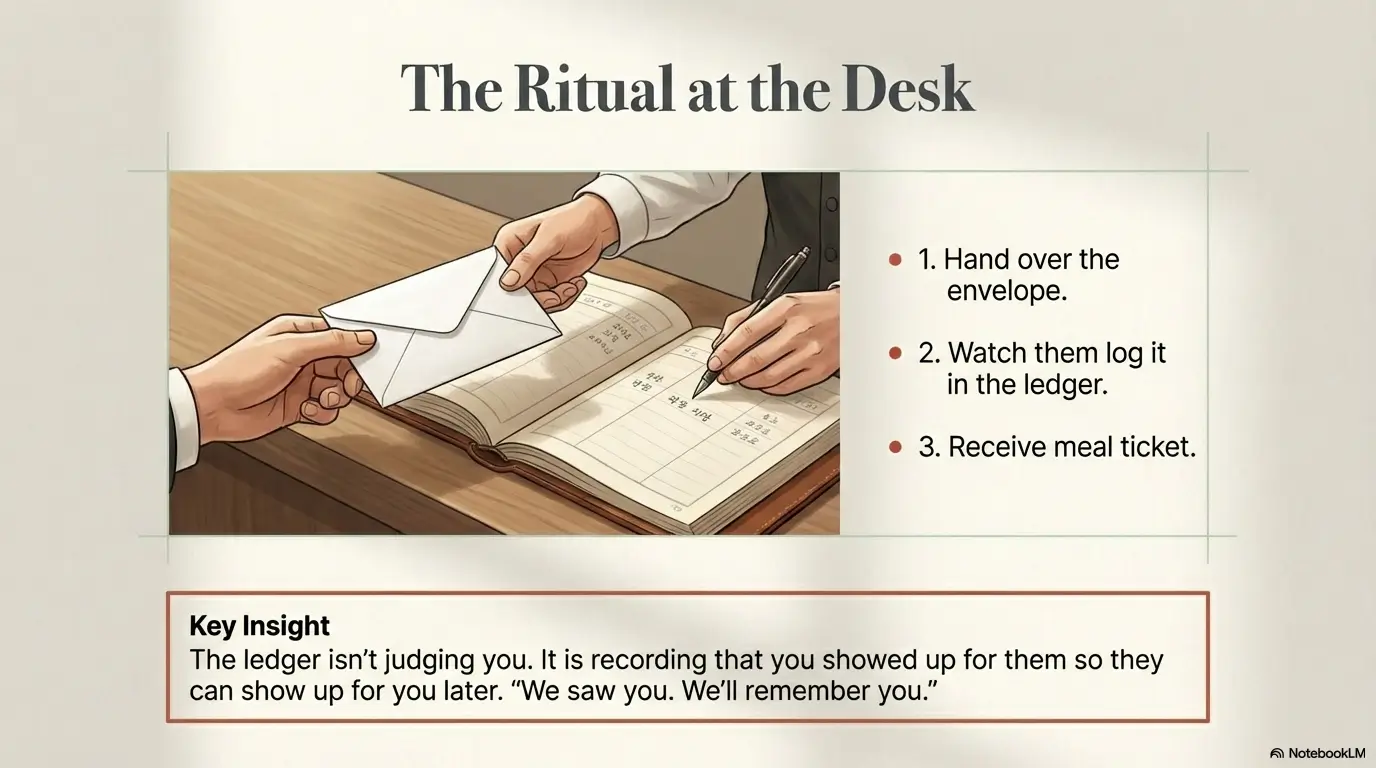
Usually there’s a reception desk near the entrance with attendants—often family members, close friends, or people who look terrifyingly competent. You hand your envelope over. They may greet you, sometimes with a small bow or warm smile. You say hello, hand it over, and move on. That’s it. (If you’re unsure how to return that tiny bow without overdoing it, this guide to Korean bowing (jeol) etiquette is surprisingly calming.)
What happens after you hand it over
They log your name and the amount. This is normal. It’s not rude there; it’s the system. If that feels transactional, you’re not wrong—just culturally early. In many Korean circles, the record says, “We saw you. We’ll remember you. We will show up for you too.”
I remember the first time I saw the ledger. My American brain did a small panic. Then the aunt at the desk laughed gently—like, “Sweetie, we’ve been doing this since before you had Wi-Fi.” And my nervousness evaporated.
Let’s be honest… yes, it can feel like a check-in counter. No, you’re not offending anyone by participating. The offense would be making the process harder than it needs to be.
What to do if you arrive late
- If the desk is open: still use it.
- If the desk is closed: ask venue staff quietly where gifts should go.
- If you’re truly stuck: find a trusted friend of the couple and ask, “Where should I hand this?” (Short and calm.)
Short Story: The Lobby Lesson (120–180 words) …
I once went to a wedding where the lobby was packed—two ceremonies back-to-back, everyone dressed like they belonged in a magazine. My friend (the bride) had warned me: “Just come, eat, and don’t stress.” Of course I stressed. I walked in, saw two desks, and froze like a confused Roomba.
A man in a suit (I later learned: the groom’s cousin) noticed my deer-in-headlights face and gently asked, in English, “Gift envelope?” I nodded. He pointed to the desk, then to the sign with the family name, like he was guiding someone through an airport. Ten seconds later, it was done. No judgment. No spotlight. Just a system catching me before I fell. That’s the real secret: you’re not being tested. You’re being helped.
9) Edge cases US guests get wrong (and how to handle them smoothly)
If you’re attending a Korean-American wedding in the US
Cash is still common, but registries may coexist. Take cues from the couple’s website language and the family vibe. If the site emphasizes a registry, that’s an explicit invitation. If it reads more traditional, cash-in-envelope often remains the cleanest move. (If you need a broader baseline first, start with this Korean wedding guide and then come back to the tiers.)
If you’re not close but your boss invited you
This is a workplace signal situation. Use the coworker tier, bring a clean envelope, and keep it professional. The goal is to be respectful without performing intimacy you don’t have. (I’ve seen people try to “buy closeness” here. It rarely lands the way they think.)
If your budget is tight
Give within your tier without harming your finances. Add a short, respectful message if appropriate—one sentence, not an apology essay. A clean, correctly written envelope with a modest amount often reads better than a messy, over-explained situation.
Curiosity gap: when a non-cash gift is acceptable
Non-cash gifts are most acceptable when explicitly requested (registry) or in culturally blended weddings where multiple gift styles are normal. If the couple clearly says “no gifts,” honor it. If the couple clearly lists a registry, follow the cue. If nothing is said and it’s a Korean-formatted wedding, cash remains the safest default.
- No registry listed
- Wedding format looks traditional
- Reception desk / envelope culture present
- Registry is explicitly listed
- “No cash gifts” is stated
- Wedding is clearly blended and gift options are named
Neutral next step: Follow the couple’s stated preference when it exists; otherwise use the tier + envelope default.
10) Next step (one concrete action you can do today)
Build your 60-second plan
- Decide your relationship tier
- Decide attending vs not (and plus-one)
- Prepare clean bills + white envelope
- Write recipient name + 축의, then sign clearly on the back
- Tier first, then amount.
- One envelope, clear names.
- Clean bills, minimal drama.
Apply in 60 seconds: Put a white envelope + pen in your bag right now and write your own full name on the back.
FAQ
How much cash should I give at a Korean wedding as an American guest?
Use tiers: acquaintance, friend/coworker, close friend, family. If you attend the reception meal, stay in your tier. If you can’t attend, drop one tier. If you bring a plus-one, stay in your tier but choose the upper end. The goal is “socially normal,” not “heroic.”
What’s the typical Korean wedding cash gift for a coworker?
Most coworkers fall into Tier A or Tier B depending on closeness (just-work vs real friendship). If it’s a boss invitation, treat it as workplace etiquette: clean envelope, professional execution, and a tier that matches your workplace relationship.
Do I give more if I bring a plus-one?
Usually yes—because you’re covering two plates. You don’t need two envelopes. One envelope is typical; just move to the upper end of your tier.
Is it okay to give a check instead of cash?
In Korea, cash-in-envelope is the standard because it’s quick to receive and log. In US-based Korean weddings, checks may be more workable—but they’re still less common than cash unless the couple signals otherwise. If you’re unsure, cash is the safer default.
What do I write on a Korean wedding money envelope (축의금)?
Front: recipient name + 축의 (or 축결혼). Back: your full name (and optional affiliation like company/team). Neatness and legibility matter more than perfect Korean. If you’re also trying to decode the sister-version of this system, see Korean condolence money (조의금) envelope etiquette.
Do I write the bride’s name or groom’s name on the envelope?
Write the person you know best, or match the desk signage. Some setups collect gifts under parents’ names; if that’s what you see, follow that labeling.
Is it rude that they track the amount at the reception desk?
It can feel transactional to Americans, but it’s normal in many Korean circles. The logging supports reciprocity and record-keeping. Your job is simply to make the process easy: clean envelope, clear name.
▶️ Video: YouTube embed (mobile responsive)
Conclusion
Remember the fear in the hook—the “What if I look clueless?” moment. Here’s the quiet ending: you won’t. Because you’re not trying to decode an entire culture in one night. You’re doing something simpler and kinder: showing up with a clear tier choice, a clean envelope, and a name they can read. That’s what “correct” looks like in real life.
(closeness first)
No → drop one
Upper end of tier
Back: Your full name
If you do only one thing: bring the envelope and write legibly. Everything else is adjustable.
Your next step (15 minutes, max): pick your tier, get KRW cash if needed, and pre-write the back of the envelope with your full name. Then you can walk into the lobby like a person who has done this before—because now, you have.
Last reviewed: 2026-01