
A US Doljanchi can go sideways in under 12 minutes: the table looks gorgeous, the baby hits stranger-danger, and half the room has no idea the “main moment” already happened.
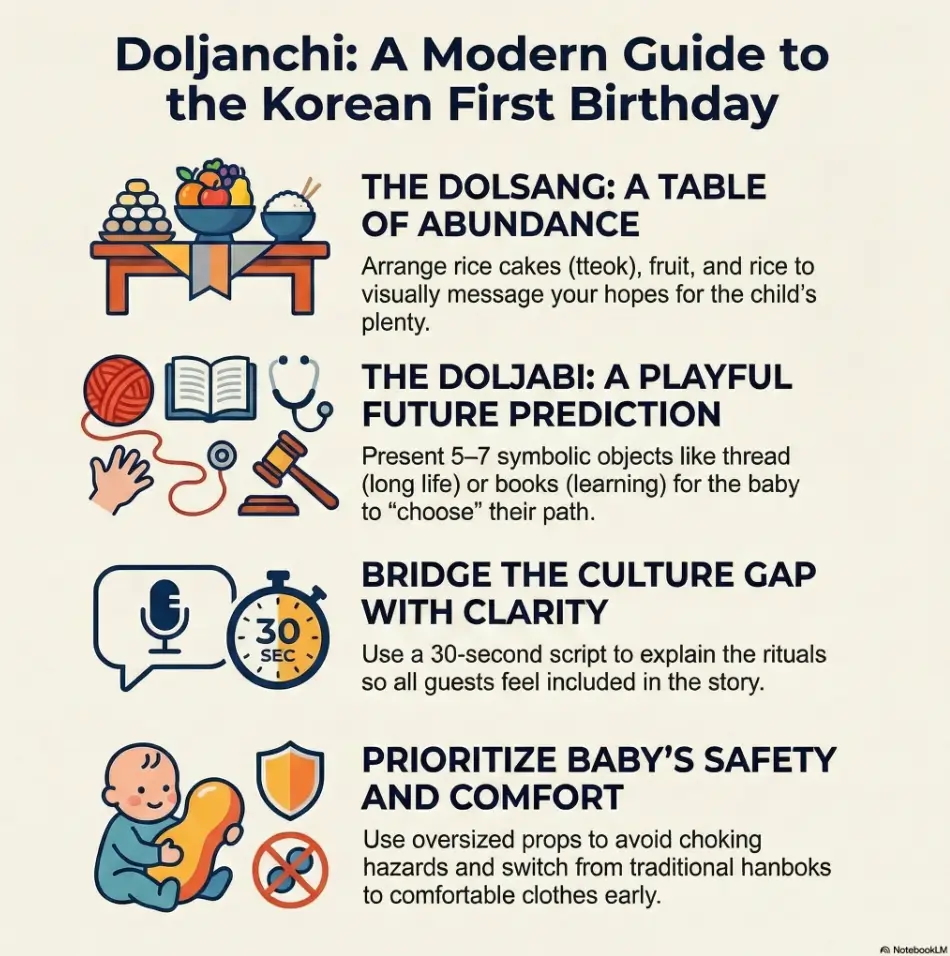
Korean First-Birthday traditions are simple at the core but easy to blur in a banquet room. A Doljanchi is centered on a dolsang (a symbolic table arranged with rice cakes and fruit) and doljabi (a playful ritual where the baby picks an object representing future strengths). It’s meant to be joyful, not prophetic.
This guide provides a tradition-respecting setup to help you navigate:
- ✨ What to anchor: Essential dolsang elements.
- 🌱 What to simplify: Hanbok and decor without the misery.
- ✂️ What to skip: Avoiding the “perfect authenticity” trap.
- ⏰ Timing: Exactly when to run the doljabi for maximum flow.
I’m chasing a celebration that feels real and survives real life. Here’s the plan.
Contents — choose a section
Table of Contents
1) Who this is for / not for: “Meaning-first” Doljanchi planning
For: US families who want tradition without the overwhelm
A US Doljanchi has a particular vibe: you want the cultural “signal” to be clear, but you also want the day to be pleasant and survivable. If you’re time-poor, running on toddler sleep math, and still want something that feels true, you’re in the right room.
Personal note: I’ve watched parents spend 6 hours styling a table only to realize they never decided when the doljabi happens. The photos looked perfect. The guests were confused. The baby was done. A Doljanchi is a ceremony and a flow.
For: Non-Korean partners who want a respectful, clear playbook
If you’re marrying into the tradition, your job is not to memorize a dissertation. Your job is to understand the meaning, protect the respectful parts, and help make it welcoming. You’ll get simple scripts, safety checks, and what-to-do-next lists that won’t make you feel like you’re cramming for an exam.
Not for: “Just a themed party” with zero cultural context (you’ll feel the mismatch)
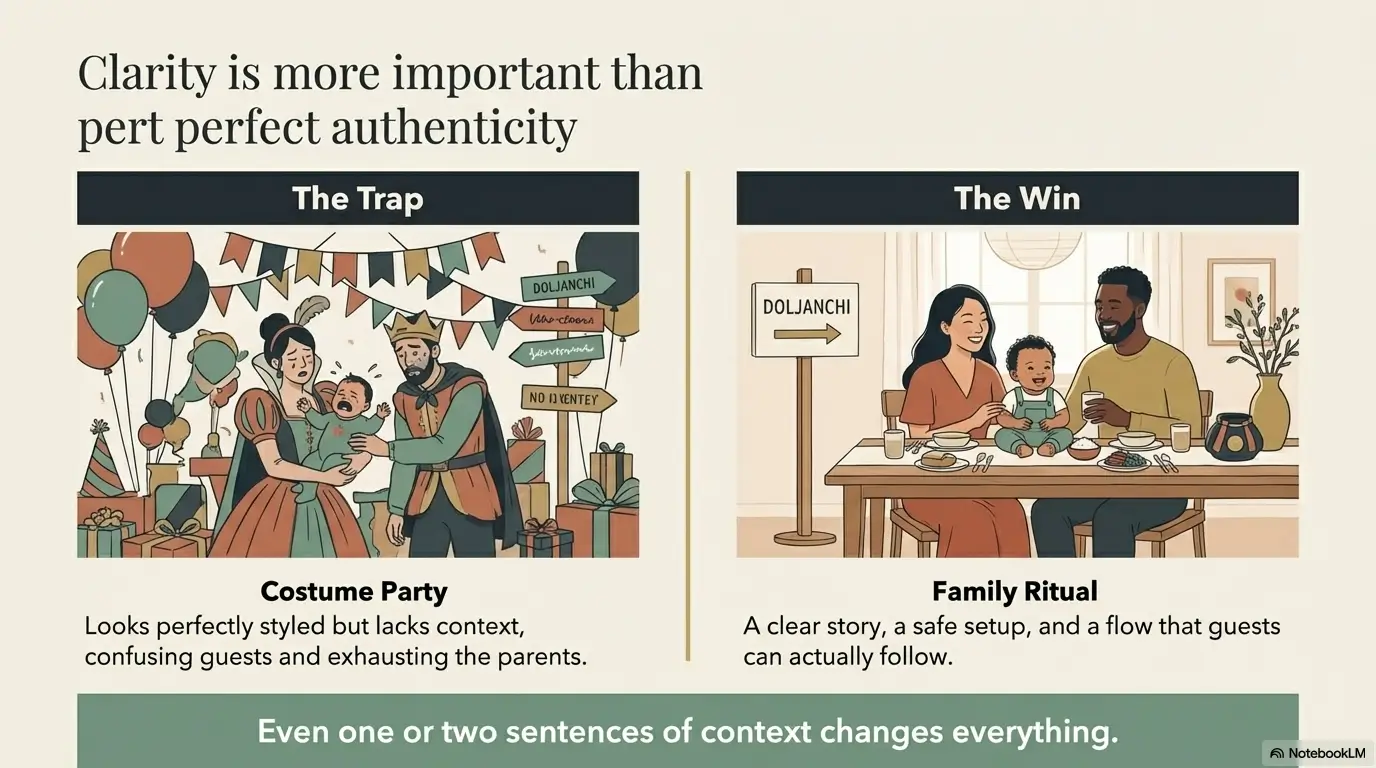
You can do “Korean aesthetic” without meaning, sure. But it often lands like a costume party that accidentally wandered into someone’s family ritual. Even one or two sentences of context changes everything. If your room includes Korean-speaking elders, a tiny boost like Korean honorifics explained for non-native speakers can help you choose respectful wording on signage and quick announcements.
Not for: Unsafe prop-heavy setups (choking hazards, fragile décor near babies)
A one-year-old is basically a tiny scientist whose research focus is: “What fits in my mouth?” We’ll keep your doljabi playful, photogenic, and safely boring in the best way.
- Decide your “meaning anchors” first (dolsang + doljabi + one sentence of context).
- Then choose the venue, menu, and décor that support those anchors.
- Keep the baby’s comfort as the real VIP policy.
Apply in 60 seconds: Write one line: “Our Doljanchi is about ____ (heritage / gratitude / hope).” That line becomes your decisions filter.
2) Doljanchi, decoded: why one year became a milestone
The original why: health, survival, and family hope (context changes everything)
Historically, reaching one year carried real weight because infant survival was never guaranteed. That’s why the celebration feels emotionally “bigger” than a typical birthday. Even today, when circumstances differ, the ritual still holds that old message: we made it here together.
One of the clearest public explanations you’ll see (including on Korea’s official culture pages) is that the first year is treated as a major threshold, which is why the dol celebration developed into its own category of family milestone rather than a simple cake-and-candles moment.
The modern why: identity, continuity, and a “home you can photograph”
In the US, Doljanchi often becomes a soft landing place for identity. It’s the day your baby is surrounded by language, food, and symbols that say: “You belong to a story that started long before your first steps.” If you’re building that “story” intentionally, it helps to understand Korean indirect communication patterns so your scripts feel warm (not overly performative) to Korean relatives and still clear to everyone else.
Personal note: I’ve seen mixed-cultural families relax the moment they realized they don’t have to “perform” Koreanness. They just have to tell the truth: “This is part of our family’s history, and we want our child to feel it.”
Curiosity gap: What’s the one detail that makes a Doljanchi feel “real,” even in a US banquet room?
It’s not the most expensive backdrop. It’s not even the most elaborate rice cake tower. The detail that flips the switch is: a dolsang that’s arranged with intention and a doljabi that’s explained with one warm sentence. When guests understand what they’re looking at, the room changes.
3) Dolsang table setup: the visual grammar of abundance
The essentials: rice cakes + fruit + symbolic dishes (what belongs on the table)
A dolsang is a celebratory table prepared for the first birthday. Traditional descriptions commonly mention a combination of rice cakes, fruit, and festive foods, arranged to look abundant and auspicious. The point is not “more food than anyone can eat.” The point is a visual message: we wish you plenty.
Rice cakes that show up often (and what they’re saying)
You’ll see certain tteok types referenced again and again in public cultural references: white rice cake (often described as symbolizing purity), plump-looking rice cakes (often described as abundance), and red bean elements (often described as warding off bad luck). If you keep just two or three tteok varieties, you’re still inside the tradition.
How to set height, symmetry, and “camera readability” (without turning it into a sugar mountain)
Think of your dolsang like a stage set. The baby is the lead. The food is the scenery. You want a clean focal point that photographs well from 6 to 10 feet away.
- Height rule: keep tall items toward the back (fruit towers, tteok stacks), shorter items toward the front (yakgwa, small plates).
- Symmetry rule: aim for left-right balance, not perfect mirroring. Balanced is calm. Calm is “traditional” on camera.
- Color rule: choose 2–3 main colors (often white, red, and natural fruit colors) and let everything else be quiet.
US-friendly sourcing: Korean markets, bakeries, and rental “dolsang kits”
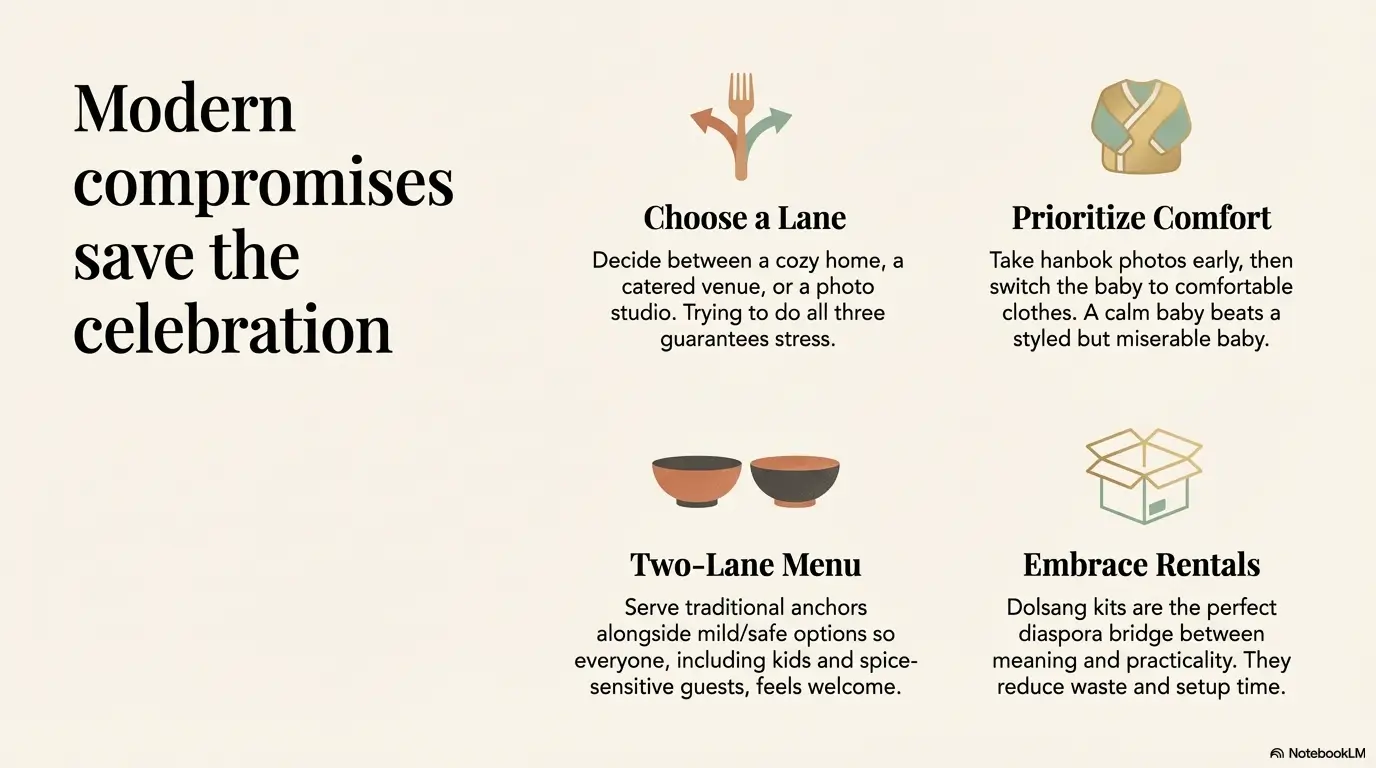
If you’re near an H-Mart, Zion Market, Lotte Plaza, or any regional Korean grocery, you can source most edible items without drama. For décor and props, rental kits are now common in the US. Many rental providers offer “dolsang/baekil kits” with backdrops, table linens, and traditional-looking props, which can reduce waste and setup time. For food-adjacent etiquette (especially if you’re serving shared dishes), this quick primer on Korean banchan refill rules can help you avoid awkward moments with well-meaning non-Korean guests.
Pattern-interrupt micro H3: Let’s be honest… half of “authentic” is where you place things
I’ve seen a dolsang with very simple food feel deeply traditional because the layout was intentional. I’ve also seen a table with premium items feel oddly empty because the spacing was chaotic. Put your “hero” items in a clear triangle: backdrop center, tall elements behind, baby seated front-center. That’s the magic trick.
Show me the nerdy details
If you want the table to read well on phones, keep the densest visual texture (tteok stacks, fruit towers) in the back third of the table depth. Leave at least 20–30% of the front surface with negative space so the baby and doljabi items don’t visually disappear. Use stable risers (boxes under cloth, not wobbly stands), and keep breakables off the grab zone.
- Use a back-to-front height gradient so photos read instantly.
- Limit tteok types to 2–3 and fruit types to 3–5.
- Keep the front zone safe and uncluttered for the baby.
Apply in 60 seconds: Stand 8 feet away and squint. If you can’t “read” the table instantly, simplify.
💡 Read the official Doljanchi guidance (National Folk Museum of Korea)
4) The doljabi moment: what the “grab” is really about
Doljabi basics: the baby picks an item that symbolizes luck/strengths
The doljabi is the playful centerpiece: the baby is placed in front of symbolic objects, and whichever item they pick first becomes a lighthearted “prediction.” Official cultural summaries often describe it exactly this way: a set of objects, a choice, and a shared story about future strengths.
Classic items + traditional meanings (the core set)
The most commonly repeated traditional set includes variations of:
- Thread or noodles: longevity.
- Money: prosperity.
- Rice: plenty, never going hungry.
- Book/brush/pen: learning and scholarship.
- Bow/arrow (sometimes): bravery or martial skill.
Different families interpret details differently, but the “big meanings” are stable and easy for guests to understand.
Modern add-ons (mic, stethoscope, gavel, etc.) and how to keep it tasteful
Modern items can be adorable if you treat them like jokes with manners. A microphone for “public speaking,” a stethoscope for “healthcare,” a small gavel for “leadership” are common in US diasporic setups. The key is tone: keep it playful, not prophetic. Your baby is not signing a contract.
Curiosity gap: Why families quietly “cheat” the doljabi and nobody calls it cheating
Because doljabi is a story, not a test. Babies grab what’s closest, shiniest, or easiest to grip. Families “help” by placing a favorite item closer, or by gently nudging attention. It’s not fraud, it’s choreography. The goal is a joyful moment and a good photo, not a legally binding career forecast.
The baby may ignore the chosen objects or become tired. Keep the event short and flexible and let the child stop; an adult’s preferred narrative is not the purpose of the activity.
5) Doljabi items cheat sheet: choose objects that match your values
“Legacy set” (thread/money/book/rice): simple, recognizable, diaspora-friendly
If you’re unsure, start here. The legacy set is readable to Korean elders and easy to explain to non-Korean guests in one sentence. It’s also easy to source safely: thick thread, a board book, a small bowl of rice sealed in a clear container, and a large “money” prop (many families use a faux oversized bill or a sealed envelope) to avoid choking hazards.
“Modern careers set” (only if you actually like the joke)
Pick 1–2 modern items max. Too many props turns doljabi into a clutter museum. A single modern item is a wink. Five modern items is a spreadsheet.
“Values set” (kindness, curiosity, community): how to symbolize without getting corny
Values-based doljabi can work beautifully if you choose objects with a simple explanation:
- Small heart-shaped pillow: compassion (soft and safe to hold).
- Little flashlight: curiosity (choose a chunky, child-safe toy version).
- Mini wooden spoon: nourishment and care (also ties to food tradition).
Keep the explanations short and honest. If you have to explain for 3 minutes, it’s not a symbol, it’s a lecture.
Pattern-interrupt micro H3: Here’s what no one tells you… the items matter less than the story you attach
The doljabi becomes meaningful when you connect it to your family’s hopes without forcing a personality onto a one-year-old. Your story can be simple: “We hope they grow up healthy, curious, and kind.” That’s it. That’s the whole spell.
- Yes if you can commit to one clear ritual moment (doljabi) and one symbolic table (dolsang).
- Yes if you have 60–90 minutes of “baby-happy time” to schedule the main events.
- No if the venue forbids outside food and you cannot bring any symbolic elements.
- No if your baby is in a heavy stranger-anxiety phase and you can’t control crowd proximity.
- Yes if you’re willing to simplify rather than chase perfection.
Neutral next step: If you checked “No” twice, plan a micro-Doljanchi at home for photos and do a regular party for guests.
6) Modern adaptations in the US: how Doljanchi travels and changes
From home ritual to venue package (why this shift happened)
In Korea, the home-based version is historically common, but modern life made the industry grow: banquet halls, hotels, styled tables, photography packages. In the US, this shift intensifies because families are dispersed, apartments are smaller, and time is expensive. Rentals and packages are the “diaspora bridge” between meaning and practicality.
Photo-studio aesthetics vs. family-table warmth: pick one “hero vibe”
This is where many US Doljanchi plans quietly wobble: trying to be a studio shoot and a cozy family table at the same time. Choose your hero vibe:
- Studio vibe: clean backdrop, curated props, tight schedule, beautiful images.
- Family-table vibe: a little messier, warmer, food-forward, more conversation.
Personal note: the happiest celebrations I’ve seen were the ones that chose a lane. The stressed ones tried to do everything and ended up doing none of it well.
Hybrid themes (traditional elements + modern motif) done right
A good hybrid looks like this: keep traditional anchors (dolsang structure, a few classic foods, doljabi core meanings), then add one modern motif (color palette, floral style, minimal signage). A bad hybrid replaces all meaning with decorations and calls it tradition because there’s a hanbok in the photos.
Curiosity gap: The one modernization that usually backfires (and the one guests love)
The modernization that backfires: overstuffed doljabi props. It confuses guests and overwhelms babies. The modernization guests love: one simple sign that explains doljabi in one sentence. Clarity is hospitality.
- Home: Lowest pressure, easiest for baby naps, most “real.” Trade-off: setup time and smaller guest capacity.
- Venue: Easiest for feeding guests and hosting elders. Trade-off: rules, timing, and less control over vibe.
- Photo studio: Best images with the least chaos. Trade-off: it can feel like a shoot, not a gathering.
Neutral next step: Choose your “hero vibe” first, then pick the location that supports it.
7) Guest experience design: make it welcoming for mixed-cultural rooms
A 30-second emcee script that explains doljabi without a lecture
Here’s a script that works in mixed rooms. It’s warm, short, and doesn’t make anyone feel lost:
Food strategy: Korean classics + “safe” options for picky US guests (and toddlers)
A practical US menu often follows a “two-lane” plan:
- Korean lane: tteok (rice cakes), japchae, bulgogi or a tofu/veg option, kimchi, fruit.
- Comfort lane: simple proteins, rice or noodles, and mild sides.
Personal note: I’ve seen rooms relax when there’s at least one mild dish for kids and spice-sensitive guests. Nobody comes to a Doljanchi to prove toughness. And if your adults are also navigating “party pressure,” this practical guide on how to refuse alcohol politely in Korea can inspire a gentle, face-saving one-liner for mixed-cultural tables.
Gifts & etiquette: money envelopes, registries, and what to say so no one panics
Many families still give money in an envelope as a practical blessing. In the US, registries are also common. The key is to communicate without awkwardness. Put one line on the invite or event page:
- Traditional: “Your presence is the gift. If you’d like, a small envelope is appreciated.”
- Modern: “No gifts required. If you prefer, we have a small registry.”
Keep it calm. No one wants to feel like they walked into a cultural puzzle trap. If you want a deeper “why” and phrasing ideas that won’t spook non-Korean guests, borrow the clarity from Korean wedding cash gift etiquette and adapt the tone for a first-birthday setting.
- Input 1: Guest count (G)
- Input 2: Food cost per guest (F) if venue or catering
- Input 3: Setup cost (S) for dolsang items or rentals
Output: Estimated total = (G × F) + S
Output note: If you’re doing home-style, set F close to your grocery/catering per-person estimate and keep S focused on one strong table moment.
Neutral next step: Run the math twice: once for “ideal,” once for “simple.” Pick the one that protects your energy.
8) Common mistakes: the fastest ways to lose meaning (or money)
Mistake #1: Turning the dolsang into pure décor (and forgetting the symbols)
A dolsang can be beautiful and still feel hollow if it has no symbolic story. Keep at least a few traditional anchors: tteok, fruit, and one or two celebratory foods that your family recognizes. Even if you modernize the styling, keep the “message” intact.
Mistake #2: Too many doljabi items (analysis paralysis for babies)
Babies don’t browse. They grab. Five to seven items is plenty. If you lay out 18 props, you’ve built a tiny museum exhibit for someone who is mostly interested in chewing.
Mistake #3: Unsafe props (small objects, sharp edges, breakables at grab distance)
Replace small coins with oversized bills, needles with a safe symbolic version (or skip), and breakable ceramics with stable containers. Also: no glass near the grab zone. Ever.
Mistake #4: No flow (guests don’t know where to look or what’s happening)
Flow is your quiet superpower. Guests will forgive a simple table. They won’t forgive standing awkwardly for 20 minutes wondering if the main event already happened.
- Simple flow: arrive → greet → food → short welcome → doljabi → photos → dessert → goodbye.
- Time cue: tell guests when doljabi happens (example: “We’ll do doljabi at 2:30 PM”).
- Keep doljabi items to 5–7 for clean photos and quick choices.
- Protect the baby zone from small, sharp, or breakable items.
- Announce the doljabi time so guests are present for the moment.
Apply in 60 seconds: Put a sticky note on your plan: “Doljabi at ____.” Everything else schedules around that.
9) Don’t do this: respectful tradition, not “cultural cosplay”
Don’t invent “ancient meanings” for trendy props (keep it honest, keep it light)
It’s okay to add a modern item. It’s not okay to claim it’s a “500-year-old symbol” because it looks cool. Guests can feel the difference between heritage and marketing copy. Honesty is more respectful than over-selling.
Don’t overload hanbok expectations (comfort beats perfection)
Traditional outfits are beautiful, but a miserable baby in an itchy outfit is not “authentic,” it’s just miserable. If you want hanbok photos, do them early, then switch to comfortable clothes. Your baby’s mood will thank you with a smile that no amount of styling can purchase.
Don’t let vendors flatten the culture into a template (you’re allowed to personalize)
Packages can be useful, but ask what’s flexible. Can you add a family heirloom? Can you include a specific tteok your parents care about? Small personal touches keep the day from feeling like a generic backdrop rental. Even small language touches matter too, so if you’re writing signage for guests, a quick look at Korean apology phrases and softening expressions can help you choose gentle, human wording (the kind that reads like hospitality, not instructions).
The most “real” Doljanchi I ever saw in the US happened in a rented community hall with fluorescent lights and folding chairs. The parents had a simple dolsang: white tteok, fruit, and a few traditional snacks. No giant arch. No fog machine. The non-Korean grandparents were nervous, not wanting to “get it wrong,” so the host read a short welcome, explained doljabi in one sentence, and invited everyone to cheer like it was a sports game.
The baby crawled forward, paused, and grabbed the book. The room erupted. Not because anyone believed the child had chosen their destiny, but because everyone understood what the moment meant: hope, laughter, and a whole family deciding to belong to the same story for one afternoon. The photos weren’t perfect. The memory was.
FAQ
What is a Doljanchi and why is it celebrated at one year?
A Doljanchi is a Korean first-birthday celebration. Traditionally, the first year was a meaningful survival threshold, so families marked it with a ritual table (dolsang) and a playful “future strengths” moment (doljabi). In the US today, it often serves as a heritage and identity milestone.
What goes on a dolsang table (traditional and modern)?
Common dolsang elements include rice cakes (tteok), fruit, and celebratory foods arranged to symbolize abundance and good wishes. Modern US tables may add a cake or styled desserts, but it still “reads” as Doljanchi when the symbolic anchors remain.
What is doljabi and what do the objects mean?
Doljabi is when the baby picks one object from a set, and the family tells a playful story about the child’s future strengths. Traditional items often include thread (longevity), money (prosperity), rice (plenty), and books or brushes (learning).
Do I need a hanbok for my baby’s first birthday?
No. It’s optional. Many families do hanbok for photos, then change into something comfortable. If hanbok creates stress or discomfort, prioritize the baby’s mood and safety. A calm baby makes every part of the ritual easier.
How do you do a Doljanchi in the US without a big Korean family network?
Keep it simple: a small dolsang, 5–7 doljabi items, and one warm explanation. You can source food from Korean markets and use rental kits for décor if needed. The tradition survives through intention, not through a huge guest list.
Is it okay to modernize doljabi items (microphone, stethoscope, gavel)?
Yes, as long as it stays playful and safe. Add 1–2 modern items max, keep the core traditional set, and avoid tiny props. Treat the moment like a family joke with respect, not a prediction machine.
Explain doljabi as a family game, not a prediction
If guests are unfamiliar with doljabi, introduce the objects and the meanings your family has chosen before the child reaches for them. Say that interpretations vary and the selection is a playful symbolic moment, not a forecast of ability or a career assignment. A bilingual card can help relatives enjoy the same explanation. Select props with the child’s safety and supervision in mind, and do not let the photo schedule override the child’s comfort.
A reader question: Can a family adapt the objects or skip the activity?
Yes. Explain your chosen version to guests. A celebration can reflect family preferences without claiming that every modern choice is an ancient or universal tradition.
Conclusion: your 15-minute next step
Let’s close the loop from the beginning: the one detail that makes a Doljanchi feel “real” in the US is not a perfect backdrop. It’s clarity. A dolsang arranged with intention, a doljabi moment guests understand, and a baby who feels safe enough to be themselves. That’s the version people remember.
- Guest count range (best case, realistic case).
- Your doljabi time window (example: 2:30–3:00 PM).
- Whether outside food is allowed (tteok, fruit, cake).
- Setup access time (can you enter 60 minutes early?).
- What’s included: table, backdrop, props, linens, signage.
Neutral next step: Send the same five questions to two vendors so you can compare apples to apples.
💡 Read the cultural context (Korea.net)
💡 Read modern trend reporting on Doljanchi (Korea Herald)
Your next step is simple and doable within 15 minutes: build your “Dolsang + Doljabi short list”. Pick 6–8 foods and 5–7 doljabi items, then write one sentence for what each symbolizes. That becomes your signage, your emcee script, and your sanity. From there, everything else is decoration, not destiny.
Last reviewed: 2026-03
Practical example and reader question added October 20, 2026. Existing source dates are retained; this addition is not a fresh verification of every earlier claim.