

The Ultimate Guide to Korean Raw Marinated Crab
Raw marinated crab in Korea is one of those dishes that can turn a confident traveler into a suddenly very honest person after a single bite.
It is rarely misunderstood on flavor alone; instead, it is the texture, richness, and risk that catch people off guard. For many diners, the hurdle isn’t a lack of courage, but bad framing. “Marinated” sounds gentler than the reality of ganjang gejang, and social media often masks the complexity of the experience.
Without the right preparation, a famous meal can feel more like a travel dare than a pleasure.
What is it? Raw marinated crab is served uncooked in either a soy-based or spicy marinade. It is prized for its soft texture, briny richness, and roe, though it carries the inherent food-safety cautions of raw shellfish.
This guide helps you decide whether gejang fits your palate, your body, and your day by weighing flavor, etiquette, and risk together. Because with this dish, hype is cheap—fit is everything.
Table of Contents
- It is marinated, not cooked
- Restaurant specialization matters
- Your body gets a vote
Apply in 60 seconds: Decide now whether you are curious about texture as much as flavor. That answer predicts the outcome better than hype does.
Before You Order: What Raw Marinated Crab in Korea Actually Is
For many foreigners, the first misunderstanding arrives before the first bite. “Marinated” sounds soft. It sounds handled. It sounds, to the uninitiated ear, suspiciously close to “prepared in a way that has made it safer and gentler.” That is not the right mental picture.
In Korea, raw marinated crab usually refers to ganjang gejang, crab marinated in soy-based seasoning, or yangnyeom gejang, crab dressed in a spicy, chili-forward sauce. Both can look glossy and luxurious. Both can smell thrillingly oceanic. Both can also surprise first-timers because the point is not cooked flake or sweet firm crab meat. The point is softness, brine, richness, roe, body juices, and sauce.
Why “raw” is the part foreigners tend to underestimate
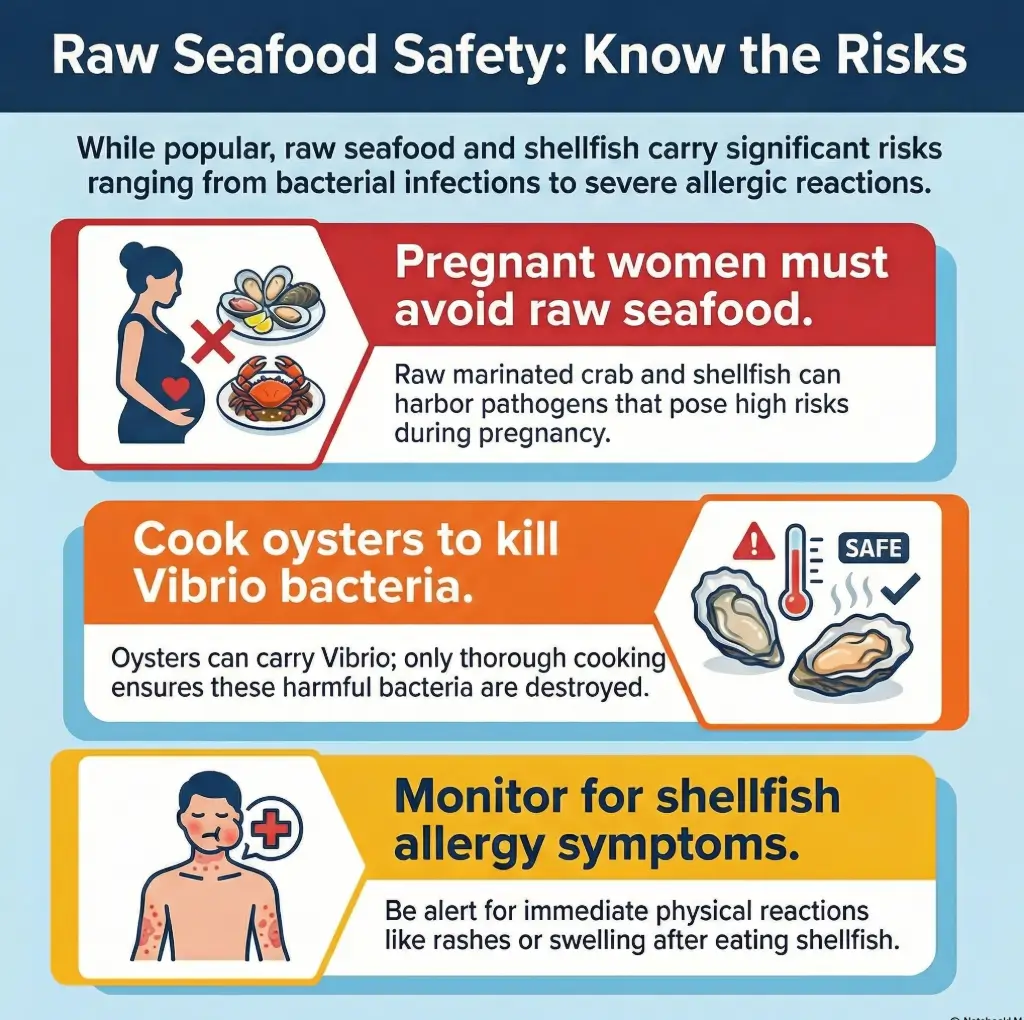
The word people mentally downplay is not crab. It is raw. That matters because raw seafood carries foodborne illness risk, and public health guidance consistently treats raw or undercooked seafood as a category that deserves caution, especially for higher-risk groups. The FDA lists raw fish and raw shellfish among foods that can be riskier for people more vulnerable to foodborne illness, and FDA guidance for pregnant people specifically advises avoiding raw seafood.
Soy sauce crab vs spicy marinated crab: the fork in the road
Soy-marinated crab often gets described as the elegant one. It can taste rounder, more savory, more quietly sweet, almost custardy in places. Spicy-marinated crab tends to hit faster. Chili, garlic, sweetness, salt, and fermented depth crowd the doorway all at once. If soy-marinated crab is silk with a tide underneath it, spicy-marinated crab is velvet carrying a small argument.
Neither is automatically easier. Some people handle chili better than slipperiness. Others manage slipperiness but find the sweetness-salt-spice combination exhausting after a few bites. This is why one table can call the dish transcendent while another looks as if it has just been assigned homework.
The texture surprise that catches first-timers off guard
Many Americans who say, “I didn’t like the flavor,” are actually reporting a texture revolt. The body can feel soft and slick. Roe can be luscious to one person and overwhelming to another. The sauce can make the whole experience feel more intense, not less. I have watched confident eaters demolish sashimi, then freeze at the first mouthful of gejang because what unsettled them was not fishiness but the combination of richness and slipperiness. Different instrument, same ocean.
- You already enjoy oysters, sashimi, or uni
- You do not panic at slippery textures
- You like rice with rich seafood
- You thought marinated meant cooked
- You are hungry enough to over-order
- You want a “safe” first Korean seafood dish
- You are pregnant
- You are immunocompromised
- You have shellfish allergy history or stomach symptoms
Who This Is For, and Who Should Probably Pass
Travel writing sometimes behaves as though openness means eating everything placed before you. That is romance talking, not judgment. A better travel ethic is this: meet the culture honestly, and meet yourself honestly too.
Best fit: adventurous eaters who enjoy oysters, sashimi, or rich seafood textures
If you already like raw oysters, fatty tuna, sea urchin, or soft-shell textures, you have a useful clue. Not a guarantee, but a clue. People who enjoy those foods are often better prepared for gejang’s density and oceanic intensity. They are less likely to be thrown by the way flavor arrives wrapped in texture.
Not a great first step for nervous eaters who struggle with slippery or intensely briny foods
If you already know that oysters make you flinch, or if the phrase “custardy seafood” sounds less like a pleasure and more like a dare, there is no shame in passing. Korea has an orchestra of seafood dishes. You do not need to begin with the most divisive violin solo.
When caution matters more than curiosity
Some situations are not about adventurousness at all. They are about risk management. Pregnant travelers should avoid raw seafood under FDA guidance, and people with weakened immune systems or certain underlying conditions can face more severe consequences from infections linked to raw or undercooked seafood. CDC guidance on Vibrio notes elevated risk for people with liver disease, cancer, diabetes, HIV, thalassemia, or immune-suppressing therapy.
- Yes / No: I comfortably eat raw seafood already
- Yes / No: I am not pregnant
- Yes / No: I do not have shellfish allergy history
- Yes / No: I am not currently sick, dehydrated, or recovering from stomach issues
- Yes / No: I can order a small portion first
Neutral next step: if you answered “no” to two or more, choose a cooked seafood dish first and revisit later.
First Risk, Then Flavor: Why This Dish Deserves More Respect Than Hype
Raw marinated crab has been flattened online into a mood board. A close-up shell. glossy sauce. rice tucked inside the carapace. captions full of destiny. But food with raw-seafood exposure should never be discussed as though aesthetics canceled biology.
Raw shellfish is not just a “local delicacy” story
Public health agencies do not talk about raw seafood risk because they dislike pleasure. They talk about it because pathogens exist, refrigeration matters, contamination exists, and vulnerability varies. The CDC notes that many Vibrio infections come from eating raw or undercooked shellfish, especially oysters, and the broader lesson is simple: raw seafood is a category where food handling and personal risk profile matter.
Freshness, refrigeration, and restaurant standards matter more than bravado
This is where the adult version of travel begins. Not with chest-thumping, but with choosing carefully. A busy specialist restaurant with strong turnover, consistent refrigeration practices, and a reputation built on this dish is not the same gamble as a random place adding gejang because it looks good on a menu. Popularity is not a perfect proxy for safety, but specialization and turnover are practical clues.
A small memory: years ago, I watched two travelers choose the shinier restaurant because it had better lighting and better selfies. The quieter specialist next door had a shorter menu and older regulars. One meal later, the lesson was obvious. In food, glamour often arrives before judgment. Expertise usually arrives in plain clothes.
Here’s what no one tells you: “popular” and “safe for you” are not identical
A place can be beloved and still not be the right choice for your body on that day. Jet lag, dehydration, a fragile stomach, lingering antibiotics, or just a low tolerance for rich raw foods can change the equation. Travelers often forget that the body keeps its own travel diary. It remembers lost sleep, airport food, long walks, and nerves.
Show me the nerdy details
“Marinated” changes flavor and sometimes texture, but it is not the same mechanism as thorough cooking. Food safety depends on the source product, temperature control, cross-contamination prevention, storage, and the diner’s vulnerability profile. That is why official guidance talks about risk groups, not just recipes.

Don’t Start Here Blind: The Biggest First-Timer Mistake
The single biggest mistake is not disliking the dish. The single biggest mistake is ordering it with the wrong internal script.
Ordering because it looks famous on social media
Fame is not fit. Social media compresses food into three things: color, reaction, and identity. It rarely translates lingering richness, scent, softness, or the emotional experience of realizing that your mouth wanted one thing and the plate delivered another. A ten-second clip can make gejang look like a universal revelation. It is not. It is a high-variance dish.
Confusing “marinated” with “cooked”
This mistake changes everything. If you arrive expecting something ceviche-adjacent or half-set by acid or heat, the first bite can feel like betrayal. The right expectation is not “safer cooked seafood in a pretty sauce.” The right expectation is “raw crab shaped by seasoning.” That mental correction solves more disappointment than any menu translation ever will.
Assuming the sweetness of the sauce means a gentler experience
Soy marinade can be sweet. Spicy marinade can be sweet. But sweetness does not soften the essential encounter. Often it amplifies it. The result can feel richer, more concentrated, more memorable, and for some people more exhausting by bite three than by bite one. The first bite can be thrilling. The fourth can feel like velvet trying to argue with your stomach.
- Do not treat fame as a recommendation
- Do not confuse marination with cooking
- Do not assume sweet sauce means mild experience
Apply in 60 seconds: Before ordering, say to yourself: “This is raw crab, and texture will matter.” That reset helps more than you think.
Texture Shock Is Real: What Many Americans Mean When They Say “I Didn’t Like It”
Americans often frame food rejection as flavor rejection because flavor sounds more defensible. It sounds informed. Texture, by contrast, feels childish to confess. But texture is not childish. Texture is architecture. It is the room flavor walks through.
The crab is soft, slick, rich, and intensely marine
This is not the neat sweetness of picked lump crab in a chilled salad. It is not the clean bite of grilled shrimp. It is softer and looser, with sauce, body richness, and marine salinity arriving together. If that sounds magnificent, you may love it. If it sounds like a poem written by sea foam at 2 a.m., you may want a backup plan.
Why the mouthfeel, not the flavor, ends the experiment for many diners
Some people enjoy the taste right away but cannot continue because the mouthfeel feels too yielding. Others dislike the way the richness lingers more than the way the sauce tastes. I once saw someone say, “The flavor is good, but my brain keeps filing a complaint.” That is texture speaking through bureaucracy.
Let’s be honest: some people dislike it instantly, and that is not a failure
Travel has enough false heroism in it already. You do not need to “grow” by overriding disgust. You can be culturally respectful, curious, and well-informed, and still decide that this particular dish is not your road. Leaving a food unfinished is not a moral problem. Forcing yourself through mounting discomfort is usually the bigger mistake.
| If you feel… | Then do… |
| Curious but surprised | Take 1 more small bite with rice |
| Full, overwhelmed, or texture-averse | Stop without guilt and pivot to cooked food |
| Nauseous, itchy, or unwell | Stop immediately and monitor symptoms |
Neutral next step: let one bite inform the second. Do not let pride order the third.
Restaurant Choice Changes Everything: Where Foreigners Go Wrong
There are dishes you can safely choose at random because the downside is mediocrity. Raw marinated crab is not one of them. Here the downside is not just “not amazing.” It can be “bad fit, bad experience, or risk taken for no good reason.”
Why raw marinated crab is not the dish to choose at random
If a restaurant is known for grilled pork, ramen-style fusion, and giant drinks, gejang may be an accessory, not a craft. That does not mean it is bad. It means you are increasing uncertainty where uncertainty is unnecessary. With raw items, uncertainty is expensive.
Signs you want a place known specifically for ganjang gejang or yangnyeom gejang
Look for specialization, steady turnover, menu focus, and the quiet confidence of repetition. Menus that clearly distinguish soy-marinated and spicy-marinated crab are a good sign. So are restaurants where rice pairings and side dishes feel structured, not like afterthoughts. Staff who answer basic questions without improvising theater are another good sign. Expertise does not usually arrive in jazz hands.
Why turnover and specialization matter more than pretty interiors
For raw-food dining, the practical questions are often dull. That is precisely why they matter. How busy is the place at the relevant meal time? Is this a signature item? Does the restaurant seem practiced? Dull questions save glamorous regrets.
Best operator move: ask one grounded question before you order, such as which marinated crab version first-timers usually prefer, or whether a small portion is possible. The response often tells you more than the décor ever will.
Don’t Ignore Your Body: Who Should Be Extra Careful
This is the unglamorous section, and therefore one of the most useful. Bodies do not care what was trending on reels this week.
Pregnant travelers and people with weakened immune systems
Pregnant travelers should skip raw seafood. That is the clearest line in this whole conversation. FDA guidance for pregnant people advises avoiding raw or undercooked seafood, and FDA consumer guidance also identifies certain groups as being at greater risk from foodborne illness.
Diners with shellfish allergy history or strong food-safety anxiety
If you have a shellfish allergy history, this is not the moment for optimism. NHS guidance on food allergy notes symptoms can include hives, swelling, breathing difficulty, vomiting, abdominal pain, and diarrhea. Shellfish reactions can be serious, and cooking does not make shellfish allergy magically disappear as a concern.
Anyone already dealing with stomach symptoms, jet lag, or dehydration
This part is not a grand medical pronouncement. It is practical travel wisdom. If you are already running on four hours of sleep, airport coffee, and a stomach that has been negotiating with you since breakfast, today is probably not the day to test your relationship with raw crab. Travel lowers judgment before it lowers ambition. That is how regrets dress themselves.
- Pregnancy is a clear skip
- Shellfish allergy history is a hard caution
- Travel-fatigued stomachs deserve restraint
Apply in 60 seconds: Ask yourself whether you would choose raw seafood at home on a low-sleep day. If not, do not outsource that wisdom to vacation mood.
At the Table, Then What? How to Eat It Without Looking Lost
Even people who decide to try gejang often stumble at the table because the dish is not served like a tidy individual portion. It is interactive. Part anatomy lesson, part rice vehicle, part glorious mess.
How Koreans usually approach the shell, roe, and body
There is variation, but many diners gently work from the legs and body, extracting what they can, then use rice with the shell where the sauce and roe collect. This is one of those dishes where elegance is less about looking polished and more about looking unpanicked. You are allowed to be slightly clumsy. Most adults are, at least for the first few minutes, even if they are already comfortable using Korean metal chopsticks.
Why rice is not a side note here, but part of the structure
Rice is not backup. Rice is engineering. It absorbs salinity, steadies richness, and turns highly concentrated bites into something balanced. The first-timer who skips rice because they want the “pure” experience usually ends up discovering a less noble truth: purity is overrated when the sauce is this intense.
Here’s what no one tells you: the “best bite” is often made, not served
The famous move is mixing rice into the shell with the leftover sauce and roe. This is often the bite people remember. It is lush, savory, and dramatically more coherent than eating everything separately. When foreigners enjoy gejang, it is often because they stop thinking of it as a sequence of isolated bites and start treating it as a composed dish.
A small scene I still remember: a first-time diner spent ten minutes politely pecking at the crab and looked unconvinced. Then an older regular showed them the rice-in-shell move. Their face changed from concern to revelation so quickly it should have had background music.
- Rice for each person
- A cooked backup dish if your group is mixed
- A sense of whether soy or spicy suits you better
- Enough time to eat slowly, not in a rush
Neutral next step: set up the table so your first bite is measured, not chaotic.
Spice, Salt, and Richness: What the Menu May Not Translate Well
Menu translations often behave like tired diplomats. They do their best, but the real negotiation still happens at the table.
Soy-marinated does not always mean mild
Foreign diners often read soy as soft and spicy as aggressive. In reality, soy-marinated crab can feel deeply intense because of salt, sweetness, umami, and raw richness. It may be less fiery, but it is not necessarily lighter.
Spicy-marinated does not only mean heat, but also sweetness and punch
The spicy version is often not just hot. It can be sweet-hot, garlicky, sticky, and vivid in a way that makes it easier for some first-timers and harder for others. Some prefer it because the seasoning gives the mouth something familiar to hold onto. Others find it too loud on top of an already dramatic texture.
Why richness fatigue can hit before fullness does
This is one of the strangest things about gejang. You may not feel physically full, but you may suddenly feel finished. Richness fatigue arrives before stomach fullness. That is why small portions, rice, side dishes, and pacing matter. Gejang is a sprint if you treat it carelessly and a long, fascinating walk if you do not.
Show me the nerdy details
Flavor fatigue often comes from concentration rather than quantity. Salinity, sweetness, spice, umami, and soft texture can create sensory saturation quickly. Rice and banchan work as contrast tools, not merely fillers. If you need a quick primer on how those little plates function, Korean banchan refill rules explain why side dishes are part of the meal’s rhythm, not decoration.
Common Mistakes Foreigners Make With Raw Marinated Crab
Most travel-food disappointments are not mysteries. They are patterns wearing sunglasses.
Choosing it as a first-ever raw seafood experience
If you have never eaten oysters, sashimi, or any raw seafood comfortably, gejang is a steep first staircase. Not impossible, just steep. There are gentler introductions to Korean seafood culture.
Ordering too much before testing a few bites
Large platters look festive. They also become expensive monuments to optimism if you realize five minutes in that the dish is not for you. First-timers should favor smaller exposure over dramatic abundance.
Skipping rice, side dishes, and pace
This is like showing up to chamber music and demanding only percussion. The structure matters. Rice cools, steadies, and contextualizes the dish. Banchan resets the palate. Pace helps your judgment catch up with your enthusiasm.
Treating discomfort as something to “push through”
There is adventurous eating, and then there is self-bullying in better lighting. If you feel overwhelmed, stop. If you feel unwell, stop faster.
Mistaking cultural openness for a requirement to eat everything
You do not honor a culture by ignoring your own body. Respect includes informed choice, restraint, and honest response. Koreans themselves vary in what they love, avoid, crave, or skip. No real food culture is made of robots. The same principle shows up in broader Korean politeness: consideration matters more than theatrical overperformance.
- Test a few bites first
- Use rice and side dishes strategically
- Do not confuse politeness with obligation
Apply in 60 seconds: Tell your table you want to start small. That one sentence saves money, appetite, and awkwardness.
So… Is It Worth Trying? The Better Question to Ask Yourself
“Worth it” is a suspicious phrase. It often hides a more useful question behind it.
Try it if you are curious about texture as much as flavor
If you love foods that blur the line between taste and mouthfeel, gejang can be extraordinary. It is one of those dishes where appreciation often begins in curiosity, not confidence. The right diner does not merely tolerate the softness. They find meaning in it.
Skip it if you want a safe, easy, crowd-pleasing Korean seafood entry point
If your real goal is simply to enjoy Korean seafood with minimal risk and minimal emotional negotiation, there are better starting places. Grilled fish, grilled shellfish, cooked crab dishes, seafood pancakes, and spicy seafood stews can all deliver pleasure without the same leap.
The real decision is not bravery, but fit
That is the loop this whole article has been closing. The dish is not a referendum on your courage. It is a fit question involving body, palate, timing, restaurant choice, and travel state. Once you see that clearly, the pressure dissolves. What remains is a cleaner decision.
Short Story: The table where the mood changed
One rainy evening in Seoul, a group of travelers ordered raw marinated crab because the restaurant name kept showing up online. Half the table was delighted immediately. One person loved the soy version and looked ready to write sonnets to the shell. Another took one bite, smiled bravely, and then stared at the rice as if it were a diplomatic exit. A third kept saying the flavor was “interesting,” which in food language is often the verbal equivalent of backing slowly toward the door.
Then something sensible happened. No one turned it into a loyalty test. They ordered grilled fish, more rice, and soup. The gejang lovers kept eating happily. The skeptics stopped pretending. The meal improved at once. That is the grown-up version of adventurous dining. Not everyone must love the same thing. The win is choosing well, adapting early, and leaving the table more informed than when you sat down.
Safer Alternatives First: What to Order If You Want the Spirit Without the Leap
Not every good travel decision is a leap. Some are a staircase. Korea gives you excellent stairs.
Grilled fish or shellfish for cautious seafood eaters
Grilled mackerel, grilled clams, and similar cooked seafood dishes still give you salinity, smoke, and Korean table energy without the raw-seafood gamble. They are easier on anxious diners and often easier to share.
Cooked crab dishes for travelers who want flavor without raw risk
If what interests you is crab itself, start with cooked crab preparations before attempting raw marinated versions. That lets you separate “I like crab” from “I like raw marinated crab,” which are not the same sentence.
Other Korean seafood experiences that feel adventurous without the same exposure
Seafood stews, haemul pajeon, grilled eel, and well-cooked shellfish can all feel vivid and local without asking your stomach to negotiate quite so much. Sometimes the best route into a cuisine is not the flashiest door. It is the right side entrance. If you want another low-pressure gateway into everyday eating culture, a good Korean convenience store guide can be surprisingly helpful on travel days when your stomach wants caution, not theater.
| Tier | What changes |
| Tier 1 | Grilled fish, seafood pancake, cooked shellfish |
| Tier 2 | Spicy cooked seafood stews, grilled eel |
| Tier 3 | Oysters, sashimi, raw seafood you already know you like |
| Tier 4 | Raw marinated crab in a specialist restaurant |
Neutral next step: choose the tier that matches your actual palate, not your aspirational one.
When to Seek Help
Most disappointing meals end as a story. A small number do not. This is the serious lane.
Severe allergy symptoms after eating shellfish
If you develop swelling of the lips or face, trouble breathing, wheezing, faintness, widespread hives, or other severe allergy symptoms after eating shellfish, seek urgent medical care. NHS guidance describes these as concerning allergy features and food-allergy symptoms can escalate quickly.
Vomiting, diarrhea, fever, or worsening abdominal pain after raw seafood
If symptoms after raw seafood are significant, worsening, or accompanied by fever or dehydration, do not dismiss them as ordinary travel inconvenience. Raw seafood-related illness is not something to romanticize into a story about being “too sensitive.”
Why travelers should not self-dismiss symptoms that escalate quickly
Travel has a bad habit of making people minimize things. They do not want to lose a day. They do not want to seem dramatic. They do not want the trip to become “about” their body. Ignore that instinct. Your itinerary can survive a pause. Your pride is cheaper than your health. If you do need care, knowing why Korean clinics are so fast may make the system feel less intimidating in the moment.

Next Step: How to Try Raw Marinated Crab Without Turning It Into a Travel Regret
If you have read this far and still want to try it, good. Not because the article has pushed you toward a yes, but because your yes is now cleaner.
Choose one reputable specialist restaurant. Go when you are reasonably rested and not already stomach-fragile. Order a modest portion. Pair it with rice from the start. If you are deciding between soy and spicy, pick the one that matches how you usually navigate rich foods: soy if you prefer depth and savor; spicy if you need stronger seasoning to frame unfamiliar textures. Bring one cooked backup dish if your group is mixed. If you are dining alone, it helps to understand the practical rhythm of solo dining in Korea before you go.
The point is not to make the meal timid. The point is to make it intelligent. There is a difference. Smart caution is not fear. It is what lets curiosity arrive with its shoes tied.
- Specialist restaurant
- Small portion first
- Rice and a backup plan
Apply in 60 seconds: Write down your plan before you go: soy or spicy, small order, rice, backup cooked dish. Decision fatigue has no place at a raw-crab table.
FAQ
Is raw marinated crab actually raw?
Yes. That is the safest assumption to make. Marination changes flavor and can affect texture, but it is not the same thing as thoroughly cooking the crab.
What does raw marinated crab taste like?
It tastes savory, sweet-salty, oceanic, and rich. Depending on the version, it may also be garlicky, spicy, and slightly fermented in character. Many people remember the texture as vividly as the flavor.
Is soy sauce crab safer than spicy marinated crab?
Not in any simple, reliable way that a diner should depend on. The more practical variables are freshness, sourcing, handling, refrigeration, and your own health situation.
Can foreigners who dislike oysters still enjoy it?
Some can, but many do not. If you already dislike slippery raw textures, gejang may be a difficult match. If your issue with oysters is only brininess, not texture, your odds may be a little better.
Is it rude to leave it unfinished?
No. It is far less awkward to stop politely than to force yourself into visible distress. Order thoughtfully, start small, and be honest.
What should I eat with it?
Rice is the big one. Side dishes help reset the palate. A cooked backup dish is wise if your table includes cautious eaters. In many Korean meals, side dishes are part of the dining logic, much the way soup can function as more than a side in why soup is a full meal in Korea.
Is it okay to try only one piece first?
Absolutely. In fact, for first-timers, that is often the best move. One measured bite with rice tells you much more than a dramatic order ever will.
What if I feel sick afterward?
Stop eating. Monitor your symptoms carefully. If you have signs of an allergic reaction, dehydration, fever, or escalating abdominal symptoms, seek medical help rather than minimizing it.
The hook, in the end, was never really about crab. It was about discernment. Raw marinated crab in Korea can be unforgettable, but unforgettable is not automatically good. The best meal happens when curiosity and self-knowledge sit down at the same table.
Within the next 15 minutes, make a simple decision list: whether you are a texture-curious diner, whether your body is in a good place for raw seafood, and whether you are willing to choose a specialist restaurant and order small first. That tiny checklist will do more for your trip than any dramatic appetite ever could. If you are building a broader food-and-etiquette map for the trip, Korean culture can help place meals like this in a wider everyday context.
Last reviewed: 2026-03.