
Navigating Korea’s National Health Insurance
The first time Korea’s National Health Insurance appears in your life, it may not arrive with drama. It may arrive as a quiet envelope in your mailbox, a clinic receptionist asking for your alien registration card, or a pharmacy bag with your name printed neatly on the label. That is the odd beauty of National Health Insurance in Korea for foreign residents: it feels less like a distant policy and more like a keycard you use when real life gets sniffly, sprained, confusing, or expensive.
For Americans, expats, teachers, students, spouses, and remote workers, the hard part is not only medical care. It is knowing when you are enrolled, why a bill arrived, what is covered, whether your family can be added, and when private insurance still matters. Guessing can cost money, delay care, and turn a small administrative snowball into a chilly little avalanche.
- ✓ Less panic at the clinic desk.
- ✓ Fewer surprises in the mailbox.
- ✓ Better questions before the bill.
Korea’s National Health Insurance is the public health insurance system that helps eligible residents, including many foreign residents, access covered medical care through clinics, hospitals, and pharmacies. Foreign residents may receive the same insurance benefits as Korean citizens once eligible, but enrollment timing, premiums, dependents, and uncovered services depend on their status.
The Daily-Life Version: What This Guide Helps You Do
Think of NHIS as the practical layer between you and routine care in Korea. It does not remove every cost, language barrier, or form. It does make ordinary care feel more reachable when you understand the rhythm.
- Check whether your enrollment situation makes sense.
- Prepare for clinic, pharmacy, and billing moments.
- Ask better questions about covered and non-covered costs.
- Know when to contact NHIS, your employer, or your school.
Table of Contents
Safety and Disclaimer
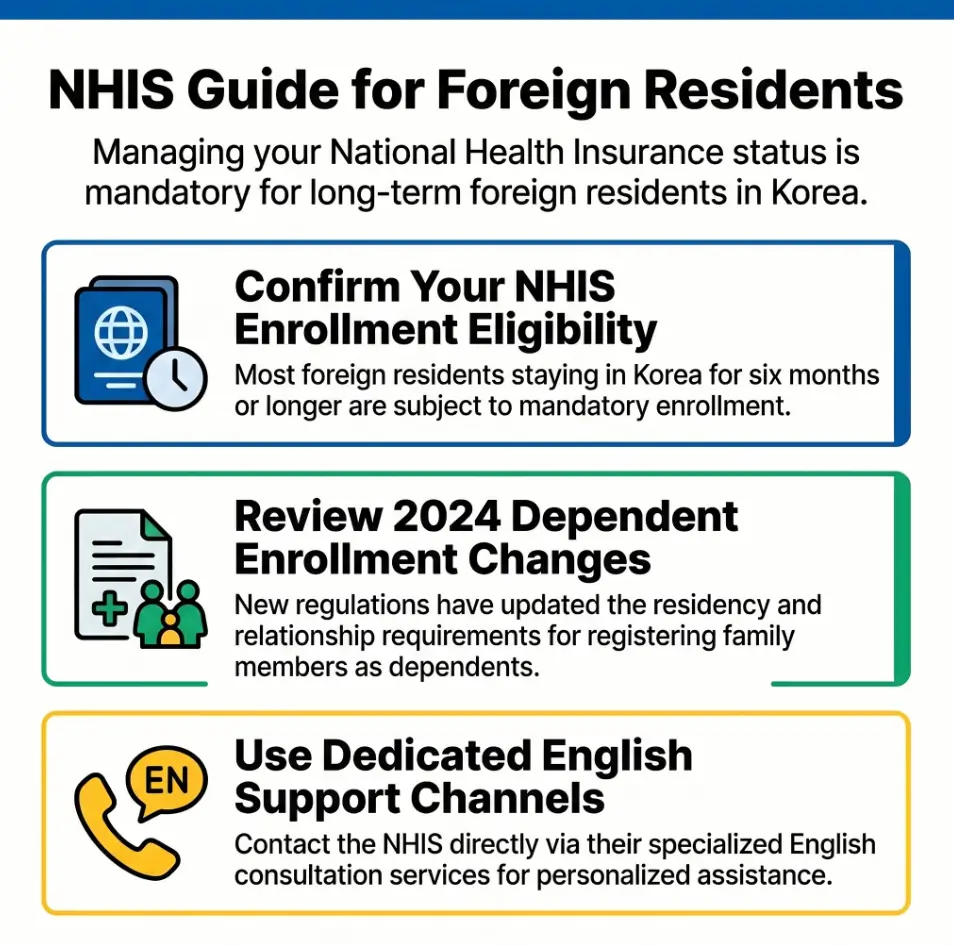
This guide is for general education, not legal, immigration, tax, insurance, or medical advice. Korea’s National Health Insurance rules can change, and your situation may depend on visa type, employer reporting, dependent status, income, address registration, and length of stay.
Foreign employees at covered workplaces are generally enrolled through employment. Many non-employed foreign residents become local subscribers after meeting residency requirements. Dependents can be more complicated, especially after the 2024 rule changes for foreign and overseas national dependents.
Before you make a financial or medical decision, confirm your own case with NHIS, your employer, your school’s international office, immigration, or a qualified adviser. If symptoms feel urgent, do not let insurance uncertainty become the locked door between you and care.
- Visa type can affect timing.
- Work status can affect how you are enrolled.
- Family coverage needs its own confirmation.
Apply in 60 seconds: Write down your visa type, work status, and arrival date before calling NHIS.
Daily-Life Reality: It Feels Less Like “Insurance” and More Like a Keycard
The first clinic visit teaches you the system faster than any brochure
For many foreign residents, NHIS becomes real at the clinic desk. You walk in with a sore throat, a rash, a twisted ankle, or the mysterious stomach rebellion that arrives after street food confidence gets too ambitious. The receptionist asks for your alien registration card. A few keyboard taps later, your insurance status appears.
Then the visit moves quickly. You see the doctor, explain symptoms, receive a prescription, pay a copay, and walk to a nearby pharmacy. The whole loop can feel almost suspiciously efficient if you come from the United States, where a simple appointment can involve portals, networks, pre-authorizations, and a bill that appears weeks later wearing a tiny villain cape.
Why Americans may feel stunned by the speed
Korea’s ordinary clinic culture often favors speed and access. Many neighborhood clinics accept walk-ins or same-day visits. Specialist clinics are common. Pharmacies cluster near medical buildings like small lanterns around a harbor.
That does not mean every visit is perfect. Some appointments are brief. Some explanations feel compressed. English support varies. Still, the day-to-day feeling can be striking: you are more likely to seek help early because the process feels less like a financial riddle.
If you want the deeper cultural context behind the pace, why Korean clinics are so fast helps explain the rhythm that many newcomers notice first.
Here’s what no one tells you
NHIS does not remove friction. It relocates it.
In the US, the friction may be network anxiety, high deductibles, surprise billing, or waiting weeks for routine care. In Korea, the friction may be enrollment timing, Korean-language letters, address updates, dependent paperwork, uncovered services, or not knowing which office to ask.
The emotional math changes. You may worry less about whether you can afford to ask a doctor about a cough. You may worry more about why a premium bill appeared when nobody sat you down with a welcome packet and a cup of tea.
Decision Card: NHIS Mindset vs US Private Insurance Mindset
| Question | US habit | Korea habit |
|---|---|---|
| Can I go? | Check network and deductible. | Check clinic, ID, and coverage status. |
| What will it cost? | Often unclear until later. | Often clearer at payment, but non-covered items still matter. |
| Who explains it? | Insurer, provider, portal, phone tree. | Clinic desk, NHIS, employer, school, or local office. |
Neutral action: Before assuming the system works like home, ask one direct question: “Is this covered by National Health Insurance?”
Who This Is For: Foreign Residents Trying to Live, Work, Study, or Stay Sane in Korea
Good fit: long-term residents who need everyday care
This guide is for foreign residents whose lives in Korea are becoming real enough to include sore throats, dental questions, pregnancy planning, child fevers, prescription refills, health checkups, and the occasional “why is my knee making rice-cracker sounds?” moment.
That includes English teachers, office workers, international students, spouses of Korean citizens, permanent residents, freelancers, remote workers, military-adjacent families, and families staying long enough that travel insurance no longer feels like a full plan.
For routine preventive care, many residents also encounter Korea’s checkup culture. If you are comparing daily clinic use with screening visits, health checkups in Korea can help you understand another side of the medical system.
Not for: tourists, short-term visitors, or emergency-only travel coverage
If you are visiting Korea for two weeks, NHIS is probably not your main tool. You likely need travel medical insurance that covers emergency care, trip disruption, and possibly return to your home country.
This distinction matters. NHIS and travel insurance are not twins. NHIS helps with domestic covered medical care once you are eligible. Travel insurance may help with travel-specific risks that NHIS does not handle, including certain emergency transportation or repatriation needs.
The “I’m only here for a few months” gray zone
The hardest cases are the gray ones. A student staying one semester. A remote worker on a visa pathway. A spouse waiting on status. A teacher whose contract starts before the apartment lease feels stable.
In those cases, do not rely on hallway folklore. Korea has many helpful foreign resident communities, but someone else’s 2021 experience may not fit your 2026 visa, job, or family structure.
Eligibility Checklist: Are You in the NHIS Conversation Yet?
- Do you have an alien registration card or domestic residence report? If yes, you may be visible to the system.
- Are you employed by a covered workplace? If yes, employee enrollment may apply.
- Have you lived in Korea for six months or longer? If yes, local subscriber rules may matter.
- Are you trying to add a spouse, child, or parent? If yes, dependent rules need separate checking.
- Are you only visiting Korea briefly? If yes, travel insurance may be more relevant.
Neutral action: Match your situation to one category first: employee, local subscriber, dependent, student, exempt, or not yet eligible.
Enrollment Timing: The Quiet Rule That Changes Everything
Workers may enter through the employer door
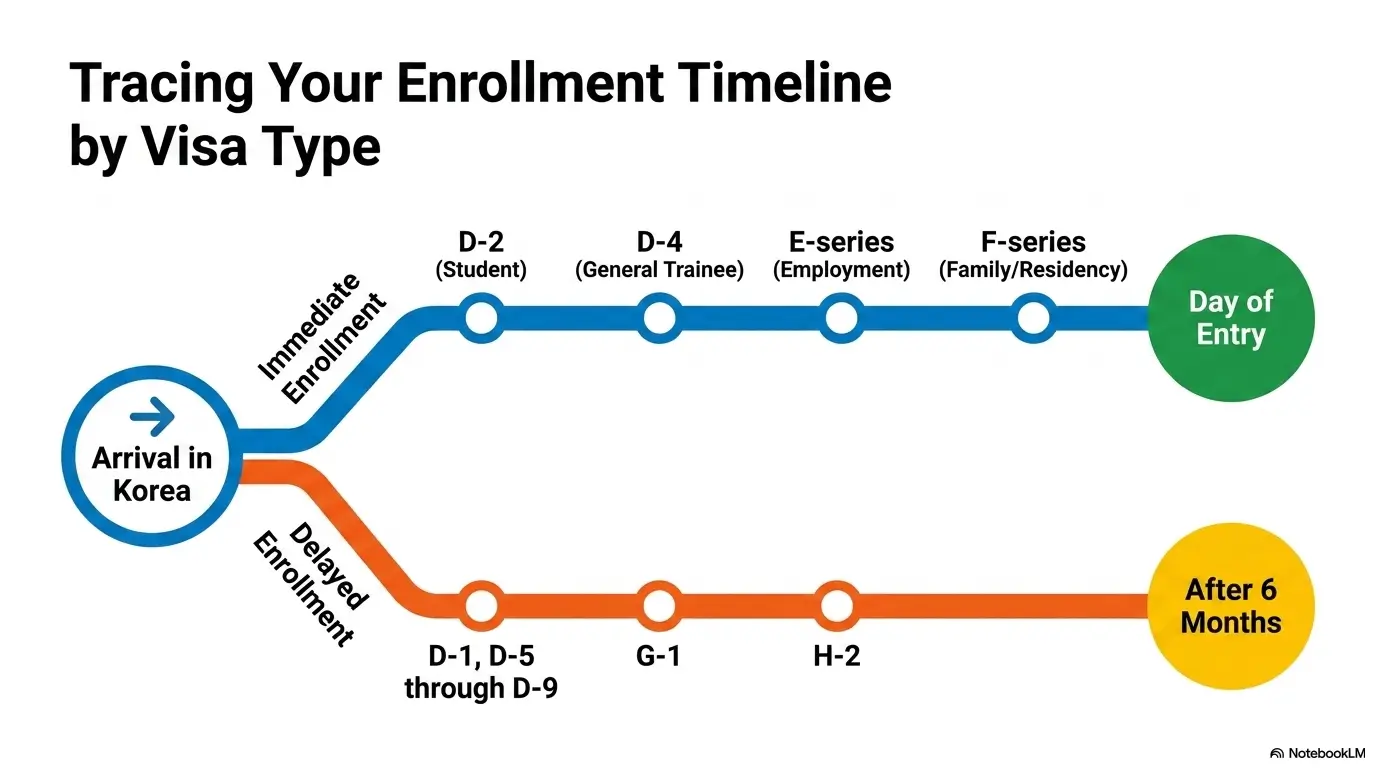
Foreigners and overseas Koreans who reside in Korea and work at an insured workplace are generally enrolled as employee insured persons. In plain English: if you are working for a covered employer, your workplace may be the doorway into NHIS.
This is why two foreigners who arrived in the same week can have different insurance timing. One starts a job that reports them. Another is studying, freelancing, job hunting, or waiting on family paperwork. Same airport. Same convenience store banana milk. Different insurance path.
Non-workers often meet the six-month wall
Many non-employed foreign residents and overseas Koreans are processed as local subscribers after they have resided in Korea for the required period, commonly described as six months. This is the rule that surprises people who did not “apply” but later receive a bill.
Automatic enrollment can feel strange if you expected a dramatic sign-up moment. Korea’s administrative machinery does not always knock politely. Sometimes it simply prints a notice.
Some visa categories do not wait the same way
Visa categories can change the timing. Students, certain workers, permanent residents, marriage migrants, and children in specific schooling situations may have special handling. The practical lesson is simple: do not treat “six months” as the only sentence in the book.
If your visa changes, your job ends, your school status changes, or your family member arrives later, your NHIS situation may need a fresh look.
Show me the nerdy details
NHIS status usually turns on categories rather than vibes. The big buckets are employee insured persons, local subscribers, and dependents. Employee enrollment is typically tied to a covered workplace. Local subscriber enrollment is often tied to registered residence and required time in Korea. Dependent eligibility can involve relationship, residence, income, and visa status. The annoying part is that these categories can change when a person changes jobs, leaves Korea, moves, marries, studies, or updates immigration status. That is why the best practical question is not “Do foreigners get NHIS?” but “Which subscriber category am I in today?”
The Mailbox Moment: Why Your First NHIS Bill Feels So Official
The bill may arrive before you fully understand the system
There is a particular feeling to receiving an official Korean envelope when you are still learning which recycling bag goes where. It sits in your hand with the energy of a tiny courthouse.
Your first NHIS bill may include a contribution amount, payment deadline, subscriber information, and instructions that feel clear to the sender but foggy to the receiver. You may not remember applying. You may wonder whether your employer already paid. You may stare at the document the way people stare at appliance manuals in a rented apartment.
Address accuracy is not a tiny admin detail
In Korea, address registration is not just housekeeping. It affects official communication. If you move and fail to update your address, you may miss bills, notices, or requests for action.
This is especially important for foreign residents who move from a temporary goshiwon, school dorm, Airbnb-style stay, or first apartment into something more stable. The mailbox follows the registered address, not your intentions.
Moving in Korea brings its own tiny orchestra of paperwork, deposits, appliances, and neighborly mysteries. For housing logistics, a Korean apartment move-in checklist can help you avoid other first-month surprises.
Pattern interrupt: the envelope is boring until it becomes expensive
Official letters rarely look exciting. That is their camouflage.
But a missed NHIS notice can lead to unpaid premiums, confusion about your status, or rushed calls when you need care. Treat health insurance mail as priority mail even when it looks routine. A boring envelope is still a little drumbeat from the system.
- Open NHIS mail promptly.
- Update address changes quickly.
- Keep photos or scans of important notices.
Apply in 60 seconds: Create a phone album named “Korea Admin” and save every NHIS notice there.
Clinic Visits: The System Feels Smoothest When the Problem Is Ordinary
Colds, rashes, sprains, stomach trouble, and routine follow-ups
NHIS feels strongest in ordinary medical life. A cold that will not leave. A skin rash that keeps negotiating with your patience. A sprained ankle after subway stairs. A follow-up for blood pressure. A stomach problem after heroic levels of spicy stew.
For these situations, Korea’s local clinic network can be wonderfully practical. You may find internal medicine clinics, ENT clinics, dermatology clinics, orthopedics, pediatrics, and pharmacies close to home or work.
The doctor visit may be shorter than Americans expect
Many foreign residents notice that visits can feel brief. The doctor may move quickly from symptoms to diagnosis to prescription. That speed can be efficient, but it also means you should arrive prepared.
Write your symptoms in plain English and simple Korean if possible. Include when symptoms began, what makes them worse, allergies, medications, pregnancy status if relevant, and any chronic conditions. Do not narrate your entire medical autobiography unless the doctor asks. Bring the headline first, the footnotes later.
Bring the right ID, not your entire life story
For routine visits, carry your alien registration card or other relevant residence ID. If you have private insurance too, keep that information available. Bring medication names, not just descriptions like “small white pill,” because Korea has a stadium full of small white pills.
If you are new to Korean culture around clinics, politeness, and brisk service, broader social habits can also help. Korean politeness explains some of the interaction style that shapes everyday service encounters.
Short Story: The Pharmacy Bag After the Rain
On a rainy Tuesday in Seoul, a new teacher named Anna walked into a neighborhood clinic with a cough, damp socks, and the private fear that the visit would become a financial maze. She had lived in Korea long enough to know where the best kimbap was, but not long enough to trust official systems. At the desk, she handed over her alien registration card. The receptionist tapped, nodded, and pointed her toward the waiting area.
Ten minutes later, the doctor listened, asked a few clipped questions, and sent her downstairs with a prescription. The pharmacy gave her a small white bag with morning-evening instructions. The whole thing cost less than the anxiety she had spent avoiding it. Her lesson was not that every visit would be easy. It was simpler: confirm your status before you need it, then let ordinary care be ordinary.
Pharmacy Life: The Little White Bag Is Part of the System
Prescriptions often feel integrated into the visit
In Korea, the clinic-to-pharmacy handoff can feel smooth. The clinic gives you a prescription, and a nearby pharmacy fills it quickly. Many medical buildings have pharmacies on the first floor or just outside the entrance.
This creates a tidy little ritual: clinic, payment, prescription, pharmacy, small bag, dosage instructions. It can be calming once you know what is happening.
Medication instructions may need a second look
Do not be shy about asking how to take the medicine. Confirm dosage, timing, food instructions, and whether you should avoid alcohol, driving, or mixing with other medication. Translation apps help, but medical nuance can be slippery.
For children, pregnancy, chronic illness, allergies, or multiple prescriptions, ask more than once if needed. It is better to feel mildly repetitive at the counter than deeply confused at midnight.
Don’t assume every familiar US brand exists
Medication names vary. A familiar US brand may not exist in Korea, may have a different dose, or may be sold under another name. Active ingredients matter more than brand memory.
Keep a simple note with the generic names of your regular medications. If you take prescription medication from abroad, ask a doctor or pharmacist how to manage continuity before you run out. Nobody wants to turn medication planning into a scavenger hunt with jet lag.
Quote-Prep List: What to Bring Before You Ask About Medication Costs
- Medication name and generic active ingredient.
- Current dose and frequency.
- Reason you take it.
- Allergies or past side effects.
- Whether you need a short refill or long-term management.
- Your NHIS status and any private insurance card.
Neutral action: Save this list in your phone before your next refill question.
Dependents: The Rulebook Gets Personal Fast
Family coverage can be the most confusing part
Single-person enrollment is one thing. Family coverage is where the paperwork starts wearing tap shoes.
Dependents may involve relationship, age, residence period, income, visa status, documents from abroad, translations, and timing. A spouse, child, parent, or adult child may not all be treated the same way. Even within one family, the answer can differ by arrival date or status.
If you are living in Korea through marriage or family ties, broader administrative life may overlap with visa status. Korea F-6 visa basics may be useful context for marriage-migrant households, though NHIS status still needs separate confirmation.
The six-month dependent rule matters
From April 3, 2024, foreigners and overseas nationals generally need at least six months of residence in Korea to qualify as dependents, with notable exceptions such as spouses, children under 19, and certain visa categories. This change matters because it affects families who expected immediate dependent coverage after arrival.
The practical lesson is not to memorize every exception from a blog. The practical lesson is to ask early, before a family member needs care or before a bill arrives with a number that makes breakfast go quiet.
Don’t move first and ask later
If your spouse, child, parent, or other family member is moving to Korea, confirm dependent eligibility before the move when possible. Ask NHIS what documents are needed. Ask whether documents from abroad need translation, apostille, or other authentication. Ask whether income or residence requirements apply.
Families have enough emotional logistics already. Suitcases, school uniforms, apartment deposits, rice cookers, and everyone quietly pretending they are not stressed. Health coverage should not be left to last-minute guessing.
Eligibility Checklist: Dependent Questions to Confirm
- Is the relationship eligible? Spouse, minor child, parent, and adult child rules may differ.
- Has the person lived in Korea long enough? Six-month residence rules may apply.
- Is there an exception? Spouses and children under 19 may be treated differently.
- Does income affect eligibility? Ask before assuming.
- Are documents from abroad required? Confirm format, translation, and authentication.
Neutral action: Before adding a family member, call NHIS with the relationship, age, visa type, arrival date, and income situation ready.
Common Mistakes: Small Assumptions That Turn Into Big Annoyances
Mistake 1: Thinking NHIS works like a US PPO or HMO
NHIS is not a US PPO with a glossy card, network maze, and deductible spreadsheet. It is a public insurance system with its own categories, copays, and covered services.
Do not ask only, “Is this in network?” Ask, “Is this covered by NHIS?” and “Are there non-covered charges?” That wording gets you closer to the Korean billing reality.
Mistake 2: Ignoring mailed notices because they look routine
Foreign residents often receive multiple official notices in Korea: immigration, local office, banking, pension, tax, housing, insurance. It can all blur together.
NHIS mail deserves attention. Open it. Translate it. Save it. If it looks wrong, ask quickly.
Mistake 3: Assuming private insurance is useless after NHIS
NHIS can be excellent for daily care, but private insurance may still matter. Consider private coverage for international travel, uncovered services, dental, vision, private rooms, higher-cost treatment choices, income protection, or emergency return to your home country.
If you are a frequent traveler, compare the role of NHIS with travel coverage. travel insurance for South Korea explains why travel-specific protection can still matter even when domestic care feels accessible.
Mistake 4: Forgetting that immigration status and insurance status talk to each other
A visa change, job change, address change, departure, re-entry, school status change, or marriage registration can affect your health insurance path. These systems do not live on separate islands. They pass notes.
When something major changes, do a status check. It is not glamorous, but neither is arguing with a bill after the deadline.
Employee, local subscriber, dependent, student, or not eligible yet.
Keep registration current so bills and notices find you.
Ask covered vs non-covered before treatment.
Bring ID, symptoms, medications, and allergies.
Use private insurance where NHIS does not fit.
What NHIS Covers Well: The Everyday-Care Comfort Zone
Doctor visits feel accessible
The strongest daily-life benefit of NHIS is psychological. When care feels reachable, you are more likely to use it early. That matters for routine problems that can become bigger if ignored.
For many foreign residents, a clinic visit becomes less of a financial cliff and more of an errand. Not always pleasant, but manageable. A Tuesday task, not a three-act tragedy.
National coverage gives psychological relief
There is a quiet relief in not having to perform financial calculus before asking about a fever, rash, sinus infection, or minor injury. It changes behavior. You may stop waiting until the problem becomes dramatic enough to deserve attention.
That said, do not mistake “more accessible” for “free.” Patients still pay copays. Some services are not covered. Some choices cost more. The comfort zone is real, but it has edges.
Same coverage does not mean every service is cheap
NHIS says eligible foreigners can receive the same insurance benefits as Korean citizens. That is an important baseline. But every service still has rules, patient cost-sharing, and possible non-covered items.
The best habit is to ask before agreeing to tests, procedures, private rooms, certificates, or optional treatments. A calm question at the desk can prevent a spicy bill later.
- Routine care often feels accessible.
- Copays still apply.
- Non-covered services can change the bill quickly.
Apply in 60 seconds: Practice this phrase: “Is this covered by National Health Insurance?”
What Still Costs Money: The Uncovered-Care Trap
Non-covered services can surprise you
Some costs sit outside the cozy center of NHIS coverage. Examples may include certain dental work, cosmetic procedures, optional treatments, private hospital rooms, some advanced tests, medical certificates, international documents, or services requested for convenience rather than medical necessity.
The exact answer depends on the provider, treatment, and current rules. That is why the question must happen before the service.
Ask “Is this covered?” before the service, not after
Try this script:
“Is this covered by National Health Insurance, or is it non-covered?”
Then ask:
“About how much will I pay today?”
Those two questions are small, but they carry a flashlight. They do not guarantee perfection, but they reduce the odds of walking into cost fog.
Let’s be honest
The front desk may not explain costs in the emotional language you need. Staff may assume you understand the system. They may be busy. They may answer literally, not expansively. This is not always unkindness. Sometimes it is just the rhythm of a crowded clinic.
Your job is to ask plainly. Not aggressively. Not apologetically. Plainly.
Coverage Tier Map: How to Think About Costs
| Tier | Care type | Cost habit |
|---|---|---|
| Tier 1 | Routine covered clinic visit | Expect copay; bring ID. |
| Tier 2 | Prescription medication | Confirm dosage and out-of-pocket cost. |
| Tier 3 | Tests or imaging | Ask covered vs non-covered before agreeing. |
| Tier 4 | Dental, vision, optional care | Compare costs and private coverage. |
| Tier 5 | Travel, repatriation, international paperwork | Consider travel or private insurance. |
Neutral action: For anything beyond a routine visit, ask for the cost category before treatment begins.
Language Barriers: The Real Copay Is Sometimes Confidence
English support varies wildly by neighborhood and hospital
Major hospitals, international clinics, and areas with many foreign residents may offer stronger English support. Small local clinics may not. Some doctors speak English well but staff do not. Sometimes the reverse happens, because life enjoys odd choreography.
Do not assume English support will be available. Also do not assume no one can help. Prepare for both.
Translation apps help, but medical nuance is slippery
Translation apps are useful for basic symptoms, timing, dosage instructions, and directions. They are less reliable for nuance, uncertainty, and complex medical history.
Write short sentences. “Pain started Monday.” “No fever.” “Allergic to penicillin.” “Pregnant.” “Taking blood pressure medicine.” Simple beats poetic when your sinuses are staging a protest.
Build a “medical Korean” note on your phone
Create a note with your allergies, medications, chronic conditions, emergency contact, blood type if known, pregnancy status if relevant, preferred pharmacy, and Korean address. Add your name in English and Korean if you have a Korean spelling.
For daily life, language and communication habits are part of the survival kit. If messaging with Korean coworkers, clinics, landlords, or local helpers makes you nervous, Korean texting formality can help you avoid sounding too abrupt or too ceremonial in ordinary messages.
- Use simple sentences.
- List allergies and medications clearly.
- Bring a Korean-speaking helper for complex visits when possible.
Apply in 60 seconds: Add “allergies, medications, conditions, emergency contact” to one phone note today.
When to Seek Help: Don’t Let Insurance Confusion Delay Care
Seek urgent medical care for emergency symptoms
If symptoms are severe, sudden, or dangerous, do not troubleshoot insurance first. Chest pain, stroke symptoms, severe allergic reactions, breathing trouble, major injury, severe bleeding, sudden vision loss, or signs of serious infection need urgent medical attention.
Insurance questions can follow. Breathing comes first. Paperwork is a poor emergency doctor.
Contact NHIS when eligibility, bills, or dependents look wrong
Call or visit NHIS when your premium looks wrong, your category seems incorrect, your dependent registration is unclear, your address changed, or you received a bill you do not understand.
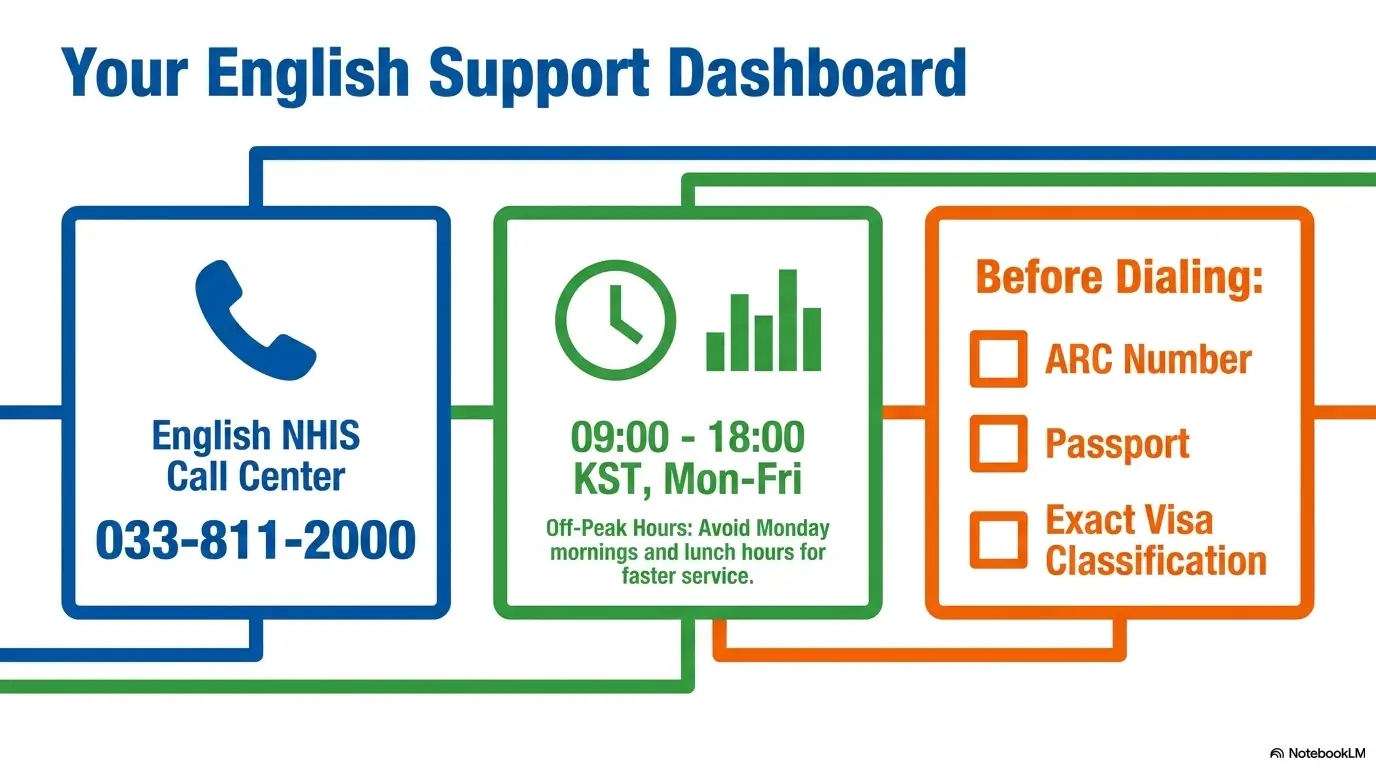
Gather documents before you call: alien registration card, visa type, employer or school details, arrival date, address, family relationship documents, and the bill or notice in question.
Ask your employer or school before deadlines pass
For workers, HR may understand how employee enrollment was reported. For students, the international office may know common timing issues. For spouses, local offices or immigration advisers may help identify which documents connect family status and insurance status.
Korean workplace communication can be indirect, so be clear and polite. If you work in Korea, Korean business communication may help you phrase administrative questions without sounding either too blunt or too foggy.
Mini Calculator: What Should You Check First?
Neutral action: Use the result as a conversation starter, not a legal conclusion.
FAQ
Do foreign residents in Korea have to join National Health Insurance?
Many long-term foreign residents do, depending on work status, visa type, and length of stay. Employees at covered workplaces are generally enrolled through employment, while many non-employed residents are enrolled after meeting residency requirements. Short-term visitors usually need travel insurance instead.
Is Korean National Health Insurance enough without private insurance?
Sometimes it is enough for ordinary daily care, but not always. Private insurance may still help with international travel, dental, vision, private rooms, uncovered treatments, special benefits, income protection, or emergency return to your home country.
Why did I get an NHIS bill even though I did not apply?
Some foreign residents are enrolled automatically once they meet the conditions, especially local subscribers after the required residence period. If the bill surprises you, contact NHIS and confirm your subscriber category, premium basis, address, and payment status.
Can my spouse or child be added as a dependent?
Possibly, but dependent rules depend on relationship, age, residence, visa type, income, and current NHIS rules. Spouses and children under 19 may have important exceptions under the 2024 dependent rule changes, so verify the specific case before assuming coverage.
Can I use NHIS at any clinic in Korea?
Many ordinary clinics and hospitals participate in the national system, but costs depend on the provider, service, and whether the care is covered. For routine visits, bring your alien registration card and ask whether any test, treatment, or document is non-covered.
What should I do if my premium looks wrong?
Contact NHIS, check your registered address and subscriber category, and gather documents related to income, employment, visa status, family status, and prior coverage. If you are employed, ask HR whether workplace reporting is correct.
Does NHIS cover dental care in Korea?
Some dental services may have coverage, while many treatments can be partly or fully non-covered. Dental costs vary widely by procedure. Ask the clinic for covered and non-covered portions before treatment begins.
Do students in Korea get NHIS?
International students may be subject to NHIS rules, but timing and premiums can depend on student status, visa category, and current policy. Your school’s international office is often the fastest first stop, followed by NHIS confirmation.
Next Step: Do This One Check Before Your Next Clinic Visit
Confirm your exact NHIS status in one sitting
The whole system becomes less intimidating when you know your category. Are you an employee subscriber? A local subscriber? A dependent? Exempt? Pending enrollment? Not yet eligible?
That one answer changes the rest of the conversation.
Save three things on your phone
Save NHIS contact information, your alien registration details, and a short medical Korean note. Add photos of recent bills or notices. Keep medication names in generic form. Add your employer or school contact if they handle reporting.
If your life in Korea includes commuting to clinics, offices, schools, or public agencies, daily systems matter too. For practical city mishaps, Korea subway lost and found is a useful companion for the kind of ordinary problem that always seems to happen on a rainy day.
The 15-minute action
Within the next 15 minutes, check your NHIS category, premium status, registered address, and dependent eligibility if family is involved. Use the website, call center, local office, employer, or school. You do not need to become a policy scholar. You only need enough clarity to walk into your next clinic visit without carrying a fog machine in your chest.
The story from the beginning was never just about an envelope or a clinic desk. It was about the quiet relief of knowing what the system will do before you need it. In daily life, National Health Insurance in Korea is not magic. It is a practical key. Make sure yours fits the lock.
Last reviewed: 2026-05.