
Navigating Korean Bureaucracy: Start Here
The first time a foreign resident meets Korean bureaucracy, it often feels oddly ordinary: fluorescent lights, a numbered ticket, a counter window, and one small missing document that suddenly becomes the boss of the day. Local District Offices in Korea are where much of that daily life gets sorted, especially after you move into an apartment, change your address, need local paperwork, or realize trash disposal has more rules than your old phone contract.
The problem is not that Korea has no system. The problem is that the system has layers: gu office, city hall, gun office, dong community service center, immigration office, HiKorea, and sometimes a landlord who says, “It should be fine,” which is not a legal category. Guessing can cost you time, fines, missed deadlines, or an afternoon spent orbiting three counters like a confused satellite. This guide helps you understand where to go, what to ask, what to bring, and when to call 1345 or use HiKorea instead.
Fast Answer: What Local District Offices Actually Do
Local district offices in Korea, often called gu office, city hall, gun office, or dong community service centers, handle many everyday tasks foreign residents need: address-change reporting, local certificates, housing-related civil services, trash disposal guidance, community programs, welfare referrals, and neighborhood notices. Visa approval, visa extensions, and status disputes usually belong to immigration offices or HiKorea, not the neighborhood counter.
Table of Contents
Safety and Immigration Disclaimer
This guide is general information for foreign residents, students, workers, teachers, military families, digital nomads, and family members navigating daily life in Korea. It is not legal, immigration, tax, housing, labor, or benefits advice.
Korean local-government procedures can vary by district, visa type, nationality, document status, and counter interpretation. Address reporting, residence-card details, lease proof, and immigration deadlines can affect your legal stay. For urgent or high-stakes questions, verify directly with your local office, HiKorea, the 1345 Immigration Contact Center, or a qualified specialist.
Tiny paperwork errors can grow little bureaucratic teeth. Better to tame them while they are still baby dragons.
- Use local offices for neighborhood-level civil services.
- Use immigration offices or HiKorea for visa and status matters.
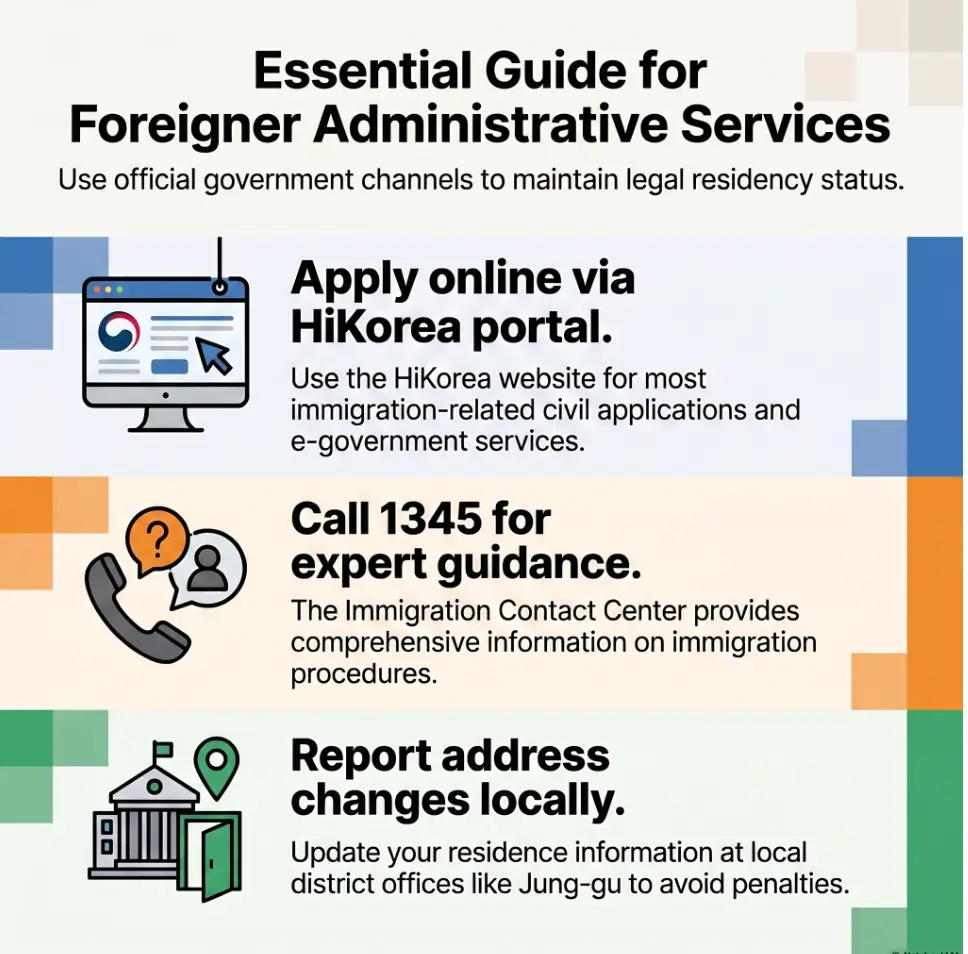
- Use 1345 when you are unsure which institution owns the task.
Apply in 60 seconds: Save 1345 in your phone as “Korea Immigration Help.”
The Office Maze: Gu, Si, Gun, Dong, and Why Foreigners Get Sent in Circles
Korea’s local-government map is efficient once you understand it. Before that, it can feel like a nesting doll made of counters.
The first rule is simple: the office you need depends on where you live and what task you need. A foreign resident in Seoul may deal with a gu office and a dong community service center. Someone in a smaller city may deal with city hall or an eup, myeon, or dong office. Someone in a rural county may see gun-level administration.
The four names that confuse almost everyone
Si usually means city. Gun means county. Gu means district, often inside a larger city. Dong means neighborhood. In everyday expat speech, people often say “district office” for gu office and “community center” for dong office.
That shorthand is useful, but not perfect. A task that one neighborhood office can handle may be sent to a district-level office in another place. A website may use English terms loosely. A landlord may use old wording. Your friend may have done the same task in Busan, but you live in Mapo, Suwon, Daegu, or Jeju. The counter has its own geography.
What a dong community service center usually handles
A dong community service center is often the most practical first stop for neighborhood-level tasks. Foreigners commonly visit for address-related reporting, local forms, civil-service guidance, trash disposal information, community program notices, and referrals to other offices.
It is also where the human texture of local Korea appears: elderly residents asking about benefits, parents handling school paperwork, office workers grabbing certificates during lunch, and one confused newcomer trying to pronounce “jeonip singo” while clutching a lease like a passport to civilization.
What a gu office or city hall may handle instead
A gu office, city hall, or county office may handle broader services: district-level civil affairs, housing-related departments, welfare divisions, tax counters, vehicle matters, environmental rules, and official guidance for services that the smaller neighborhood office cannot complete.
When the task touches a larger policy or district-wide system, the gu or city office may become the right door. When the task is tied to your exact neighborhood address, the dong office may be better.
The key question to ask first: “Is this my jurisdiction?”
The most valuable sentence at the counter is not fancy Korean. It is jurisdictional humility.
Ask: “Is this office responsible for my address?”
In Korean, you can say: “여기가 제 주소 관할 주민센터인가요?” It means, “Is this the community center with jurisdiction over my address?”
This one question can save you from a slow-motion paperwork ballet. It also signals that you understand the system has boundaries. Clerks appreciate that. Nobody wants to print a form only to discover the address belongs to the office three subway stops away.
Try your dong community service center first.
Ask the gu office, city hall, or county office.
Use HiKorea, immigration office, or 1345.
Call 1345 before you lose an afternoon.
Who This Is For, and Who Should Use Immigration First
This guide is for people whose Korean life has moved beyond airport arrival and into the practical middle: leases, utility notices, address updates, waste bags, phone calls, appointment slips, and the strange relief of receiving the correct printed certificate.
It is especially useful for English teachers, exchange students, long-term residents, foreign spouses, U.S. military families living off base, remote workers with legal residence status, and family members trying to help someone settle in.
Good fit: foreign residents handling local-life paperwork
If you already have a Korean address, residence card, lease, employer paperwork, school documents, or local notices, a district or community office may enter your life quickly.
You may need help understanding trash disposal rules, reporting a move, finding your district’s bulky-waste sticker system, asking about local programs, or confirming which counter handles a document.
If you are still learning everyday systems, pair this guide with practical neighborhood resources such as a Korean apartment move-in checklist. A move in Korea is not just boxes and tape. It is address proof, building rules, utility habits, recycling stations, and the tiny diplomacy of elevator etiquette.
Good fit: newcomers setting up housing, address, trash, and certificates
Newcomers often think the hardest part is finding housing. Then they meet the follow-up choir: address reporting, landlord contacts, recycling schedules, food-waste bins, internet setup, and mail that arrives with no translation and great confidence.
The local office cannot solve everything. But it can often point you toward the right local department or process.
Not for: visa approval, visa extension, or status disputes
Visa approval, extension, employment permission, status changes, re-entry rules, and complex registration-card issues usually belong to immigration, not your neighborhood office.
Even when a local office accepts address-change reports, that does not mean it can fix visa problems. Think of the local office as the neighborhood stage crew. Immigration is a different theater, with sharper lighting.
Not for: complex legal, labor, tax, or family-registration cases
Some issues look local but are legally heavier than they seem: unpaid wages, divorce, custody, tax residency, nationality, family registry, deposit disputes, employer-sponsored visa conflicts, or housing fraud.
For those, use the local office as a referral point, not as your final authority. You may need immigration guidance, labor counseling, a lawyer, a tax specialist, or a tenant-support service.
Money Block: Local Office or Immigration First?
| Your task | Try first | Why |
|---|---|---|
| Address change after moving | Dong office, gu office, HiKorea, or immigration depending on status and timing | Some local offices accept reports, but deadlines and rules matter. |
| Visa extension | HiKorea or immigration office | This is an immigration-status matter. |
| Trash bags or bulky-waste sticker rules | Local district or dong office | Waste rules are local. |
| Housing deposit legal dispute | Tenant support, legal aid, specialist advice | The local office may guide, but may not resolve the legal issue. |
Neutral action line: Before you travel, write your task in one sentence and call 1345 or the local office to confirm the right counter.
Address Changes: The Small Deadline That Can Become a Big Problem
Address reporting is one of those tasks that looks small until it becomes urgent. Your address is not just where your shoes live. It is tied to immigration records, local jurisdiction, notices, housing proof, and sometimes later applications.
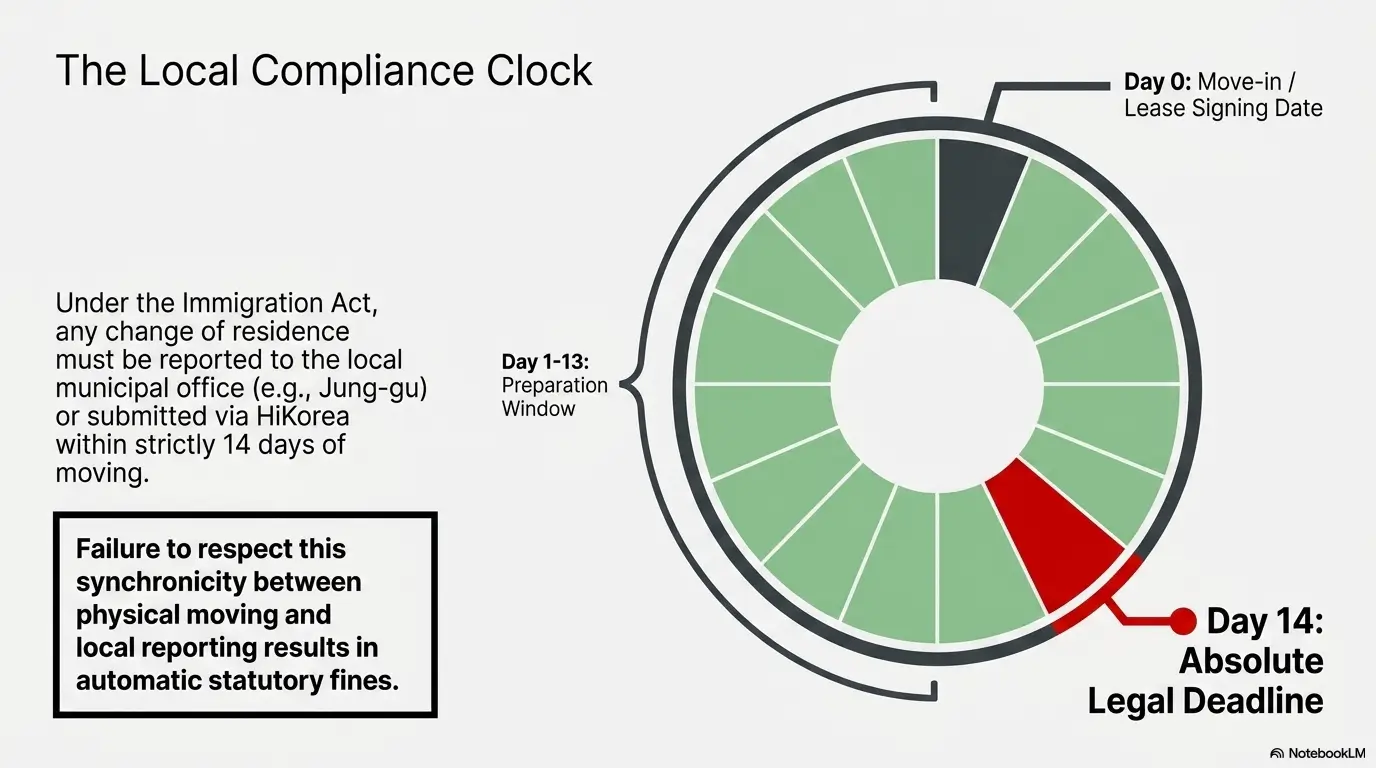
Foreign residents who move in Korea generally need to report a change of residence within a short legal window. Several local-government pages describe reporting through city, county, district, eup, myeon, dong, or immigration offices, with timing often described as within 14 or 15 days depending on status and category. Some offices specify 14 days, while others note 15 days for registered foreigners and 14 days for certain overseas Korean resident-card holders. This is exactly why verification matters.
Why your address is more than a mailing detail
Your registered address can affect where official notices go, which office has jurisdiction, how your residence card information appears, and whether later paperwork matches. If your lease says one address, your residence card says another, and your phone bill says a third, you have created a paperwork triangle. Triangles are elegant in geometry. Less elegant at a counter.
The 14-day rule foreigners should not ignore
Many foreign residents are told to report a residence change within 14 days of moving. Some local offices and institutions describe a 15-day period for certain categories. Rather than betting on memory, treat the shorter deadline as your safety rail and confirm your exact case through 1345, HiKorea, or the office with jurisdiction over your new address.
For practical purposes, your goal is simple: report quickly, keep proof, and do not wait until visa renewal season to repair old address information.
What to bring before you queue
A safe starter folder includes your residence card, passport, lease or housing proof, your Korean address written clearly, landlord or housing contact information, your phone, and copies of anything tied to the move.
If you live in an officetel, goshiwon, dormitory, company housing, shared apartment, or sublet-style arrangement, ask in advance what proof the office accepts. These housing types can be perfectly normal, but the paperwork can have extra corners.
Don’t do this: waiting until renewal season to fix your address
Some residents discover address problems only when they need something else: visa renewal, school enrollment, banking, health insurance, or employer paperwork. That is like finding out your umbrella has a hole during the typhoon.
Handle address changes early. Keep a photo of the completed form or receipt if available. Ask whether the residence card itself needs an update or whether the report is reflected in the system. Then write down the date, office name, and staff guidance in your own notes.
- Report soon after moving.
- Confirm whether your case uses 14 or 15 days.
- Keep proof of the report and the office visited.
Apply in 60 seconds: Put your move-in date and reporting deadline on your calendar now.
Show me the nerdy details
Address-change rules for foreign residents are often described across multiple public-facing pages, and English wording may differ by local government. Some pages use “within 14 days,” some use “within 15 days,” and some separate registered foreigners from overseas Korean resident-card holders. The practical method is to identify your legal status, your new-address jurisdiction, and your reporting route before the deadline. When stakes are high, rely on current official confirmation rather than a saved screenshot from an old blog or university page.
Daily Documents: Certificates, Stamps, Copies, and the Paper Trail Nobody Warns You About
Korea runs many ordinary tasks through formal documents. That does not mean every errand is terrifying. It means the right paper often matters more than a persuasive explanation.
A local office may issue or guide you toward civil documents, local confirmations, address-related records, welfare forms, family-support documents, or department referrals. Some documents may be available through kiosks, online systems, or a larger office. Others may not apply to foreigners the same way they apply to Korean citizens.
What local offices can issue or guide you toward
Depending on your status and the service, local offices may help with address records, move-in-related reporting, local tax or fee guidance, waste disposal stickers, welfare referrals, and community program registration.
If a clerk says a document is not available to you, ask for the Korean name of the document and the reason. It may be because you need immigration, because foreigners use a different form, because the office lacks jurisdiction, or because the requested Korean-citizen document does not exist for your status.
Why your Korean name spelling matters
Foreign names can be written in English, Korean transliteration, passport order, residence-card format, or banking format. Small differences can cause friction. Middle names are especially good at becoming tiny gremlins.
Before leaving the counter, check your name, date of birth, nationality, address, and document date. If a form shows your name in Korean, make sure the spelling matches the version used by your school, employer, bank, or immigration record when that matters.
The “one extra copy” rule for calmer visits
Bring one extra copy of everything you think you need. Bring a printed lease even if you also have a phone screenshot. Bring your passport even if the online guide only mentions your residence card. Bring the notice you received, not just your memory of it.
This is not paranoia. It is paperwork weatherproofing.
Here’s what no one tells you: the clerk may be right and the website may still be vague
English pages can lag behind Korean pages. Local rules can change. A district’s trash system, appointment process, or acceptable proof may not match the page you found through search.
That does not mean the system is broken. It means you need a flexible counter strategy: ask politely, get the Korean service name, confirm the next step, and record what you were told.
Money Block: The Calm Folder Checklist
- Yes/No: Do you have your residence card?
- Yes/No: Do you have your passport?
- Yes/No: Do you have your lease, dorm proof, or housing confirmation?
- Yes/No: Is your Korean address written in full?
- Yes/No: Do you have one printed copy of key documents?
- Yes/No: Do you have the Korean name of the service you need?
- Yes/No: Is your phone charged with translation ready?
One-line next step: If any answer is “No,” fix it before you take a number at the office.
Housing Paperwork: When Your Lease, Address, and Office Counter Collide
Housing in Korea can be wonderfully efficient and quietly complicated at the same time. A shiny officetel lobby may have clear elevators, spotless mailboxes, and a recycling room that feels designed by a puzzle enthusiast.
Your lease can affect address reporting, deposit protection, local jurisdiction, and whether your documents look complete to a clerk. If you are new to Korean housing, it helps to understand the administrative side before the move-in dust settles.
Lease documents foreigners should keep ready
Keep your lease contract, landlord or agent contact details, building name, room number, full Korean address, move-in date, deposit and rent details, and any official housing confirmation from a school, employer, dormitory, or goshiwon.
If your deposit is substantial, take housing paperwork seriously. Korea’s jeonse and large-deposit systems can involve protections and deadlines that deserve more than a casual handshake. For deeper housing-risk awareness, read about jeonse deposit protection before assuming a lease is just a lease.
Why officetels, goshiwons, and shared housing can complicate proof
Some housing types do not fit the neat mental model of “tenant signs standard apartment lease.” A goshiwon may provide a residence confirmation instead of a typical lease. A company apartment may be under the employer’s name. A shared apartment may have one main tenant and several residents. A dorm may use school-issued proof.
These arrangements are common, but they can affect what document the office accepts. Ask early. The phrase you need is: “What document proves my residence for this address?”
How to ask about confirmation documents without sounding lost
Try this simple English-to-Korean strategy:
- English: “I need to report my address. What housing document do you accept?”
- Korean: “주소 변경 신고를 하려고 합니다. 거주 증명 서류는 어떤 것이 필요한가요?”
- Follow-up: “Can you write the document name in Korean?”
You do not need perfect grammar. You need the exact document name. Precision beats poetic fluency at the counter. Although, if you can make a clerk smile, the day gets softer around the edges.
Don’t do this: assuming your landlord handled everything
Your landlord may register something. Your real-estate agent may prepare something. Your employer may submit something. But your immigration-related address responsibility may still be yours.
When in doubt, verify. This is especially true if you are changing neighborhoods, moving from a dorm to private housing, switching from employer housing to your own lease, or updating an old address before a residence-card appointment.
Short Story: The Lease in the Blue Folder
Mara arrived at her dong office with a phone screenshot of her lease, a half-charged battery, and heroic optimism. The clerk asked for the original contract or printed proof. Mara opened her gallery, zoomed in, and watched the clerk’s expression become politely geological. She left, printed the lease at a stationery shop, returned with a blue folder, and finished the report in ten minutes.
The lesson was not that the office was impossible. The lesson was that Korea’s civil-service counters often move quickly when the paper trail is clean. After that, Mara kept a “Korea folder” near her front door: residence card copy, passport copy, lease, building address, landlord number, and one blank pen. It looked boring. It was freedom disguised as stationery.
The practical lesson is plain: prepare a folder once, and future visits become less like fog and more like a hallway with lights.
Trash Rules: The Most Local Bureaucracy in Korea Is Often a Garbage Bag
Some foreigners expect the first serious Korean bureaucracy lesson to involve immigration. Then the building manager points at a food-waste bin and says something fast. Suddenly, the real test is whether banana peels, plastic lids, delivery containers, and a broken chair belong in four different systems.
Trash rules in Korea are local, detailed, and socially visible. You may never meet your district mayor, but your neighbors will know if you put food waste in the wrong bag. The bins are silent. The CCTV is not.
Why disposal rules change by district
Waste disposal is usually managed at the local-government level. That means bag colors, disposal days, bulky-waste stickers, food-waste systems, and recycling instructions can differ by city, district, building, and housing type.
Do not rely only on a friend’s rules from another neighborhood. Ask your building manager, check your district website, or visit the local office. If you live in an apartment complex, the building may have its own schedule and signage.
Food waste, recycling, bulky waste, and sticker systems
The major categories are usually general waste, food waste, recycling, and large items such as furniture or appliances. Food waste may require special bags, cards, bins, or weight-based systems. Bulky waste may require paid stickers or online registration through your district.
If you are new, learn trash rules before your first delivery-food weekend. A pile of containers can reproduce overnight like plastic rabbits.
For a more detailed household setup, compare this guide with recycling in Korea for foreigners. Recycling is not only a lifestyle habit in Korea. It is a neighborhood rhythm.
The fastest way to avoid fines and neighborly frostbite
Take a photo of the building’s trash sign. Translate it. Ask a neighbor, manager, or local office if you are unsure. Buy the correct official bags from a nearby convenience store or mart. Learn the disposal days.
If you have a bulky item, do not leave it downstairs and hope it becomes art. Register it properly or buy the required sticker.
Let’s be honest… trash rules are culture shock with handles
Trash rules are strangely intimate. They teach you the city’s metabolism: what it eats, what it rejects, what it sorts, and what it asks you to carry downstairs at 9 p.m.
Once learned, though, the system becomes less intimidating. You stop guessing. You start sorting. You become the person who knows which bag takes what. A small civic crown, but a crown nonetheless.
- Rules can differ by district and building.
- Food waste and bulky waste often have separate systems.
- Official bags or stickers matter.
Apply in 60 seconds: Photograph your building’s trash notice and save it in a “Korea home” album.
Foreigner Support: Translation, Hotlines, Multicultural Centers, and the Human Shortcut
The most underrated tool in Korean bureaucracy is not an app. It is calling before you go.
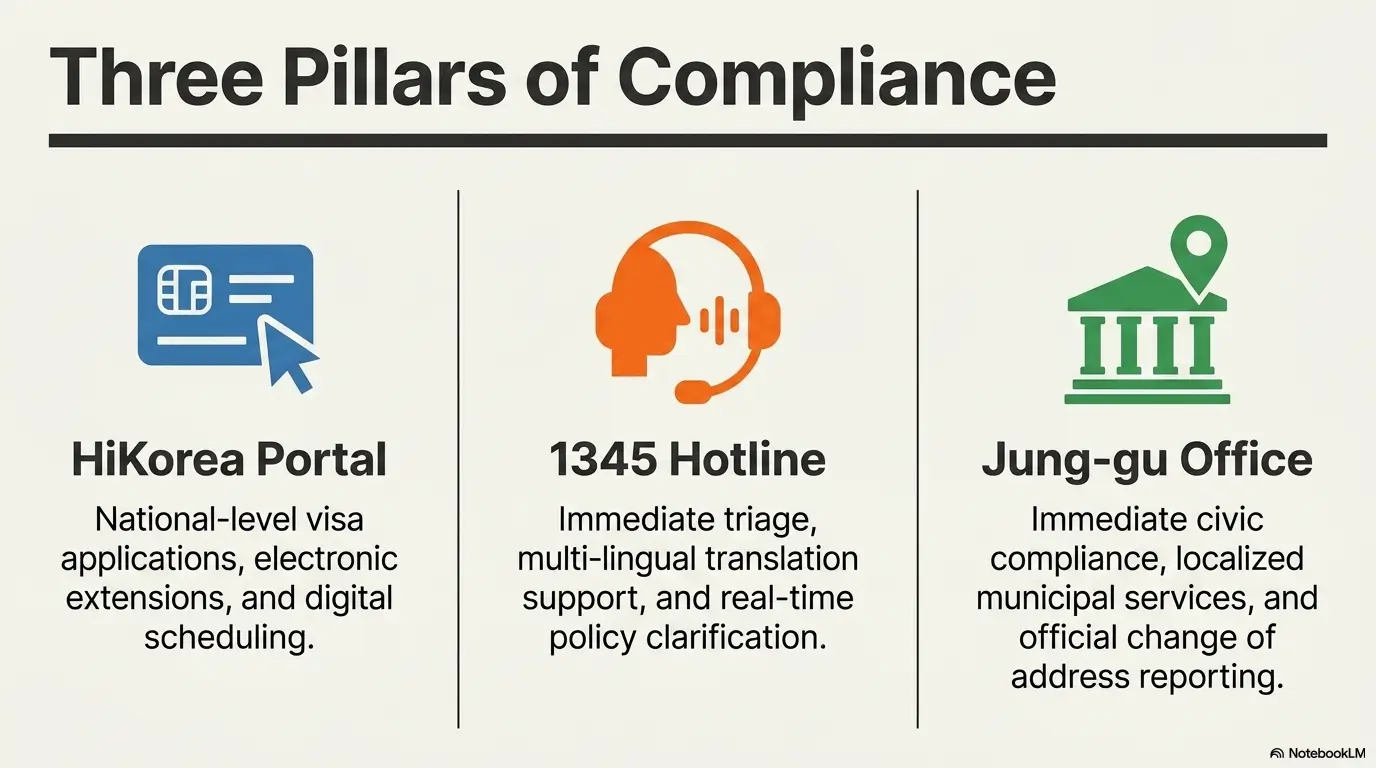
The 1345 Immigration Contact Center provides multilingual counseling on immigration civil affairs and living-in-Korea information for foreign residents. It can help you understand whether a task belongs to immigration, HiKorea, a local office, or another agency. Some local governments also describe interpretation support for dealing with public agencies.
When to call 1345 before visiting an office
Call 1345 when your question touches residence status, address reporting, deadlines, immigration-office jurisdiction, online applications, or uncertainty about whether a local office can accept your paperwork.
Do not call with a long emotional novel first. Start with the facts: visa type, city or district, task, deadline, and what document you have.
When a multicultural family center may be more useful than the counter
If your situation involves marriage, children, family support, parenting programs, Korean classes, local settlement help, or translation support, a multicultural family support center may be more useful than a civil-service counter.
These centers often know the practical friction points: which office to visit, what wording to use, how family documents are usually handled, and where residents get stuck. They may not replace legal advice, but they can be a humane bridge.
How to ask for interpretation politely
You can say: “통역 도움을 받을 수 있을까요?” This means, “Could I receive interpretation help?”
Or say in English, slowly: “May I call 1345 for interpretation?” Many clerks have seen this before. A three-way call may help, especially for exact document names and deadlines.
The quiet power of going at 9:10 a.m.
Timing matters. Offices can be calmer soon after opening, before lunch, or outside obvious rush periods. Avoid arriving just before closing unless the task is urgent. Bureaucracy has a stomach; lunch hours matter.
Bring patience, but do not bring helplessness. Have your sentence ready, your documents visible, and your next question prepared. Quiet confidence goes far in public offices.
Benefits and Local Programs: What Foreigners Might Miss Because Nobody Advertises It Well
Local offices are not only for forms. They can also point residents toward language classes, community events, parenting support, health notices, disaster alerts, volunteer programs, welfare referrals, and neighborhood services.
The catch is visibility. Programs may be posted in Korean, announced through district websites, shared on bulletin boards, or promoted through centers that foreigners do not know exist. The useful information is sometimes there, wearing a very plain coat.
Language classes, community events, parenting support, and local notices
Ask whether your district has Korean classes, foreign-resident programs, multicultural-family services, public-health guidance, or local community events. Families with children may also need to understand school-related local systems, childcare pickup culture, and neighborhood expectations.
If you are raising children in Korea, topics such as Korean childcare pickup routines and hagwons for foreign families can help you see how local life, education, and family schedules overlap.
What may depend on visa status, family status, or residency period
Some programs are open to all residents. Others depend on visa status, income, household registration, family relationship, length of stay, insurance status, or local residency.
Ask eligibility questions without embarrassment. Nobody is born knowing the invisible hinges of a benefits system. Even locals ask.
How to search your district website without drowning in menus
Use the Korean name of your district plus terms like 외국인, 다문화, 주민센터, 쓰레기, 대형폐기물, 주소 변경, or 생활정보. Browser translation helps, but Korean search terms often find better pages.
If the English page is thin, check the Korean page and translate it. English local-government pages can be helpful, but they are often summaries, not the full operating manual.
The open loop: your district may offer more than immigration ever tells you
Immigration focuses on legal stay. Local governments focus on residents. That difference matters.
Your district may have programs for health checkups, parenting, language learning, neighborhood events, safety alerts, disaster preparation, or community culture. For healthcare-adjacent local life, the guide to health checkups in Korea can help foreign residents understand why public systems often feel fast but document-heavy.
Money Block: Local Program Eligibility Checklist
- Yes/No: Do you live in the district offering the program?
- Yes/No: Does your visa or residence status qualify?
- Yes/No: Is the program for individuals, families, parents, seniors, workers, or students?
- Yes/No: Do you need Korean health insurance or income documents?
- Yes/No: Is there an application deadline?
- Yes/No: Can a foreign resident apply directly, or must a Korean family member apply?
One-line next step: Ask the office for the Korean program name and eligibility requirement before filling out forms.
Common Mistakes: The Bureaucracy Traps That Waste a Whole Afternoon
Most local-office mistakes are not dramatic. They are small, plausible, and inconvenient. One wrong office. One missing original. One translated screenshot that does not count. One assumption that your friend’s district rule applies to yours.
The good news: these mistakes are preventable.
Mistake 1: going to the wrong jurisdiction
This is the classic. You go to a convenient office near work, but your registered address belongs somewhere else. The clerk cannot process the task because the system is address-based.
Before going, search the office assigned to your exact address. If unsure, call.
Mistake 2: bringing screenshots instead of originals or printed copies
Phone screenshots are useful for communication, but they may not satisfy document requirements. Bring originals and copies when possible.
Yes, it feels old-fashioned. So does a rubber stamp. Both still get things done.
Mistake 3: trusting one blog post over the current local office rule
Blogs help you prepare, but they cannot override current local procedure. Rules, forms, and office interpretations can change.
Use articles as maps, not passports.
Mistake 4: mixing up immigration office tasks and local office tasks
A local office may process or receive some residence-related reports, but it is not a full immigration office. If the task affects visa status, employment authorization, stay period, or residence-card renewal, confirm through immigration channels.
Mistake 5: forgetting that lunch hours and queue systems matter
Many public offices use ticket systems. Some counters slow around lunch. Some tasks stop earlier than general office hours. If your errand is important, go earlier than you think you need to.
A good rule: do not begin urgent bureaucracy after 4 p.m. unless you enjoy suspense.
- Confirm the right office before leaving home.
- Bring originals, copies, and housing proof.
- Arrive early enough to solve surprises.
Apply in 60 seconds: Write your task as one sentence and translate it into Korean before your visit.
The Visit Script: What to Say, Bring, and Check Before You Leave
A good local-office visit has three parts: the opening sentence, the document folder, and the exit check. Think of it as a tiny ceremony. Less incense, more photocopies.
The three-sentence Korean phrase strategy
You do not need fluent Korean to begin well. You need a clear, respectful opening.
- Sentence 1: “안녕하세요. 주소 변경 신고를 하려고 합니다.” This means, “Hello. I would like to report a change of address.”
- Sentence 2: “제가 필요한 서류를 확인해 주실 수 있을까요?” This means, “Could you check the documents I need?”
- Sentence 3: “이 업무가 여기 관할인가요?” This means, “Is this office responsible for this task?”
Change the task name as needed. For trash: 쓰레기 배출 방법. For bulky waste: 대형폐기물 신고. For certificates: 증명서 발급.
If you work in a Korean office or need to understand workplace communication around paperwork, Korean business communication habits can help you recognize why indirect answers sometimes mean “ask a more specific question.”
Documents to pack in a simple folder
Pack your residence card, passport, lease or housing proof, printed address, phone number, landlord or manager contact, school or employer document if relevant, and copies of any notice or prior application.
If you are dealing with a family matter, bring family relationship documents if you have been told they are needed. If you are handling a child’s school or local program, bring the child’s ID-related documents and parent proof where applicable.
Photos, copies, phone battery, and translation app setup
Charge your phone. Download offline Korean translation if needed. Take photos of your documents for backup, but do not depend only on photos. Bring a pen. Bring your glasses if you use them. Bureaucracy loves small print.
If you need to call someone during the visit, have their number ready: landlord, employer, school office, spouse, real-estate agent, or 1345.
Before you walk out: verify the spelling, date, and next step
Before leaving, check any printed document for name spelling, address, date, nationality, and document type. Ask whether anything else is required. Ask whether the report is complete or pending. Ask where to go next if the office cannot process it.
The final question is: “Is there anything else I need to do?”
In Korean: “추가로 해야 할 일이 있나요?”
Money Block: The 15-Minute Visit Prep Mini Calculator
Use this tiny checklist score before leaving home. No data is stored.
Neutral action line: If your score is under 3, delay the visit long enough to fix the missing item.
When to Seek Help: Don’t White-Knuckle Serious Paperwork
There is a brave kind of independence, and then there is trying to solve visa-adjacent paperwork alone while a deadline breathes on your neck. Choose the first one. Avoid the second.
Get help early when the consequences are legal, financial, employment-related, or status-related.
Get help if your visa status, address deadline, or employer paperwork is involved
If the task affects your visa, employer sponsorship, residence-card validity, status of stay, or legal address, call 1345 or contact immigration. If your employer is involved, get clear written instructions rather than relying only on hallway conversation.
English teachers and sponsored workers should be especially careful. A simple move can become tangled with employer records, school documents, or renewal timing.
Get help if the office gives conflicting answers
Conflicting answers happen. One office may say local reporting is fine. Another may say immigration must handle it. One clerk may request a document that a website did not mention.
When that happens, ask for the exact Korean service name, the reason, and the office that has authority. Then call 1345 if immigration is even faintly involved.
Get help if you need legal, labor, tax, or family-law interpretation
Do not rely on casual translation for contracts, wage disputes, divorce, custody, taxes, large deposits, or family-registration issues. These topics can carry consequences that outlive the appointment.
If housing money is involved, review tenant protections and keep evidence organized. Guides like jeonse insurance can help you understand why deposits in Korea deserve careful paperwork, not wishful thinking.
Best escalation path: local office, 1345, HiKorea, then specialist help
A practical escalation path looks like this:
- Ask your local office whether it has jurisdiction.
- Call 1345 if the matter touches immigration or residence status.
- Use HiKorea for online civil applications, reservations, and immigration information.
- Seek specialist help for legal, tax, labor, family, or major housing-money issues.
- Use local offices for local tasks.
- Use 1345 and HiKorea for immigration-sensitive questions.
- Use specialists for legal, tax, labor, and high-value housing disputes.
Apply in 60 seconds: Write down your visa type, residence-card expiry date, and current registered address.
FAQ
Can foreigners use local district offices in Korea?
Yes. Many foreign residents can use local district offices, city halls, gu offices, and dong community service centers for daily-life administrative tasks. Common examples include address-related reporting, local certificates, trash disposal guidance, community programs, and referrals. The exact service depends on your location, status, and the office’s jurisdiction.
Is a 주민센터 the same as an immigration office?
No. A 주민센터, or dong community service center, handles neighborhood-level civil services. Immigration offices handle visa, status, registration, extension, and many residence-card matters. Some address-related tasks may overlap, but the institutions are not the same.
Can I report my new address at a local office in Korea?
Often, yes, depending on your status, location, timing, and the office that has jurisdiction over your new address. Some local offices accept foreigner residence-change reports. Because timing rules can differ by category, verify your exact case through 1345, HiKorea, or the local office before relying on a general rule.
What should I bring to a Korean district office?
A safe starter set includes your residence card, passport, lease or housing proof, full Korean address, phone, relevant notices, printed copies, and the Korean name of the service you need. For address changes, bring your move-in proof and ask whether your residence card information needs to be updated.
Do Korean local offices speak English?
Some staff may speak English, especially in areas with many foreign residents, but it is not guaranteed. Translation apps, simple Korean phrases, written task names, and the 1345 hotline can help. Going early and asking specific questions also improves your odds of a smoother visit.
Can tourists use district offices in Korea?
Tourists usually have limited need for district offices. Long-term residents, students, workers, foreign spouses, military families living off base, and people with Korean housing or residence-card responsibilities are more likely to need local offices.
What is the difference between a gu office and a dong office?
A dong office is a neighborhood-level community service center. A gu office is a larger district-level office. Some tasks are handled at the neighborhood level, while others require the district office or city hall. Always confirm jurisdiction using your exact address.
What if the local office says they cannot help me?
Ask which office handles the task, request the Korean name of the service, and ask whether the issue belongs to immigration, district government, city hall, or another department. If residence status is involved, call 1345. The most useful question is not “Can you help me?” but “Which office owns this exact problem?”
How long does a district office visit usually take?
Simple tasks may take minutes once your number is called, but waiting time, missing documents, lunch hours, and jurisdiction problems can stretch the visit. For important tasks, allow extra time and avoid arriving close to closing.
Can I use screenshots instead of printed documents?
Screenshots help explain your situation, but they may not be accepted as official proof. Bring printed copies and originals whenever possible, especially for leases, residence cards, passports, notices, and forms.
Next Step: Build Your One-Page Korea Office Cheat Sheet
The counter maze becomes less intimidating when you carry your own small map. Not a grand system. Just one page with the facts you keep needing.
That is the curiosity loop from the beginning: the office was never just a room with fluorescent lights. It was a test of whether your information, jurisdiction, documents, and timing lined up. Once they do, Korean bureaucracy can move surprisingly fast.
Write your address in Korean and English
Include postal code, province or city, district, neighborhood, building name, unit number, and landlord or manager contact. Keep it in your phone and in your folder.
Save your dong office, gu office, immigration office, and 1345
Save phone numbers, addresses, office hours, and map links. If you use public transit often, it can also help to understand everyday recovery systems such as Korea subway lost and found, because one lost folder on Line 2 can turn a simple errand into a detective drama.
List your visa type, residence-card expiry date, and landlord contact
Write your visa type, residence-card expiry date, passport number location, landlord phone number, employer or school contact, and emergency interpreter option. Keep private details secure, but accessible when needed.
Do this today: check which office handles address changes for your exact neighborhood
Within the next 15 minutes, search your address plus 주민센터, save the office, and write one sentence describing your next likely task. If you recently moved, call 1345 or your local office and confirm your deadline now. Future-you will be embarrassingly grateful.
Local district offices in Korea are not glamorous. They are not the postcard version of life abroad. But they are where residency becomes daily life: the lease in the blue folder, the correct trash bag, the address that matches, the clerk who points you to the right counter, and the small relief of leaving with the next step clear.
Last reviewed: 2026-05.