

Your Deposit is Your Leverage: The Operator’s Guide to Jeonse Protection
In Korea, the most expensive “errand” you’ll ever run involves two boring office stamps. On a Jeonse lease, timing isn’t just a detail—it’s the ultimate decider of who gets paid first when things go sideways.
For foreigners, Jeonse isn’t a quirky rent hack. It is a significant, refundable deposit that often feels like a down payment, wired in one lump sum to eliminate monthly rent. The concept is simple, but the risk is buried in liens, loans, and priority rules.
“Keep guessing, and the thing you lose isn’t comfort. It’s leverage—especially at move-out, when you’re packed, tired, and the deposit return suddenly becomes a negotiation.”
The Healthy-Paranoid System
- ✔ Sequence First: Verify the registry before any money moves.
- ✔ Report Fast: File your Move-in Report (전입신고) and Fixed-Date Stamp (확정일자) immediately.
- ✔ Insure the Risk: Check HUG/SGI return guarantee options before getting emotionally attached.
Read this before you transfer. Save it for viewing day. Run the 30-minute script. Then sign like someone who wants their money back.
Jeonse is Korea’s “key-money” lease: you pay a large deposit (often instead of monthly rent) and the landlord returns it when you move out. The danger isn’t the concept—it’s what happens if the landlord has loans, liens, or can’t pay, because repayment follows strict priority rules. Your safety comes down to sequence (when you pay, move in, and file paperwork) plus whether you qualify for deposit-return guarantee insurance.
This is general educational information, not legal or financial advice. Jeonse disputes can move fast—especially around contract end, auctions, and insurer eligibility. Before transferring a large deposit or signing unusual clauses, get qualified help (a lawyer, legal aid, or a tenant support center) and verify documents from official channels.
Table of Contents
Jeonse deposit basics: what you’re really paying for
The “key money” logic in one sentence (why rent looks low)
Jeonse is best understood as: you lend the landlord a big chunk of money so your monthly rent drops dramatically (sometimes close to zero). In many areas, the contract is commonly 1–2 years, and the landlord returns the deposit at the end. Seoul’s city guidance describes jeonse exactly this way: a large deposit “entrusted” to the landlord, returned after the contract ends.
A reader once told me, “It feels like I’m buying a house I don’t get to keep.” That emotional reaction is normal. The trick is to stop thinking of jeonse as a “cute cultural quirk,” and start treating it like a deposit security system with rules—part finance, part paperwork, part living inside Korean culture as a foreigner.
The timeline that matters: contract → transfer → move-in → stamps → insurance
Jeonse safety is built on sequence. If you only remember one thing from this section, remember this: who gets paid first in a worst-case scenario often depends on whether you completed key steps before other claims attached to the property.
Infographic: The “Don’t-Get-Hurt” Jeonse Timeline
Contract drafted, names and unit must match official records.
Pull the registry, check liens, owner, and unit designation.
Pay by bank transfer to the correct payee, keep receipts.
Physical possession matters. Keys + occupancy are not “just vibes.”
Move-in report + fixed-date stamp. Timing is everything.
If eligible, apply for deposit-return guarantee early, not last week.
If any step feels “optional,” assume it’s the one that saves you later.
The exit moment: why “deposit return day” is the only day that counts emotionally
On paper, you “get the deposit back at move-out.” In real life, that means: the day you hand over keys becomes a negotiation moment. Some tenants hand over everything and then wait. That’s like returning a rental car, then hoping the company refunds your card “eventually.” You want a plan where handover and repayment are linked tightly—without turning it into a shouting match in the stairwell.
- Operator mindset: treat move-out like a closing date, not a casual goodbye.
- Proof pack mindset: every transfer and filing should be screenshot-able and printable.
- Timing mindset: if the landlord needs “more time,” your risk just increased.
“Where is my money sitting?” The hidden deposit engine (and why it can break)
The landlord’s playbook: how deposits often get recycled
Jeonse works smoothly when the landlord can reliably return your deposit. How do they do that? Often by using some mix of: other tenants’ deposits, refinancing, sale proceeds, or personal capital. It’s a system built on liquidity at the end date.
I’ve seen this misunderstanding sink people: “The building looks new, so my money is safe.” New paint doesn’t repay deposits. Repayment comes from money flows and legal priority.
Curiosity gap: why a “normal building” can still be a deposit trap
A building can look calm and still be financially crowded. The risk rises when the property has heavy loans, multiple deposits stacked across units, or a price that can’t comfortably cover claims if it sells under stress.
Show me the nerdy details
Think of repayment like a line at a bakery where some people have “priority tickets.” In worst cases (auction, insolvency), payment order can depend on legal registration, timing of filings, and whether claims are secured. Your goal isn’t to memorize every statute—it’s to structure your timeline so you’re not standing at the back of the line with a very expensive croissant.
Risk thermometer: the jeonse-to-value ratio that quietly predicts pain
Policy researchers and housing analysts in Korea often discuss how high deposits relative to property value can amplify systemic risk. You don’t need a perfect number to use the idea. You need a question: “If this property sold quickly at a discount, would my deposit still be repaid after senior claims?”
- Buildings can be “pretty” and still be financially crowded.
- Your risk is about repayment capacity + legal priority, not vibes.
- Assume a discount sale is possible and stress-test anyway.
Apply in 60 seconds: Write down: “Market value (rough) – senior loans (rough) – my deposit = cushion.” If the cushion feels thin, slow down.
Mini calculator: “Do I have cushion?” (quick stress test)
This is not a valuation tool. It’s a sanity check. Use rough numbers and err conservative.
Neutral next step: If your cushion is thin, pause and gather official registry details before transferring more money.

Two stamps, one outcome: the paperwork that changes who gets paid first
This is the part most first-time foreigners miss because it sounds boring. Unfortunately, boring paperwork is how you keep large money from becoming “a learning experience.”
전입신고 (move-in report): your “I live here” proof
Think of the move-in report as establishing you as an occupant. It’s the “I live here, officially” step. It’s typically handled at a local community center/office after you move in (requirements can vary by status and local practice). The key idea isn’t bureaucracy—it’s timing and proof.
확정일자 (fixed-date stamp): your “this contract existed then” proof
The fixed-date stamp attaches an official date to your lease contract. In plain English: it helps prove when your contract existed. In disputes and priority scenarios, “when” is not trivia.
Show me the nerdy details
When multiple claims compete (mortgages, liens, other tenants, taxes), systems usually need a way to order them. A fixed date is a formal way to anchor a document in time. You don’t need to win an argument on the internet about which claim always beats which—you need your paperwork to be in the strongest position it can be, as early as it can be.
Curiosity gap: miss the timing—and you may lose priority in the line
Here’s the painful truth: doing the “right steps” late can still be wrong. If you move in but delay the filings, you can end up behind claims that attach in the meantime. This is why experienced tenants treat “stamps day” like a scheduled mission, not an errand you do after brunch when you feel emotionally settled.
- Make it concrete: put “Move-in report + fixed date” on your calendar for the earliest possible day.
- Make it provable: keep copies/photos of submitted forms and your stamped contract.
- Make it boring: boring is good. Boring means you did the process cleanly.
Foreigners’ eligibility: the part guides bury in footnotes
Most foreigners ask: “Am I protected the same way?” The practical answer is: protections often depend on your ability to complete the official residency/occupancy steps (and to prove them). Some protections in Korea’s housing lease framework are tied to concepts like residence, possession, and formalized dates—so your status and documentation matter.
Are foreigners protected the same way? The “registered resident” caveat
If you can do the required filings and establish the legally recognized relationship to the unit (occupancy + documented date), you’re usually operating inside the protective structure. If you can’t, you’re relying more on the contract alone—which is weaker in the scenarios that scare people (delay, insolvency, auction).
What to bring: a practical checklist (so you don’t get bounced at the counter)
- Identification: passport and (if you have it) ARC details
- Lease contract: signed original + copies
- Transfer proof: bank transfer receipts (screenshots are not enough; get official confirmation when possible)
- Unit clarity: exact unit number and building name matching official records
- Agent/broker info: if a broker is involved, keep their office details and license info accessible
Let’s be honest… your agent may not optimize for your risk
Some agents are excellent. Some are rushed. Some assume you won’t ask technical questions. A reader once admitted they were afraid to look “difficult,” so they didn’t request the registry until after paying the first chunk. They weren’t being careless—they were being polite in the wrong moment. In jeonse, polite is nice. Verified is nicer.
Eligibility checklist (yes/no): “Am I set up for protection steps?”
- Can I legally occupy the unit under this contract (correct name + correct unit)?
- Can I complete the move-in report at the local office soon after moving in?
- Can I obtain a fixed date on the signed lease contract quickly?
- Do I have proof for every transfer (official bank record, not just chat screenshots)?
- Can I apply for deposit-return guarantee insurance (if available) within the required window?
Neutral next step: If you answered “no” to any item, restructure the deal (lower deposit, different unit, or professional help) before transferring more.
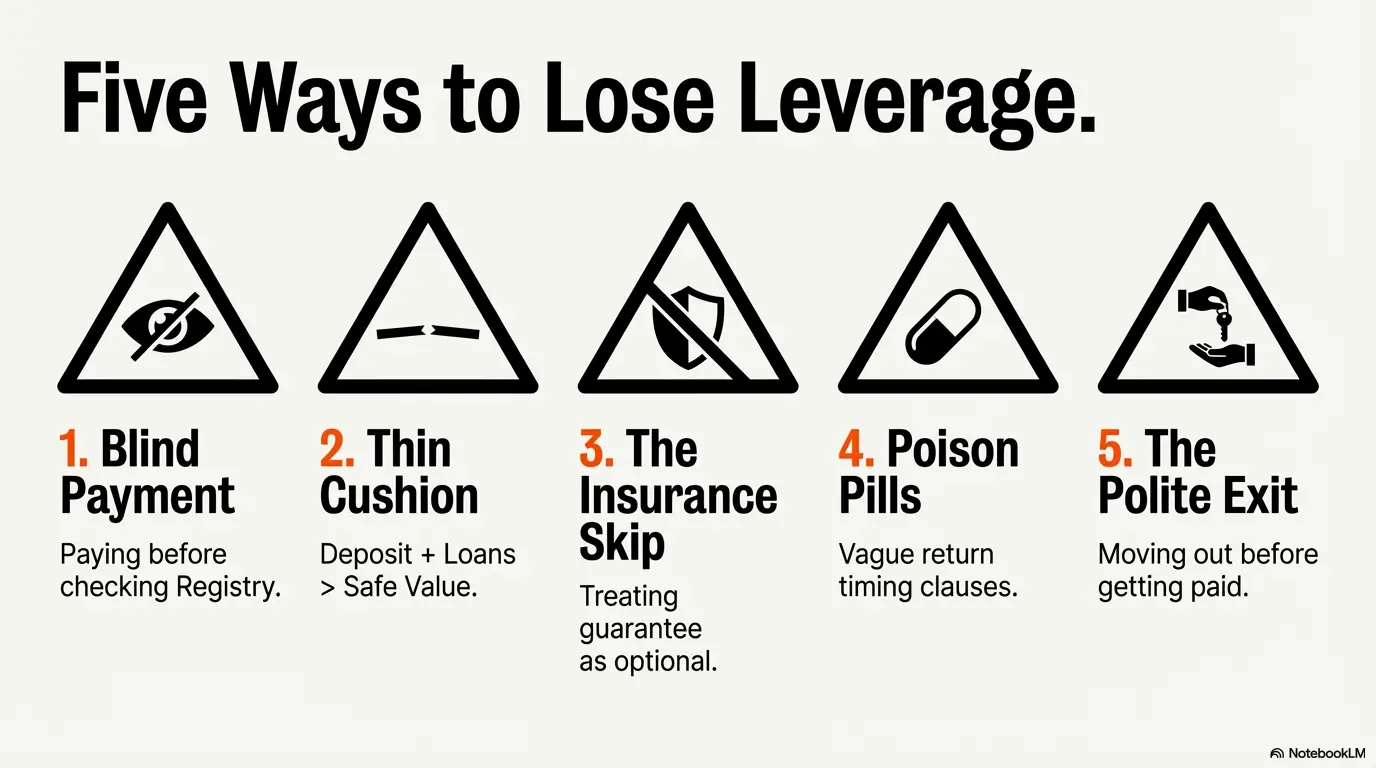
The 5 risks people miss (the “I wish someone told me” list)
Here we go—the list that saves people real money. Not because it’s dramatic, but because it’s specific. If you’re time-poor, read this section twice and everything else once.
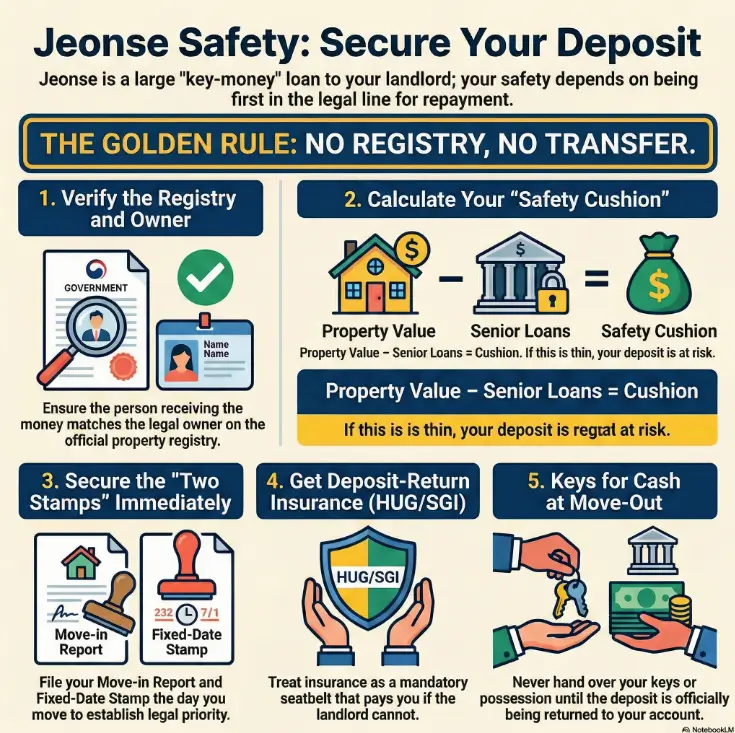
Risk #1 — You paid before checking the registry (liens, owner mismatch)
Before money moves, confirm the owner, liens, mortgages, and whether the person receiving money matches the legal owner (or an authorized, documented arrangement). I’ve seen tenants rely on a screenshot from an agent’s phone. Screenshots are great for menus. They’re not a legal safety device.
Risk #2 — Your deposit + existing loans exceeds the property’s safety margin
This is the “cushion” concept from earlier. If the building sells under pressure, you’re not paid by vibes—you’re paid from proceeds, after senior claims. A thin cushion is not an automatic “no,” but it’s an automatic “slow down and restructure.”
Risk #3 — You skipped deposit insurance because it felt “optional”
Jeonse deposit-return guarantee products exist specifically because repayment can fail. Insurers usually require clean paperwork, timing, and risk limits. If you’re eligible, insurance can act like a seatbelt: you hope you never need it, but you’ll be grateful it’s there if the landlord can’t return the deposit.
Risk #4 — Your contract has a quiet poison pill (special clauses, unclear unit, weird payee)
Poison pills aren’t always evil; sometimes they’re just sloppy. Common danger patterns:
- Unit ambiguity: the contract describes “3rd floor” but not the exact unit designation used in official records.
- Payee mismatch: you’re asked to transfer to a third party without a clear, documented reason.
- Deposit-return vagueness: the contract is oddly soft about return timing or conditions.
- “Special clause” creep: clauses that weaken your ability to enforce return, or force you to accept delays.
Risk #5 — Move-out leverage failure (handover timing, keys, and “deposit return first” strategy)
People lose leverage at the exact moment they’re tired, packed, and emotionally done. A reader once described moving out like a breakup: “I just wanted to leave the keys and disappear.” But if you hand over possession without deposit return (or without a tightly linked plan), you can turn your strongest negotiating moment into a waiting game.
- Registry first, money second.
- Thin cushion means restructure, not optimism.
- Move-out is a transaction moment—plan it like one.
Apply in 60 seconds: Text yourself: “No registry, no transfer.” Then treat it as law.
Short Story: The day “refundable” started to feel optional (120–180 words) …
One expat couple (friends of a friend—close enough to feel real, far enough to be a warning) found a spotless villa. The agent was charming. The landlord sounded reasonable. They were jet-lagged and wanted certainty, so they wired the first big payment the same day they signed—right after navigating Korea’s main airports and arrival logistics.
Two weeks later, while scheduling the move-in paperwork, they learned the property had heavier loans than they’d assumed—and another tenant’s deposit was already in the mix. Nothing illegal had happened. Nothing “scammy” had happened. But suddenly the couple was doing math at midnight, translating documents, and wondering why nobody had mentioned the risk order. They eventually solved it by renegotiating: lower deposit, a different unit, and a tighter schedule for filings. The lesson wasn’t “never jeonse.” The lesson was: speed is expensive when you’re moving large money.
Common mistakes: don’t do these two things with a large transfer
Mistake #1: Sending 계약금/잔금 before your red-flag checks are done
In practice, jeonse often involves staged payments (a smaller deposit first, then the balance near move-in). The mistake is treating those stages like a formality. Each transfer should happen only after your checks are complete for that stage. If you feel rushed, assume the rush is part of the risk.
Mistake #2: Trusting screenshots instead of official docs (registry + contract + receipts)
Use official documents for anything that answers: “Who owns it?” “Who has claims?” “What unit is this legally?” and “When did I pay?” Screenshots can support a story. Official documents support your deposit.
Here’s what no one tells you… “nice” buildings can be structurally risky on paper
Some of the worst-risk listings look the nicest because they’re priced and staged to move quickly. A clean lobby doesn’t mean clean priority. Don’t confuse aesthetics with solvency—especially when you’re browsing apartments for rent in Seoul and everything looks “move-in ready.”
- Scan the contract: names, unit, dates, deposit amounts, return conditions.
- Scan the registry: owner + encumbrances + anything that signals claims.
- Scan the payment trail: bank transfer records with clear memo lines.
Deposit-return insurance: the “seatbelt” that’s getting stricter
What it is (plain-English)
Deposit-return guarantee insurance is designed to protect tenants if a landlord fails to return the jeonse deposit at lease end. In broad terms, the insurer pays out under the policy rules, then pursues recovery from the landlord. In Korea, a major institution associated with this is HUG (Housing & Urban Guarantee Corporation). Another entity you may hear about is SGI Seoul Guarantee Insurance (availability and terms vary). If you want a dedicated deep dive, start with this Jeonse insurance guide (eligibility, timing, and deal-structure fallbacks).
Why eligibility got tighter: ratio thresholds & screening
Insurers do not want to guarantee deposits that are likely to fail. Over time, screening can tighten around factors like deposit-to-value levels, lien presence, and documentation timing. This is why you shouldn’t treat insurance as an afterthought you buy when you’re already emotionally committed.
Show me the nerdy details
Insurance is pricing risk, not promising comfort. If your building has thin cushion, unclear registry issues, or delayed filings, you may fail eligibility or be offered narrower coverage. That’s not the insurer being mean; it’s the insurer refusing to become the last person holding the bag.
What you’ll typically need (and when to apply)
Most applicants should expect to provide: the signed contract, proof of occupancy/filings (as required), and proof of payment. Because requirements can change, treat “when to apply” as: as early as you’re allowed, not “once I’m moved in and relaxed.”
If you can’t get insured: safer fallback structures
If you’re not eligible (or the unit can’t be insured), you still have options:
- Lower deposit structure: shift to wolse (monthly rent) or banjeonse (mix).
- Different unit: same neighborhood, different building with cleaner registry and better cushion.
- Shorter commitment: if you’re staying 6–12 months, paying for flexibility may be cheaper than paying for risk.
Decision card: Jeonse vs Wolse (for time-poor expats)
- You can verify registry cleanly and early.
- Your cushion looks healthy under stress.
- You can complete filings on time.
- Insurance eligibility looks plausible.
- You’re staying 6–12 months and want flexibility.
- The building’s cushion is thin or unclear.
- Insurance is unavailable or rejected.
- You want lower “single-event” loss risk.
Neutral next step: Pick one “deal breaker” rule (e.g., registry clarity) before you tour the next place.
Your 30-minute due diligence script (before you feel emotionally “moved in”)
This is the repeatable part—the script you can run even when you’re tired, hungry, and operating on iced coffee.
Step 1: Pull the property register and read it like a lender (owner, liens, seizures)
Confirm the owner and check for claims/encumbrances. If the agent “can’t get it right now,” that’s not a small inconvenience—it’s a reason to pause. For official issuance and verification, Korea’s registry services are connected to the judiciary system (the public-facing experience can be clunky, but that’s normal).
Step 2: Stress-test the numbers: “If this sells at a discount, do I still get paid?”
Use conservative assumptions. Assume a forced sale could be below the happy listing price. If your cushion becomes thin, treat that like a smoke alarm—not a suggestion.
Step 3: Verify the exact unit matches the registry (multi-unit buildings are where confusion lives)
Multi-unit villas and officetels can be where “unit confusion” hides. Your contract should match the legal unit designation precisely. One digit off is not cute. One digit off is expensive.
Step 4: Plan the “stamps day” + keep proof of every transfer
Make a plan for the move-in report and fixed-date stamp as early as possible after you move in. Keep your proof pack organized: contract, registry copy, transfer records, and any filings. When you need help, the person helping you will move 3× faster if your documents are clean.
Quote-prep list: what to gather before you compare units (or call for help)
- Address + exact unit designation (as used in official records)
- Owner name (from registry) and payee name (from contract/bank)
- Deposit amount + payment schedule
- Registry summary (loans/liens/encumbrances)
- Planned filing dates for move-in report + fixed date
- Insurance eligibility notes (if you’re pursuing a guarantee)
Neutral next step: Save this list as a note template before your next viewing day.
When to seek help (fast)
If you’re thinking, “I don’t want to overreact,” I’m going to gently disagree. The cost of waiting in jeonse disputes is often higher than the cost of asking early.
If the landlord delays deposit return past contract end
Delays happen for benign reasons, but delays also happen because repayment is difficult. Treat missed timelines as a signal to escalate: gather your proof pack and consult a professional.
If you discover new liens after signing / before moving in
Do not normalize “We’ll fix it later.” If new claims appear, your priority position may be affected. This is a restructure moment.
If the building enters auction / insolvency, or you’re told “we’ll pay later”
This is where priority and documentation matter most. If you hear words like “auction,” “seizure,” or “we’re refinancing soon,” stop improvising. Get help.
Who to contact (bring your proof pack)
Depending on your city and situation, options can include: tenant support channels, legal aid organizations, your insurer/guarantee institution, and trusted bilingual professionals. Commercial entities you’ll commonly hear in this space include HUG for deposit return guarantees, SGI for guarantee products, and Korea’s legal information portals for understanding housing lease rules.
FAQ
1) What is jeonse in Korea and why is the deposit so high?
Jeonse is a rental structure where the tenant provides a large refundable deposit to the landlord instead of paying normal monthly rent. The deposit can be high because it substitutes for rent and interacts with how landlords finance property. Treat it as a financial arrangement, not just “rent.”
2) Is jeonse safe for foreigners, or do I need special residency paperwork?
Foreigners can participate in jeonse, but practical protection depends on completing required filings and proving occupancy and contract date. Bring proper ID, keep official transfer records, and plan your move-in paperwork early. If your status or timeline makes filings difficult, consider a lower-deposit structure.
3) What are 전입신고 and 확정일자, and when exactly should I get them?
They are key administrative steps tied to proving residency/occupancy and the contract’s date. You generally want them completed as soon as you’re eligible after moving in, because timing can affect priority if something goes wrong.
4) Can I get jeonse deposit insurance as a foreigner, and what documents are required?
It may be possible depending on the product and your situation, but eligibility can be strict. Expect to provide the signed lease, proof of payments, and proof that required residency/contract steps were completed. Apply early within the allowed window—don’t wait until move-out is close.
5) How do I check if a property has mortgages or liens before paying deposit?
Use official registry documentation rather than screenshots. Confirm the owner, check for recorded claims, and ensure the contract’s unit and payee match the legal reality. If you can’t obtain official documentation, pause the transaction.
6) What happens if the landlord can’t return my deposit at move-out?
That’s when priority rules and documentation become crucial. If you have a deposit-return guarantee, the insurer may pay out under its rules. If not, you may need to pursue formal steps to recover the deposit. Either way, your proof pack and your timeline matter.
7) Should I choose jeonse vs wolse if I’m only staying 6–12 months?
Often, wolse (monthly rent) can be the lower-stress choice because it reduces single-event loss risk and makes moving easier. If you still prefer jeonse, tighten your process: verify registry, plan filings, and check insurance eligibility before committing.
Conclusion: your next 15-minute move
Remember the eyebrow raise from the beginning? Here’s the loop we close: jeonse isn’t magical, and it isn’t automatically dangerous. It’s a system where your outcome is shaped by repayment capacity + paperwork timing. If you run the script—registry first, transfers second, filings early, and insurance checked before you get emotionally attached—you stop being “the foreigner who hopes” and become “the tenant who verifies.”
Your next step (do this today): create a one-page “Jeonse Proof Pack” checklist in your phone notes: registry pull, unit match, payee match, transfer receipts, stamps plan, insurance window. Then promise yourself one thing: no large transfer until every box is checked. Fifteen minutes now can save months later.
Last reviewed: 2026-01-24