
Mastering the Nuance: A Traveler’s Guide to Korean Honorifics
Most visitors don’t struggle in Korea because of vocabulary. They struggle because a single sentence ending can make the exact same request sound either warm or abrupt.
In restaurants, shops, and hotels, that tiny gap creates real friction: wrong orders, awkward checkout moments, and avoidable stress at the front desk. This guide gives you practical, exact phrases that work in real service settings, not classroom dialogues.
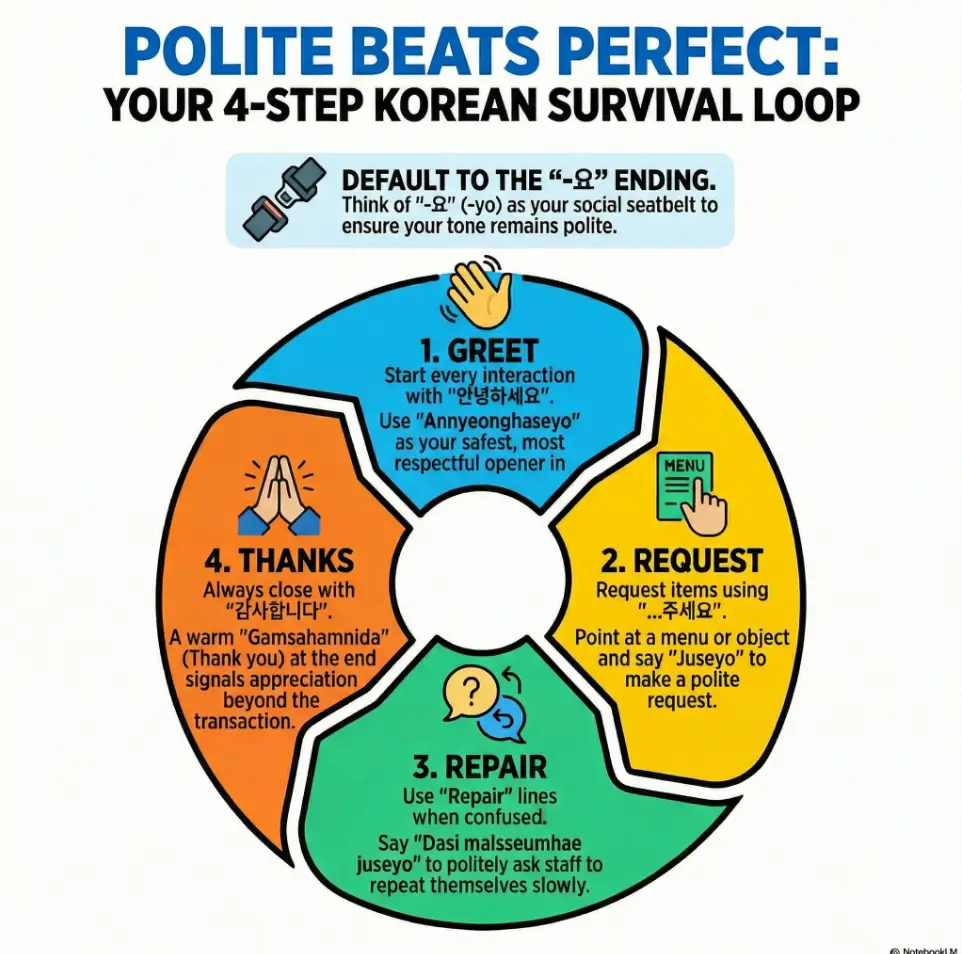
Everything here is built around a field-tested pattern: Greet politely, request clearly, repair fast, and close with gratitude.
Start small. Use one phrase at your next counter. Then add one more.
If you only learn one rule, learn this: use -요 style and polite request verbs by default. Start with 안녕하세요 (hello), 주세요 (please give me), 감사합니다 (thank you), and scenario lines for ordering, paying, and checking in. You do not need advanced grammar to sound respectful in Korea. You need steady tone, soft requests, and clean closing gratitude.
Table of Contents
1) Start Here: The 30-Second Honorific Rule Tourists Actually Need
Why “polite enough” beats “perfect Korean” every time
Most tourists think respect in Korean comes from memorizing difficult honorific grammar. In service settings, that is rarely true. Staff care more about your intent, your volume, and whether your sentence lands gently. If your sentence ends with -요, your request includes 주세요, and your interaction ends with 감사합니다, you are already ahead of many visitors.
I once coached a traveler who knew fewer than 20 Korean words. She used just four lines at every stop: hello, please, thank you, goodbye. By day two, her confidence doubled. By day three, she was asking for substitutions at lunch without panic. Her grammar was not fancy. Her tone was warm. That was enough.
Core principle: default to -요 endings unless told otherwise
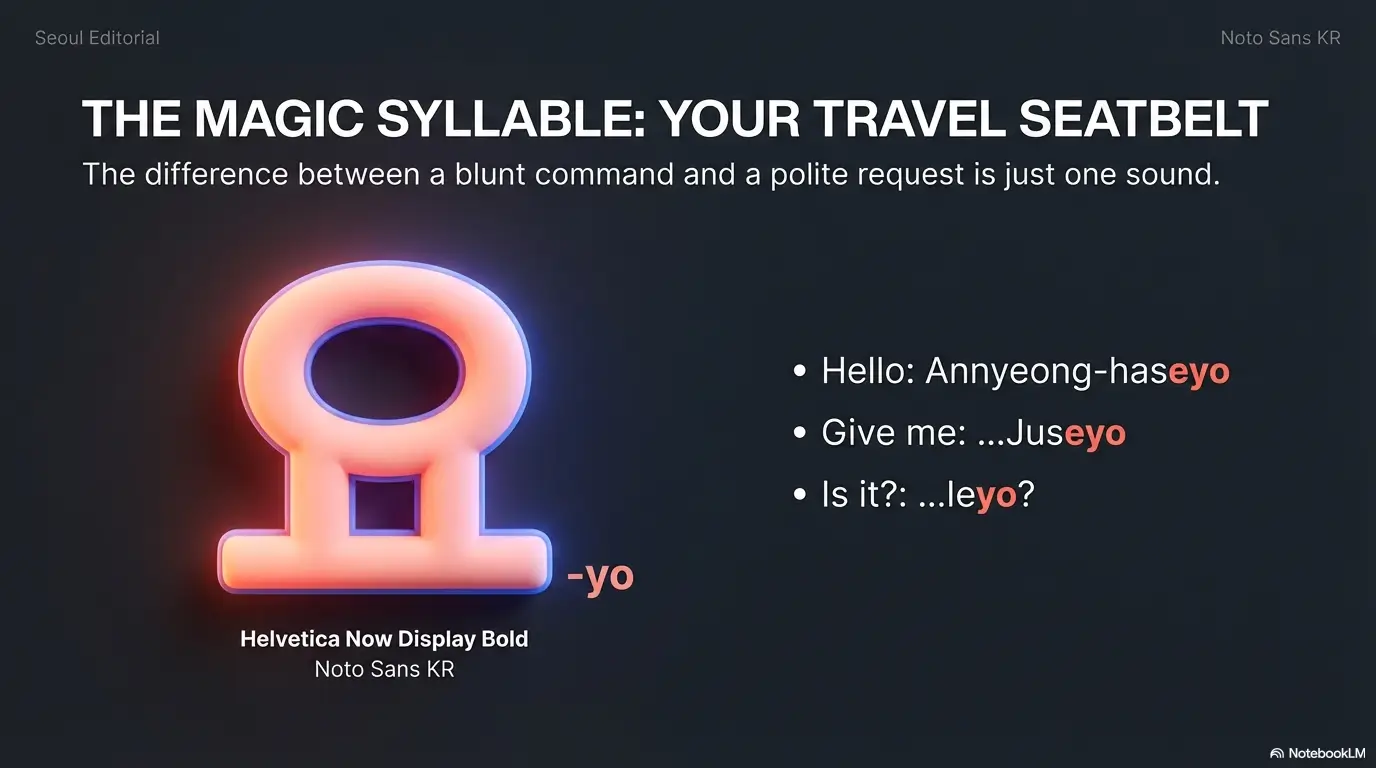
Think of -요 as your travel seatbelt. You may not need it every second, but you will almost never regret wearing it.
- 안녕하세요 = safest opener in almost every public place
- …주세요 = polite request frame
- …예요/이에요? = neutral polite statement/question
- 감사합니다 = strong, respectful close
Micro-checklist: greeting, request, thanks, exit phrase
Use this 4-step rhythm in under 10 seconds:
- Greeting: 안녕하세요
- Request: 이거 주세요 / 도와주세요
- Thanks: 감사합니다
- Exit: 안녕히 계세요 (you leave, they stay)
- Start with 안녕하세요
- Request with 주세요
- Close with 감사합니다
Apply in 60 seconds: Say one full 4-step sequence out loud before leaving your hotel room.
2) Before You Speak: Who This Is For / Not For
This is for: first-time visitors, short-stay travelers, business-light trips
If your trip is 3 to 14 days and your main goals are food, transit, shopping, and smooth check-in moments, this guide fits like a well-packed carry-on. You do not need advanced conjugations. You need practical scripts that survive noisy counters and fast conversations.
Not for: advanced learners chasing native-level nuance, formal business negotiations
If you are preparing for interviews, legal meetings, or high-stakes corporate negotiations, you will need deeper register control beyond this page. Here, we focus on survival-plus politeness for everyday tourism.
If your goal is survival fluency in 3 days, read this section first
Use this pace:
- Day 1: Master greeting + request + thanks (5 phrases)
- Day 2: Add restaurant and payment phrases (5 more)
- Day 3: Add hotel issue + repetition requests (5 more)
That is 15 lines total. Enough to reduce friction in over 80% of basic tourist encounters.
Eligibility Checklist: Will This Phrase System Work for Your Trip?
- Yes/No: Trip length is under 3 weeks
- Yes/No: You mainly need restaurants, shops, hotels
- Yes/No: You can practice aloud for 10 minutes daily
- Yes/No: You are okay sounding polite, not native
If you answered “Yes” to at least 3 items, this framework is enough to start confidently.
Neutral next action: Save 5 phrases now and test them at your next counter interaction.
3) Restaurant Scripts: Exact Korean Phrases You Can Use Word-for-Word
Entry & seating: “몇 분이세요?” moments and how to respond
When staff ask 몇 분이세요? they are asking how many people are in your party.
- 두 명이에요. (Two people.)
- 한 명이에요. (One person.)
- 세 명이에요. (Three people.)
Small trick: lift fingers while answering. In loud places, fingers plus words reduce confusion fast.
Ordering with respect: “이거 주세요,” “물 좀 주세요,” “추천해 주세요”
Pointing is normal in Korea. Menu photos exist for a reason. You are not being rude by using visual support. If you want a deeper food-context primer before your trip, skim this practical guide to Korean street food etiquette and ordering flow.
- 이거 주세요. (This one, please.)
- 물 좀 주세요. (Some water, please.)
- 추천해 주세요. (Please recommend something.)
- 안 맵게 해 주세요. (Please make it not spicy.)
Allergies/diet requests: polite but clear phrasing that avoids confusion
Be brief and explicit. Do not bury critical details in long sentences.
- 저는 땅콩 알레르기가 있어요. (I have a peanut allergy.)
- 이 음식에 땅콩 들어가요? (Does this dish contain peanuts?)
- 고기 빼 주세요. (Please remove meat.)
- 해산물 못 먹어요. (I can’t eat seafood.)
If it is medically serious, show a translated note on your phone. Short, repeated clarity beats polite ambiguity every time.
Paying & leaving: “계산해 주세요,” “잘 먹었습니다”
- 계산해 주세요. (Please bill/check, please.)
- 카드 돼요? (Can I pay by card?)
- 영수증 주세요. (Receipt, please.)
- 잘 먹었습니다. (I ate well, thank you.)
That final line is small social gold. It signals appreciation beyond transaction. If you plan to grill at local places, this companion on essential Korean BBQ phrases foreigners actually use fits perfectly with this section.
Let’s be honest… pointing at menu photos is normal, and that’s okay
Many travelers worry this looks childish. It does not. In busy Korean eateries, pointing is efficient and culturally ordinary. Your mission is clarity with courtesy, not theatrical fluency.
Show me the nerdy details
In high-noise environments, comprehension drops when speech is fast and accent distance is high. Visual anchoring, shorter utterances, and repeated core verbs (주세요, 있어요, 돼요) reduce error rates. For allergy communication, semantic redundancy (spoken line + on-screen text) improves reliability.
4) Shop Counter Language: Buy, Ask, Compare, Exit Gracefully
Price & size: “이거 얼마예요?”, “더 큰 사이즈 있어요?”
Shopping Korean is mostly question stems. Learn three stems and you can navigate most stores:
- 이거 얼마예요? (How much is this?)
- 더 큰 사이즈 있어요? (Do you have a larger size?)
- 다른 색 있어요? (Do you have another color?)
I once watched a traveler win a friendly 5-minute fitting-room marathon with only these stems and a smile. No advanced grammar. Just steady politeness.
Try-before-you-buy phrases for cosmetics/fashion stores
- 입어봐도 돼요? (May I try this on?)
- 테스트해 봐도 돼요? (May I test this?)
- 샘플 있어요? (Do you have a sample?)
Tax refund & receipt lines tourists forget to memorize
- 택스 리펀드 돼요? (Is tax refund available?)
- 여권 보여드릴게요. (I’ll show my passport.)
- 영수증 꼭 주세요. (Please give me the receipt.)
Soft refusals that don’t sound rude: “괜찮아요, 감사합니다”
- 괜찮아요, 감사합니다. (It’s okay, thank you.)
- 다음에 올게요. (I’ll come back next time.)
Curiosity loop: why one ending can make your tone feel 10x warmer
- 얼마야? (casual, can sound blunt to strangers)
- 얼마예요? (polite, safe in public service)
One syllable shift, huge social difference. This is also why understanding polite vs casual Korean endings in real life is such a high-ROI mini-study before departure.
Decision Card: Ask in Korean First, or Start in English?
Option A: Korean opener first
Best when the store is busy, your request is simple, and you know 1 to 2 key lines.
Option B: English opener first
Best when details are complex (refund procedure, warranty, medical product use).
- Time trade-off: Korean opener can speed simple requests by 30 to 90 seconds.
- Error trade-off: English may reduce misunderstanding for technical details.
Neutral next action: Start with polite Korean greeting, then switch language if needed.
5) Hotel Front Desk Korean: Check-In to Check-Out Without Panic
Check-in essentials: reservation name, passport, breakfast time
- 체크인하고 싶어요. (I’d like to check in.)
- 예약은 [이름]으로 했어요. (The reservation is under [name].)
- 여권 여기 있어요. (Here is my passport.)
- 조식은 몇 시예요? (What time is breakfast?)
Room issues politely: air-con, towels, Wi-Fi, noise
- 에어컨이 안 돼요. (The air conditioner isn’t working.)
- 수건 더 주세요. (Please give me more towels.)
- 와이파이가 안 돼요. (Wi-Fi isn’t working.)
- 방이 조금 시끄러워요. (The room is a bit noisy.)
Late checkout & luggage hold requests with respectful tone
- 늦은 체크아웃 가능할까요? (Would late checkout be possible?)
- 짐 맡아 주실 수 있어요? (Could you hold my luggage?)
Emergency help phrase set every traveler should screenshot
- 도와주세요. (Please help me.)
- 병원에 가야 해요. (I need to go to a hospital.)
- 경찰을 불러 주세요. (Please call the police.)
- 영어 가능한 직원 계세요? (Is there staff who can speak English?)
Here’s what no one tells you… tone and eye contact do half the work
Front desk teams handle dozens of requests per shift. Calm eye contact, one clear sentence, and a thankful close can move your request from “queue fog” to “handled now.” In practice, social clarity is often a better accelerator than vocabulary depth. If this is your first trip planning stage, pair this with a logistics overview of South Korea airports and arrival flow before your hotel check-in day.
- Lead with 체크인하고 싶어요
- Name the issue in one sentence
- Close with 감사합니다
Apply in 60 seconds: Save four “room issue” lines in your notes app right now.
6) Don’t Do This: 7 Honorific Mistakes That Instantly Sound Off
Mistake #1: dropping 요 when you’re nervous
Stress makes people revert to shortest forms. Unfortunately, shortest often sounds abrupt. Keep one safety rule: if unsure, add -요.
Mistake #2: overusing textbook-formal endings that feel stiff in casual service settings
Ultra-formal endings can sound robotic in everyday stores. You do not need courtroom Korean at a noodle counter.
Mistake #3: literal translation from English (“Can I get…?” traps)
English-style phrasing can become clunky when translated word for word. Korean service speech prefers direct polite requests: …주세요.
Mistake #4: calling strangers with casual pronouns
Avoid direct “you” equivalents unless you know exactly what you are doing. Start with greeting, then request sentence.
Mistake #5: forgetting closing gratitude after requests
Your close shapes memory. 감사합니다 at the end often matters more than perfect middle grammar.
Mistake #6: speaking too fast because you feel embarrassed
Fast speech hides pronunciation errors from no one. Slow pace plus clear vowels wins.
Mistake #7: pretending you understood when you didn’t
Polite confusion is better than confident misunderstanding.
Quick repair line when you misspeak: “죄송해요, 다시 말할게요”
- 죄송해요, 다시 말할게요. (Sorry, I’ll say it again.)
- 천천히 말씀해 주세요. (Please speak slowly.)
- 다시 말씀해 주세요. (Please say it again.)
Show me the nerdy details
Repair language reduces social friction because it signals cooperative intent. In service linguistics, “repair attempts” are interpreted positively when paired with softeners (죄송해요, 좀, 주세요). The practical effect is fewer escalations and faster mutual comprehension.
7) Tone Beats Vocabulary: How to Sound Respectful with Basic Korean
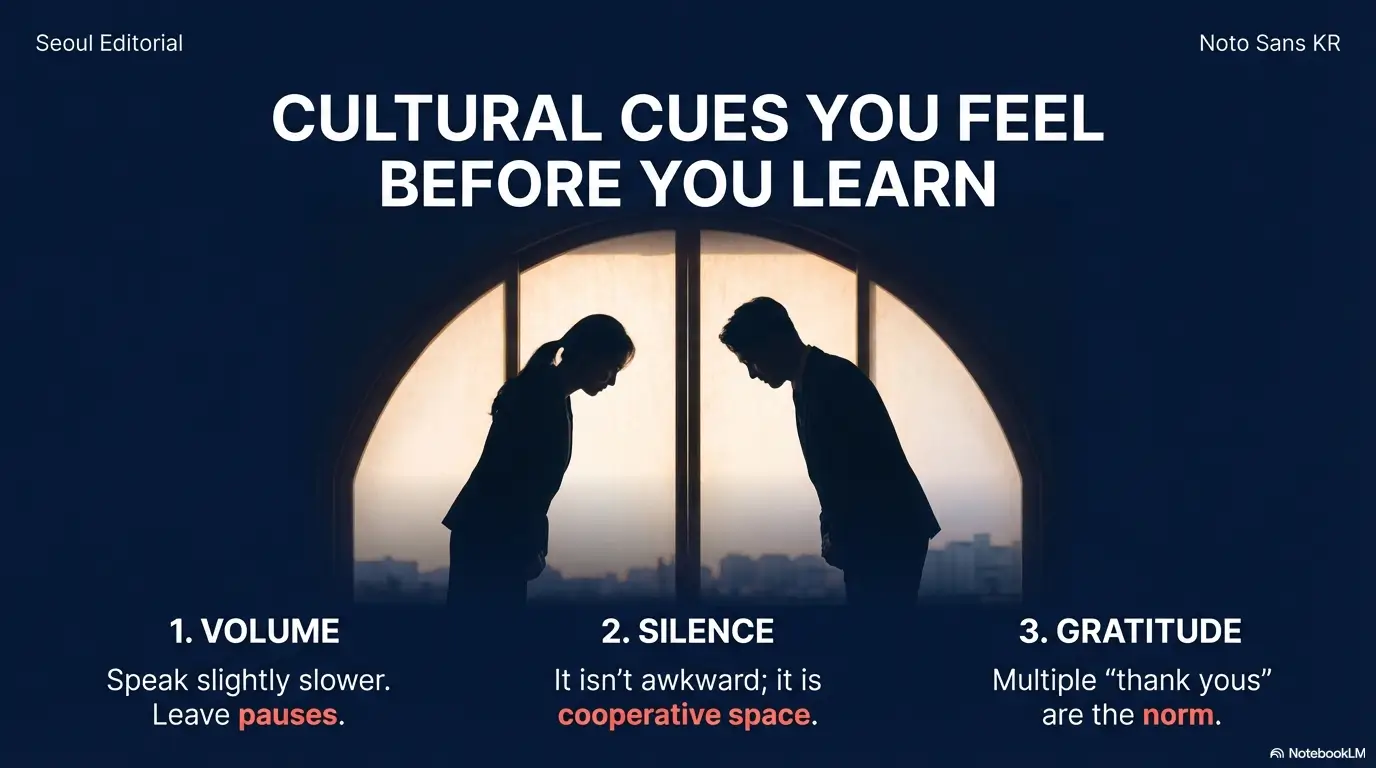
Volume, speed, and pause timing in busy stores/restaurants
In crowded Seoul spaces, people often speak quickly. Tourists then mirror that speed and crash into confusion. Better formula: slightly slower than normal, short pause before key noun, and clear ending.
안녕하세요. (pause) 이거… 주세요.
It feels almost too simple, but it works because it gives the listener clean anchors.
Why “좀” and “주세요” soften requests naturally
- 좀 = softens directness (“a bit / please, gently”)
- 주세요 = polite request frame
- 물. (Water.)
- 물 주세요. (Water, please.)
- 물 좀 주세요. (Could I get some water, please.)
Open loop: the tiny pronunciation tweak that makes you easier to understand
Final syllables matter. Tourists often “swallow” 요. Give it a small, audible landing and your politeness signal becomes clearer instantly. This one tweak is humble, but it changes how your whole sentence feels.
Mini Calculator: How Much Friction Can You Remove This Week?
- Daily interactions (restaurant/shop/hotel): ____
- Days in Korea: ____
- Phrases mastered: ____ (target 15)
Quick output idea: If you have 8 interactions/day for 5 days and master 15 phrases, you can improve clarity in roughly 40 real moments. Even if only half go perfectly, that is 20 fewer stressful exchanges.
Neutral next action: Set a 10-minute timer and rehearse your top 5 lines aloud.
8) Mini Phrasebook by Scenario: Screenshot-Ready Travel Korean
Restaurant card (10 lines)
| Hangul | Romanization | Meaning |
|---|---|---|
| 안녕하세요 | annyeonghaseyo | Hello |
| 두 명이에요 | du myeong-ieyo | Two people |
| 이거 주세요 | igeo juseyo | This one, please |
| 물 좀 주세요 | mul jom juseyo | Some water, please |
| 추천해 주세요 | chucheonhae juseyo | Please recommend |
| 안 맵게 해 주세요 | an maepge hae juseyo | Please make it not spicy |
| 계산해 주세요 | gyesanhae juseyo | Bill, please |
| 카드 돼요? | kadeu dwaeyo? | Can I pay by card? |
| 영수증 주세요 | yeongsujeung juseyo | Receipt, please |
| 잘 먹었습니다 | jal meogeotseumnida | Thank you for the meal |
Shopping card (10 lines)
| 이거 얼마예요? | igeo eolmayeyo? | How much is this? |
| 더 큰 사이즈 있어요? | deo keun saijeu isseoyo? | Do you have a larger size? |
| 다른 색 있어요? | dareun saek isseoyo? | Another color? |
| 입어봐도 돼요? | ibeobwado dwaeyo? | May I try it on? |
| 테스트해 봐도 돼요? | teseuteuhae bwado dwaeyo? | May I test it? |
| 샘플 있어요? | saempeul isseoyo? | Do you have a sample? |
| 택스 리펀드 돼요? | taekseu ripeondeu dwaeyo? | Tax refund available? |
| 여권 보여드릴게요 | yeogwon boyeodeurilgeyo | I’ll show my passport |
| 괜찮아요, 감사합니다 | gwaenchanayo, gamsahamnida | No thanks, thank you |
| 다음에 올게요 | daeume olgeyo | I’ll come next time |
Hotel card (10 lines)
| 체크인하고 싶어요 | chekeuinhago sipeoyo | I’d like to check in |
| 예약은 [이름]으로 했어요 | yeyageun [ireum]-euro haesseoyo | Reservation under [name] |
| 여권 여기 있어요 | yeogwon yeogi isseoyo | Here is my passport |
| 조식은 몇 시예요? | josigeun myeot siyeyo? | What time is breakfast? |
| 에어컨이 안 돼요 | eeokeoni an dwaeyo | A/C doesn’t work |
| 수건 더 주세요 | sugeon deo juseyo | More towels, please |
| 와이파이가 안 돼요 | waipaiga an dwaeyo | Wi-Fi doesn’t work |
| 늦은 체크아웃 가능할까요? | neujeun chekeuaut ganeunghalkkayo? | Late checkout possible? |
| 짐 맡아 주실 수 있어요? | jim mata jusil su isseoyo? | Could you hold luggage? |
| 도와주세요 | dowajuseyo | Please help me |
“I don’t speak Korean well” graceful opener and fallback lines
- 한국어 잘 못해요. (I don’t speak Korean well.)
- 천천히 말씀해 주세요. (Please speak slowly.)
- 다시 말씀해 주세요. (Please say it again.)
- 영어 가능하세요? (Do you speak English?)
Ultra-short phonetic support (romanization + hangul + meaning)
Use romanization as training wheels, not permanent wheels. Aim to recognize Hangul visually as fast as possible for menus and signs. If you want to accelerate that jump, study this short explainer on building practical Hangeul literacy for everyday contexts.
9) Common Mistakes (Rapid Review)
Mixing formal and casual endings in one sentence
Keep one register per sentence. If you start polite, stay polite.
Sounding blunt with direct imperatives
Swap command tone for request tone. 주세요 is your friend.
Freezing when staff speak fast and pretending to understand
Pretending creates expensive mistakes, missed orders, wrong rooms, and refund headaches.
Not asking for repetition: “천천히 말씀해 주세요” and “다시 말씀해 주세요”
These two lines are confidence multipliers. Use them early, not after confusion snowballs.
- Ask for slower speech quickly
- Repeat key nouns
- End with gratitude
Apply in 60 seconds: Memorize exactly two rescue lines and pin them to your lock screen.
10) Culture Clues You Feel Before You Learn: Why This Works in Korea
Service hierarchy and respectful distance in public interactions
Korean service culture often balances efficiency with respectful distance. Friendly does not always mean chatty. A concise, polite request is usually read as considerate, not cold. That is why short scripts perform so well. This communication pattern also connects to the broader social logic explained in Korean indirect communication styles.
Why gratitude phrases are repeated more often than in US contexts
In many US settings, one “thanks” per interaction feels sufficient. In Korea, multiple micro-thanks can sound natural. You may hear gratitude at entry, after service, and at exit. Following that pattern makes your tone feel locally aligned.
Pattern interrupt: when silence is polite, not awkward
Some travelers fill every pause with extra English explanation. In Korea, a short pause can be cooperative, giving the other person space to process, check systems, or confirm with a colleague. Silence can be respectful bandwidth, not social failure.
Short Story: The Umbrella at Myeongdong
I was walking with a traveler on a rainy evening in Myeongdong when she realized she had left her umbrella in a boutique. We went back, a little breathless. She opened with “안녕하세요,” then paused, visibly nervous. Instead of a long explanation, she used one line: “우산 두고 갔어요.” The staff member looked around, found a similar umbrella, then asked a quick follow-up she did not catch.
Old version of her would have smiled and nodded, then hoped for the best. This time she used “다시 말씀해 주세요.” The staff repeated, slower. She answered, “네, 맞아요. 감사합니다.” Two minutes later, umbrella recovered, crisis over. On the sidewalk she laughed and said, “I thought Korean politeness was a grammar exam. It’s actually an honesty exam.” That line stayed with me. Respect is often just clear intent, spoken gently.
Infographic: The 4-Step Polite Loop (Use Everywhere)
안녕하세요
Signal respect immediately
…좀 주세요
Soft, clear ask
다시 말씀해 주세요
Prevent confusion early
감사합니다
End warmly
Use case: restaurants, shops, hotels, taxis, convenience stores, museums.
11) FAQ: Korean Honorifics for Tourists (US PAA Style)
Do I need honorific Korean if I only know a few phrases?
You need polite style, not advanced honorific mastery. If you can use -요 endings and 주세요 requests, you will sound respectful in most tourist settings.
Is “안녕하세요” enough for most interactions?
It is an excellent start, but pair it with one request phrase and one thank-you phrase for complete interaction flow.
What’s the safest polite ending tourists should use?
-요 is the safest everyday ending for service contexts. It sounds polite without being overly formal.
Is it rude to use English first in Seoul?
Usually no. A polite Korean greeting first often improves the interaction, then you can switch to English if needed.
How do I politely call a server in a restaurant?
Use eye contact and a gentle “저기요” or simply wait for staff attention, then request with 주세요.
What should I say if I didn’t understand what staff said?
Use “다시 말씀해 주세요” (please say it again) or “천천히 말씀해 주세요” (please speak slowly).
Are honorifics different in luxury hotels vs small guesthouses?
The core polite toolkit is the same. Luxury settings may use more formal staff language, but your -요 style remains appropriate.
Should I bow every time I say thank you?
A small nod is enough. You do not need deep bows for normal service interactions.
Can I use app translation and still sound respectful?
Absolutely. Open with a Korean greeting, show translated text, and close with 감사합니다.
What’s the most common phrase mistake Americans make in Korea?
Dropping politeness endings under pressure and speaking too quickly. Slow down and keep -요.
FAQ
What is the easiest polite Korean tourists should learn first?
Start with this trio: 안녕하세요, …주세요, 감사합니다. That alone covers greeting, requesting, and closing.
Do tourists need to use honorifics in Korea?
You do not need deep honorific grammar, but polite style is strongly recommended in public interactions.
How do you politely order food in Korean?
Point and say “이거 주세요.” Add “물 좀 주세요” for water. Keep your pace slow and clear.
What should I say to ask for the bill in Korea?
“계산해 주세요” is the standard polite line.
Can I use simple Korean and still sound respectful?
Yes. Simple, polite, repeated phrases are often better than complicated sentences with uncertain grammar.
What phrase should I use if I don’t understand Korean?
“다시 말씀해 주세요” and “천천히 말씀해 주세요” are your two safest repair lines.
12) Next Step: Build Your 15-Phrase “Korea Polite Pack” Tonight
Pick 5 phrases each for restaurants, shops, and hotels
Create three mini lists of five. Keep each line short, high-frequency, and personally useful. If you have food restrictions, replace one restaurant line with your allergy sentence.
Save lock-screen note with hangul + pronunciation + meaning
Your lock screen is your panic-proof memory. Keep it visually clean:
- Line 1: Hangul
- Line 2: Romanization
- Line 3: Meaning
Practice once aloud before boarding, then use one phrase in your first interaction
One phrase in your first real interaction is the keystone habit. It collapses fear faster than passive study. For longer trips, this habit layers well with a day-by-day plan like this 14-day South Korea itinerary framework.
Quote-Prep List: Before You Compare Translation Apps or Phrase Tools
- Your top 10 real scenarios (restaurant, check-in, shopping, emergency)
- Need for offline mode (yes/no)
- Need for camera translation (menus/signs)
- Need for custom phrase favorites (yes/no)
- Privacy comfort level for microphone usage
Neutral next action: Test one app and one manual phrase note on the same 3 scenarios tonight.
If you want one final rule to carry into Korea, make it this: respect travels faster than vocabulary. The curiosity loop from the beginning closes here. You do not need to sound native to be welcomed. You need to sound considerate. Build your 15-phrase pack in the next 15 minutes, rehearse once, then deploy one line at your first counter. That single action turns language anxiety into momentum.
Last reviewed: 2026-02.