
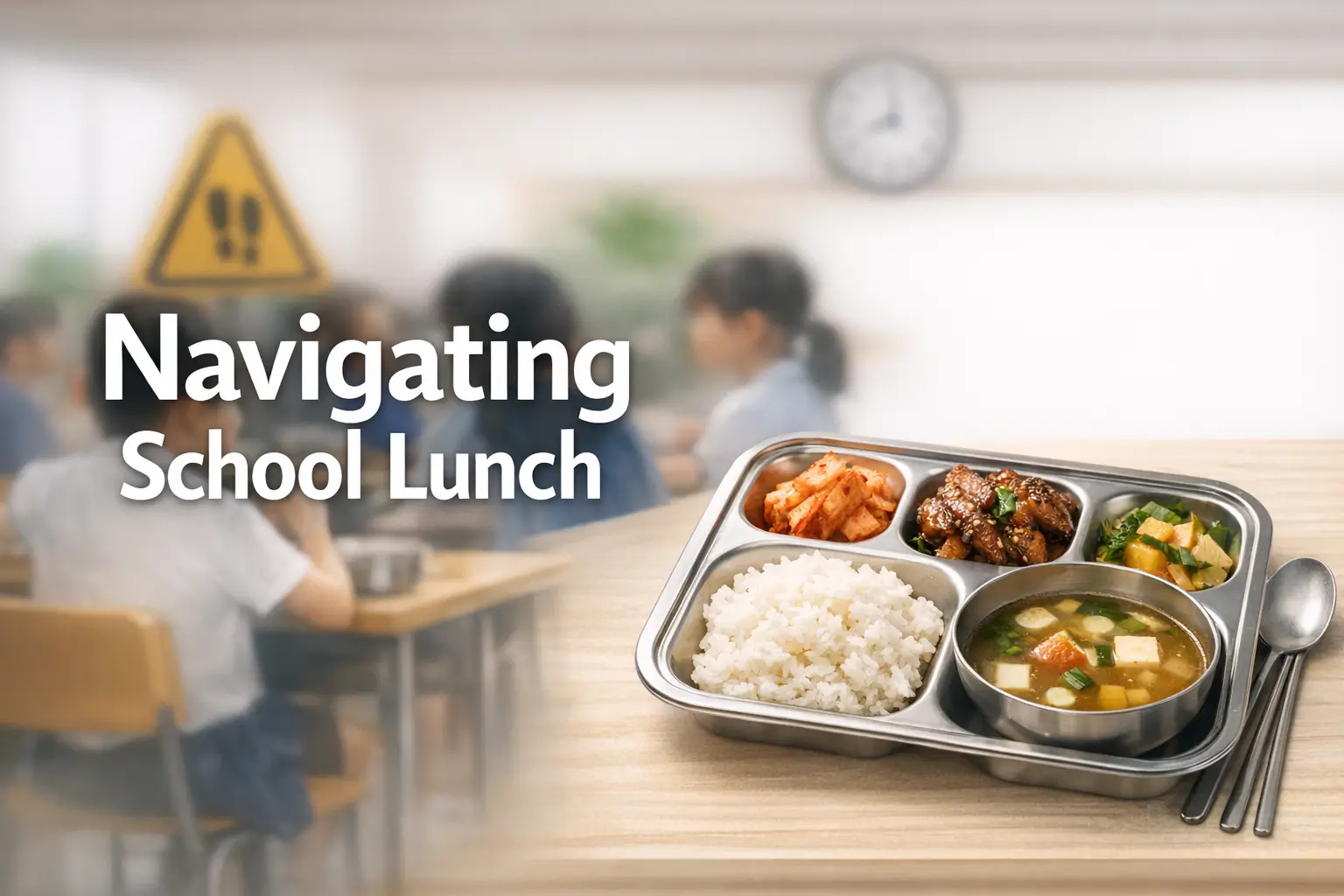
For many foreign parents, the first school lunch in South Korea is not unsettling because of kimchi. It is unsettling because everything moves with invisible timing. Trays appear, children fall into step, and side dishes settle into place, everyone else already knows the rhythm.
The real stress isn’t just unfamiliar food; it’s a child trying to decode pace, etiquette, and social signals all at once. Without the right insight, a simple adjustment can quietly harden into school dread or communication gaps with staff.
“Because lunch complaints are not always about lunch. Because ‘I’m fine’ is often incomplete. Because the tray is only half the story.”
This guide helps you spot sensory friction, allergy concerns, and hidden social discomfort, allowing you to respond earlier, calmer, and far more effectively.
Contents — choose a section
Table of Contents
Start Here First, What “School Lunch Culture” Really Means in South Korea
Why lunch is not just a meal but part of the school routine
In many Korean schools, lunch is woven into the same fabric as lining up, cleaning up, classroom transitions, and group timing. It is food, yes, but it is also habit training. That can feel surprisingly different for parents coming from school systems where lunch reads more like a flexible break in the day.
Constructed example: A parent expects unfamiliar flavors to be the main challenge, but the child finds the queue and eating time difficult. Asking about the whole routine can reveal a practical adjustment; it does not exclude an ingredient or medical concern.
How Korean school lunch often reflects group rhythm over individual customization
This is the key cultural hinge. Many foreign parents arrive looking for a menu-choice system, but what their child meets is closer to a common-meal system. A shared tray, a shared lineup, a shared window of time, and a shared expectation that lunch is something the group does together. That does not mean there is no flexibility. It means flexibility may be narrower, more procedural, and more dependent on clear communication with the school.
That difference matters because it changes the questions you ask. Instead of only asking, “What food options are there?” you start asking, “How is this meal served, how much room is there for adjustment, and how will my child experience the social part of eating?”
What foreign parents usually notice in the first two weeks
The first two weeks often bring a cluster of small surprises. Your child may mention soup appearing often, metal trays with separate sections, mixed dishes that hide familiar ingredients inside unfamiliar flavors, or the simple fact that everyone around them seems much less dramatic about fermented vegetables than they are.
Parents also notice something subtler: children may report being “fine” even when they are quietly overwhelmed. Lunch discomfort does not always show up as hunger. Sometimes it shows up as slower mornings, hesitation about school, low-energy afternoons, or the suddenly suspicious sentence, “Can I just eat a big breakfast instead?”
- Look at lunch as culture plus logistics, not food alone
- Ask how lunch works, not only what is served
- Watch for routine stress disguised as “I’m just not hungry”
Apply in 60 seconds: Ask your child to describe the lunch routine from tray pickup to cleanup, not just the food.
Who This Is For, and Who May Need a Different Guide
Best for US and other foreign parents with children entering Korean schools
This guide is especially useful if your family is newly in South Korea and your child is about to enter, or has just entered, a Korean school setting. It also fits parents who know the broad cultural headlines already but need the practical underlayer. The sort of information you want at 10:47 p.m. when your child says, “I don’t want lunch tomorrow,” and you are trying not to turn one rough day into a family referendum.
Useful for short-term expat families, mixed-nationality households, and first-time school parents
Short-term families often assume lunch issues do not matter because the stay is temporary. Ironically, short stays can make adjustment sharper. There is less time for habits to settle. Mixed-nationality households may also find that one parent reads the lunch experience as “normal school adjustment” while the other hears a deeper cultural mismatch. Both may be partly right.
First-time school parents, meanwhile, are doing two forms of learning at once: learning the school and learning the country. That can make lunch feel bigger than lunch. Which, to be fair, it sometimes is.
Not enough on its own for families dealing with severe medical dietary needs
If your child has a severe allergy, celiac disease, medically required dietary restrictions, or a feeding disorder, you will need more than cultural decoding. You will need school-specific confirmation, practical safety planning, and probably repeated communication in clear language. Warm assumptions are lovely at dinner parties and terrible in risk management.
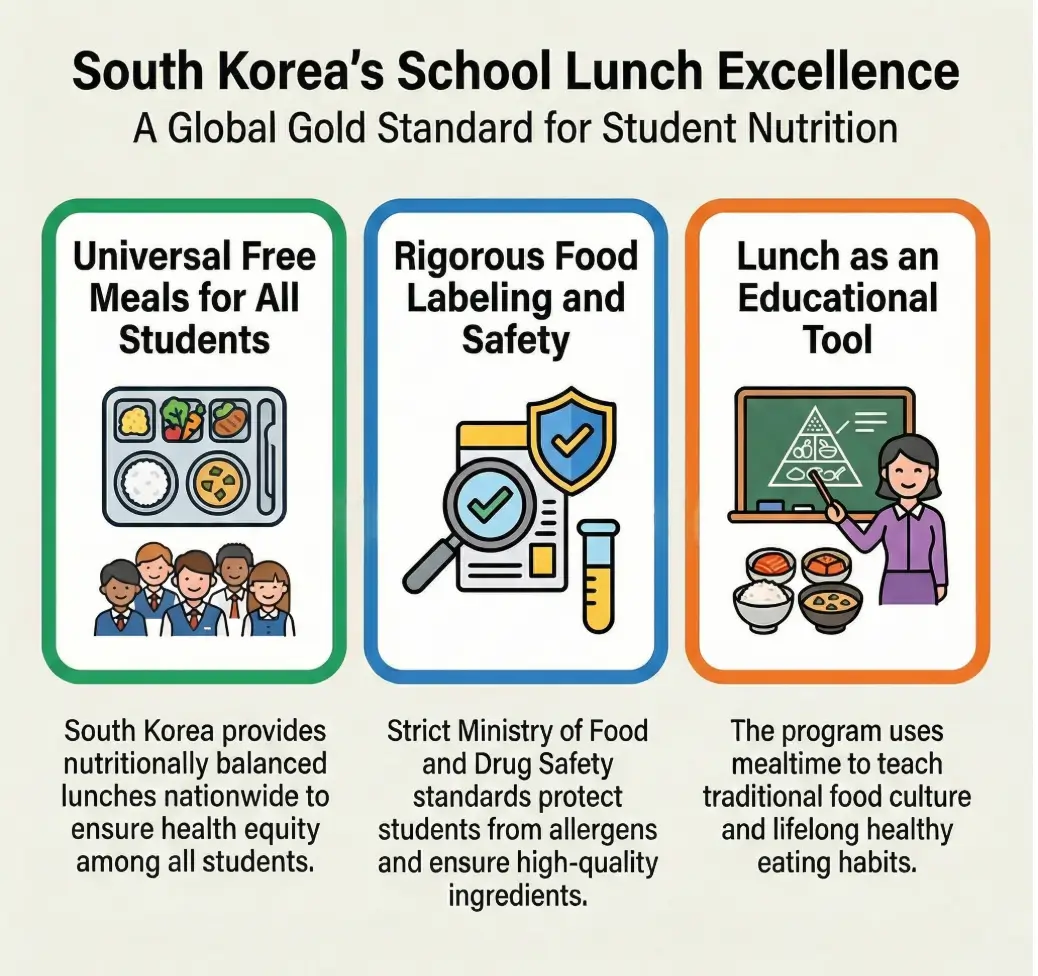
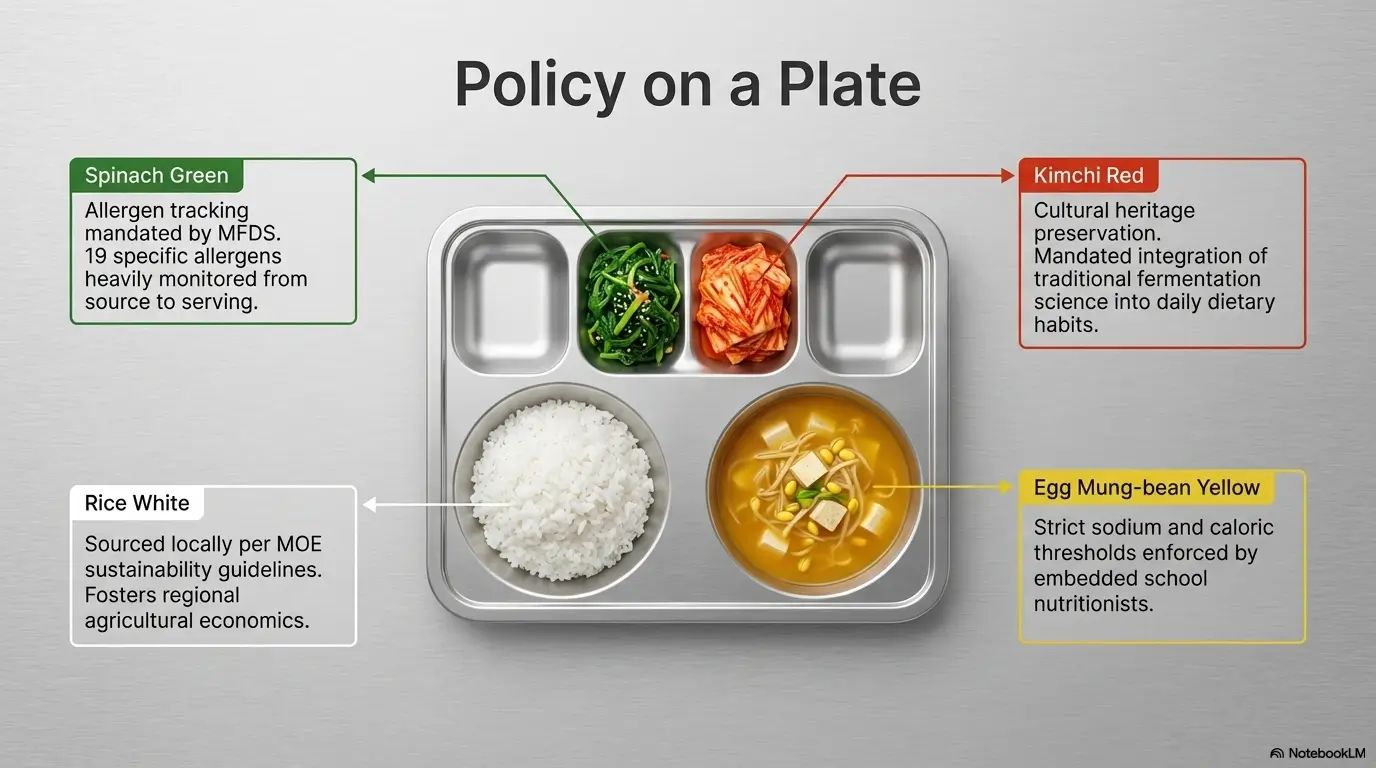
The Ministry of Education has highlighted school-meal safety standards and notes that ingredient origin and quality are reviewed through school management procedures that include parent participation. The Ministry of Food and Drug Safety also maintains English-language information on food labeling systems, which can help parents frame ingredient and allergen questions more precisely. Those mechanisms are useful, but they are not a substitute for direct school-level confirmation when a child’s risk is high.
- Is your concern mainly adjustment, unfamiliar food, or lunch routine? Yes → This guide will help.
- Is your child’s issue medically significant, severe, or safety-critical? Yes → Use this guide only as a starting point.
- Do you need school-specific accommodation details? Yes → Contact the school directly early.
Neutral next step: classify your child’s lunch issue as cultural, practical, medical, or mixed before you contact the school.
Expect the Tray, Why Korean School Lunch Can Feel More Structured
How set menus reduce daily choice but simplify logistics
From a parent’s point of view, set menus can feel limiting. From an operations point of view, they are elegant. Schools can plan nutrition, preparation, service flow, and cost control more cleanly when most students are eating the same basic meal. The trade-off is obvious: less daily choice for families, more predictability for the institution.
That predictability can help children, too. Kids often settle faster when they learn the pattern. Rice. Soup. One or more side dishes. Something protein-based. Kimchi or another vegetable component. The specific menu changes, but the architecture often feels familiar after a week or two.
Why many children eat the same meal at the same time
Because the meal is organized around the group, lunch can reinforce a sense of shared participation. It is not only that children eat similar foods. It is that they do so together, within a defined window, often in ways that make timing visible. A slow eater notices. A hesitant eater notices. A child who is still deciding whether spinach is edible may notice very much.
That does not mean lunch is militaristic. It usually means the structure is clearer than some foreign families expect. If your child is used to long meandering lunches or highly individualized food choice, the new rhythm may feel like stepping into a moving train. Not dangerous. Just already in motion.
What “balanced meal” may look like in a Korean school setting
A balanced Korean school lunch may not look balanced to a parent expecting sandwiches, raw fruit cups, or milk cartons as the visual shorthand. Balance may show up through rice, soup, protein, cooked vegetables, fermented items, and a rotating menu built for nutritional planning rather than Instagram diplomacy. If you want a broader cultural lens on why broth carries so much weight at the table, why soup is a full meal in Korea offers a helpful companion perspective.
Schools in Korea operate under formal school-meal structures, and the Ministry of Education has publicly emphasized quality standards and safety oversight for ingredients used in school meals. That helps explain why many meals feel standardized in their design even when they vary in taste.
Show me the nerdy details
When a school meal system is designed around a common tray and a shared service flow, the operational benefits stack up quickly: easier procurement, more consistent portioning, fewer timing bottlenecks, and clearer nutrition planning. Parents sometimes read “less choice” as “less care,” when institutions often mean “more consistency.”
Menu Shock Is Real, What Children Often Need Time to Learn
Why soup, rice, kimchi, and side dishes may appear more frequently than US families expect
Foreign parents often prepare themselves for “spicy Korean food” and then discover the larger surprise is repetition of form. Soup appears often. Rice is central. Side dishes are normal, not decorative. Kimchi is common enough that children can start treating it as part of the scenery even when they do not eat much of it.
Constructed example: A child says lunch is “always soup.” Instead of dismissing the complaint or taking it literally, the parent asks which foods were served, what was eaten and what felt difficult. Check the actual menu together.
How texture, fermentation, and unfamiliar vegetables can matter more than “spice”
Parents frequently over-focus on heat and under-focus on texture. But many children struggle more with softness, slipperiness, chewiness, fermentation, or mixed textures than with actual chili. A mild dish can still feel deeply unfamiliar. Bean sprouts, seaweed, mushrooms, marinated vegetables, and fermented flavors all ask for adaptation of a different kind than “too spicy.” If parents need a gentler doorway into this pattern, a quick read on how Korean banchan works and why side dishes matter can make the tray feel less mysterious.
That matters because it changes your support strategy at home. If you keep asking, “Was it spicy?” you may miss the real issue. Your child may be trying to say, “It felt wet and cold,” “Everything touched,” or “I didn’t know what was in it.” Those are different problems, and they need different language.
Let’s be honest… sometimes the surprise is cultural rhythm, not flavor alone
Sometimes lunch shock is not about taste at all. It is about being new, eating quickly, watching classmates move confidently, and feeling odd for hesitating over a tray that everyone else accepts as ordinary. Food becomes the stage where the bigger drama of belonging plays out.
This is why some children eat better on week three even when the menu does not change much. The food did not become easier. The room did.
| If you notice… | It may mean… | Try… |
|---|---|---|
| “It tastes weird” every day | General unfamiliarity | Ask about texture and smell, not just flavor |
| Better eating at home, worse at school | Social or pace stress | Ask about seating, line flow, and time pressure |
| Refusal of one category only | Specific sensory issue | Identify the repeating ingredient or texture pattern |
Neutral next step: log three lunch complaints exactly as your child says them before interpreting them.
Spice Is Not the Only Issue, What Kids Actually Struggle With
Mild-looking dishes that still feel unfamiliar
A pale soup can still be intimidating. A small side dish can still feel mysterious. Children do not assess food like adults reading a menu. They assess it as a sensory event with social consequences. “Mild” is not the same thing as “easy.”
Food can be unfamiliar because of texture, temperature, smell, naming or presentation. Respect the child’s report and investigate the specific obstacle without calling the child difficult or assuming every refusal is cultural.
Why mixed dishes and shared flavor profiles can slow adjustment
Many Korean meals combine components in ways that make sense to local eaters and feel hard to parse for children from elsewhere. Sauced vegetables, mixed rice dishes, marinated proteins, or side dishes with overlapping seasoning notes can make the tray feel more continuous than segmented, even when it is physically sectioned.
For some children, predictability comes from recognizing each item instantly. If they cannot do that, eating becomes work. And lunchtime is not always the hour when a child wants extra cognitive labor.
How to tell the difference between normal hesitation and a real eating problem
Normal hesitation is common. A real issue usually has a pattern. Watch for persistent hunger after school, headaches, fatigue, unusual irritability, anxiety before lunch days, or repeated avoidance of school itself. Also watch for the child who says everything is “fine” but suddenly starts wanting huge snacks the moment they get home. That child may be adapting. Or quietly under-eating.
Two or three rough lunches are not a crisis. Two or three rough weeks deserve a clearer look.
- Mild-looking food can still feel hard
- Mixed dishes can increase uncertainty for some children
- Patterns over days matter more than one dramatic lunch complaint
Apply in 60 seconds: Ask your child, “Was anything hard to recognize today?” and see what surfaces.
Allergy and Dietary Questions, Where Foreign Parents Should Slow Down
Why assumptions based on US cafeteria norms can backfire
This is where parents should move slowly and precisely. Some families assume the school will handle dietary needs the way a US school district does. Others assume the opposite and panic too fast. Both instincts can cause friction. What matters is not your prior model. It is the school’s actual process.
Korean schools operate within formal school-meal and food-safety frameworks, but parents should not treat that as a guarantee that staff automatically understand a foreign family’s exact dietary language. “Dairy allergy,” “tree nut cross-contact,” “vegetarian but okay with broth,” and “religious avoidance” are not interchangeable categories. Yet nervous parents sometimes communicate them as if they are.
How to ask schools about ingredients, substitutions, and safety procedures
Ask narrow questions. Ask them early. Ask them in writing if possible. A good starting frame is simple:
- Which foods or ingredients are the concern?
- What happens when those items appear on the menu?
- Are substitutions possible in ordinary practice?
- How are ingredients or allergens communicated to families?
- Who should the parent contact if a menu item raises concern?
School menu allergen information is a useful starting point, but the exact process must be confirmed with the actual school. Incheon’s education office describes advance menu notices and displayed allergen information. Ask how the school verifies ingredients, changes and cross-contact for your child rather than treating a menu code as a complete safety plan.
When language gaps can create more risk than the food itself
Language gaps are often the hidden hazard. A school may be willing to help but misunderstand the severity. A parent may explain the concern but not the consequence. A child may know the English word for the food they avoid but not the Korean one that appears on the menu.
One of the smartest moves you can make is building a one-page lunch note with the child’s name, class, exact concern, what exposure looks like, what symptoms look like, what the child can safely eat, and who to call. Not elegant. Very effective. School communication does not need poetry. It needs clarity.
Show me the nerdy details
Food-risk communication works best when it is specific, behavior-oriented, and repeatable. “My child has food issues” is vague. “My child must not eat shrimp, crab, or foods cooked with them; symptoms include hives and stomach pain; please notify us if these items appear” is operational. Schools can act on operational language.
- The exact foods or ingredients involved
- What happens if your child eats them
- Whether this is preference, intolerance, allergy, religion, or medical instruction
- Any doctor’s note or prior school accommodation summary
- A Korean translation of the critical terms if possible
Neutral next step: write the issue in one sentence that a busy teacher can understand in 10 seconds.
Don’t Assume Choice, One Common Misread Foreign Parents Make
Why “my child can just skip what they dislike” may not work the way parents expect
Many foreign parents quietly imagine a fallback system: the child will eat the parts they like and ignore the rest. Sometimes that works. Sometimes it does not. In a more group-shaped meal environment, children may feel pressure to at least try items, move at the class pace, or avoid drawing attention to themselves through visible pickiness.
This does not mean schools are trying to force-feed children into cultural enlightenment. It means the social atmosphere may make selective eating feel more conspicuous than it would in a more choice-based cafeteria model.
How group mealtime expectations shape what children actually do
Children watch each other. They calibrate quickly. If most classmates sit down and begin without discussion, the newcomer notices. If cleanup starts while your child is still negotiating a suspicious mushroom, the newcomer notices that too. Lunch can become a small theater of self-consciousness, and children often prefer mild discomfort over visible difference. That is one reason parents can underestimate the problem at first.
What respectful flexibility may look like inside a Korean school culture
Respectful flexibility usually works best when it is framed as cooperation, not exception-seeking. A parent who says, “We want to help our child adapt, but we also want to understand how to handle these specific difficulties,” usually gets further than a parent who opens with a list of demands shaped entirely by another country’s norms.
The most effective stance is calm, specific, and partnership-oriented. Not “Change lunch for my child.” More “We want to support the school routine while helping our child eat enough and stay safe.” That sentence travels well across cultures. The same logic appears in many everyday interactions shaped by Korean indirect communication and a broader culture of politeness in Korea.
Don’t Wait Too Long, Another Mistake Is Raising Concerns Too Late
Why the first small signs matter more than one dramatic complaint
Parents often wait for a cinematic sign. Tears. Refusal. A notebook-worthy tragedy featuring untouched soup and existential despair. In real life, lunch problems often begin as something much smaller: slow chewing, skipping a category, recurring after-school hunger, vague dread, or “Can I please bring something else?”
Those small signs matter because they are easier to solve early. Once lunch stress fuses with school stress, the problem gets stickier. Food becomes a symbol. Then you are no longer dealing only with kimchi or soup. You are dealing with the child’s sense that school is a place where they fail three times a day before math even begins.
How to bring up lunch concerns without sounding confrontational
Lead with observation. Then ask for process. For example:
- “Our child seems hungry after school and says lunch is hard. Could you help us understand the routine?”
- “We want to support adaptation. Are there particular menu patterns we should know about?”
- “When a child struggles with certain items, what usually happens?”
That language opens a door. It does not slam one. Cross-cultural school communication often goes better when parents sound curious before they sound corrective.
What teachers and staff can often solve early if parents ask clearly
Early communication can solve surprisingly practical things: helping a teacher monitor whether the child is eating enough, clarifying how menus are shared, identifying recurring trigger foods, or simply giving staff the context that this child is not being defiant. They are translating a new system in real time.
In other words, do not wait for lunch to become a referendum on your relocation choice. By then the rice is innocent and everyone is tired.
- Look for patterns before the child starts dreading school
- Open with observations, not accusations
- Ask the school about process and routine, not just menu details
Apply in 60 seconds: Write down two concrete lunch patterns you have noticed before contacting the school.
Social Signals at Lunch, The Part No One Explains Early Enough
How lunch can shape belonging, confidence, and classroom comfort
Lunch is one of the fastest ways a child learns whether they feel ordinary in a new school. If the child can navigate the tray, the pace, and the basic etiquette, lunch becomes a daily confidence-builder. If not, the meal can become a quiet reminder of foreignness.
Parents sometimes miss this because children rarely say, “I feel socially exposed by lunch.” They say, “I don’t like the food,” which is often true but not complete. When a child feels unsure, embarrassed, or slow, food becomes the vocabulary of that discomfort.
Why eating speed, table manners, and trying unfamiliar foods may carry social meaning
In any school culture, children notice norms around pace and participation. In Korea, those norms may feel especially visible to newcomers because the group rhythm is clearer. A child who eats slowly may worry about holding things up. A child who declines too many items may feel noticed even if no one says anything. A child who spills soup once may remember it for a week. Children are exquisitely talented at turning minor moments into private operas.
Here’s what no one tells you… sometimes lunch stress is really friendship stress in disguise
If your child suddenly hates lunch after seeming fine, ask about seatmates and social atmosphere. Sometimes a child who feels lonely or uncertain around peers starts locating that discomfort in the food. Lunch is one of the most social parts of the school day. It amplifies emotions because there is less academic structure to hide inside.
Illustrative scenario, not a reported event: A child who complains about soup also describes difficulty finding a seat. The parent asks the school about both food and routine and agrees on practical support. This is one possible explanation, not a way to rule out allergy, pain or inadequate intake.
Parent Expectations Differ, What US Families May Misread at First
Why Korean schools may communicate differently about daily meals
Some foreign parents expect frequent individualized meal communication. In practice, schools may share menus and procedures in ways that feel more standardized and less conversational. That can be efficient for the school and slightly disorienting for families used to more frequent informal explanation.
This difference does not automatically mean the school is indifferent. It may simply mean that the system assumes parents will read the shared information, understand the standard process, and raise specific concerns when needed. The burden of initiation can feel different. That is often where foreign families stumble.
How parent involvement around school food may feel more indirect than in the US
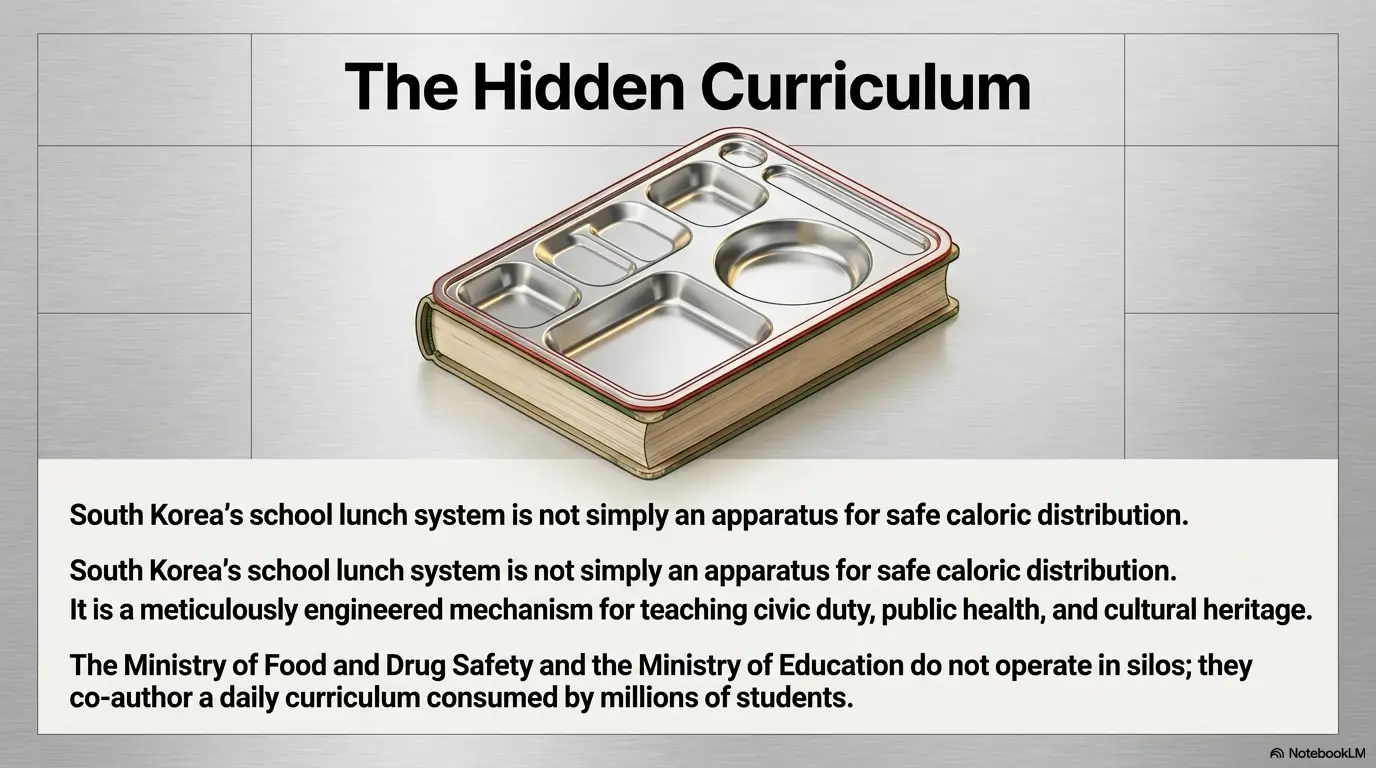
Parent involvement may exist, but not always in the form foreign parents recognize. The Ministry of Education has stated that ingredient origin and quality decisions for school meals are reviewed through school management committee processes that include parent participation. In other words, there is oversight, but it may not feel like personalized day-to-day discussion unless a child’s situation calls for it.
What to document before assuming the school is ignoring a concern
Before concluding that no one is listening, document a simple sequence:
- What your child reported
- On which days the problem occurred
- Whether the issue is taste, amount, safety, or social discomfort
- What exactly you asked the school
- What response you received
This protects everyone. It also keeps your concern from expanding into a fog of feeling. Fog is emotionally understandable. It is a terrible communication tool.
Practical check: Use the specific questions and actions below. A point score cannot establish intent, health needs or the right arrangement for every setting.
Common Mistakes Foreign Parents Make About School Lunch in South Korea
Treating every unfamiliar menu item as a problem
Not every unfamiliar dish is a red flag. Some are simply new. Parents sometimes accidentally teach anxiety by reacting too strongly to menus that look strange from a foreign perspective. Children notice that tone. If the parent approaches lunch like a diplomatic emergency, the child may follow suit.
Focusing only on spice and missing texture, routine, or peer pressure
This is one of the biggest blind spots. Spice is easy to imagine, easy to talk about, and sometimes real. But many lunch problems come from texture, speed, confusion, or social visibility. The child who says “too spicy” may mean “too unfamiliar,” “too mixed,” or “too stressful to eat in front of everyone.”
Assuming silence means the child is fully adjusting
Some children say very little while adapting. Silence can mean resilience. It can also mean they do not yet have the language to describe what feels hard. The quiet child deserves as much observation as the expressive one.
Comparing Korean lunch culture to US cafeteria choice too literally
Comparison is useful until it becomes a trap. If you keep measuring Korean lunch against a US cafeteria choice model, you may misunderstand what the Korean system is optimizing for. It is often optimizing for shared routine, nutrition planning, and service flow, not maximum individual selection. Once you see that, many frictions make more sense.
Waiting until the child dreads school before contacting staff
This is the costliest mistake. By then lunch is no longer a meal issue. It has become a school-emotion issue. Early conversation is almost always lighter, easier, and more effective.
How the class lines up, eats, and clears away.
Rice, soup, sides, protein, vegetables, fermentation.
Allergies, dietary restrictions, and exact communication.
Belonging, pace, seatmates, confidence, and embarrassment.
Use it this way: when your child struggles, identify which layer is the real issue before reacting.
Talk to Your Child Better, Questions That Reveal More Than “Did You Eat?”
How to ask about hunger, embarrassment, pace, and social comfort
“Did you eat?” is a perfectly loving question and a remarkably weak data tool. Most children will answer with one of the classic three responses: “Yes,” “No,” or “I don’t remember,” which is a lyrical way of saying the adult has failed to ask well.
Better questions are narrower and kinder:
- Which part of lunch felt easiest today?
- Which part felt hardest?
- Did you feel rushed, confused, or mostly okay?
- Was there anything you wanted to eat but could not?
- Did anyone help you, or did you figure it out yourself?
Why specific prompts work better than broad daily check-ins
Specific prompts lower the child’s effort. They also help separate food from feeling. A child may not be able to narrate the lunch experience globally, but they can often tell you whether the soup was hard to manage, whether they liked sitting with someone, or whether they felt awkward about taking too long.
That kind of detail gives you something usable. “Lunch was bad” is a cloud. “I didn’t know if I was supposed to finish the radish” is a window.
What patterns across one week can tell you that one bad day cannot
Track one week, not one lunch. Look for repeated categories of difficulty. Food recognition. Amount eaten. Time pressure. Social comfort. Energy after school. When you see the pattern, you can respond more intelligently and speak to the school more clearly if needed.
- Ask about one moment, not the whole meal
- Separate food difficulty from social difficulty
- Use observations to explain nonurgent concerns; do not delay help for safety issues or repeated under-eating
Apply in 60 seconds: Tonight, ask your child, “What part of lunch felt easiest today?”
FAQ
Understanding whether Korean school lunches are usually included, subsidized, or separately paid
This varies by school type, region, and policy context. Some families encounter lunch as a standard part of school life with public funding playing a major role, while others may see fees or administrative details handled differently by school. Treat this as a school-specific logistics question, not something to guess from another parent’s experience.
Knowing how spicy school meals typically are for younger children
Many meals for younger children are milder than foreign parents fear, but “not very spicy” does not always mean “easy for a new child to enjoy.” Texture, fermented flavor, and unfamiliar side dishes can matter just as much as heat. For families still trying to decode why familiar-looking utensils and dishes can feel unexpectedly hard, this guide to Korean metal chopsticks helps explain how small table differences can create real friction for newcomers.
Clarifying whether children can bring food from home in ordinary cases
Policies vary. Some schools are more flexible than others, especially for health or documented dietary reasons. Do not assume that bringing substitute food is automatically normal in ordinary cases. Ask the school directly and frame the question respectfully.
Understanding how allergies and food restrictions are usually handled
Schools may have structured ways to communicate menus and allergens, but parents should still confirm the exact process at the school level. If the concern is serious, provide clear written information rather than relying on verbal explanation alone.
Knowing what happens if a child dislikes key menu items
In many cases, children are expected to participate in the shared meal routine even if they do not love every item. What actually happens when a child struggles can differ by teacher, age group, and school culture. That is why process questions matter more than assumptions.
Learning whether lunch etiquette is stricter than in many US schools
It can feel more structured, especially to newcomers. The difference is often less about harsh rules and more about visible group rhythm, shared timing, and smoother expectations around eating and cleanup. Parents who want a wider frame for how respect and roles surface in daily interaction may also find this introduction to Korean honorifics for foreigners useful.
Understanding whether vegetarian or religious dietary needs are easy to accommodate
Accommodation may be possible in some contexts, but parents should not assume it will be simple or uniform across schools. Explain the need clearly, distinguish preference from requirement, and ask what the school can realistically support.
Knowing when parents should contact the school about lunch-related distress
Contact the school when a pattern appears, not only when a meltdown arrives. Repeated hunger, recurring avoidance, anxiety around school, or medically relevant dietary concerns all justify earlier communication.
Send a specific school-lunch question before the first day
If your child has an allergy, dietary need or difficulty managing a particular food, contact the school’s designated staff before the first lunch. Ask how menus and ingredient information are shared, what information the school needs privately, and what arrangements it can actually provide. Avoid relying on another parent’s description of a different class or school. Explain the agreed plan to your child in simple language, including whom to tell if the meal does not match it.
| Focus | What to check |
|---|---|
| Information | Find the school’s menu and ingredient contact. |
| Arrangement | Confirm the particular support available. |
| Child’s role | Name the adult to ask if something is unclear. |
A reader question: Can I assume the school will provide a substitute?
No. Confirm the actual arrangement, its limits and any permitted packed-lunch option with the school. A published menu alone does not establish an individual accommodation.
Next Step, Do This Before the First Month Ends
Build a one-page lunch communication note with your child’s needs, concerns, and adjustment signs to share with the school if needed
Before the first month ends, make one page. Not a folder. Not a masterpiece. One page. Include your child’s name and class, any food safety concerns, the top 2 or 3 foods or situations that seem hard, what signs you are seeing at home, and the one thing you are asking the school to help monitor. Keep it plain. The best school note is not literary. It is legible.
If your child is mostly adjusting well, that page may never need to leave your desk. If a pattern emerges, you already have a calm starting point. That is the practical magic. You are no longer reacting from fog. You are responding from observation.
And that brings us back to the original worry. Most foreign parents do not need to panic about whether their child will be fed. They need to understand the unwritten rules around how lunch works, what discomfort really means, and when to step in. Once you see lunch as a system of routine, culture, safety, and belonging, the puzzle becomes much less mysterious. In that sense, school lunch belongs to the same wider cultural landscape as everyday expressions like why Koreans ask if you ate, where food often carries more social meaning than outsiders first expect.
- Tier 1: Mild unfamiliarity → Observe for one week
- Tier 2: Repeated dislike of a category → Ask better child questions
- Tier 3: Regular under-eating → Contact the school for routine clarification
- Tier 4: Persistent distress or school avoidance → Coordinate with teacher and staff promptly
- Tier 5: Allergy or medical safety issue → Use direct written communication and confirm process clearly
Use the actual symptoms, intake and school arrangements to decide the next step. Allergy or medical concerns need a confirmed safety process; acute symptoms need appropriate medical help. A culture tier is not a clinical triage tool.
If you do one thing in the next 15 minutes, do this: write down your child’s three most repeated lunch comments from the past week and sort each one into food, routine, safety, or social. That tiny sorting step closes the gap between vague worry and useful action. It also reveals the quiet truth beneath this whole topic: the hard part is rarely lunch alone. It is helping a child feel at home inside someone else’s rhythm.
Last reviewed: 2026-03.
Practical example and reader question added October 20, 2026. Existing source dates are retained; this addition is not a fresh verification of every earlier claim.