
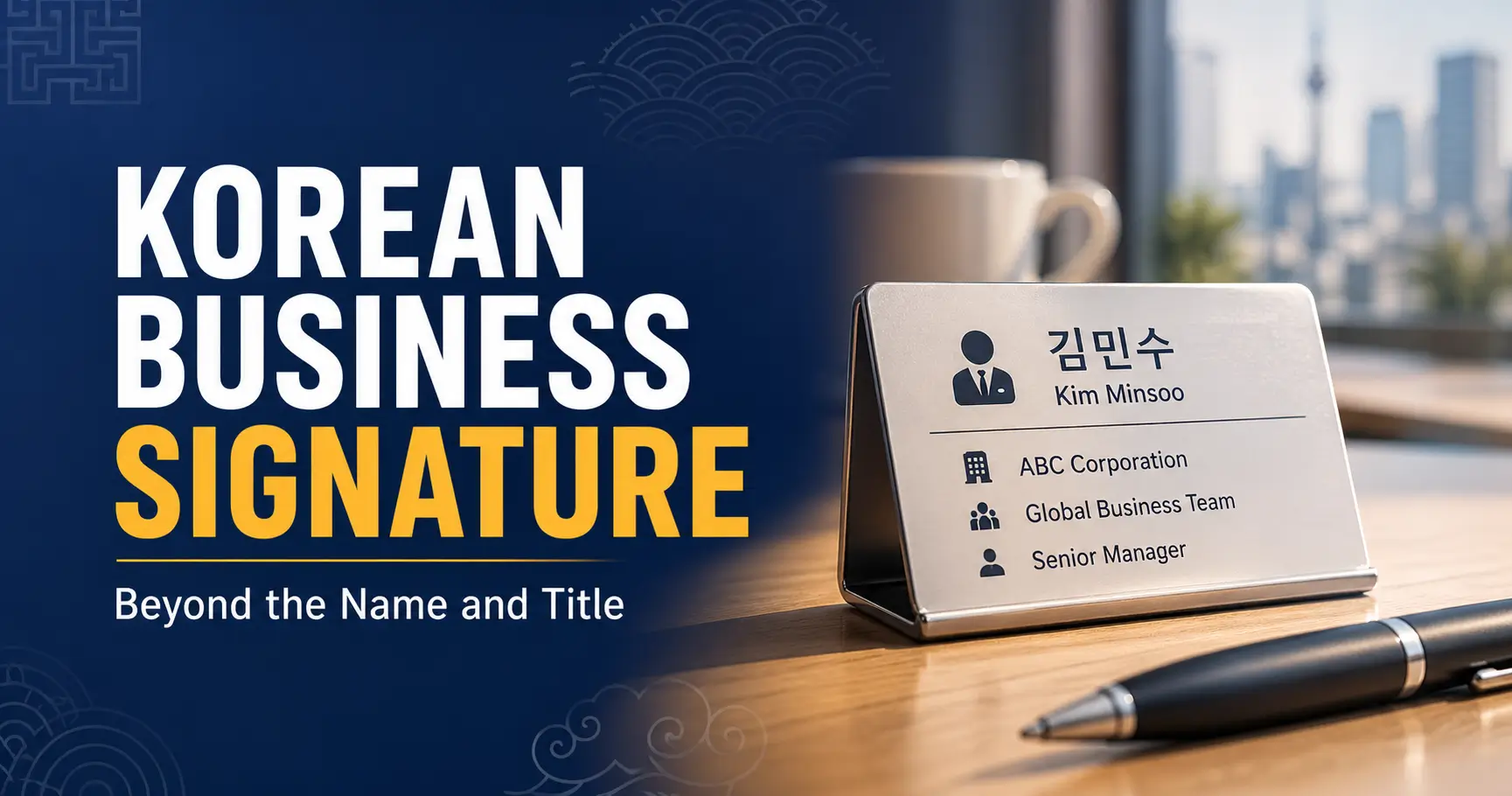
Decoding the Korean Business Signature:
Beyond the Name and Title
You can learn a surprising amount about a Korean office before anyone opens a slide deck. Sometimes the real clue is hiding in the small block under an email: name, department, company, and title.
For Anglo-American readers, this is where Korean business etiquette can feel slippery. A job title is not just a label for what someone does; it signals seniority, respect, and decision authority. Guess wrong, and the exchange can become quiet, slow, or oddly stiff—like a meeting room where everyone politely notices a chair in the wrong place.
Adjust when the relationship gives you permission.
Table of Contents
Start Here: A Korean Job Title Is Not Just a Label
Why a title can tell you how to speak before the meeting starts
In many US workplaces, a job title often explains what someone does. Director of Marketing. Product Manager. Senior Analyst. Useful, yes, but not always emotionally loaded. In a Korean office, a title often does more social work. It can hint at seniority, responsibility, age-adjacent respect, decision authority, and how direct your language should be.
That does not mean every Korean workplace is stiff. It means the room usually has a readable structure. The title is one of the signs on the wall.
I once watched an American colleague open a meeting with cheerful first-name energy. Nothing exploded. Nobody frowned. But the Korean side became just a shade quieter, the way a concert hall changes when someone coughs during the first violin entrance. The problem was not friendliness. The problem was timing.
The hidden map inside one short email signature
A Korean email signature can look compact, but it often carries a full map: company, division, team, title, phone number, sometimes mobile, sometimes address. That title tells the reader whether the sender is likely gathering information, making recommendations, negotiating, approving, or speaking on behalf of a senior decision-maker.
The practical point: do not skim past the signature like it is wallpaper. Read it as a small instruction manual.
Why US readers often underestimate the emotional weight of rank
US business culture loves the myth of flatness. Even when the company is not flat at all, people may still say, “We are all on a first-name basis here.” Korean workplace culture is often more honest about structure. Rank exists, so language gives it a place to sit. For a deeper cultural layer, it helps to understand how Korean titles and first names carry different social weight before you decide how casual to sound.
- Use the title to judge formality.
- Check the department to understand context.
- Do not rush into first-name casualness.
Apply in 60 seconds: Before replying to a new Korean contact, read their signature twice and note title, team, and company order.
The Office Ladder You Can Hear in Everyday Korean
From 사원 to 대리 to 과장: why rank often enters the conversation
Korean corporate titles vary by company, industry, and generation, but many office workers recognize a rough ladder. You may see titles such as 사원, 대리, 과장, 차장, 부장, 이사, 상무, 전무, and 대표. The English translations can feel slippery because “manager” does not always map cleanly across systems.
For a US reader, the biggest mistake is treating each title as a perfect equivalent. 대리 is often translated as assistant manager or senior staff, but the meaning depends on the company. 과장 may be manager or section chief. 부장 may be department head or general manager. The translation gets you into the room. It does not always tell you where the chairs are.
팀장님, 부장님, 대표님: titles as social coordinates
In Korean, people may be addressed by title rather than first name. A team leader may be called 팀장님. A department head may be called 부장님. A company representative or CEO may be called 대표님. These are not merely labels. They are coordinates.
Imagine walking into a building where each doorway has a sign: “speak casually here,” “be careful here,” “wait before disagreeing here,” “send the summary after the meeting here.” Titles do some of that work.
The “-님” ending and why it softens the whole room
The honorific 님, often romanized as “nim,” adds respect. It can attach to titles, names, and roles. In business settings, using a title plus 님 often creates a safe, polite default. It is not syrupy. It is not theatrical. It is more like putting a coaster under a hot cup. Small, but it prevents a mark. Readers who are new to this system may also want a broader primer on Korean honorifics for foreigners, because the workplace version is only one room in a much larger house.
Simple Visual Map: How Titles Often Function
사원
Often newer or non-managerial staff.
대리, 과장
Often handles workstreams or coordination.
차장, 부장
Often closer to team or department decisions.
이사, 상무, 전무, 대표
Often signals high authority.
Reader caution: titles shift by company. Use this as a compass, not a courtroom transcript.
Email Signatures Work Like Tiny Business Cards
What the signature is really saying before the first sentence
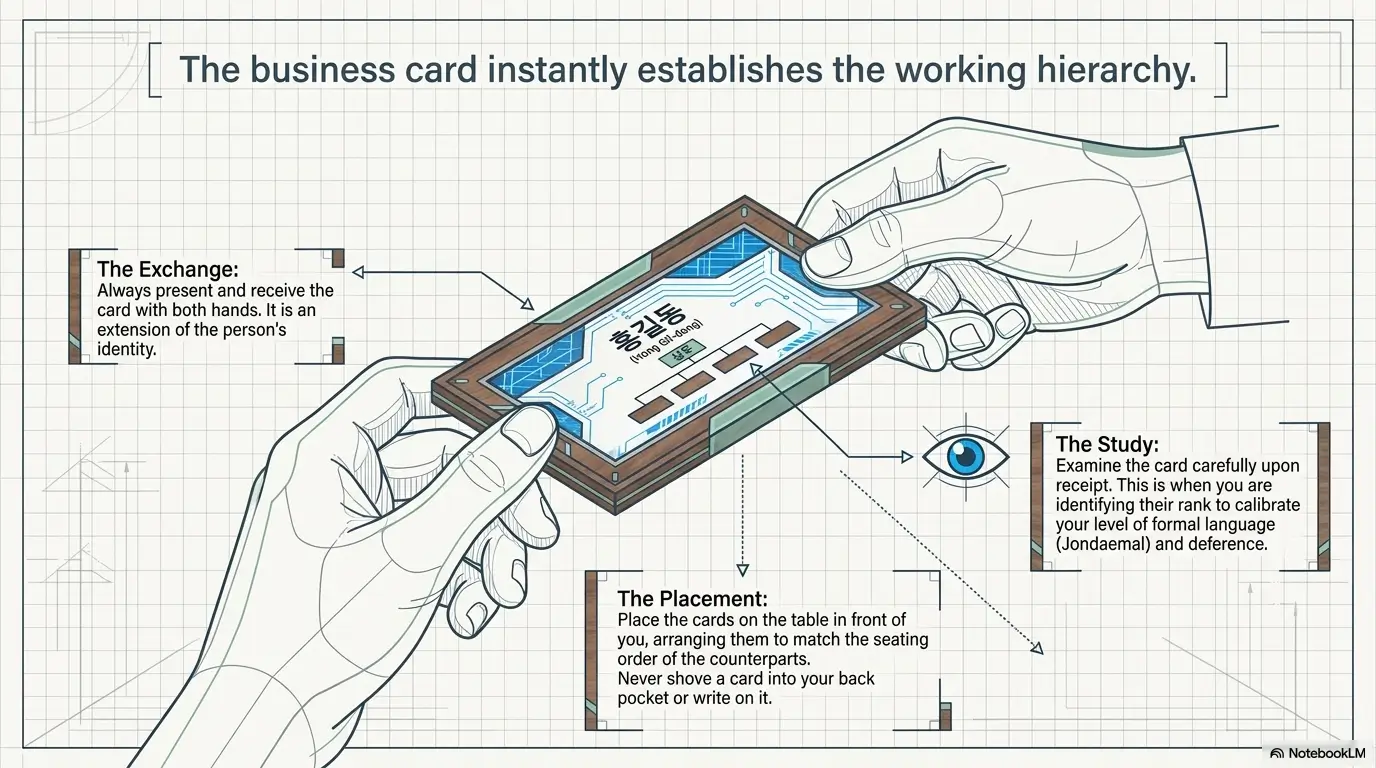
An email signature in a Korean business exchange can do the work of a business card before the actual business card appears. It tells you identity, affiliation, role, and sometimes the correct path for follow-up. If the email body is the conversation, the signature is the seating chart.
In US email culture, people often cut signatures down to a name and phone number. Minimalism feels efficient. In Korean business communication, a fuller signature can feel more complete because the reader needs context. A title is not vanity glitter. It is a practical cue.
Department, title, company name: the quiet order of credibility
When you see department and title together, pay attention. A “Sales Manager” in one company might be a decision-maker. In another, that person may prepare materials for someone more senior. A “Team Leader” may have meaningful authority in daily operations. A “Director” may be a formal executive title or an English rendering of a Korean rank.
This is where many cross-border emails wobble. The American reader thinks, “Great, I know their job.” The Korean sender may assume, “Great, they know how this should be routed.” Those are not always the same thing.
Why leaving out a title can feel oddly unfinished
If someone sends a title-free email in English, it may feel casual and modern. But in a Korean-facing business context, a missing title can create uncertainty. Who is this person? Are they junior, senior, external, internal, technical, administrative, or executive? The reader may need 2 or 3 extra emails to figure out the communication path.
That tiny ambiguity can slow down a project. Not dramatically. More like sand in a suitcase wheel.
Decision Card: Minimal Signature vs. Context-Rich Signature
| Use this | When it works | Risk |
|---|---|---|
| Minimal signature | Internal US team, familiar contacts, informal thread | May feel incomplete in a Korean business exchange |
| Context-rich signature | New Korean contact, vendor, partner, senior audience | Can look heavy if overdesigned |
Neutral action: Use a fuller signature for first contact, then simplify only after the relationship settles.
Hierarchy Is Not Always Cold Authority
In Korean offices, rank often carries responsibility, not just power
It is tempting to read Korean hierarchy as a simple power pyramid. That is too thin. In many offices, rank also carries obligation. Senior people may be expected to absorb risk, represent the team, guide juniors, attend difficult meetings, and protect harmony when a project becomes loud and smoky.
This does not make every hierarchy healthy. Some are rigid. Some are inefficient. Some make honest feedback harder than it should be. But if you read every title as ego, you will miss the responsibility side of the system.
Why junior staff may speak carefully even when they have strong ideas
A junior colleague may have a sharp idea and still present it gently. They may say, “It may be difficult,” when they mean, “This will not work.” They may ask a question instead of issuing a correction. The idea is still there. It is just wearing a formal coat.
I have seen brilliant Korean junior staff save a project with one careful sentence. The sentence looked small on paper. In the room, it redirected the whole river.
Here’s what no one tells you: silence may be strategy, not agreement
In a US meeting, silence is often read as consent, confusion, or disengagement. In a Korean business context, silence can also mean respect, calculation, disagreement deferred, or a decision waiting for the right person. The quiet is not empty. Sometimes it is crowded. That pattern becomes easier to read when you understand Korean silence in conversation as a social signal, not simply a lack of response.
If you are the foreign partner, do not bulldoze the silence. Leave room for follow-up. Send a written summary. Ask whether the team would like time to review internally. That one sentence can save everyone from a public corner.
Show me the nerdy details
In cross-cultural communication, titles reduce uncertainty by encoding role, distance, and expected speech level. This is especially useful in high-context communication environments, where not every boundary is stated directly. The title helps both sides avoid overfamiliarity, misrouting, and public disagreement before trust has developed. This is closely related to Korean indirect communication, where what is unsaid may still carry weight.
Recommended External References
-
U.S. International Trade Administration: South Korea Business Travel and Etiquette Guidance
Useful for business-card etiquette, meeting behavior, and practical expectations when working with Korean partners. -
U.S. International Trade Administration: South Korea Market Entry Strategy
Helpful for understanding why relationship-building, regular communication, and local context matter in Korean business. -
Korea.net: Key Points to Remember When Learning Korean
Relevant background for Korean formality, polite endings, and why respectful language shapes social and workplace communication.
The First-Name Mistake Americans Make Too Quickly
Why “just call me Mike” may not travel cleanly across cultures
Americans often use first names to show equality and warmth. “Just call me Mike” sounds open, friendly, and efficient. In a Korean business exchange, that same line can create a puzzle. Is Mike inviting real casualness? Is this just American style? Should the Korean colleague mirror it? Would that sound rude in front of others?
The phrase is not wrong. It simply may arrive before the relationship has a shelf to hold it.
Don’t flatten the room before you understand the room
Some rooms are genuinely casual. Korean startups, global teams, creative agencies, and English-heavy companies may use English names, first names, or flatter internal titles. But you should let the room reveal that to you. Flattening everything immediately can feel less like friendliness and more like walking into someone’s house and rearranging the furniture because your apartment has a better layout.
Start formal. Watch. Then adjust.
When English-language friendliness creates Korean-language awkwardness
The trickiest moments happen when the email is in English but the relationship still sits inside Korean business culture. English makes casual address feel available. Korean context may still require careful respect.
That is why “Dear Mr. Kim” or “Dear Director Kim” may be safer than “Hi Jisoo” when you are writing for the first time. Once they reply with an English name and casual sign-off, you can soften. The same principle appears in digital spaces too, where Korean texting formality can change depending on age, role, closeness, and the room around the message.
- Use formality as a bridge, not a wall.
- Wait for the other person’s cue before becoming casual.
- Remember that English language does not erase Korean context.
Apply in 60 seconds: Replace your first-contact “Hi First Name” habit with “Dear Title Last Name” when writing to a senior Korean contact.
Titles Protect Everyone From Social Guesswork
The title gives both people a safe opening script
A title gives both sides a script before the relationship has its own rhythm. This is useful because early business exchanges are full of unknowns. Who can approve the budget? Who should receive the technical attachment? Who needs to be copied? Who should be addressed carefully in front of the group?
Titles do not answer everything, but they reduce the number of guesses. That matters when one wrong guess can make the first exchange feel clumsy.
Why formality can feel warmer than forced casualness
Many Americans hear “formal” and imagine cold marble floors. But formality can also be care. It says, “I do not know you well enough to assume, so I will give you respect first.” In Korean business culture, that can feel warmer than premature casualness. This is one reason Korean politeness often works less like a personality trait and more like a shared safety rail.
I once received a Korean email that was extremely formal but oddly comforting. Every sentence had a clear place. The greeting, the request, the thanks, the signature. No confetti. No forced sparkle. Just a well-swept path.
Let’s be honest: nobody wants to guess the wrong level of respect
Most people are not trying to be difficult. They are trying not to embarrass themselves or the other person. Titles create a shared starting point. They give the conversation shoes before it steps into the room.
Eligibility Checklist: Should You Use a Formal Title?
- Yes if this is your first exchange with the person.
- Yes if the person appears senior in the signature.
- Yes if other Korean colleagues use the person’s title.
- Yes if the email includes executives, clients, or external partners.
- No, maybe soften if the person explicitly invites first-name use.
Neutral action: When unsure, begin formal and let the relationship earn casualness.
The Title That Travels Outside the Office Door
Why work titles may appear at meals, meetings, and introductions
In some Korean business settings, a title can follow a person beyond the desk. It may appear during introductions, restaurant seating, group greetings, business card exchange, and after-hours work meals. This can surprise Americans who mentally clock out of titles once the meeting ends.
But in Korea, workplace relationship and social relationship may overlap more visibly. The title keeps the hierarchy legible even when the setting changes from conference room to dinner table. That overlap becomes especially visible in Korean office lunch culture, where meals may still carry workplace rhythm, seniority, and group awareness.
Business cards, seating order, and greetings as one etiquette system
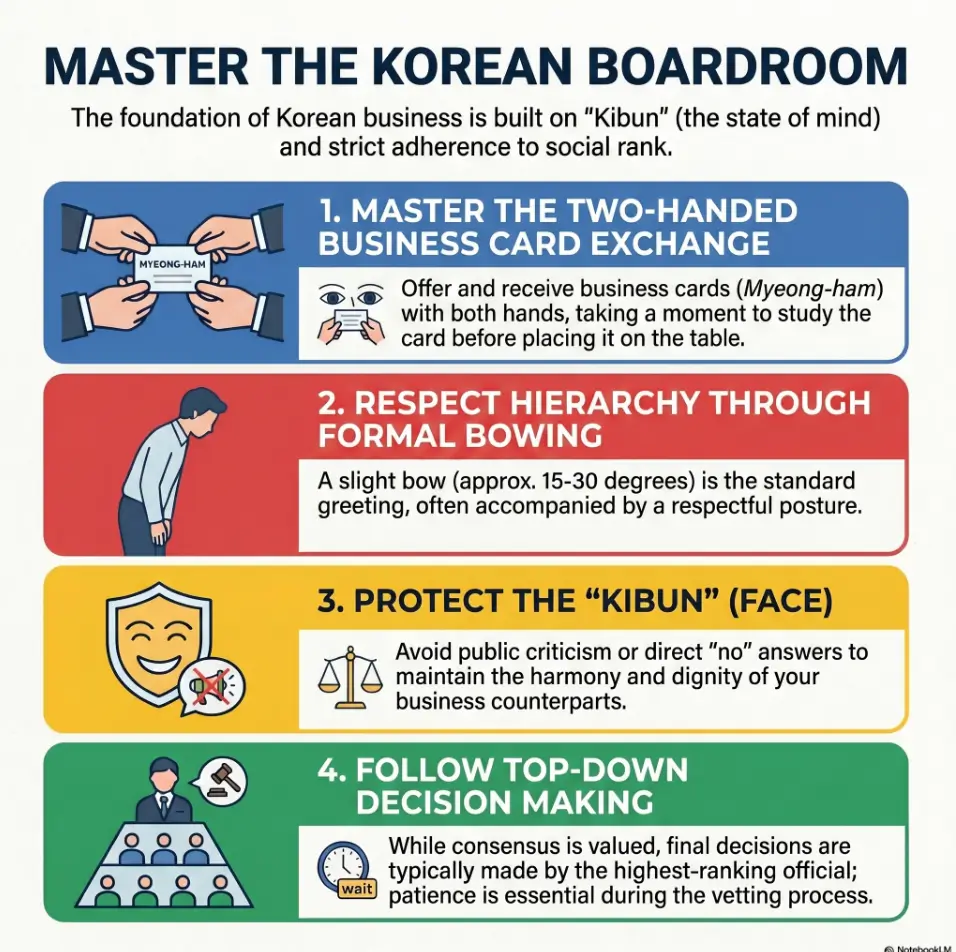
Do not treat titles, business cards, seating order, greetings, and email signatures as separate etiquette trivia. They belong to the same system. The system asks: Who is senior? Who is hosting? Who speaks first? Who receives the card with two hands? Who should be addressed with extra care?
Once you see the system, the details become less random. The room stops looking like a maze and starts looking like a map. If you want a practical companion to this, study both Korean seating hierarchy and how to hand business cards politely, because those gestures often speak before the agenda does.
When a title becomes part of someone’s public identity
A senior title may become part of how someone is known in business circles. That does not mean the person is vain. It means the title is socially useful. It tells others where that person stands, what responsibilities they carry, and how to approach them.
In a relationship-driven business culture, identity is not only personal. It is relational. The title is one thread in that fabric.
- Expect titles in introductions and group settings.
- Watch how Korean colleagues address each other.
- Use business cards and signatures as context clues.
Apply in 60 seconds: In your next Korean-facing meeting, write down how each person is introduced and mirror that wording in follow-up.
Common Mistakes: What Not to Do With Korean Job Titles
Mistake 1: Translating titles too literally into US corporate terms
The title “manager” is a known troublemaker. It looks simple and then steals your lunch. In Korean-English business translation, “manager” may be used for several ranks, not all of which match US managerial authority. A person may manage tasks but not people. Another may manage people but need senior approval for final decisions.
So do not assume that the English title gives you the entire authority picture. Read the title, then read the behavior, email routing, and meeting flow.
Mistake 2: Assuming “manager” means the same thing everywhere
In a US company, manager often suggests direct reports. In a Korean context, it may be a translation choice for rank, responsibility, or external readability. The same word can carry different luggage.
When money, contracts, deadlines, or legal commitments are involved, ask process questions instead of rank questions. “Who should review the final version?” is usually better than “Are you the decision-maker?” One is practical. The other can sound like you are checking someone’s badge at the door.
Mistake 3: Dropping honorifics because English feels more casual
English can lure people into informality. But if the Korean side is using titles, formal signatures, and careful language, do not strip all that away in your reply. You do not need to perform Korean fluency. You do need to respect the signal.
Mistake 4: Reading hierarchy as personality instead of structure
A careful junior employee is not necessarily timid. A senior person who speaks last is not necessarily disengaged. A formal email is not necessarily unfriendly. The structure shapes the behavior.
Reading hierarchy as personality creates needless friction. It is like blaming the violin for playing in the key printed on the sheet music.
Quote-Prep List: What to Gather Before Comparing Korean Business Contacts
- Full email signature, including Korean and English title if available.
- Department or team name.
- Who copied whom on the email thread.
- Who speaks first and last in meetings.
- Who sends the final approval or summary.
Neutral action: Use these clues before deciding how direct your next message should be.
For US Teams: How to Write to Korean Colleagues Without Overdoing It
Start more formal, then adjust when invited
The safest default is simple: begin formal, then relax when the other person gives you permission. You do not need to write like a nineteenth-century ambassador trapped in a spreadsheet. Just avoid instant casualness.
A clean first email might begin with “Dear Director Kim” or “Dear Mr. Park,” depending on the information you have. If they sign the next reply “Best, Daniel,” and use your first name, you can usually soften your tone.
Use title plus family name when the relationship is new
When you know the title and family name, use them. If you do not know the title, use a polite English fallback such as Mr., Ms., or full name. If you are unsure about gender, full name can be safer than guessing.
For Korean names, remember that family name often comes first in Korean order, as in Kim Minji or Park Jisoo. But many Korean professionals use Western order in English contexts. Check the signature. It is your little etiquette lantern.
Mirror the signature until the person gives you another cue
If the signature says “Jisoo Kim, Senior Manager,” do not immediately write “Hey Jisoo!” in a first reply. Try “Dear Ms. Kim” or “Dear Senior Manager Kim” if the title seems appropriate. If they reply casually, follow their lead.
Keep warmth in the message, not in premature informality
Warmth does not require first names. You can be respectful and human at the same time. Thank them clearly. Summarize next steps. Avoid blunt demands. Give deadlines with context. Use please and thank you without turning the email into a lace curtain.
- Mirror the title and signature.
- Use direct structure but softened phrasing.
- Let the Korean contact set the pace of casualness.
Apply in 60 seconds: Save one formal opening and one polite closing in your email snippets today.
Who This Is For, and Who It Is Not For
For expats, remote workers, vendors, students, and cross-border teams
This guide is for people who need a practical bridge. Maybe you are an American vendor writing to a Korean client. Maybe you are an expat preparing for office life in Seoul. Maybe your remote team now includes Korean colleagues, and you want fewer awkward openings.
You do not need to become an etiquette scholar. You need a few reliable defaults that keep the door open.
For Americans who want fewer awkward openings and better trust
Trust often begins before the main request. It begins in the greeting, the title, the order of names, the level of directness, and whether you seem to notice the other person’s context. These are small signals. Small signals are exactly where trust likes to hide.
Not for stereotyping every Korean workplace as identical
Korean workplaces are changing. Startups, global tech companies, creative firms, universities, conglomerates, family businesses, and government-adjacent organizations do not all communicate the same way. Some teams use English names. Some flatten titles internally. Some maintain traditional rank language. Some mix everything and somehow survive Monday.
So treat this guide as a set of useful defaults, not a cage.
Not for memorizing rank charts without reading the room
Rank charts help, but they can also seduce you into fake certainty. The room matters more. Watch who defers to whom. Watch who summarizes. Watch who approves. Watch who is copied after a meeting. Korean job titles are clues, not magic x-ray goggles.
FAQ
Why do Koreans use job titles instead of first names at work?
Koreans often use job titles at work because titles signal respect, seniority, and relationship distance. In a structured office, using a title can help both people avoid awkwardness. It tells the speaker how formal to be and tells the listener that their role is recognized.
Should I call a Korean colleague by their English name or Korean title?
Use the cue they give you. If their email signature uses an English name and they sign casually, you can usually use that name. If the exchange is formal, senior, or new, start with title plus family name or a polite English form of address. Adjust after they invite a more casual tone.
What does “nim” mean after a Korean job title?
“Nim” is an honorific ending that adds respect. In business settings, it often appears after titles such as 팀장님, 부장님, or 대표님. You do not need to force Korean words into an English email, but understanding “nim” helps you recognize why title-based address matters.
Is it rude to use only someone’s name in a Korean office?
It can be, depending on rank, relationship, age, and company culture. Using only a name may sound too casual if the relationship is new or the person is senior. In English-heavy teams, names may be normal. The safest move is to mirror the other person’s signature and the team’s usage.
Why do Korean email signatures include detailed titles and departments?
Detailed signatures help readers understand where the sender sits in the organization. Department, title, and company name can clarify authority, responsibility, and the right follow-up path. In cross-border communication, this context can prevent delays and misread expectations.
Do startups in Korea still care about job titles?
Some do, some do not, and many sit somewhere in the middle. Korean startups may use flatter titles, English names, or global communication habits, especially in tech and creative sectors. Still, hierarchy can reappear when investors, executives, clients, or older partners enter the conversation.
How should Americans address senior Korean business partners?
Start formal. Use title plus family name when available, or Mr. or Ms. plus family name if you are unsure. Keep your message clear, polite, and organized. Do not rush into first-name address unless the senior partner invites it.
What should I do if I do not know someone’s Korean title?
Use a polite English fallback and ask through context rather than bluntly. You can write, “Dear Ms. Lee,” or use the full name if you are unsure. In the body, keep the tone respectful. Then watch the reply signature for the better cue.
Next Step: Save One Respectful Default Script
Use this when replying to a Korean colleague for the first time
The fastest way to improve your Korean business emails is not memorizing every title. It is saving one respectful default script. That script protects you when the room is unfamiliar.
Formal-First Email Template
Subject: Follow-up on our discussion regarding project timeline
Dear Director Kim,
Thank you for your message. I appreciate the context you shared. I have summarized the next steps below so your team can review them easily.
- Item 1: Confirm the preferred timeline.
- Item 2: Share the updated document.
- Item 3: Review any questions from your team.
Please let me know if there is someone else I should include in the next update.
Best regards,
Your Name
Neutral action: Save this as a snippet and adjust the title, name, and next steps before sending.
Match their signature, keep the tone clear, and avoid instant casualness
The curiosity loop from the beginning closes here: the title in the email signature is not decorative. It is a tiny business card, seating chart, and tone guide folded into one. If you read it carefully, you do not need to guess wildly. You already have a respectful starting point.
That is the quiet magic of titles in Korean business culture. They are not only about status. They help strangers begin without stepping on each other’s shoes.
One concrete action: create a “formal-first” email template before your next Korean business exchange
Take 15 minutes and build one template now. Include a formal greeting, a short thanks, a clean summary, a polite next-step question, and a complete signature. That little template can spare you from three common problems: sounding too casual, misreading authority, and making the other person do extra social work.
Final thought: In Korean offices, a title is rarely just a title. It is a small lantern. Hold it up before you walk into the conversation.
Last reviewed: 2026-04.