
Decoding the Hidden Grid:
Navigating Life via the Korean Resident System
You can live in Korea for weeks before noticing the resident registration system, then one ordinary task—opening a bank account, verifying a phone number, or using a delivery app—turns into a tiny locked door with fluorescent lighting.
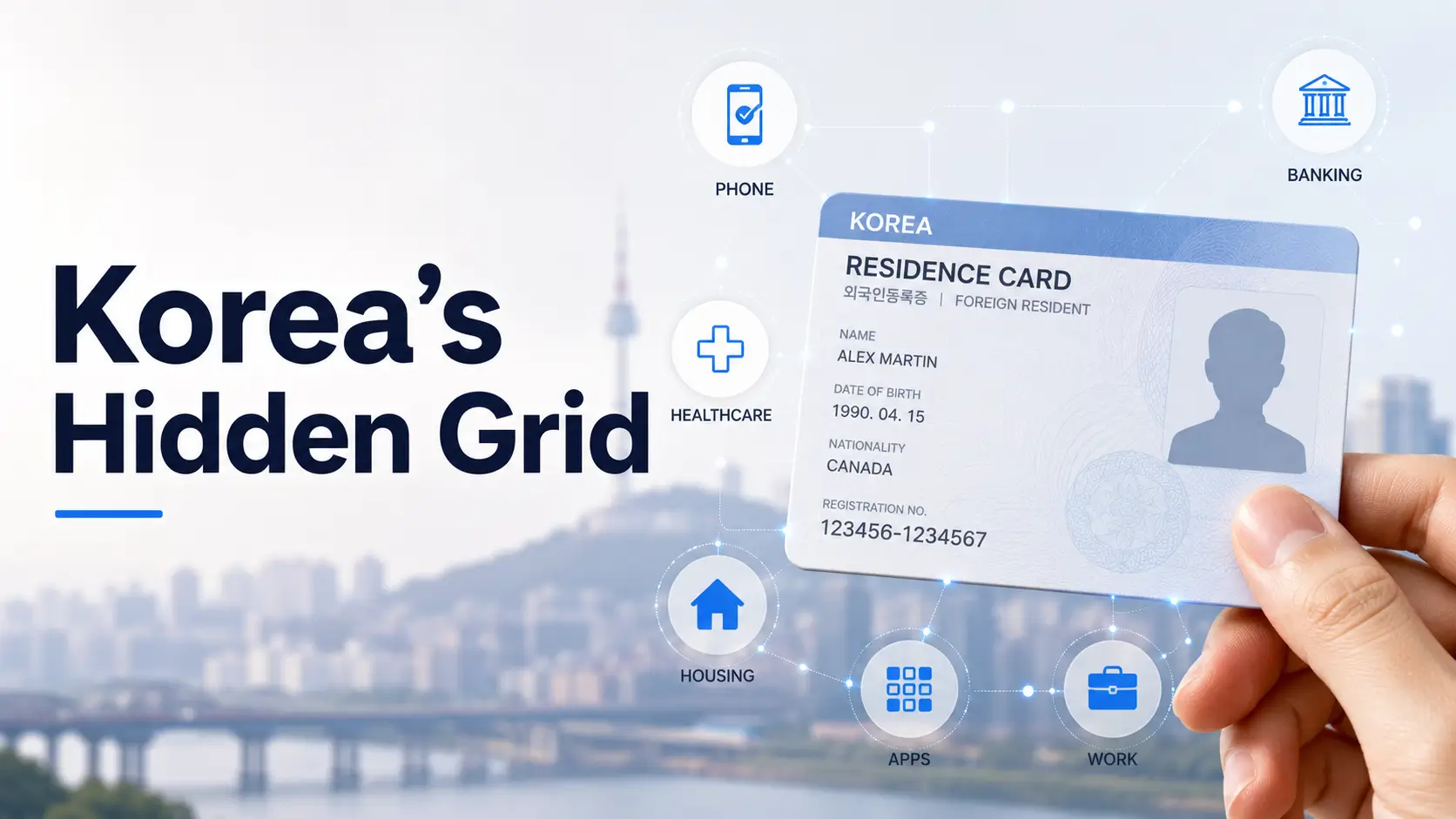
Resident registration is the identity-and-address framework that connects public offices, banks, and healthcare. For foreign residents, the Residence Card is your daily-life key, linking your immigration status to your phone, banking, and insurance records.
The pain is rarely dramatic; it is the maddening almost-finished moment where the form still says “no” despite having your card in hand. Small mismatches can delay payroll, clinic visits, and basic app access.
Table of Contents
The Hidden Grid Behind Korean Daily Life
Why “resident registration” is more than an ID number
In the United States, identity often feels scattered. Your driver’s license, Social Security number, address, phone number, bank account, insurance card, and school records sit in separate drawers. Sometimes those drawers talk to each other. Sometimes they behave like divorced raccoons fighting over a sandwich.
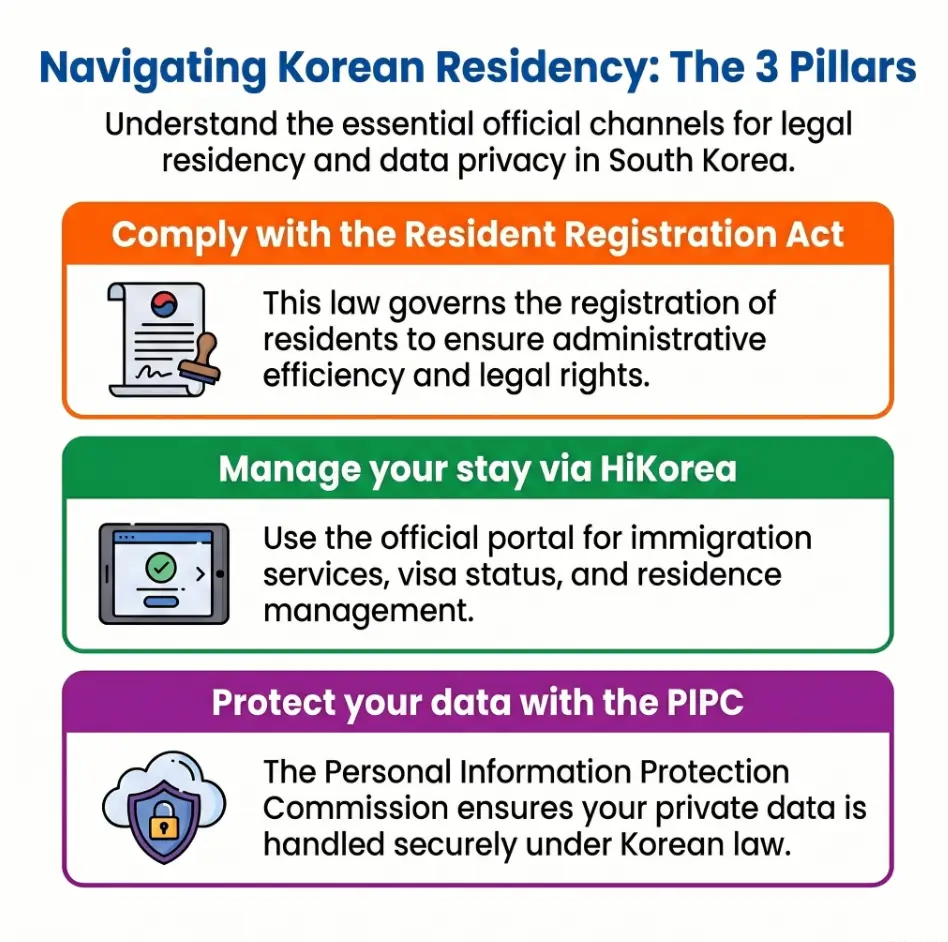
Korea’s resident registration system feels different because it was built around a stronger administrative spine. The Resident Registration Act describes its purpose as promoting convenience in residents’ lives and processing administrative affairs properly by clearly understanding residential status and population movement. That sounds dry, yes. But daily life is where dry law turns into wet pavement under your shoes.
The practical meaning is simple: Korea often asks, “Who are you, where do you live, and can this be verified?” before it gives you the smooth version of a service.
The address-first logic foreigners often miss
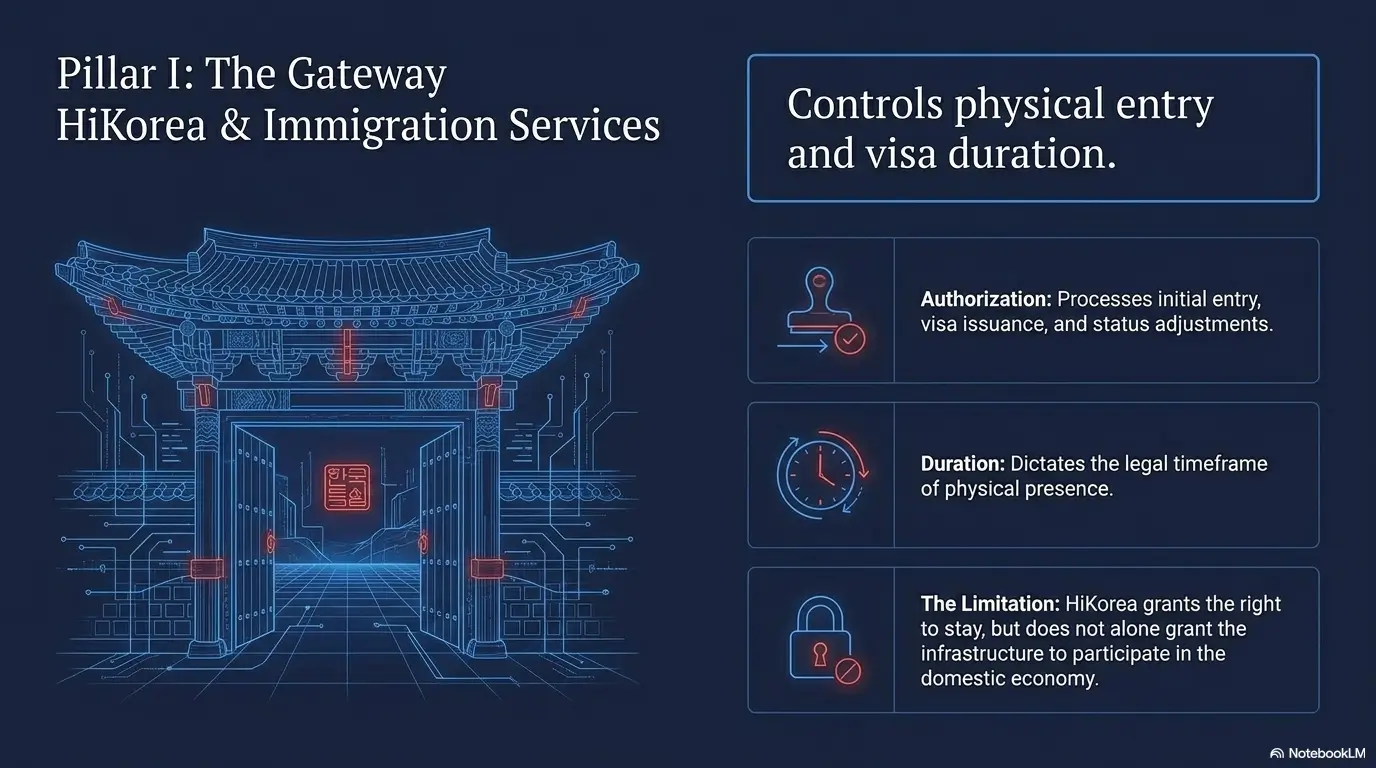
Many foreigners arrive thinking an address is just where delivery chicken lands. In Korea, address can also decide which local office handles your record, which immigration office has jurisdiction, where notices may go, and which neighborhood services recognize you.
I once watched a friend update his apartment address with one service, then discover two weeks later that another account still thought he lived across town. Nothing dramatic happened. No thunder. Just a polite wall of “please verify again,” which is somehow more exhausting than thunder.
- Your address can determine which office or service handles you.
- Your name format must match across systems.
- Your phone number often works best when tied to verified identity.
Apply in 60 seconds: Write your legal name exactly as it appears on your Residence Card and passport, then use that version everywhere.
Here’s what no one tells you: Korea runs on verified belonging
The real story is not that Korea “loves bureaucracy.” That is too easy, and frankly, too grumpy. The better story is that Korea has built much of everyday convenience on verified belonging. Once you are inside the grid, things can move with astonishing speed. Before you are inside, even a basic form can feel like a locked glass door.
This is why foreigners often experience Korea in two layers. The visible layer is fast trains, delivery apps, hospital efficiency, and cashless payments. The invisible layer is the identity architecture that quietly decides whether those conveniences open for you. For the food-at-your-door side of that world, Korean delivery etiquette offers a helpful cultural companion to the technical verification story.
Reader shortcut: When something fails in Korea, do not only ask, “Is the app broken?” Ask, “Which part of my identity bundle is not matching?”
Who This Is For, And Who Should Skip It
For Americans moving to Korea for work, study, marriage, or long stays
This guide is for the person who has a visa, a suitcase, a half-formed KakaoTalk contact list, and one very sincere plan to “figure it out when I get there.” That plan works for buying convenience-store triangle kimbap. It works less well for banking, mobile verification, housing paperwork, and immigration appointments.
If you are moving for English teaching, university study, corporate work, marriage, research, military-adjacent family life, or remote work with a long stay, your Residence Card will likely become the hinge on which ordinary routines swing. If your move is family-based, the broader paperwork picture may also overlap with Korea F-6 visa planning, where identity, marriage records, and residence status sit very close together.
For tourists wondering why some apps feel locked behind a glass door
Tourists feel the edges of the system too. You may get a prepaid SIM, use maps, ride transit, and pay with an international card. Then one app asks for domestic identity verification and the music stops. The violin does not break. It just refuses to tune.
That does not mean Korea is impossible for visitors. It means some domestic services were designed around residents, not temporary guests. The difference matters.
Not for people seeking case-specific immigration or legal advice
This article will not tell you which visa to choose, how to solve a rejected application, or whether your exact immigration timeline is compliant. For that, use official immigration resources, your school or employer’s international office, or a qualified professional.
| Situation | Prepare now? | Next step |
|---|---|---|
| Staying under 90 days as a visitor | Yes, lightly | Know which apps may require domestic verification. |
| Staying over 90 days | Yes, seriously | Plan Residence Card registration and appointment timing. |
| Opening bank, phone, insurance, or school records | Yes | Use one exact name format across all systems. |
Neutral action: Before comparing services, gather passport, visa details, Korean address, phone plan information, and Residence Card status.
The First Surprise: Your Address Has Administrative Weight
Moving house is not just “updating your profile”
In many American routines, moving means forwarding mail, updating Amazon, and discovering that your tape dispenser vanished into the moving-box underworld. In Korea, moving can mean administrative reporting obligations and updates across services that rely on your registered address.
For foreign residents, address changes can matter to immigration records, banking records, phone accounts, insurance, school documents, and local services. The exact steps depend on your status and situation, so treat moving as an administrative event, not just a furniture event. A practical Korean apartment move-in checklist can help you think beyond boxes, keys, and the ceremonial first convenience-store run.
Why neighborhood offices matter more than they look
Korean neighborhood offices may look humble from the outside. Fluorescent lights. Number tickets. Someone calmly helping three people at once. But these offices are a working surface of the state. They connect residents to certificates, local records, welfare-related services, and address-based administration.
A visitor may walk past one without noticing. A resident learns quickly that the small office down the street is not small in the way that matters.
The quiet power of being in the right jurisdiction
Jurisdiction is one of those words that sounds like it escaped from a courthouse wearing stiff shoes. In daily life, it means the right office must often handle the right person at the right address. Immigration offices, local offices, and public services may organize work by where you live.
If you move from one district to another, do not assume every system follows you automatically. Some systems may update smoothly. Others may require your hand on the wheel.
The Korea Identity Grid: one mismatch can ripple outward
Passport and Residence Card spelling
Jurisdiction, notices, local records
Domestic verification and app access
Payments, transfers, payroll
Health records and benefits routines
Delivery, shopping, booking, portals
Pattern: The smoother the service feels, the more likely it depends on identity matching behind the curtain.
The Phone Number Trap Most Foreigners Meet First
Why a Korean phone number is not always enough
Foreigners often think the phone problem ends when they buy a Korean SIM. The phone rings. Data works. Maps load. Life appears civilized again. Then a verification screen asks for your name, carrier, birth date, and phone number, and suddenly your cheerful SIM becomes a tiny plastic philosopher: “But who are you, really?”
In Korea, a phone number can be more than contact information. It can be a verification tool tied to a registered identity. If the number is prepaid, tourist-oriented, under another person’s name, or formatted differently from your official record, some verification flows may reject it. Before choosing a carrier, it helps to compare Korean phone plans for Americans with identity verification in mind, not just data speed and price.
When your SIM works, but your identity verification does not
This is the classic “almost signed up” problem. You can receive calls. You can use mobile data. You can text your landlord. Yet the app’s identity check fails because its system expects a resident-linked carrier record.
I have seen people try the same verification form ten times, changing capitalization like it was a spell. Sometimes the issue was not the app. It was the record behind the number.
Don’t do this: assuming prepaid phone access equals full digital access
Prepaid SIMs can be excellent for visitors. They are not always enough for long-stay life. If you plan to open a bank account, use domestic payment apps, sign up for delivery services, or rely on government portals, ask the carrier what type of identity verification the plan supports.
| Option | Best for | Trade-off |
|---|---|---|
| Tourist prepaid SIM | Short visits, maps, messaging, basic calls | May fail domestic identity verification. |
| Resident-linked phone plan | Long stays, banking, apps, official services | Usually requires proper resident documentation. |
Neutral action: Before choosing a plan, ask whether it supports PASS or carrier-based identity verification for foreign residents.
Banking Starts With Identity, Not Just Money
Why banks ask for more than a passport
In Korea, opening a bank account is not just a bank deciding whether it likes your deposit. Banks must verify identity, purpose, contact details, and sometimes additional documents depending on account type and risk controls. Your passport may prove you are a person. It may not prove enough about your Korean resident status, address, phone linkage, or transaction purpose.
This can surprise Americans because US banking often feels fragmented but flexible. Korea can feel stricter at the front door, then remarkably efficient once your identity is properly seated at the table. The social part of that same front-door logic also shows up in Korean business etiquette, where titles, introductions, and trust signals often matter before the actual transaction begins.
The Residence Card moment: when financial life finally opens
For many long-stay foreigners, the Residence Card is the moment life moves from improvised to integrated. Payroll becomes easier. Transfers become easier. Mobile banking becomes more realistic. Payment apps stop treating you like a ghost wearing a backpack.
The card does not magically solve every account issue. Banks still have internal policies. Branches may interpret documents differently. But without a Residence Card, many residents find themselves stuck in the lobby of ordinary life.
Mobile residence cards are changing the front door, but not removing the lock
Korea has been expanding digital identity tools, including mobile forms of official ID. That can reduce friction in some settings, but it does not erase the underlying logic. The system still wants verified identity. The lock may become digital; the door still has a lock.
- Bring your passport and Residence Card when available.
- Use the exact same English name order across phone and bank records.
- Ask what documents are needed before visiting a branch.
Apply in 60 seconds: Create one note on your phone with your official name order, Korean address, carrier, bank branch, and document list.
Apps, Deliveries, And The Tiny Friction Nobody Warns You About
Food delivery, shopping, and payment apps often expect domestic verification
Korea’s app ecosystem is a small orchestra of convenience. Food arrives quickly. Payments glide. Reservations snap into place. But some of that music assumes you have domestic identity verification already tuned.
Apps may ask you to verify through your carrier, bank certificate, domestic card, or identity service. Foreign users can sometimes join smoothly. Other times, the form rejects a name, fails a phone match, or refuses an international card. It feels personal. Usually, it is not personal. It is a system expecting a shape you do not yet fit.
The “almost signed up” problem
The most emotionally irritating part is not total rejection. Total rejection is clear. The worse feeling is being 95% finished. You chose a password, entered your address, selected chicken, imagined the crispness, and then identity verification fails at the final gate. That is not dinner. That is theater.
When this happens, check the identity chain: legal name, phone carrier record, Residence Card number, bank card, app language settings, and address format.
Let’s be honest… convenience feels different when the form rejects your name
English names can be troublemakers in Korean systems. Middle names, hyphens, spaces, long surnames, and order differences may create mismatches. A bank may store your name as SURNAME GIVEN MIDDLE. A phone carrier may store GIVEN MIDDLE SURNAME. An app may only accept a limited character pattern.
This is where patience becomes a practical skill. Not spiritual patience. Administrative patience. The kind involving screenshots, branch visits, and not yelling at a dropdown menu. Because so many app questions eventually drift into messaging, verification, and response timing, KakaoTalk etiquette is also useful for understanding the social layer wrapped around Korea’s digital routines.
| Bring or capture | Why it helps |
|---|---|
| Exact error message screenshot | Support can identify whether it is phone, name, card, or app failure. |
| Official name format | Prevents support from guessing your record order. |
| Carrier and bank record names | Shows where mismatch may occur. |
| Korean address format | Delivery and identity systems may parse addresses differently. |
Neutral action: Save screenshots before retrying repeatedly. Ten failed attempts rarely improve the mood of a database.
Healthcare And Insurance: Where Registration Becomes Practical
Why registration can affect access to benefits and records
Healthcare is where Korea’s administrative system becomes less abstract. Once you are properly registered and connected to eligible insurance routines, clinics and hospitals can often process visits with impressive efficiency. Records, eligibility, payments, and prescriptions move through a system that expects verified identity.
This is not the same as saying every foreigner gets the same benefits at the same time. Eligibility depends on status, length of stay, employment, insurance rules, and changes in policy. The practical lesson is humbler: healthcare works best when your administrative identity is not blurry. For a cultural-practical look at what happens after the paperwork works, see why Korean clinics are so fast.
How long-stay foreign residents move from visitor status to resident routines
A visitor can receive medical care, of course. But a long-stay resident begins to live differently. You learn which clinic is near your apartment. You keep your card in your wallet. You learn that a pharmacy can be both efficient and emotionally soothing after a feverish morning.
One winter, I watched someone handle a clinic visit in under 40 minutes because their records matched cleanly. Another person spent longer explaining a name mismatch than describing symptoms. The body had a problem, but the paperwork demanded an opening act.
The difference between being present and being administratively visible
You can be physically in Korea and still not fully visible to Korean systems. That gap matters. Being administratively visible means your identity can be recognized across the routines that make life stable: clinic visits, insurance billing, employer paperwork, school records, and notices.
Show me the nerdy details
Korea’s identity-linked services work through multiple layers rather than one magical master switch. A resident record, immigration record, phone carrier record, financial institution record, insurance eligibility file, and app database may each store a version of your identity. A service can fail when one layer cannot match another. For foreign residents, the most common friction points are Romanized name order, middle-name handling, hyphen spacing, carrier registration type, recent address changes, and timing delays after a card or record update.
- Keep your Residence Card available for clinic visits.
- Confirm insurance enrollment rules based on your status.
- Update address and phone details when they change.
Apply in 60 seconds: Save your nearest clinic, pharmacy, and insurance contact point in one note.
Work, School, And Family Life Run Through The Same Gate
Employment records, tax paperwork, and payroll identity checks
Work life in Korea is not just about the contract you sign. It is also about whether payroll, tax, insurance, immigration status, bank account, and employer records align. A mismatch may not explode. It may simply delay salary, block a portal, or create a quiet email chain with too many attachments.
For employees, the Residence Card often becomes part of proving identity and status. For employers, accurate records help manage tax withholding, social insurance, and compliance obligations. Nobody wants payroll to become interpretive dance. Once inside the office, the same systems-and-signals mindset appears in nunchi at work in Korea, where reading context can be almost as important as reading the form.
School enrollment and dependent records for foreign families
Families feel the system in another way. School enrollment, dependent records, health insurance, housing contracts, and family relationship documents can all intersect. International schools, Korean schools, universities, and local offices may ask for different documents, and translation or notarization requirements may vary.
If you are moving with children, start earlier than your inner optimist wants. Your inner optimist is charming. It is also usually wrong about paperwork timelines. Families navigating school pressure may also want to understand Korean hagwons for foreign families, because education logistics often grow out of the same address, identity, and neighborhood routines.
Why one missing document can create a domino line of delays
One missing document can delay the next step, which delays the next appointment, which delays the next account, which delays the moment your life finally stops feeling temporary. The dominoes are small, but they fall with excellent posture.
| Tier | Readiness level | What changes |
|---|---|---|
| Tier 1 | Passport only | Basic travel functions, limited resident services. |
| Tier 2 | Korean address and phone access | Better communication, still possible verification limits. |
| Tier 3 | Residence Card issued | Banking, employment, and official routines become easier. |
| Tier 4 | Phone, bank, address, card aligned | Domestic verification succeeds more often. |
| Tier 5 | Records maintained after moves or renewals | Fewer surprise blocks during normal life. |
Neutral action: Treat each new job, school, apartment, or renewal as a record-sync moment.
Common Mistakes Foreigners Make With Korean Registration
Mistake 1: Waiting too long to book immigration appointments
Foreigners planning to stay in Korea for more than 90 days generally need foreign resident registration within the required timeline. Appointment availability can be tight, especially near university intake periods and hiring waves. Waiting until the last week is a bold strategy in the same way carrying soup in your pocket is bold.
Book early, check jurisdiction, and confirm your document list with official or institution-specific guidance. Schools and employers often provide checklists, but you should still verify current requirements.
Mistake 2: Using slightly different names across bank, phone, and immigration records
This is the quiet villain. JOHN MICHAEL SMITH in one system. SMITH JOHN MICHAEL in another. JOHN M SMITH somewhere else. Every version looks like you to a human. To a verification system, they may look like cousins who met once at a wedding.
Use the exact spelling and order from your official documents whenever possible. Ask the bank and carrier how they store foreign names. Write it down.
Mistake 3: Forgetting that address changes can affect multiple services
Moving apartments can trigger updates across immigration, bank, phone, insurance, employer, school, and delivery profiles. Do not assume one update travels everywhere. Korea is efficient, not telepathic.
Mistake 4: Treating the Residence Card as optional once life “mostly works”
Sometimes a foreigner can improvise for a while. A friend helps with an app. A prepaid SIM works. Cash and cards cover the basics. But “mostly works” is fragile. The first bank issue, clinic visit, job change, or renewal can reveal the missing foundation.
- Book immigration appointments early.
- Keep one official name format across systems.
- Update address changes in every relevant place.
Apply in 60 seconds: Make a checklist titled “After I move” and list immigration, bank, phone, employer, insurance, school, and apps.
Short Story: The Name That Would Not Fit
A graduate student from Oregon arrived in Seoul with two suitcases, one winter coat, and a middle name long enough to need its own subway seat. Her university record used all three names. Her phone carrier dropped the middle name. Her bank reversed the order. For three weeks, she could attend class, buy coffee, and ride the subway, but one food delivery app treated her like a rumor.
The fix was not heroic. No grand speech. She visited the carrier, confirmed the stored name, adjusted her bank record where possible, and began using one exact format for every new account. The lesson was painfully ordinary: in Korea, convenience often begins with boring consistency. She later joked that her first real Korean phrase should have been not “hello,” but “please check the spacing.”
The Privacy Question: Convenience Has A Shadow
Why Korea’s system feels efficient and intimate at the same time
Korea’s identity systems can feel wonderfully efficient. They can also feel intimate in a way that unsettles foreigners. When one number, card, or phone record unlocks many services, the convenience is real. So is the sensitivity.
The Personal Information Protection Act is Korea’s main privacy law, and the Personal Information Protection Commission is a key authority in this area. That does not mean you should hand over ID details casually. Good law is not a substitute for good habits.
What foreigners should understand before handing over ID details
Your Residence Card, registration number, passport, phone verification code, and banking information deserve caution. Be especially careful with unknown websites, informal landlords, strangers asking through chat apps, or anyone pressuring you to send full card images without a clear reason.
A legitimate office or institution may need identification. A random person in a chat room does not become legitimate by adding a polite emoji. That boundary can be easier to hold when you also understand Korean personal questions etiquette, because curiosity, paperwork, and privacy do not always live in separate rooms.
The practical rule: verify the requester before sharing your number or card
Before sharing sensitive details, ask three questions: Who is requesting it? Why is it needed? Is there an official channel? This one-minute pause can save weeks of cleanup.
- Use official portals where possible.
- Do not send full ID images through casual chat unless you have verified the need.
- Cover unnecessary details when a partial copy is acceptable.
Apply in 60 seconds: Create a “safe sharing” rule: no full ID image unless the requester, purpose, and channel are verified.
Why Koreans May Not Notice What Foreigners Find Strange
Systems feel invisible when they were built around you
Most Koreans do not experience resident registration as exotic. It is part of life’s furniture. You do not admire the chair every time you sit down. You only notice the chair when one leg is missing.
For citizens, resident registration begins early and follows ordinary life through school, housing, healthcare, voting-related records, tax routines, certificates, and local administration. The system’s assumptions fit them from the beginning. Foreigners arrive mid-song and have to learn the rhythm while holding luggage.
The cultural gap between “prove who you are” and “just let me sign up”
American digital culture often tolerates looser signups. Email, password, maybe a card. Korea often wants stronger identity proof for domestic services. Neither approach is pure virtue. Loose systems can be easier and messier. Strong verification can be safer and more exclusionary.
The friction foreigners feel is often the gap between these defaults. One side says, “Just let me use the service.” The other side says, “First, prove you are the correct person in the correct system.” The same deeper pattern appears in everyday language and hierarchy too, which is why understanding Korean titles versus first names can make the identity-first culture feel less mysterious.
The real story is not bureaucracy. It is trust infrastructure.
The hook at the start was about floor heating: invisible until one cold corner reveals the system. Resident registration works the same way. It is not merely a government file. It is trust infrastructure. It tells banks, clinics, schools, apps, and offices that you are legible to the system.
That legibility can feel empowering once it works. Before it works, it can feel like standing outside a warm restaurant, watching your own dinner get verified.
FAQ
Do foreigners in Korea get a resident registration number?
Foreigners generally do not receive the same resident registration number used for Korean citizens. Long-stay foreigners usually use foreign resident registration through immigration systems and receive a Residence Card with a foreign registration number. The card serves as a key identity document for many daily routines.
Is a Residence Card the same as a Korean resident registration card?
No. A Korean resident registration card is for Korean citizens. A Residence Card, formerly commonly called an Alien Registration Card or ARC, is issued to eligible foreign residents. In daily life, both can function as important ID documents, but they come from different legal and administrative systems.
Why do Korean websites ask for identity verification so often?
Many Korean websites and apps are designed around domestic identity verification. This can help reduce fraud, confirm age, connect payments, or verify account ownership. For foreigners, the challenge is that the verification flow may require a resident-linked phone number, matching name format, domestic card, or compatible identity record.
Can I open a Korean bank account without a Residence Card?
Sometimes limited options may exist, depending on the bank, branch, visa, documents, and purpose. However, many long-stay foreigners find banking much easier after receiving a Residence Card. Ask the specific bank branch what it currently requires before you go.
Why does my Korean phone number not work for every verification screen?
Your phone number may work for calls and data but not for identity verification. Some verification systems check whether the number is registered under your verified identity with a carrier. Prepaid, tourist, corporate, or mismatched-name plans can cause problems.
What happens if I move apartments in Korea?
Moving can require updates to immigration and other services depending on your status. You may also need to update banks, phone carriers, employer records, insurance, school records, and delivery apps. Treat moving as a record-sync task, not just a change of scenery.
Is Korea’s resident registration system safe for personal data?
Korea has privacy laws and regulators, including the Personal Information Protection Act and the Personal Information Protection Commission. Still, identity data is sensitive. Use official channels, avoid casual sharing of full ID images, and verify why information is being requested.
Why do delivery and payment apps feel harder for foreigners?
Many apps assume domestic verification, Korean-name formats, local card systems, or resident-linked phones. Foreigners may run into name spacing, card compatibility, or phone verification issues. Once your phone, bank, card, address, and Residence Card records align, many services become easier.
Next Step: Build Your Korea Identity Checklist Before You Need It
One concrete action: make a “name, phone, address, card” consistency sheet
The best time to build your Korea identity checklist is before a form rejects you at 11:47 p.m. while your dinner cools into a diplomatic incident. You do not need a fancy spreadsheet. You need one accurate place where your core identity details live.
Include your passport name, Residence Card name, Korean address, phone carrier name format, bank name format, visa type, immigration office jurisdiction, and important renewal dates. Keep it secure. Do not store full sensitive numbers in an unprotected note.
Check your records before opening bank, phone, insurance, and app accounts
Before you open or change an account, compare the details. Does your phone carrier use the same name order as your bank? Does your address match your current residence? Did you recently renew your card? Has the system had time to update?
Think of this as tuning an instrument before the concert. Not glamorous. Absolutely audible.
Save official contact points before a small mismatch becomes a paper-dragon
Save links and phone numbers for immigration, your local office, your bank branch, your carrier, your employer or school office, and your insurance support channel. When something fails, you want a map, not a panic picnic.
- Record official name formats across systems.
- Track address, phone, bank, insurance, and card updates.
- Keep official contact points in one safe place.
Apply in 60 seconds: Create a secure note called “Korea Identity Checklist” and add your exact passport name first.
Conclusion
Korea’s resident registration system shapes daily life because it sits under the ordinary things: the phone in your hand, the bank card in your wallet, the clinic visit on a rainy Tuesday, the delivery app that either opens smoothly or sulks at your middle name.
For foreigners, the system can feel strict, intimate, and occasionally maddening. But it is not random. The pattern is clear: verified identity comes before convenience. Once you understand that, the country becomes less confusing. Not always easier, but more legible. And legibility is the first lantern in any new place.
Your next step is small: spend 15 minutes building your Korea Identity Checklist. Start with exact name format, phone carrier, address, Residence Card status, bank record, and key official contacts. Future you may not applaud, but future you will quietly exhale.
Last reviewed: 2026-05
Tags: Korea resident registration, Residence Card Korea, expat life Korea, Korean identity verification, moving to Korea
Meta description: How Korea’s resident registration system affects phones, banking, healthcare, apps, housing, privacy, and daily expat life.