The Civic Stage: Decoding the Visual Symphony of Korean Campaigns
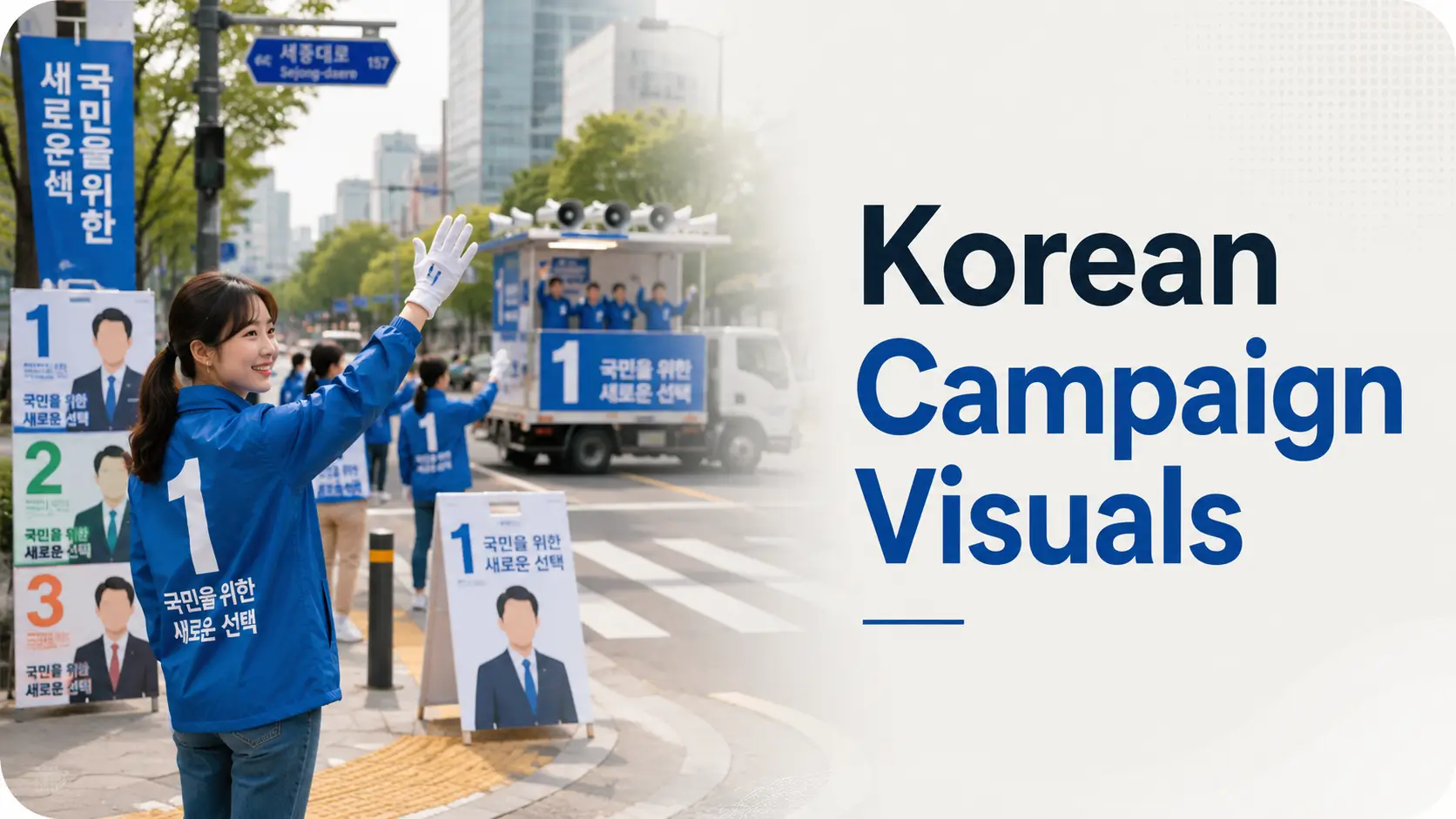
A Korean election season can ambush you at an ordinary crosswalk. One week the corner is just a bakery, a bus stop, and someone balancing iced coffee like civic infrastructure. The next week, the same corner has candidate faces, numbered signs, matching jackets, waving campaign workers, and a truck that seems to have swallowed a small concert stage.
That is why Korean election seasons feel hyper-visual even to people who do not follow politics. The campaign does not wait politely inside a news app. It walks into streets, markets, apartment roads, subway exits, and daily errands. For US readers used to TV ads, yard signs, mailers, and social feeds, the Korean version can feel startlingly physical.
Here is the useful lens:
- • Not party drama.
- • Not a prediction game.
- • Not “who will win?” whispered over coffee.
This is public communication design: color, number, face, sound, timing, and repetition. Once you see the pattern, the city stops feeling chaotic and starts looking like a temporary civic stage with rules, rituals, and a very loud soundtrack.
The Quick Map: Why It Feels So Intense
Korean campaign visuals work because they meet people where attention already lives: sidewalks, stations, intersections, markets, apartment entrances, and neighborhood routes. Candidate numbers simplify recognition. Party colors create seasonal mood. Posters build repetition. Campaign trucks add motion and sound. Street teams turn politics into a short-lived performance that even nonpolitical residents cannot fully ignore.
Table of Contents
Who This Is For, And Who Should Skip It
For Korea-Curious Readers Who Notice the Posters First
This article is for readers who are Korea-aware but not necessarily election-obsessed. Maybe you are an American traveler in Seoul, an expat in Busan, a student writing about Korean public culture, a diaspora reader comparing memories, or a culture watcher who noticed that Korean campaigns look louder, brighter, and more choreographed than expected.
You may not know the candidates. You may not follow party platforms. You may not even know which election cycle is happening. Still, you can feel that something has changed in the street.
That sensation is worth studying. It tells us how politics enters daily life before it becomes opinion.
Not for Readers Looking for Party Predictions
This is not a voting guide. It is not a candidate profile, polling roundup, ideology map, or “which side is winning” forecast. The point is not to tell readers what Korean voters think. That would require careful polling, language context, regional context, and a giant pot of coffee.
The point is narrower and more useful: why the visual environment becomes so noticeable, even when you are not trying to notice it.
The Safer Lens: Public Design, Not Partisan Drama
Think of Korean election season as a temporary redesign of public space. The usual visual grammar of the street, store signs, delivery scooters, school uniforms, cafe menus, apartment notices, suddenly has a new layer.
That layer is political, yes. But it is also logistical. It is regulated, scheduled, repeated, and performed.
- Focus on placement, timing, repetition, and recognition.
- Avoid treating every loud sign as a deep ideological clue.
- Notice how ordinary routes become campaign channels.
Apply in 60 seconds: Pick one street corner and ask, “What changed here during the campaign window?”
The First Shock: Politics Does Not Stay on the Screen
From News Feed to Crosswalk
In the United States, many people experience campaigns through screens first: TV ads, YouTube pre-rolls, social posts, fundraising emails, texts, podcasts, and the occasional yard sign migration. Even when politics becomes loud, it often arrives through private devices or car-dependent spaces.
In Korea, especially in dense cities, campaigning often becomes part of the pedestrian world. You can meet it while buying tteokbokki, leaving a subway station, waiting for the light, walking past an apartment entrance, or trying to remember whether you bought trash bags for the correct district. That last one is its own civic exam.
This street-level quality is one reason campaign season feels so immediate. It is not only watched. It is crossed, heard, sidestepped, and walked past.
Why US Readers May Feel the Difference
US campaigns can be visually intense too, especially during presidential years. But American campaign visibility is spread across a larger geography, a longer media cycle, and more private or semi-private channels. Many voters see yard signs, bumper stickers, mailers, rallies, and digital ads. Yet a neighborhood does not always feel physically transformed overnight.
In Korea, density changes the math. One intersection can carry a large share of local daily movement. Put posters, banners, campaign workers, and a moving sound truck near that intersection, and the campaign becomes unavoidable. It is attention design with sneakers on.
Here’s What No One Tells You…
Political indifference does not protect the eye.
A person may not follow the National Assembly, presidential politics, local councils, or party debates. Still, the campaign can reach them through repetition. The same candidate face appears by the station. The same color appears near the market. The same truck passes near the apartment road. The same number lands in the mind before policy does.
That does not mean the person is persuaded. It means the public environment has performed its basic function: making the election visible.
Color, Number, Face: The Three-Second Recognition Machine
Candidate Numbers Work Like Visual Shortcuts
Korean ballots and campaign materials often make candidate numbers highly visible. For casual observers, a number is faster to remember than a name, platform, district history, or party faction. It becomes a handle.
This is especially powerful in motion. A walker, driver, cyclist, or bus passenger may have only two or three seconds to process a poster. A number cuts through visual clutter. It says, “Remember me quickly.”
For Americans, this can feel unusual because US campaign identity usually leans harder on names, slogans, party labels, and candidate biography. Korea’s number-forward campaign design adds a different recognition layer.
Party Colors Become Civic Weather
Color turns politics into atmosphere. A street lined with repeated campaign colors does not merely show information. It changes how the place feels.
The effect can be oddly seasonal. Election colors arrive like sale banners, school festival posters, or holiday decorations, except with more stern faces and fewer pastries. A neighborhood can feel washed in a temporary palette. Even if you do not know the party details, you feel the color rhythm.
This is why Korean election visuals can seem larger than the election itself. Color does not ask for close reading. It hits the nervous system first and the policy brain later, if the policy brain has had lunch.
The Face Is the Logo
Large candidate portraits are not accidental decoration. They are recognition tools. In a busy street, a face can do what a paragraph cannot: create instant familiarity.
That does not mean trust is automatic. It means repeated visibility lowers the distance between stranger and public figure. The face becomes a civic logo, a human signboard, a repeated invitation to remember.
Money Block: The Three-Second Visual Read
| Signal | What You Notice First | What It Helps You Do |
|---|---|---|
| Number | Fast numeric cue | Remember a candidate under time pressure |
| Color | Party or campaign palette | Recognize political grouping from a distance |
| Face | Candidate portrait | Attach identity to memory |
| Slogan | Short promise or theme | Create a quick emotional frame |
Neutral action line: When you see campaign material, name the first signal your eye catches before judging the message.
Campaign Trucks Turn Streets Into Moving Billboards
Movement Beats Static Posters
A poster waits. A truck arrives.
That difference matters. Campaign trucks add motion, sound, height, lights, staff presence, and route repetition. They do not simply occupy public space. They travel through it, sometimes slowly enough to feel theatrical.
For someone walking through a Korean neighborhood, a campaign truck can dominate attention for a few minutes. It may carry large candidate images, amplified speech, music, hand gestures, and a small team of people dressed in matching colors. A static poster says, “Look if you want.” A campaign truck says, “The election has entered the chat.”
The City Becomes the Media Buy
In a dense urban area, the city itself becomes a campaign channel. Intersections are not only traffic nodes. They are attention nodes. Subway exits are not only transit points. They are people funnels. Markets are not only food and errands. They are social circulation.
Korean campaign teams know this. So do street vendors, convenience stores, tutors, cafes, religious groups, universities, and anyone who has ever placed a banner where people already move. The campaign truck is one version of a broader Korean public-communication habit: meet the crowd where the crowd already is.
That same logic appears in many everyday Korean settings. Public behavior often has a choreography, whether you are reading the room at work, navigating nunchi at work in Korea, or learning why timing and indirect cues matter in Korean indirect communication.
Don’t Miss This: The Truck Is Also a Stage
Campaign vehicles are not just moving billboards. They can be mobile stages.
There may be speeches. There may be music. There may be coordinated waving. There may be staff standing in formation. In some cases, passersby witness something closer to a tiny civic performance than a static advertisement.
This does not mean everyone enjoys it. A performance can be effective and irritating at the same time. Anyone who has heard the same campaign tune several times before lunch understands this dual citizenship of the ear.
The Loudspeaker Effect: You Hear the Election Before You Choose to Look
Sound Pulls the Eye
Sound changes visual attention. You may not look at every poster, but a loudspeaker can pull your eyes toward the source. Music, slogans, speeches, and repeated names create a sensory chain: first the ear, then the head turn, then the eye.
This is why sound belongs in an article about visuals. It is not separate. It activates looking.
In a quiet American suburb, a campaign truck might feel wildly intrusive. In a dense Korean district already filled with bus announcements, cafe music, delivery scooters, school bells, construction alerts, and market sellers, the campaign sound joins a thicker public audio world. Still, it can stand out sharply because it is political, rhythmic, and repetitive.
Why Noise Complaints Become Part of the Season
Korean media has often reported complaints about election campaign noise, especially around loudspeaker vehicles in residential and commercial areas. The details vary by election, district, and enforcement context, but the basic tension is stable: campaigns want attention, residents want sleep, and babies do not care about turnout strategy.
For nonpolitical residents, the irritation may have little to do with ideology. It may be the very human experience of hearing amplified slogans before coffee or during a work call.
Let’s Be Honest…
Noise is intimate. A banner is outside your window. A loudspeaker feels inside it.
That is why the loudspeaker effect can shape how foreigners perceive Korean campaigns. They may remember the sound even more than the poster. They may describe the election as “everywhere” because it entered their apartment, their classroom, their cafe table, or their phone call with a parent back home.
- Loudspeakers turn passive streets into active attention zones.
- Noise complaints often reflect daily-life friction, not just political disagreement.
- The campaign becomes memorable because it is heard before it is analyzed.
Apply in 60 seconds: When you hear a campaign truck, notice how quickly your eyes start scanning for it.
Posters Feel Everywhere Because They Are Placed Where Daily Life Already Flows
High-Traffic Placement Creates Passive Exposure
Election posters feel everywhere because they appear where life already flows: sidewalks, transit-adjacent walls, building fronts, neighborhood entrances, markets, and public boards. The secret is not mystical. It is traffic.
People do not need to seek out campaign material. Campaign material enters the route they already use. That creates passive exposure. You absorb the same faces while buying fruit, passing a school, leaving work, or walking toward the subway.
In Korea, daily routes can be compact and repetitive. A person may pass the same station exit, apartment gate, and commercial strip several times a day. Repetition turns a poster into a familiar neighbor with excellent lighting and no small talk.
Repetition Makes Politics Feel Larger Than It Is
Seeing one poster is information. Seeing the same image across multiple errands is atmosphere.
This explains why elections may feel more visually dominant than their actual share of daily life. A campaign image does not need to occupy every surface. It only needs to appear at enough repeated touchpoints to create the feeling of omnipresence.
The Wall Becomes a Voter Information Board
Official campaign posters are not merely decoration. They function as formal voter information in public space. That is one reason damage or defacement can be treated seriously. The poster is part of the election environment, not just a piece of paper with a haircut budget.
For foreigners, this can be easy to miss. A wall of candidate posters may look like street advertising at first glance. In practice, it may be closer to a public notice system designed for recognition and voter awareness.
Money Block: Is This Campaign Visual Informational or Promotional?
- Yes/No: Does it include candidate number, name, party color, or official portrait?
- Yes/No: Is it placed along a high-traffic pedestrian or transit route?
- Yes/No: Does it repeat the same identity cues across several locations?
- Yes/No: Does it appear during the official campaign window?
- Yes/No: Is it designed to be understood in under five seconds?
Neutral action line: If you answer yes to three or more, read it first as voter recognition infrastructure before treating it as simple street clutter.
The Short Campaign Window Makes Everything Feel Compressed
Intensity Replaces Duration
One reason Korean election visuals feel sudden is that official campaign activity is bound by rules and timing. When the visible campaign window opens, the public-facing materials can appear quickly and intensely.
US readers may be used to long campaign seasons that stretch across months or even years. In that environment, campaign signs and ads become a slow drip. In Korea, the public street layer can feel more compressed. It is less like a faucet and more like someone opened the civic umbrella indoors.
Why It Feels Like Someone Turned Up the Brightness Overnight
Visual compression makes change feel dramatic. Posters, banners, trucks, jackets, slogans, and candidate numbers arrive within a limited period. The street you knew on Monday may feel redesigned by Friday.
That shock is not only about volume. It is about contrast. Ordinary Korean streets already have rich visual density: store signs, cafe boards, delivery stickers, apartment notices, school banners, seasonal promotions, safety warnings, and restaurant menus. Election materials join that dense field, but they do so with faces, numbers, and political colors that command a different kind of attention.
The Calendar Is Part of the Design
The campaign calendar shapes perception. When political visuals are allowed and expected within a defined window, the public notices the switch. The city changes costume.
This is familiar in other Korean contexts too. Public life often has strong calendar signals: university festivals, exam days, Chuseok travel, Seollal etiquette, company dinners, seasonal desserts, and campus events. If you have seen how a campus transforms during a Korean university festival, the election-season shift may feel like a more formal cousin: less glitter, more governance.
Show me the nerdy details
Campaign visibility works through what communication researchers often call salience and recall. Salience means a signal stands out from its surroundings. Recall means a person can remember it later. Korean election visuals raise salience through size, color, sound, motion, repetition, and placement near routine paths. They improve recall by repeating simple cues: number, face, name, and color. The system does not require deep attention from every passerby. It works partly because low-attention exposure still leaves traces, especially when the same cues appear across repeated daily routes.
Common Mistakes US Readers Make When Interpreting Korean Campaign Visuals
Mistake 1: Assuming Loud Means Less Serious
A loud campaign style does not automatically mean shallow politics. It may reflect the format of public campaigning, attention competition, legal boundaries, neighborhood density, and long-standing habits of street communication.
This mistake is easy to make because American political seriousness is often coded through debates, endorsements, policy papers, investigative journalism, and solemn podium lighting. Korean campaign visuals can look festive or theatrical. But theater and seriousness are not opposites. Ask any courtroom, church, graduation hall, or military ceremony.
Mistake 2: Reading Every Banner as Grassroots Energy
Visibility does not always equal organic enthusiasm. A banner may represent campaign logistics, permitted placement, party organization, or standard election practice. It may not tell you how voters are leaning.
This matters because foreigners sometimes overread street energy. A candidate with many visible materials may appear dominant to an outsider, but the actual electoral picture depends on polling, turnout, district history, candidate quality, party alignment, local issues, and late-breaking events.
Mistake 3: Treating Korean Election Style as “Just Spectacle”
The reverse mistake is dismissing the visuals as mere spectacle. That misses their function.
Posters, banners, numbers, faces, trucks, and uniforms can carry voter information, support recognition, create campaign presence, and mark election timing. The spectacle is not separate from communication. It is one of its delivery systems.
Money Block: Interpretation Filter for Foreign Observers
| When You See | Do Not Assume | Safer Reading |
|---|---|---|
| A loud truck | The candidate is unserious | Street campaigning is using sound to capture attention |
| Many banners | The race is already decided | Campaign visibility is high in that route |
| Matching outfits | Support is spontaneous | The campaign is creating instant group identity |
| Repeated faces | Everyone likes the candidate | Recognition strategy is working |
Neutral action line: Describe the visual strategy before turning it into a political conclusion.
Why Even Nonpolitical People Remember the Visuals
Familiar Routes Become Memory Hooks
Memory loves routine. The same walk to the subway, the same market entrance, the same apartment road, the same corner cafe: these routes already have a mental map. When campaign visuals appear on that map, they attach themselves to familiar places.
You may not remember a candidate’s platform. But you may remember “the blue poster by the pharmacy” or “the number on the truck near the station.” The place becomes a filing cabinet.
Faces Stick Because They Interrupt Routine
Faces are powerful because humans are built to notice them. A large unfamiliar face on a familiar street interrupts routine. It feels personal, even when it is mass communication.
Korean streets are already rich with faces: beauty clinic ads, tutoring ads, performer posters, restaurant owners, idol images, real estate agents, and local notices. Candidate faces join that world with a different social meaning. They are asking not just to be seen, but to be remembered as public actors.
Numbers Are Easier to Remember Than Platforms
For casual observers, candidate numbers may become more memorable than policy details. That is not a moral failure. It is how low-attention environments work.
A person walking to work is not a debate moderator. They may be thinking about a deadline, a child’s pickup time, a transfer station, a grocery list, or whether the cafe has the good citrus ade today. A number can enter memory where a platform cannot.
Illustrative Scenario: The Number by the Tangerine Stand
On a chilly spring morning in a neighborhood market, a foreign resident stopped at a fruit stall for tangerines. She did not know the candidates, and she was not planning to read election news. But every morning that week, the same campaign truck paused near the crosswalk. The same color flashed across the banner.
The same candidate number sat beside a smiling portrait. By Friday, she still could not explain the platform, but she knew the number, the corner, the jingle, and the face. That is the lesson hidden in the noise: campaign design does not always try to create deep belief on first contact. Sometimes it creates a handle. A small mental hook. Later, if the person chooses to learn more, the hook gives the information somewhere to land.
- Routine lowers the effort needed to notice repetition.
- Faces interrupt familiar streets more strongly than text alone.
- Numbers create quick memory hooks for low-attention observers.
Apply in 60 seconds: Think of one candidate image you remember and identify the exact place where you first noticed it.
The Performance Layer: Jackets, Gestures, Dance, and Street Teams
Matching Outfits Create Instant Group Identity
Campaign uniforms make support visible from far away. A group of people wearing the same color can be understood before a single word is heard. It signals organization, energy, and belonging.
To US readers, this may feel closer to a college event, sports rally, or brand activation than a standard campaign stop. In Korea, public group identity often carries strong visual cues, from school uniforms to company events to campus clubs. If you have read about Korean school uniform culture or Korean campus clubs, you already know that coordinated presentation can do social work before anyone speaks.
Waving Is Not Random
Campaign waving may look simple, but it is a low-friction persuasion tool. It does not demand conversation. It creates presence. It says, “We are here. We see you. Remember us.”
The gesture also softens the campaign’s interruption. A truck may be loud, a banner may be large, but a wave is neighborly. It turns public advertising into a small human exchange, even if the exchange lasts half a second.
The Tiny Theater of the Intersection
An intersection during campaign season can become a miniature stage. Staff stand in formation. Drivers glance over. Pedestrians pass through. A candidate may appear, speak, bow, wave, or move to the next location. The whole scene can feel choreographed because it is trying to be legible in motion.
This is one reason Korean campaign visuals can look so memorable in video clips. They are designed not only to be read, but to be witnessed.
Infographic: The Korean Election Attention Loop
A loudspeaker, chant, or campaign song makes people search for the source.
Color, portrait, number, and banner placement create instant recognition.
The same visuals appear along commutes, markets, stations, and apartment roads.
Repeated cues become familiar even when the viewer is not politically engaged.
Don’t Overread the Visuals: What They Can and Cannot Tell You
Visual Energy Does Not Equal Electoral Outcome
A visible campaign is not automatically a winning campaign. Street presence can suggest organization and resources, but it cannot replace polling, turnout data, local political history, candidate reputation, party alignment, and voter mood.
This is a crucial media-literacy point. Outsiders often treat visible intensity as a proxy for popularity. Sometimes that instinct helps. Often it misleads. A campaign can be loud because it is strong, loud because it is trying to become strong, or loud because that is simply how campaigns operate in that district.
A Loud Campaign May Still Be Legally Ordinary
Many campaign methods that feel intense to foreign observers may exist within formal election rules. South Korea’s Public Official Election Act provides legal structure for campaign periods and election conduct. The details can be technical, but the broader point is simple: noticeable does not automatically mean abnormal.
That said, legality and comfort are different questions. A sound truck may be allowed and still annoy residents. A poster may be formal voter information and still visually crowd a narrow street. Public life often lives in that gray zone between permitted and pleasant.
What the Visuals Actually Reveal
The visuals reveal how campaigns compete for attention in dense cities. They show how law, timing, design, and everyday movement shape political communication. They show how public space becomes a temporary interface between voters and candidates.
They do not, by themselves, reveal the soul of the electorate. That job is above the pay grade of a banner flapping near a convenience store.
The Deeper Reason: Korean Elections Make Democracy Physically Noticeable
Politics Enters the Body Through Noise, Color, and Movement
Democracy is often described through institutions: ballots, debates, parties, courts, laws, counting systems, public offices. All of that matters. But election season also enters the body.
You hear it before you understand it. You see it before you analyze it. You change your walking route around it. You raise your voice over it in a cafe. You glance up from your phone because a campaign song has landed on the street like a brass band wearing sensible shoes.
This bodily quality is why Korean election seasons can feel so memorable. The campaign is not only an information event. It is a sensory event.
Public Space Becomes a Temporary Civic Calendar
Korean public life often marks time visually. Exam banners, seasonal cafe menus, university festivals, holiday gift sets, apartment notices, and neighborhood events all change the look of ordinary places. Election visuals join this calendar, but with a sharper civic edge.
They say: this is the season when public choice becomes visible.
That connection to daily culture is important. If you are trying to understand Korea beyond headlines, it helps to compare election visuals with other public rituals: the collective pulse of Korean exam day rituals, the social coding of Korean meeting etiquette, or the way neighborhood life changes during Chuseok travel.
The Ordinary Street Becomes an Argument
During election season, the street argues without becoming a debate hall. It argues through placement, scale, sequence, repetition, and sound. It says some candidates want to be seen here. It says voters pass through here. It says attention is scarce, and every campaign wants a small piece of it.
That may feel noisy. It may feel festive. It may feel exhausting. It may feel strangely moving if you catch it at the right hour, when the sun is low, the market lights are turning on, and the city seems to be reminding itself that public choice is not abstract. It has corners, speakers, faces, and feet.
FAQ
Why do Korean elections have so many posters and banners?
Posters and banners help voters recognize candidates quickly in busy public areas. They use simple cues such as candidate number, portrait, name, color, and slogan. In dense neighborhoods, repeated street placement can reach people who may not watch campaign news closely.
Why are Korean campaign trucks so noticeable?
Campaign trucks combine movement, height, sound, images, staff presence, and repetition. A poster stays in one place, but a truck can move through apartment roads, markets, intersections, and station areas. That makes it harder to ignore, especially when loudspeakers are involved.
Are Korean election campaigns louder than US campaigns?
They can feel louder at street level. US campaigns often reach voters through TV, digital ads, mail, signs, and texts. Korean campaigns can feel more physical because campaign vehicles and street teams appear in dense everyday spaces. The difference is partly format, partly density, and partly timing.
Do Korean voters actually rely on these visuals?
Some voters already know their choices before they see a poster. Others may use visuals for recognition and awareness. The visuals do not need to persuade every person deeply. They often work by making candidate identity easier to recall during a busy election period.
Is the hyper-visual style unique to Korea?
Not entirely. Many democracies use posters, rallies, banners, vehicles, and public events. Korea’s version can feel distinctive because of urban density, candidate numbers, color coordination, loudspeaker vehicles, street teams, and compressed campaign timing.
Why do people who dislike politics still notice Korean election campaigns?
The campaign is embedded in daily routes. People encounter it while commuting, shopping, walking, waiting at intersections, or passing apartment entrances. Even without political interest, the senses still register color, sound, faces, movement, and repetition.
Are campaign posters legally protected in Korea?
Election posters are treated as part of the formal election environment, and damaging or defacing them can carry legal consequences. For casual observers, the safest approach is simple: look, photograph public scenes respectfully if appropriate, but do not touch or alter campaign materials.
What is the best way for foreigners to understand Korean election visuals?
Start with public communication design. Notice color, number, face, sound, repetition, route, and timing. Then add political context after you have described what is happening. This keeps your interpretation careful, nonpartisan, and less vulnerable to overreading.
Next Step: Do a 10-Minute Election-Season Walk
Count the Visual Triggers
Take one familiar route during campaign season and count five things:
- Candidate numbers you can remember after passing them once.
- Dominant colors that appear more than twice.
- Poster locations near transit, markets, schools, or apartment entrances.
- Campaign vehicles or sound sources.
- Gestures from staff, such as waving, bowing, or coordinated standing.
This small walk can teach more than a long argument online. The street gives receipts.
Separate Observation From Opinion
Write what you saw before deciding what it means. “Three posters near the station” is observation. “Everyone must support this candidate” is interpretation. The gap between the two is where media literacy lives.
This habit is useful beyond elections. It helps when reading Korean office dynamics, family rituals, school culture, and public etiquette. Many social signals in Korea become clearer when you first describe the behavior without rushing to judgment. That is also why topics like Korean politeness and Korean titles versus first names reward slow observation.
One Simple Takeaway
If a campaign can reach someone who is not trying to pay attention, the design is working.
- Count visible cues instead of guessing political meaning.
- Notice where campaign materials appear along daily movement.
- Separate what you observe from what you infer.
Apply in 60 seconds: Open your notes app and make two columns: “I saw” and “I think it means.”
<div style="position:relative;width:100%;max-width:900px;margin:0 auto;padding-bottom:56.25%;height:0;overflow:hidden;border-radius:14px;background:#000;">
  <iframe
    src="https://www.youtube.com/embed/CwpUNUhdZRc"
    title="YouTube video player"
    style="position:absolute;top:0;left:0;width:100%;height:100%;border:0;"
    loading="lazy"
    allow="accelerometer; autoplay; clipboard-write; encrypted-media; gyroscope; picture-in-picture; web-share"
    allowfullscreen>
  </iframe>
</div>
Conclusion: Read the Street Before You Judge the Noise
The crosswalk from the introduction is not just a crosswalk during Korean election season. It becomes a small civic theater. The candidate face, the number, the color, the staff jacket, the truck speaker, the repeated route: each piece helps explain why Korean election seasons feel hyper-visual even to people who avoid politics.
The practical value is simple. When you understand the design, the street feels less random. You can notice the campaign without overreading it. You can respect the legal and civic context without pretending every loudspeaker is delightful. You can see how democracy becomes physical for a short, intense season.
Your next step is small: take one familiar route for 10 minutes and count the cues. Do it before judging the message. The city may not become quiet, but it will become legible.
Last reviewed: 2026-05.
Tags: Korean elections, Korean culture, visual politics, Seoul street culture, media literacy
Meta description: Why Korean election seasons feel so visual: posters, trucks, numbers, colors, sound, and street-level campaign culture explained.