
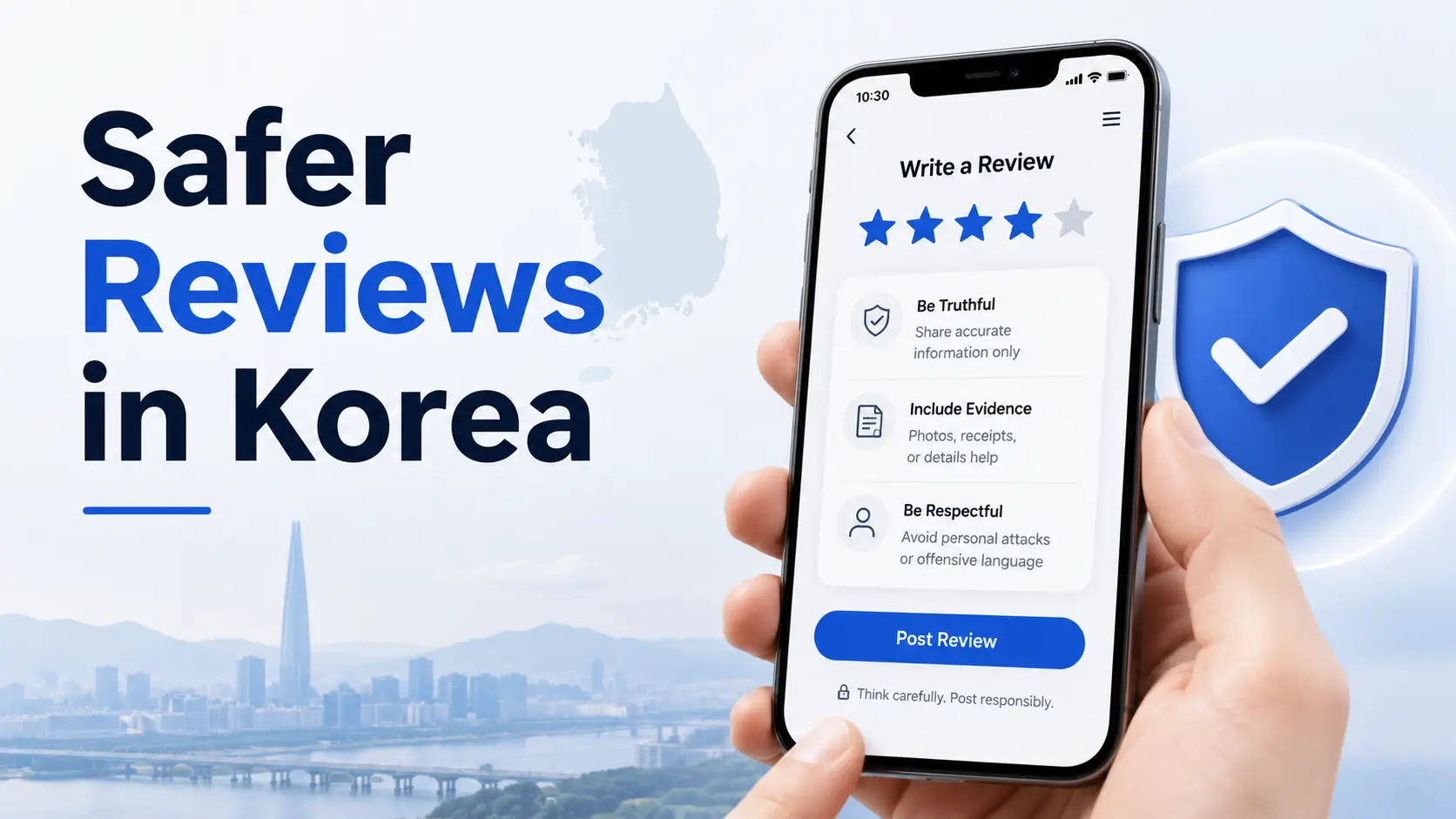
Legal-risk guide for foreigners in Korea
A bad apartment handover, a clinic visit that felt rushed, a hagwon contract dispute, a restaurant bill that made your eyebrows leave your face: in many countries, the next move feels obvious. Open Google, write the review, warn the village. In Korea, that familiar instinct needs a calmer hand.
Korean defamation law can treat online speech differently from what many US and UK readers expect. A review can create risk even when it describes a real experience, especially if it names people, alleges crime, reveals private details, or sounds more like punishment than consumer information.
This guide is not here to make you silent. It is here to help you write with receipts, restraint, and a clean trail. Think of it as a pre-flight checklist before your review leaves the runway.
Lower the heat
Turn anger into specific, verifiable wording that still helps other consumers.
Protect the paper trail
Know what to save before editing, deleting, translating, or replying.
Spot lawyer moments
Recognize when a review is no longer DIY territory.
Useful promise: you will leave with a safer review structure, a risk checklist, and a 20-minute pause routine before you post. 🧭
Snapshot
This guide is for tourists, expats, exchange students, English teachers, creators, renters, patients, and foreign business owners in Korea who want to post honest online reviews without creating avoidable legal risk. You will learn how Korean defamation risk works, what wording becomes dangerous, when evidence helps, when to get a Korean lawyer, and how to run a quick review risk check before publishing.
Contents — choose a section
Table of Contents
Before You Act: What This Guide Can and Cannot Do
This article gives general legal information for English-speaking readers. It is not legal advice, and it cannot judge whether your specific post is safe, unlawful, strategic, or worth publishing.
Korean law can apply to foreigners in Korea, and online review disputes can touch criminal complaints, civil claims, platform removal requests, workplace conflict, housing problems, school issues, immigration stress, and translation errors. If your review involves fraud, crime, medical harm, employment misconduct, sexual harassment, housing retaliation, child safety, privacy, or a named individual, speak with a Korean lawyer before posting.
For broader background, you may also want to read this related guide to defamation law in Korea. This article narrows the lens to online reviews, where one sentence can travel farther than the writer expected.
Before you act
Use this guide to compare risk, improve wording, preserve evidence, and decide whether to pause. Do not use it as a substitute for a lawyer, especially if police contact you, a platform asks for identity details, a business sends a demand letter, or your visa, job, school, clinic care, housing, or business license could be affected.
The practical boundary
A safe review is not just “truthful.” A safer review is narrow, documented, useful to other consumers, and written without unnecessary personal attacks.
That difference matters. “I waited 80 minutes after my scheduled appointment and was not offered an explanation” is a different legal creature from “this clinic scams foreigners.” The first sentence gives a reader usable information. The second sentence throws a legal match into dry grass.
What this guide helps you do
- Understand why Korean online review risk can surprise foreigners.
- Separate firsthand facts from interpretation, insult, and accusation.
- Choose safer wording for landlords, schools, clinics, employers, restaurants, shops, and service providers.
- Preserve evidence without turning private documents into public ammunition.
- Know when DIY posting is not worth the risk.
Korea’s Review Trap: Why “True” Is Not Always Safe
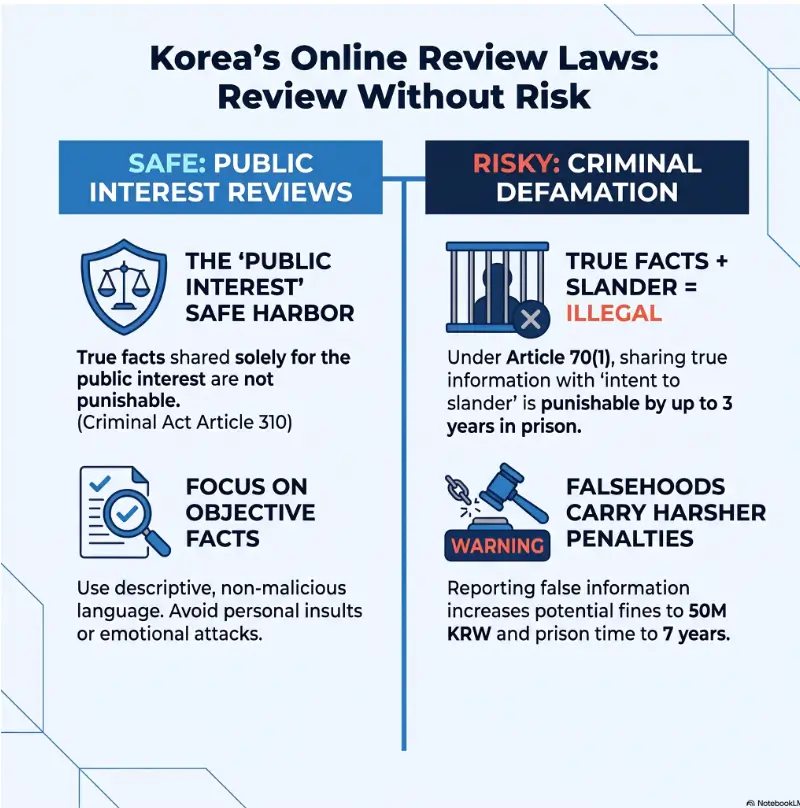
Many US and UK readers arrive with a simple mental model: if it happened, you can say it. Korean defamation law is more complicated. Publicly alleging facts can create risk even when those facts are true, depending on purpose, wording, audience, public interest, and damage to reputation.
False statements are more dangerous, of course. But truth alone does not work like a magic umbrella in a typhoon. If the post looks personal, vindictive, excessive, humiliating, or unnecessary to protect others, risk rises.
The uncomfortable rule: truth is not a magic shield
The Criminal Act distinguishes public allegations of facts under Article 307(1) from false-fact allegations under Article 307(2). Article 310 addresses true facts and public interest specifically in relation to Article 307(1). Do not treat it as a universal defense to every online claim, insult, privacy issue or civil demand. The government’s EasyLaw explanation is a starting point; have counsel identify the actual provision and current text relevant to a dispute.
For a foreign reviewer, the practical question is not, “Can I prove I was angry?” The better question is, “Can I show that each sentence was necessary, accurate, consumer-useful, and not written mainly to punish?”
Criminal defamation, online defamation, insult, and civil claims
Online reviews can sit near several legal fault lines at once. A written accusation may be treated as defamation. A harsh attack without a specific factual claim may raise insult concerns. A post on an online platform may also draw attention under information-network rules. Separately, a business or individual may seek civil remedies if they claim reputational or financial damage.
This is why a short review can feel legally outsized. The post may be only four sentences long, but those four sentences can carry tone, accusation, identity, screenshots, translations, and public reach.
The “public interest” defense, and why revenge language weakens it
Public interest is easier to understand in plain English than to rely on in a real dispute. A warning about a verifiable consumer risk may look different from a post written to shame a specific owner, doctor, teacher, landlord, manager, or employee.
Language matters. “Future tenants should check the water-damage clause before signing” sounds consumer-focused. “Everyone should destroy this landlord’s reputation” sounds like a lawsuit invitation wearing tap shoes.
Key takeaway
Write as if a police officer, platform reviewer, translator, business owner, and judge may all read the same sentence later. Calm wording is not weakness. It is legal insulation.
Foreigners Are Still Inside the Frame
Foreigners sometimes assume that a review in English, on a foreign platform, or aimed at other expats floats outside Korean legal reality. That assumption is brittle.
If the reviewed business, landlord, clinic, school, employer, or service provider is in Korea, and the harm is felt in Korea, risk may not disappear just because the post was written in English. Jurisdiction can become fact-specific, but the safe writing habit is simple: assume the post may be read, translated, screenshotted, and challenged locally.
Tourists, expats, students, English teachers, creators, and business owners
The risk pattern changes by reader. A tourist may worry about a hotel or surgery-trip complaint after leaving Korea. An exchange student may be posting about a school office, dorm, club, or professor. An English teacher may be writing about a hagwon contract or withheld pay. A creator may be making a TikTok or YouTube video with a business name in the title.
Foreign business owners in Korea face an extra wrinkle. A heated review or public accusation can bounce back into customer trust, vendor relationships, licensing, or local reputation. The post becomes more than speech. It becomes business weather.
Why “I posted in English” does not make the risk disappear
English can slow down understanding. It does not erase publication. Translation tools, bilingual staff, platform alerts, group chats, and screenshots can carry your words into Korean quickly.
The translation itself can also create problems. “Sketchy,” “scammy,” “abusive,” “criminal,” and “unsafe” may sound casual in one expat group and explosive in a translated complaint file.
When US free-speech instincts misfire in Korea
US-style free-speech instincts can be helpful for confidence, but dangerous for risk assessment. Korea has different legal rules, different reputational norms, different platform procedures, and different expectations around public accusation.
The smarter habit is cultural bilingualism. You can still warn people. You simply write with a Korean-risk lens: facts first, names only when necessary, private information out, and moral thunder kept in the drawer.
Key takeaway
If a Korean person, business, clinic, school, employer, or landlord is identifiable, write as though the post may be translated into Korean and attached to a formal complaint.
Online Reviews: The Risk Map Before You Hit Publish
Not every negative review carries the same risk. Platform, audience, wording, identity, evidence, and repetition all matter. A one-star rating on a booking platform is not the same as a 12-minute YouTube video naming staff members and calling the business criminal.
Before posting, map the review by reach and specificity. The more public, searchable, emotional, repeated, and identity-rich it becomes, the more carefully you should write.
Google reviews, Naver reviews, blogs, Reddit, YouTube, Instagram, TikTok, and forums
Different platforms create different trails. Naver and Korean platforms may feel closer to the local business. Google reviews may feel international, but they are still public and searchable. Reddit or Facebook groups may seem conversational until someone screenshots the post. Creator platforms add another layer because titles, captions, thumbnails, comments, and pinned replies can all amplify the claim.
If you are still learning local digital habits, this guide to the Korean mobile app ecosystem can help explain why platform context matters in Korea. The place where you post often changes who sees it, how quickly it spreads, and how formal the reaction becomes.
Star ratings versus written accusations
A star rating alone is usually less detailed than a written accusation, but it is not automatically risk-free. Context matters. A rating paired with a profile name, photos, repeated posts, captions, or comments may still contribute to a dispute.
Written claims are where the temperature climbs. “Dirty room” is specific and experience-based. “They run a criminal operation” is a serious accusation. Between those two sentences lies a canyon full of legal paperwork.
| Review format | Common risk level | Safer habit |
|---|---|---|
| Star rating only | Lower, but context still matters | Avoid adding accusatory comments later in replies. |
| Short factual review | Moderate | Use dates, first-person wording, and neutral verbs. |
| Long accusation post | Higher | Remove crime labels, private details, and unnecessary names. |
| Video or viral social post | Higher | Review title, captions, comments, and translations before posting. |
| Repeated posts across platforms | Higher | Do not repost the same allegation everywhere to apply pressure. |
Public post, private message, group chat, and anonymous account
Private messages and group chats can still become evidence if they are forwarded or screenshotted. Anonymous accounts can be traced in some situations through platform data, login patterns, payment records, phone numbers, or ordinary detective work by people who already know the dispute.
Do not rely on anonymity as your main safety plan. Better wording beats a fake username.
Fact, Opinion, Insult: The Three Buckets That Matter
Before posting, sort each sentence into one of three buckets: fact, opinion, or insult. This sounds simple until you try it with an angry draft at midnight. Still, it is one of the best free tools you have.
“The room was dirty” versus “they are scammers”
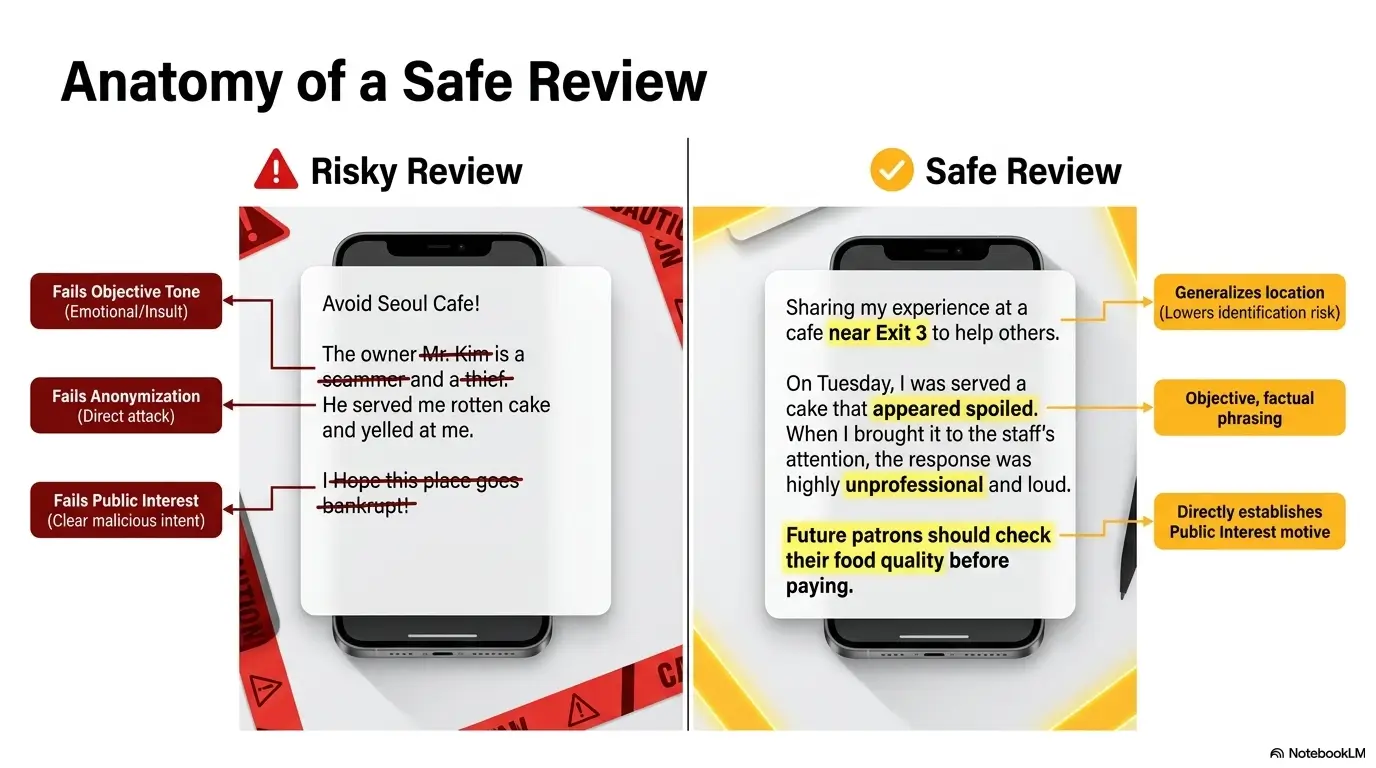
“The room had visible mold near the bathroom window on May 3” is a factual claim tied to a date and observation. “They are scammers” is a broad character or crime-like accusation. One helps future guests inspect a room. The other invites a fight over reputation and intent.
In Korea, that distinction matters. Serious labels such as fraud, scam, abuse, assault, illegal, criminal, fake, and malpractice should be treated as red-alert words. Use them only with legal advice or official support.
Personal experience language that lowers heat without hiding the truth
First-person wording does not make everything safe, but it often lowers unnecessary heat. It signals that you are describing your own experience rather than delivering a public verdict on someone’s character.
| Riskier wording | Safer alternative |
|---|---|
| They stole my deposit. | My deposit was not returned by the date stated in our messages. |
| This doctor is dangerous. | I felt uncomfortable with the explanation I received and sought a second opinion. |
| The owner is a liar. | The owner’s written explanation differed from the receipt I was given. |
| This school cheats teachers. | My final pay calculation did not match my understanding of the contract. |
| Do not trust these criminals. | I would not use this service again based on my experience. |
“I felt cheated” is not the same as “they committed fraud”
Feelings are real. Legal labels are heavier. “I felt misled” describes your reaction. “They committed fraud” suggests a legal conclusion that may require proof you do not have.
The safest reviews often use this rhythm: what I expected, what happened, what evidence I have, what I asked for, how they responded, and what I would recommend other consumers check.
Show me the nerdy details
A review sentence can do several legal jobs at once. It can identify a person, allege a fact, imply a crime, reveal private information, and damage commercial reputation. That is why one spicy adjective can change the whole flavor of the post.
The practical filter is not only “true or false.” Ask: Is it public? Is someone identifiable? Is it factual or merely insulting? Is the claim necessary for consumer protection? Is the tone proportional? Is private information exposed? Would I be comfortable explaining this sentence through a translator?
The Receipts Rule: Evidence Helps, But It Does Not Bless Everything
Evidence is important. Receipts, photos, contracts, appointment records, emails, chat logs, invoices, delivery records, and timestamps can help you write accurately. They can also help if a dispute begins after posting.
But evidence is not a license to publish everything. A contract may prove timing, but that does not mean you should upload the other party’s phone number, home address, passport details, medical information, employee name, or internal document.
Keep dates, receipts, photos, emails, contracts, and chat logs
Create one folder before you publish. Save the original review draft, screenshots of the platform page, receipts, message threads, photos with metadata if available, and notes about phone calls or in-person conversations.
If the issue involves housing, keep the lease, inspection photos, payment proof, and move-in or move-out messages. For readers dealing with Korean housing, this officetel lease guide may help you understand why written records matter so much.
Avoid publishing private documents, IDs, medical details, addresses, or employee names
Publishing private information can create new problems even when your underlying complaint is legitimate. This is especially important for clinics, schools, employers, landlords, and small local businesses where individuals are easy to identify.
For medical reviews, be extra careful. A review of a skin clinic, mental health provider, hospital, or pharmacy can involve sensitive facts, staff identities, diagnosis details, images, and treatment records. For context on healthcare navigation, see these guides to Korean skin clinics and mental health visits in Korea for foreigners.
Evidence should guide wording, not become a weapon
Use evidence to narrow your sentences. Do not use evidence to humiliate people. “The receipt shows a 30,000 won cleaning fee added at checkout” is more useful than posting a staff member’s name and calling them corrupt.
Evidence folder checklist
- Original receipts, contracts, invoices, booking records, or payment proof.
- Unedited photos or screenshots with dates visible where possible.
- Messages showing what you asked for and how the business responded.
- A clean copy of your review draft before publishing.
- A private note separating what you know, what you believe, and what you cannot prove.
Safer Review Writing: Say the Thing Without Lighting the Fuse
The goal is not to write a bland review dipped in legal oatmeal. The goal is to be useful without being reckless. Readers need clear information. You need a lower-risk trail.
Lead with your firsthand experience only
Start with your relationship to the business: guest, tenant, patient, customer, employee, applicant, parent, student, client, or vendor. Then describe what you directly saw, paid, received, signed, or were told.
Avoid adding rumors from group chats, “everyone knows” claims, or stories from friends unless you have legal advice. Hearsay fattens a review without making it stronger.
Separate facts from interpretation
A clean review lets readers see the facts and draw their own conclusion. Instead of declaring, “They intentionally deceived me,” you might write, “The price shown in the message was different from the amount requested at checkout, and I was not given a written explanation.”
That kind of sentence still warns people. It simply avoids pretending to know the other side’s intent.
Use dates and neutral verbs instead of character attacks
Neutral verbs are your quiet armor: charged, delayed, declined, requested, replied, canceled, changed, explained, refused, provided, omitted, corrected. They make the review sturdier because they focus on conduct, not personality.
| Review setup | Good | Better | Best |
|---|---|---|---|
| Low-detail complaint | “Bad service.” | “My appointment started 45 minutes late.” | “My 2:00 p.m. appointment started at about 2:45 p.m.; I was not told the reason for the delay.” |
| Deposit dispute | “Terrible landlord.” | “My deposit was delayed.” | “The deposit was due on June 5 under our messages, but I had not received it by June 12.” |
| Clinic complaint | “Unsafe clinic.” | “I felt rushed.” | “The consultation lasted about five minutes, and I left without written aftercare instructions.” |
| School or employer complaint | “They exploit foreigners.” | “My pay was different from what I expected.” | “My final payment did not match the contract section I relied on, and I requested a written breakdown.” |
End with a consumer-useful takeaway, not a public punishment ritual
A useful ending sounds like advice, not revenge. “Ask for the full price in writing before booking” is stronger than “Let’s make sure they lose customers.”
This is also better for SEO and reader trust. Practical reviews age well. Rage posts often rot quickly and start smelling up the author’s own credibility.
Safer Review Framework
1. Evidence
Save proof before posting.
2. Scope
Use firsthand facts only.
3. Wording
Replace labels with conduct.
4. Privacy
Remove IDs, addresses, and names.
5. Pause
Get help if stakes are high.
Takedown Requests and Temporary Blocks: What May Happen Next
After a negative review goes live, the next chapter may come quickly. A business may reply publicly, ask you to delete it, report it to the platform, send a demand letter, or file a complaint. A platform may remove, hide, restrict, or temporarily block access to the post while reviewing a rights complaint.
A takedown does not automatically prove that you were legally wrong. It also does not mean you should ignore the situation. Treat it as a signal to preserve evidence and stop improvising.
A business may request deletion, rebuttal, or platform action
Some requests are calm and reasonable. Others sound threatening. Either way, do not reply while angry. Save the message, note the time, and compare the request against your review line by line.
If the dispute could be handled through an official complaint channel instead of a public accusation, consider that route. This guide to the Korea public complaint system may be a useful next read for readers who want formal consumer or administrative options.
Korean network rules may allow temporary measures
Korean information-network rules include procedures related to rights-infringing information and deletion or temporary measures. In practical terms, this means platform action can happen before the deeper legal question is fully resolved.
Do not assume a temporary block equals defeat. Do not assume it is meaningless either. It is a good moment to speak with a lawyer if the post involves serious allegations, a named person, or money at stake.
What to preserve before editing, deleting, or replying
- Screenshot the original review, including date, platform, username, URL if visible, rating, photos, and comments.
- Save any platform notice, takedown message, or complaint notification.
- Save business replies, private messages, demand letters, and call notes.
- Keep your supporting evidence in the same folder.
- Do not post a second angry update while the first dispute is active.
Key takeaway
When a takedown request arrives, your first job is not to win the argument. Your first job is to preserve the record and stop adding fuel.
When to Seek Help Before This Becomes Expensive
Some reviews are low-stakes and can be rewritten carefully. Others are not DIY projects. If your post could affect someone’s license, business, job, immigration status, reputation, school enrollment, clinic, or criminal exposure, get advice before publishing.
Contact a Korean lawyer before serious allegations
Speak with a Korean lawyer before posting allegations about crime, fraud, abuse, medical harm, employment wrongdoing, sexual misconduct, unsafe treatment, discrimination, child protection, illegal housing conduct, or fake documents.
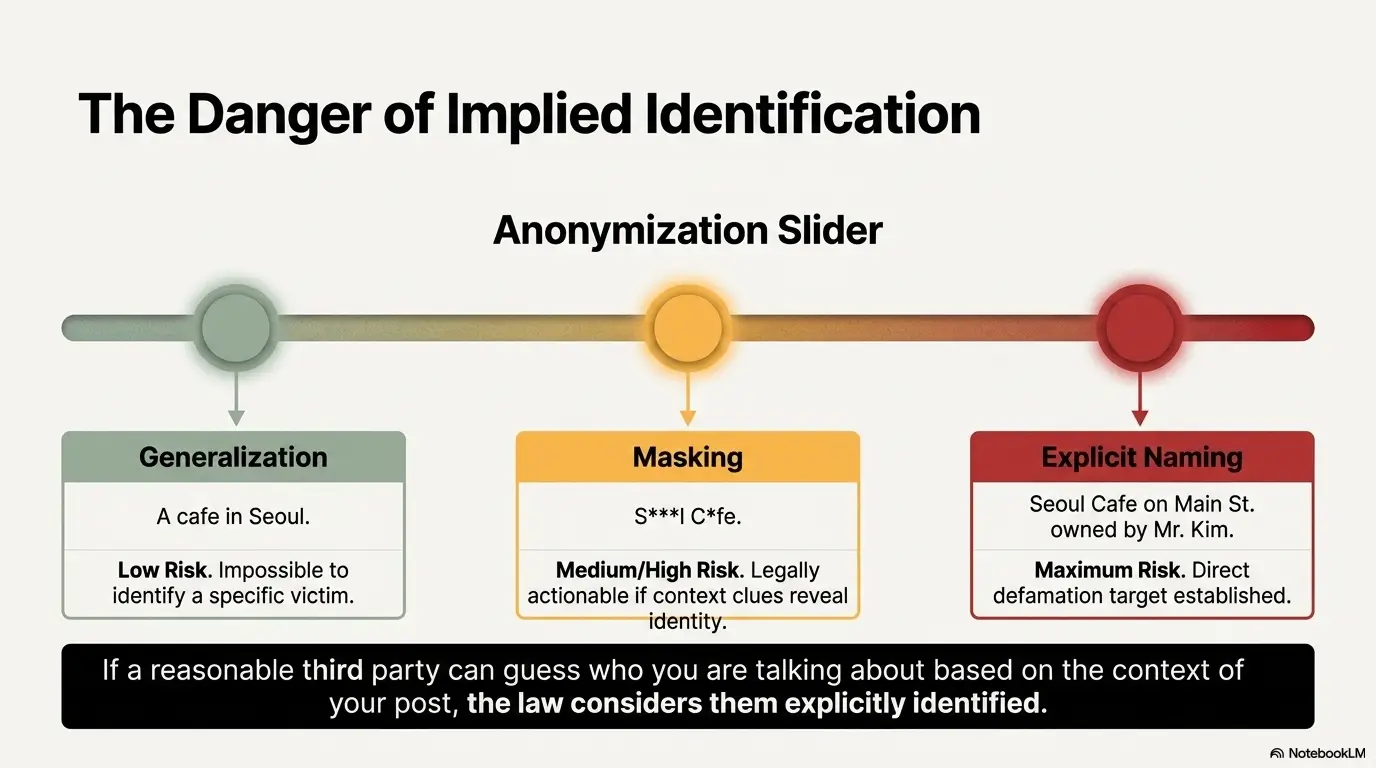
This is especially important if you plan to name a person. Naming a business is already sensitive. Naming an owner, doctor, teacher, manager, landlord, patient, student, coworker, or family member can sharpen the dispute.
Get help immediately after police contact, a demand letter, or identity request
If police contact you, a complaint is filed, a lawyer sends a demand letter, or a platform asks for identity details, pause. Do not send a long emotional explanation. Do not delete evidence. Do not post “they are threatening me now” as a sequel.
Ask for the contact details, case information if available, and time to respond. Then consult a Korean lawyer, ideally one who can explain criminal, civil, platform, and immigration angles in plain English.
Use a translator carefully: one mistranslated sentence can sharpen the blade
Machine translation is useful for menus and train notices. It is less reliable when your legal risk depends on tone. Words like “fraud,” “threat,” “abuse,” “illegal,” “fake,” and “dangerous” can become harder-edged in translation.
If you need to communicate with police, a lawyer, a landlord, a clinic, a school, or a government office, consider professional translation or interpretation. For healthcare-related situations, this guide to medical translation in Korea may help you think through language risks.
| Situation | DIY may be enough when… | Professional help is wiser when… |
|---|---|---|
| Restaurant or cafe complaint | You describe service, price, wait time, or food quality calmly. | You allege fraud, discrimination, food poisoning, or criminal conduct. |
| Housing review | You describe maintenance, noise, contract timing, or communication. | You accuse theft, illegal renting, intimidation, or deposit fraud. |
| Clinic review | You discuss wait time, communication, pricing, or aftercare experience. | You allege malpractice, injury, unsafe treatment, or name medical staff. |
| School or employer post | You describe your own contract confusion without naming staff. | You allege wage theft, abuse, harassment, visa threats, or illegal conduct. |
| Creator content | You make a general consumer guide without naming individuals. | You plan a viral exposé, hidden-camera style content, or repeated allegations. |
Keep a review draft separate from the evidence file
For a disputed service, preserve the contract, invoice, messages and a dated account of what you personally observed. Mark conclusions and secondhand claims separately. If considering a public review about an identifiable person or business, ask qualified counsel about the actual draft and distribution where stakes warrant it. Removing a name or adding “in my opinion” does not automatically settle identification, privacy or defamation questions.
| Focus | What to check |
|---|---|
| Evidence | Preserve original documents and a chronology. |
| Draft | Separate observations from accusations or inference. |
| Channel | Consider the actual audience and obtain specific advice. |
A reader question: Can a neutral tone make every factual allegation lawful?
No. Tone is only one part of the context. A factual record, a private complaint and a public post serve different purposes and may raise different legal issues.
The 20-Minute Review Risk Check
Before you publish, run this short check. It is free, boring in the best possible way, and much cheaper than learning legal caution after the screenshot has already escaped.
Minutes 0 to 5: Save your evidence in one folder
Collect the material that supports your review. Do not edit screenshots in a way that changes meaning. Keep originals. Add a note explaining what each file shows.
Minutes 5 to 10: Highlight risky sentences
Mark every sentence that names a person, alleges a crime, reveals private facts, uses absolute language, or attacks character. These are your legal hot stones.
Minutes 10 to 18: Rewrite into firsthand, neutral, verifiable wording
Replace legal labels with observed conduct. Replace assumptions about intent with what happened. Replace character attacks with dates, amounts, timelines, and responses.
Minutes 18 to 20: Decide whether to pause
If the post involves medical care, employment, housing, schools, fraud, harassment, immigration, criminal allegations, or a named person, consider pausing for legal advice. A 24-hour pause can feel annoying. A formal complaint can feel like winter with paperwork.
20-minute review risk scorecard
- Add 2 points if you name an individual person.
- Add 2 points if you allege crime, fraud, abuse, malpractice, or illegality.
- Add 1 point if you include private documents, photos, messages, or personal details.
- Add 1 point if you are posting across more than one platform.
- Add 1 point if your wording includes “always,” “never,” “everyone,” “criminal,” “scam,” “dangerous,” or “liar.”
- Add 2 points if the dispute could affect your visa, job, school, housing, clinic care, or business license.
Practical reading: 0 to 1 points means rewrite carefully. 2 to 3 points means pause and simplify. 4 or more points means get legal advice before posting.
Key takeaway
The safest negative review usually sounds less dramatic, more specific, and more useful. That is not censorship. That is craft.
FAQ
Can foreigners be sued or charged for online defamation in Korea?
Yes, foreigners can face legal risk in Korea for conduct connected to Korea. The exact risk depends on facts such as where the post was made, who was identified, what was said, where harm was felt, and whether criminal, civil, or platform procedures are involved.
Is a true review safe under Korean defamation law?
Not automatically. Truth can help, and public interest may matter, but a true statement can still create risk if it publicly harms reputation and is not handled carefully. Keep the review narrow, factual, and consumer-useful.
Can I write a negative Google review about a Korean business?
You can write a negative review, but you should do it carefully. Stick to firsthand experience, dates, amounts, and neutral wording. Avoid crime labels, personal attacks, private details, and unnecessary names.
Is it safer to leave only a star rating?
A star rating may be lower risk than a detailed accusation, but it is not a perfect shield. Context, repeated posting, profile identity, photos, captions, and follow-up comments can still matter.
Can I name the owner, doctor, teacher, landlord, or manager?
Naming individuals increases risk. If the person’s identity is not necessary for consumer protection, leave it out. If naming them feels necessary because the allegation is serious, speak with a Korean lawyer before posting.
What should I do if a business asks me to delete my review?
Do not reply while angry. Save the request, screenshot your original review, preserve evidence, and consider whether the review can be edited into narrower, more factual wording. If the request includes legal threats, get advice before responding.
Can I delete the post after a complaint starts?
You may be able to delete or edit a post, but do not destroy evidence. Save the original, platform notices, and related communications first. If a complaint has already started, ask a lawyer before making moves that could be misunderstood.
Should I apologize, edit, or stay silent if contacted?
It depends on the facts. A calm correction may help if you made an error. A rushed apology may create new complications. Silence may be safer in some legal situations. Once formal contact begins, get advice before sending a long explanation.
Your Final 15-Minute Pause Before Posting
The strongest review is not the angriest one. It is the one that survives daylight. Before posting, read your draft once as a consumer, once as the person being reviewed, and once as a stranger translating it into Korean for a formal file.
Then do one concrete thing: remove every sentence that alleges crime, attacks character, reveals private facts, or names an individual unless that sentence is necessary, verified, and worth getting legal advice about.
A safer review can still tell the truth. It simply does not hand your frustration a microphone and a gasoline can. Keep the receipts. Lower the temperature. Help the next reader make a better decision.
Final 15-minute action
- Save your original draft and evidence folder.
- Replace legal labels with observed conduct.
- Remove unnecessary personal names and private details.
- End with a practical consumer takeaway.
- Pause and seek legal advice if the post involves serious allegations.
Last reviewed: 2026-07
Practical example and reader question added October 20, 2026. Existing source dates are retained; this addition is not a fresh verification of every earlier claim.