
Korea safety guide for visitors and long-stay foreigners
Korea Police Report Guide for Tourists and Expats:
112, Lost Items, Scams, and Embassy Steps
A police report in Korea can feel simple until your wallet is gone, your passport is missing, your phone battery is blinking red, and the hotel lobby suddenly sounds like a railway station. The right first move is not to tell the whole story perfectly. It is to choose the right number, give your exact location, preserve evidence, and ask for the next document before you leave.
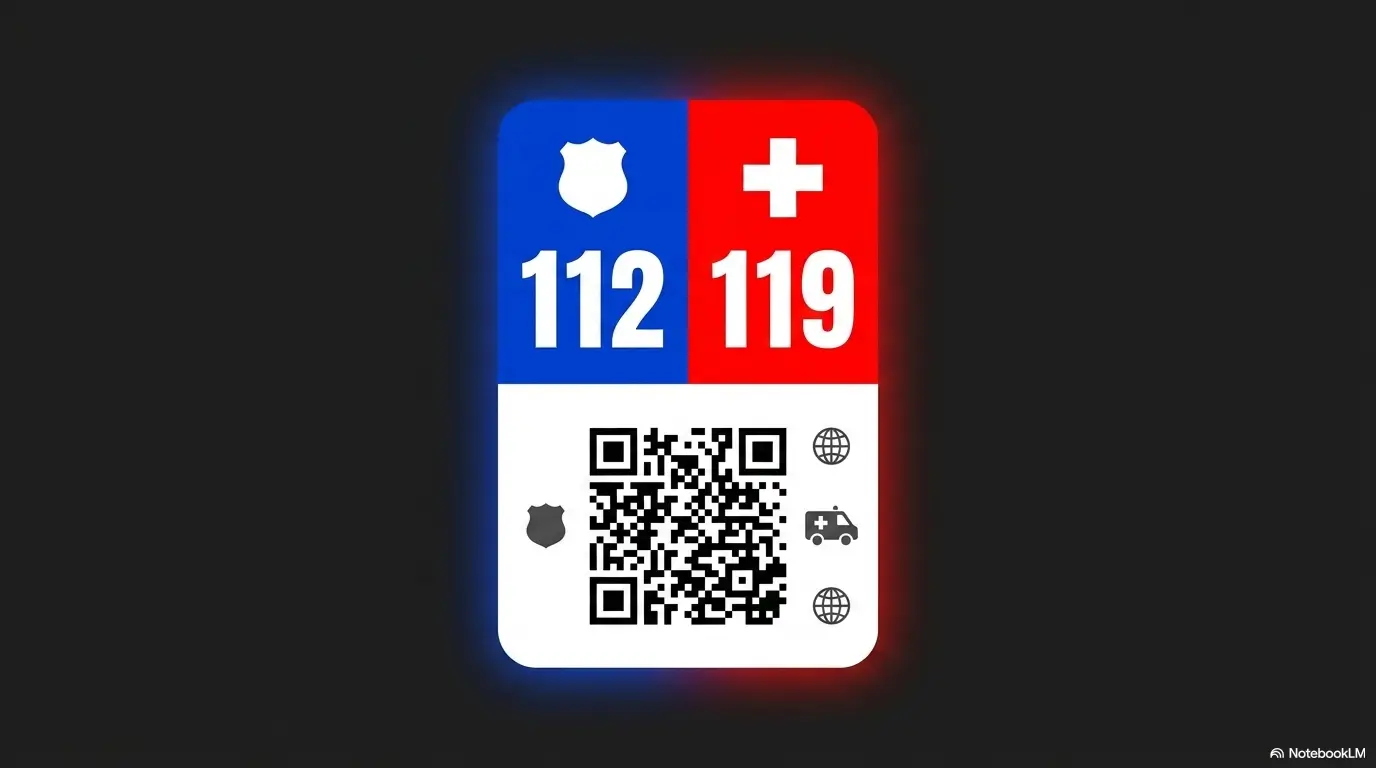
For police emergencies and crime reports in Korea, use 112. For fire, rescue, or ambulance help, use 119. For tourist interpretation and travel complaints, use 1330. For visa and immigration questions, use 1345. Those four numbers are the small emergency orchestra you want saved before the cymbals crash.
This guide is built for US and UK travelers, study-abroad students, military-adjacent families, digital nomads, and long-stay expats who need calm, practical steps. It explains what to say, what to bring, what evidence to keep, when embassy help matters, and how to avoid the quiet mistakes that can turn a report into paperwork soup.
Pick the right line
Know when to call 112, 119, 1330, 1345, 182, or an embassy contact.
Build the report
Use simple scripts, evidence folders, location clues, and document requests.
Leave less exposed
Protect insurance claims, passport replacement, visa questions, and follow-up access.
Save the four-number safety card before Korea tests your battery percentage. 🧭
Snapshot
This article is for English-speaking tourists, students, expats, and digital nomads in Korea who need to report theft, lost property, scams, harassment, assault, cybercrime, or passport loss. You will learn which number to use, what to say, what evidence to save, how embassy support fits in, and what to request before leaving the police station.
Table of Contents
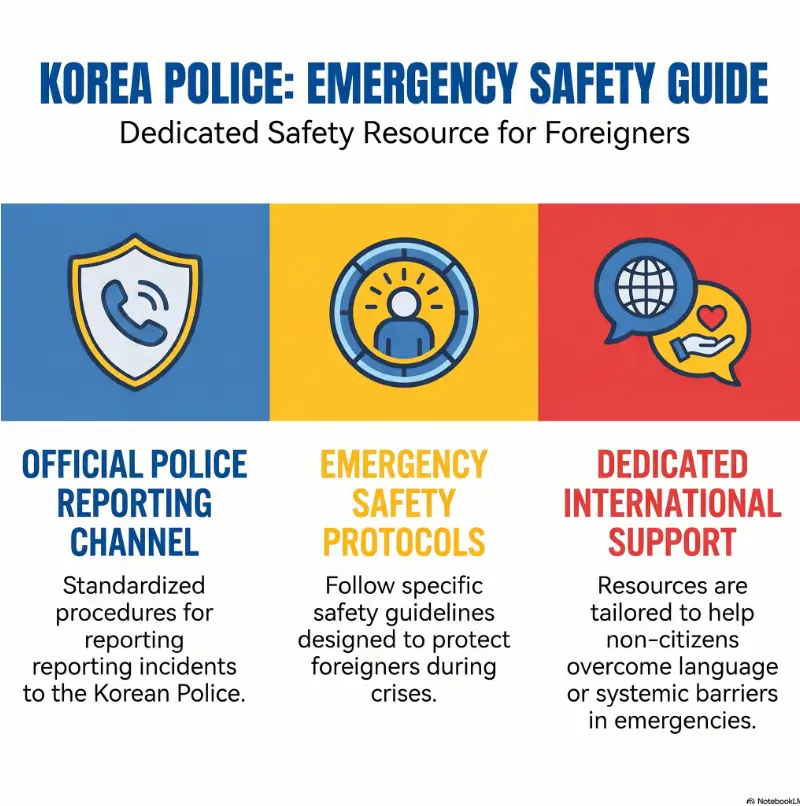
Before You Act: What This Guide Can and Cannot Do
This is practical safety education, not legal advice. It can help you organize your next steps when you need to contact Korean police, report lost property, preserve evidence, or contact an embassy. It cannot tell you how a police officer, prosecutor, immigration official, insurer, airline, university, employer, or court will decide your individual case.
If there is immediate danger, call emergency services first. In Korea, 112 is the police emergency and crime-reporting number. 119 is for fire, rescue, and ambulance help. If you are unsure because someone is injured and a crime also occurred, call the line that matches the most urgent risk, then explain the rest.
Before You Act
Call 112 now if there is violence, stalking, threats, sexual violence, theft in progress, an intruder, a missing vulnerable person, or fear of immediate harm. Do not pause to perfect your Korean, compare forum advice, or decide whether the incident is “serious enough.” Safety comes before paperwork.
Best fit for this guide
This guide works best if you are a visitor or foreign resident who needs to report a real incident, prepare for a police station visit, or understand how Korean emergency numbers fit together. It is especially useful for stolen wallets, lost passports, phone theft, accommodation disputes, cyber scams, nightlife incidents, harassment, stalking, and travel insurance documentation.
It also fits study-abroad students, English teachers, military-adjacent families, digital nomads, and long-stay expats who may not know whether to call police, tourist support, immigration, or a consular office first.
Who should not rely on it alone
Do not rely on a blog article alone if you are a suspect, defendant, accused person, visa-overstay case, civil lawsuit party, or someone facing arrest, detention, deportation risk, or serious criminal allegations. That is no longer a “how do I file a report?” situation. It is a professional-help situation.
For high-stakes cases, consider contacting a qualified Korean attorney, your embassy or consulate, a victim-support organization, your school or employer’s emergency contact, or a trusted bilingual advocate.
Official links to keep open
Official pages can change, and phone menus can shift. Use the resources below as action points, not decorative bookmarks. Save them somewhere you can reach even if your main phone is lost.
First 90 Seconds: Pick the Right Number Before Stress Picks for You
In a calm kitchen, numbers are easy. In a Seoul alley at 1:20 a.m., with a missing bag and a friend crying beside a convenience store, numbers become fog. Your first job is to match the problem to the line.
Think of the first 90 seconds as triage. You are not writing a full statement yet. You are routing the situation to the right door.
Call 112 for police, crime, threat, or public safety
Call 112 if you need police help. This includes theft in progress, assault, stalking, threats, harassment, public disorder, suspicious intrusions, violence, robbery, domestic violence, sexual violence, missing vulnerable people, or any situation where police presence is needed.
You can also use 112 if you are not sure where the nearest police station is and need direction. When in doubt, lead with your location and the immediate risk.
Call 119 for fire, rescue, or ambulance help
Call 119 if someone is injured, unconscious, trapped, bleeding heavily, having difficulty breathing, in a fire, in a road accident, or in urgent medical distress. If the situation also involves a crime, tell the dispatcher that police may be needed too.
For example, after a street assault with visible injury, 119 may be the fastest route for medical care, while 112 may be needed for the police report. Do not worry about sounding perfect. Dispatchers are used to messy real life.
Use 1330 for tourist help, interpretation, or complaints
Use 1330 when the problem is tourism support, interpretation, travel information, or a tourist complaint. It can be useful when you are not in immediate danger but need help communicating with a taxi driver, hotel desk, attraction, transport office, or local service.
For travelers who freeze when Korean speakers talk quickly, 1330 can be the bridge between “I know what happened” and “I can explain it in a way someone can act on.”
Use 1345 for visa, stay status, and immigration administration
Use 1345 for immigration questions, visa status, alien registration, office jurisdiction, foreigner administration, and stay-related uncertainty. It is not a substitute for police if you are being threatened or harmed.
If you are a victim and afraid your visa situation complicates the report, separate the questions. Safety and crime reporting belong with police. Visa and stay-status questions belong with immigration support or a qualified professional.
| Situation | Best first contact | Why it fits | What to say first |
|---|---|---|---|
| Someone is following or threatening you | 112 | Police and immediate safety | “English please. I am at [location]. Someone is following me.” |
| Someone is injured after an incident | 119, then 112 if crime involved | Medical help first, police second if needed | “Ambulance. I am at [location]. Injured person.” |
| Lost wallet with no clear theft | Lost112 or nearby police station | Lost property process may apply | “I lost my wallet. I need a lost property report.” |
| Taxi fare or route dispute | 1330 or police if threats/fraud | Interpretation or complaint support | “I need help with a taxi complaint.” |
| Visa concern after an incident | 1345 for immigration questions | Immigration guidance, not emergency response | “I need immigration guidance in English.” |
| Online scam with payment records | ECRM or police station, 112 if urgent danger | Cybercrime reporting and investigation route | “I was scammed online and have payment evidence.” |
Key takeaway
If there is danger, call 112 or 119 first. Use 1330 and 1345 for support questions, not as a delay button when safety is at stake.
The 112 Call Script: What to Say When Your Brain Goes Blank
Most people explain emergencies backwards. They begin with the whole saga, then mention the location after two minutes. In an emergency call, location is the candle in the dark room. Give it first.
You do not need elegant Korean. You need a clear location, a plain incident sentence, a risk level, and a way to stay reachable.
Start with location, not the whole story
Say the address if you have it. If you do not, use nearby buildings, subway exits, street signs, hotel names, café names, convenience stores, or your smartphone map. In Korea, a subway exit number can be more useful than a poetic description of a street.
Useful location format: city or district, neighborhood, landmark, exact spot. For example: “Seoul, Hongdae, near Hongik University Station Exit 9, in front of the CU convenience store.”
Say “English please” or “Interpreter please”
If you do not speak Korean, start simply: “English please” or “Interpreter please.” If you know only one Korean emergency phrase, use this: 영어 통역 필요해요, which means “I need English interpretation.”
Speak slowly. Keep sentences short. If the line becomes confusing, repeat your location and the immediate risk. The goal is not literary excellence. It is dispatch clarity.
Give the incident in one clean sentence
After location and language, use one plain sentence. The dispatcher can ask follow-up questions.
- “My wallet was stolen on the subway.”
- “A man is following me and I am scared.”
- “My friend was assaulted outside a bar.”
- “Someone broke into my room.”
- “I lost my passport and need a police report.”
- “I was scammed online and the person is threatening me.”
Keep a calm call script saved
Save this in your notes app before you need it. Panic steals vocabulary first.
112 call script for foreigners in Korea
- “English please. Interpreter please.”
- “I am at [city/district/landmark/address].”
- “The problem is [theft/assault/threat/stalking/scam/lost passport].”
- “I am [safe/not safe/injured/not injured].”
- “My phone number is [number]. I will stay on the line.”
Real-world example: location beats perfect grammar
A study-abroad student leaves a noraebang near Hongdae and realizes a stranger is following her across two blocks. Her Korean is limited, and her hands are shaking. Instead of trying to explain the entire evening, she calls 112 and says, “English please. I am at Hongik University Station Exit 8. A man is following me. I am scared.”
That is enough to start. The dispatcher can ask whether she is alone, what the person looks like, where she is moving, and whether she can enter a lit business. The report begins with a pin on the map, not a flawless paragraph.

Police Station Visit: What to Bring Before You Walk Through the Door
A Korean police station visit is easier when you arrive with a tight folder. Not a theatrical folder. Not a 98-page emotional dossier. A practical folder.
Your goal is to help the officer understand who you are, what happened, where it happened, what was lost or harmed, who may be involved, and what proof exists.
Bring identification and stay details
Bring your passport if you have it. If you are a registered foreign resident, bring your alien registration card or residence card. If your passport is missing, bring a photo or scan of the passport ID page if available.
Also bring your hotel, Airbnb, dorm, officetel, base housing, or local address written in English and Korean if possible. If you have a Korean phone number, bring it. If your phone number may stop working after departure, prepare an email address and an overseas number too.
Bring proof, not just a memory
Police reports live on details. A clean screenshot can do more work than a long, angry explanation. Bring receipts, card alerts, booking confirmations, app history, taxi plate numbers, KakaoTalk chats, Instagram or marketplace messages, bank transfer records, photos of injuries or damage, and names of witnesses.
If you used transit, write down station names, line numbers, train direction, carriage location if remembered, and approximate time. If the incident happened near a store, café, hotel, club, subway gate, or bus stop, note nearby CCTV clues. Do not assume police can magically summon every camera in Korea by waving a digital wand.
Ask for an interpreter before the story gets complicated
If the case is simple, translation apps may help with basic words. If the case involves violence, sexual contact, threats, fraud, immigration concerns, a suspect you know, or major financial loss, ask for interpretation and consider bringing a trusted bilingual person.
Be careful with friends as interpreters when the facts are sensitive. A well-meaning friend can accidentally soften, dramatize, or reinterpret your statement. In a legal setting, those small distortions can grow teeth.
Ask for the report number before you leave
Before leaving, ask for the case number, report reference, station name, officer or department contact if available, and what happens next. If the report is for insurance, embassy, airline, school, or employer use, ask what type of document can be issued and when.
Key takeaway
Before you leave the station, ask: “What is my report number, who handles follow-up, and what document can I use for insurance, embassy, airline, school, or employer records?”
| Bring this | Why it helps | Budget-friendly alternative |
|---|---|---|
| Passport or residence card | Confirms identity and stay status | Passport photo, scan, or embassy record |
| Hotel or local address | Helps contact and jurisdiction | Booking confirmation screenshot |
| Receipts and card alerts | Shows payment, time, and loss | Bank app screenshots |
| Chat logs and usernames | Supports scam, threat, or harassment report | Screen recording plus exported chat if possible |
| Photos of injury or damage | Preserves condition at the time | Timestamped phone photos |
| Travel insurance details | Clarifies documents you may need | Policy number in notes app |
If you are also trying to sort out phone access, identity verification, or apps after a theft, these related guides may help: Korean identity verification for foreigners, the Korean mobile app ecosystem, and Korean phone plans for Americans.
Lost Wallet or Passport: The Tiny Object That Becomes a Paperwork Dragon
A lost passport is not just a lost booklet. It is border permission, airline check-in, hotel ID, bank friction, embassy appointment, and sometimes immigration paperwork wearing one little blue jacket. A lost wallet can be just as annoying: cards, cash, transit cards, IDs, receipts, and that one loyalty card you inexplicably care about.
The first question is whether the item was lost or stolen. If you simply misplaced it, the lost-and-found process may be the right starting point. If someone took it, threatened you, pickpocketed you, or used your cards, police reporting becomes more important.
Lost property is not always treated like theft
If you left your wallet on a café table, subway seat, taxi, bus, or restroom shelf, start by checking the place where it was last seen. Then check relevant lost-and-found channels. Korea has a national police lost-and-found portal known as Lost112, and transport operators may have their own lost property offices.
If your item disappeared from a bag, pocket, locked room, or payment counter, or if your card was used after the disappearance, treat it more seriously. Preserve card alerts, merchant names, times, and locations.
Use Lost112, but visit police for passport-loss paperwork
Lost112 can help you search for items and understand the lost-property process. For a lost passport, however, you may need to visit a nearby police station for documentation before applying for replacement travel documents through your embassy or consulate.
Do not wait until the morning of your flight. Passport replacement, emergency travel documents, police paperwork, embassy appointments, airline requirements, and immigration exit procedures do not always move at tourist-speed.
Passport-loss checklist for US and UK travelers
The exact process depends on your nationality, travel schedule, and whether the passport was lost, stolen, or damaged. Still, the practical order is usually similar.
- Move to a safe place and cancel cards if your wallet was also missing.
- Write down where and when you last had the passport.
- Search bags, hotel safe, jacket pockets, taxi or rideshare records, and transport lost-and-found.
- Visit a nearby police station if you need a police report or loss documentation.
- Contact your embassy or consulate for replacement passport or emergency travel document instructions.
- Ask your airline what document is required to board.
- Ask immigration or your embassy whether any exit documentation is needed if your entry stamp or proof is affected.
Transit card, wallet, and phone steps
If your T-money card, credit card, or phone was lost, act in layers. Freeze cards first. Then check transit lost-and-found if the loss happened on a subway, train, bus, or taxi. Then gather proof for a report or insurance claim.
For subway-specific recovery steps, see Korea subway lost and found. If your transit card is part of the problem, this T-money Korea guide can help you understand how the card fits into daily travel.
Lost item action card
- Lost, no crime clue: check the location, transport operator, and Lost112.
- Possible theft: call 112 if urgent, visit police if documentation or investigation is needed.
- Passport missing: get local police documentation when required, then contact your embassy or consulate.
- Card used after loss: freeze cards, save alerts, note merchant names, and report quickly.
Scams, Taxi Fights, and Nightlife Incidents: When Annoying Becomes Reportable
Not every bad night in Korea becomes a police case. A rude taxi driver, a confusing club bill, or a stubborn refund dispute may begin as a complaint rather than a crime report. But when money is taken through deception, threats appear, violence happens, property is damaged, or someone is followed or coerced, the temperature changes.
The trick is to stop arguing long enough to preserve the facts. Outrage evaporates. Screenshots stay for breakfast.
Fraud needs proof of promise, payment, identity, and loss
For scam reports, gather four categories: what was promised, what you paid, who received it, and what loss occurred. A police officer or investigator needs a path from the promise to the payment to the person or account.
- Marketplace listing screenshots
- Seller usernames, phone numbers, email addresses, and profile links
- Bank account details, crypto wallet addresses, or payment app records
- Chat logs showing the promise, price, delivery terms, and refusal
- Delivery tracking, refund refusal, or blocked-account proof
- Any identity clues, including Korean bank account holder name if visible
Taxi disputes need route, fare, plate, and receipt
For taxi disputes, write down the license plate, taxi company name if visible, receipt, pickup and drop-off points, route, app history, fare amount, and time. If the driver threatens you, locks the door, refuses to let you leave, assaults you, or takes property, treat it as a safety issue and contact 112.
If it is a complaint about route, fare, or communication without immediate danger, 1330 can help with travel complaint routing or interpretation.
Nightlife incidents need timestamps before memory fades
Nightlife cases often involve dim lighting, alcohol, crowded stairs, loud rooms, CCTV, card receipts, door staff, taxis, and rapidly changing memories. Write a timeline as soon as you are safe.
Include arrival time, venue name, people present, drinks ordered, payment time, incident time, departure time, taxi or rideshare details, and who saw what. If you were injured, threatened, sexually touched, assaulted, followed, or prevented from leaving, call 112 and consider medical support.
Good, Better, Best evidence setup
| Setup | What it includes | Best for | Cost |
|---|---|---|---|
| Good | Phone screenshots, written timeline, receipts, card alerts | Simple lost property, taxi complaint, minor dispute | Free |
| Better | Organized folder by time, exported chats, witness names, map pins, photos | Theft, fraud, harassment, insurance claim | Mostly free |
| Best | Interpreter support, attorney consultation if needed, medical records, official report documents | Assault, sexual violence, major fraud, immigration-sensitive case | May involve paid help |
Key takeaway
For scams and disputes, build a receipt folder: promise, payment, identity clue, loss, timeline, and follow-up messages. That folder is often more useful than a dramatic retelling.
Assault, Harassment, Stalking, or Sexual Violence: Do Not Self-Triage Danger
Some incidents should not be softened into “maybe it was nothing” while you are still shaking. If someone is nearby, following you, threatening you, touching you without consent, blocking your exit, damaging property, or escalating after you told them to stop, call 112.
This is not about being dramatic. It is about not asking a frightened brain to perform legal classification at midnight.
Call 112 if the person is nearby, following, threatening, or escalating
Move toward a lit public place if you can do so safely: convenience store, hotel lobby, staffed subway area, café, restaurant, police box, or busy street. Tell staff, “Please call police. 112.” Then call yourself if possible.
If the person knows where you live, works with you, studies with you, or has access to your building, say that. Relationship and access matter. A threat from someone who can find you tomorrow is not just tonight’s problem.
Preserve clothing, messages, photos, and CCTV clues
If you may need to report assault or sexual violence, preserve evidence as best you can. Keep clothing and items in a paper bag if available. Save messages, calls, ride records, photos, venue names, receipts, and location data. Take photos of visible injuries over time because bruises can change.
Do not delete chats because they are embarrassing. Do not clean up damaged items before photographing them. Do not rely on “the CCTV will show everything” unless someone knows where to ask and before footage is overwritten.
Ask for interpreter, medical help, and victim support
Ask directly: “I need an interpreter.” “I need medical help.” “I need victim support information.” If you are a student, contact your university emergency line or international office when safe. If you are employed in Korea, consider whether a trusted manager, HR contact, or coworker can help with interpretation and logistics, while protecting your privacy.
If you are in emotional shock after a frightening event, you may also find it useful to read about mental health visits in Korea for foreigners and medical translation in Korea.
When paid help may be worth considering
Most basic reports do not require a lawyer. But paid professional help may be worth considering if the incident involves serious injury, sexual violence, a known offender, workplace retaliation, housing access, immigration risk, a suspect accusing you back, a large financial loss, or pressure to sign something you do not understand.
Before paying anyone, ask what they will actually do: attend the police station, translate documents, explain procedure, contact investigators, prepare a statement, or advise on rights and risks. A vague “we handle everything” promise is not a service description. It is fog with an invoice.
Cybercrime and Online Scams: Build the Report Like a Receipt Folder
Online scams rarely arrive wearing a villain costume. They arrive as a used phone listing, apartment deposit request, crypto group, romance message, concert ticket sale, fake job offer, rental room, or “urgent verification” link. The report is strongest when you preserve the trail before the other person disappears.
If there is immediate danger, threats, extortion, stalking, or risk of physical harm, use 112. If the case is online-first and not physically urgent, Korea’s cybercrime reporting channels and police stations may be the more fitting route.
Save URLs, usernames, bank details, and chat logs
Cyber reports need identifiers. Save the page URL, listing ID, username, profile image, phone number, email address, bank account number, crypto wallet address, payment receipt, delivery tracking, chat log, and any threat messages.
Take screenshots, but do not stop there if the platform allows exports. A screenshot can be edited or incomplete. Exported data, timestamps, payment records, and bank alerts help create a sturdier trail.
Do not delete the account, chatroom, or listing too soon
When people feel scammed, they often block the person, delete the chat, leave the group, or close the account. That may feel emotionally clean, but it can make evidence recovery harder.
Instead, mute if needed, screenshot and export, record the URL, save the other person’s profile, then ask police or a professional before deleting anything central to the case.
Use cybercrime reporting channels for online-first cases
Korea’s Electronic Cybercrime Report and Management system can be useful for cybercrime reports, consultations, and tips. Some cases may still require an in-person station visit, especially when formal investigation or documentation is needed.
Evidence strength by online scam type
Show me the nerdy details
For marketplace scams, the strongest evidence usually connects a listing, a seller identity clue, a payment destination, and non-delivery. For phishing, the useful trail is often the link, message source, account access logs, bank or card records, and the time you entered information.
For romance, crypto, or investment scams, organize the timeline by relationship building, promise, pressure, transfer, refusal, and threats. Do not summarize ten weeks of chat as “they tricked me.” Pull out the exact messages where money was requested, returns were promised, or urgency was created.
For account takeover, save login alerts, password reset emails, device notices, unauthorized transactions, recovery attempts, and platform support tickets. The best report is a timeline with attached proof, not a pile of screenshots named IMG_4829.
Immigration-Sensitive Situations: Do Not Let Visa Fear Silence a Safety Report
Foreigners sometimes hesitate to contact police because they fear visa trouble, school consequences, employer retaliation, landlord conflict, or military-family complications. That fear is understandable. It should not silence a safety report when you are a victim or in danger.
The clean way to think about this is separation. Police handle immediate safety and crime reporting. Immigration questions belong with immigration channels or qualified professional guidance. Embassy or consular offices may help citizens navigate lost passports, victim support, attorney lists, or emergency contact needs.
If you are in danger, safety comes first
If someone is hurting you, threatening you, coercing you, stalking you, or blocking you from leaving, call 112. Do not spend the first ten minutes searching online for visa consequences while the risk is moving in real time.
After you are safe, you can ask informed questions about immigration, employer reporting, school procedure, housing, or travel documents.
Use 1345 for status-related uncertainty
For visa, stay status, immigration office, alien registration, extension, reporting obligations, and other foreigner administration questions, contact 1345 or review official immigration guidance. If your question involves possible violation, detention, removal, or criminal exposure, consider legal advice rather than guessing from old social media threads.
Bring a trusted helper when stakes are high
For serious cases, a trusted helper can make the process less lonely. That might be a consular contact, school international office, employer emergency contact, attorney, victim advocate, professional interpreter, or bilingual friend who is not part of the conflict.
Choose carefully. Do not bring someone who may pressure you to soften the story, protect a suspect, protect an employer, or translate selectively.
Cost and help options without wasting money
| Help option | Typical use | Strength | Watch out for |
|---|---|---|---|
| Free official hotline | Basic routing, emergency, tourism, immigration guidance | Low-cost first step | May not provide case strategy |
| Trusted bilingual friend | Simple station visit, lost item, taxi issue | Fast and familiar | Not neutral in sensitive cases |
| Professional interpreter | Police station, hospital, official appointment | Cleaner communication | Confirm fees and availability first |
| Attorney consultation | Criminal exposure, serious victim case, immigration risk | Legal risk review | Ask scope, cost, language support, and documents needed |
| Embassy or consulate | Lost passport, citizen welfare, attorney lists, emergency contact | Citizen support and official routing | They do not replace local police investigation |
If your situation overlaps with Korean administrative systems, you may also find these helpful: local district offices in Korea, Korea’s public complaint system, and defamation law in Korea if you are tempted to post accusations online before getting advice.
Common Mistakes That Quietly Weaken Your Police Report
A weak police report is not always caused by dishonesty. Often it is caused by fatigue, panic, translation gaps, deleted evidence, and “I’ll do it after my flight” optimism. The problem is that official processes do not care how tired you were when the evidence vanished.
Here are the mistakes to avoid when the room is noisy and your brain is trying to leave the building.
Mistake 1: waiting until your flight day
Passport loss, theft, insurance documentation, and embassy steps take time. If your flight is tomorrow, you may still get help, but you have fewer options and more stress. Report as soon as you reasonably can after becoming safe.
Mistake 2: translating your story differently each time
If you tell the hotel, police, insurer, embassy, and airline slightly different versions, you create confusion. Write a short timeline in English first. Then translate from that same timeline. Consistency is not about sounding rehearsed. It is about not accidentally changing facts under pressure.
Mistake 3: deleting chats or cleaning up too soon
Do not delete messages, call logs, payment records, ride histories, marketplace listings, or photos because they feel messy. Do not repair damage or wash relevant clothing before documenting it if the case is serious. Ask what should be preserved.
Mistake 4: treating the report like an insurance form
A police report is a legal statement, not just a travel insurance attachment. Be accurate. Say what you know, what you believe, what you did not see, and what proof you have. Avoid filling gaps with guesses because you feel ignored.
Mistake 5: exaggerating facts because you feel unheard
False or exaggerated reporting can create legal risk. Calm accuracy is the safer path: what happened, when, where, who was involved, what was lost, what you can prove, and what you need next.
Key takeaway
The safest report is not the loudest report. It is the most accurate, specific, documented, and consistent report you can make under the circumstances.
Korea police report flow
The calm five-step path
1. Safety
Move to light, people, staff, or a safe room.
2. Number
112 police, 119 ambulance, 1330 travel, 1345 immigration.
3. Evidence
Screenshots, receipts, locations, names, times, photos.
4. Statement
Use one timeline. Ask for interpretation if needed.
5. Follow-up
Get report reference, station name, document options.
The Report Copy Problem: What to Request Before You Leave Korea
Many travelers think filing the report is the finish line. Then the airline asks for proof, the insurance company asks for a document, the embassy asks what station handled it, and the traveler is already in another country with a Korean SIM that no longer receives calls. The paperwork dragon flaps again.
Your job before leaving the station is to make follow-up possible for future-you, who may be jet-lagged, phoneless, and mildly furious.
Ask for the case number or report reference
Ask politely for the report number, case receipt, or reference information available for your type of report. Terminology can vary depending on the situation, station, and document type. The practical question is simple: “What number should I give if I need to follow up?”
Ask which station or unit is handling it
Write down the station name, district, phone number, department if available, and the date and time you visited. If the case is transferred, ask how you will know and whether there is a new contact point.
Ask about insurance, embassy, airline, or school documentation
Different organizations ask for different proof. Travel insurers may ask for a police report, loss report, theft report, receipts, proof of ownership, card statements, or claim forms. Embassies may ask for local police documentation for lost or stolen passports. Airlines may ask for identity or travel document information.
Do not assume one paper satisfies everyone. Ask what the station can provide, when, and whether it can be issued in a form you can use after departure.
Set up follow-up after your Korean number stops working
If you use a prepaid SIM or travel eSIM, your Korean number may expire. Give an email address and overseas phone number if possible. Screenshot station details. Save every document to cloud storage, not only your device.
If insurance is part of the issue, compare what your policy requires before paying for replacements or extra travel. A good travel insurance policy may still require proof, deadlines, receipts, and reasonable mitigation steps. For a broader planning angle, see travel insurance for South Korea.
Before you leave the police station, ask these five questions
- What is my report number or reference?
- Which station or unit is handling this?
- Can I receive documentation for insurance, embassy, airline, school, or employer use?
- How do I follow up if I leave Korea?
- What should I not delete, repair, wash, or replace yet?
FAQ
Can foreigners call 112 in Korea?
Yes. Foreigners can call 112 in Korea for police emergencies and crime reports. If you do not speak Korean, say “English please” or “Interpreter please,” then give your exact location first.
Will Korean police provide English interpretation?
Interpretation support may be available, especially for emergency calls and police procedures involving foreigners. Availability and timing can vary, so ask clearly and early. For serious cases, consider a professional interpreter or qualified legal support.
Should I call 112 or go directly to a police station?
Call 112 if there is immediate danger, a crime in progress, threats, violence, stalking, or urgent public safety risk. Visit a police station for non-emergency reports, lost-passport paperwork, insurance documentation, or follow-up when you are already safe.
Do I need a police report for a stolen US passport in Korea?
US citizens should report a lost or stolen passport to local police and contact the US Embassy or Consulate in Korea for replacement passport instructions. Do this as soon as possible, especially if you have upcoming travel.
Can I file a report after leaving Korea?
It may be harder after departure, especially if the report requires in-person identity confirmation, local documents, or station follow-up. If the incident happened in Korea and you still need a report for insurance, embassy, or legal reasons, contact the relevant police station, embassy, or official helpline for guidance.
What should I do if my phone, wallet, or bag was lost instead of stolen?
Start with the last place you had it, transport lost-and-found, hotel or venue staff, and Lost112. If there is evidence of theft or card misuse, preserve proof and contact police.
Can I report an online scam to Korean police?
Yes. Save URLs, usernames, payment records, chat logs, bank details, crypto wallet addresses, and screenshots. Use cybercrime reporting channels or visit a police station. Call 112 if there are threats or immediate danger.
What if I am afraid my visa status will become an issue?
If you are in danger or a crime victim, prioritize safety and contact police. For visa or stay-status questions, use 1345 or seek qualified immigration advice. Do not rely only on social media comments for high-stakes decisions.
Save the Four-Number Safety Card Today
The best time to understand Korean emergency numbers is not after the taxi pulls away with your bag, not after your passport vanishes, and not after a stranger turns the same corner for the third time. The best time is a boring, ordinary minute when nothing is wrong.
Take 15 minutes today. Save 112 police, 119 fire/ambulance, 1330 travel helpline, and 1345 immigration contact center in your phone. Add your hotel or home address in Korean and English. Screenshot your passport ID page, travel insurance details, embassy emergency page, and local address. Save those screenshots somewhere your lost phone cannot take with it.
If you are traveling with family, students, coworkers, or friends, send the safety card to the group chat. It is not pessimism. It is quiet competence, folded neatly into your pocket.
Your 15-minute Korea safety card
- 112 Police: crime, threat, theft, assault, stalking, urgent public safety
- 119 Fire, rescue, ambulance: injury, fire, trapped person, medical emergency
- 1330 Travel helpline: tourist interpretation, travel support, tourist complaints
- 1345 Immigration: visa, stay status, alien registration, immigration office guidance
- Saved address: Korean and English version of hotel, dorm, apartment, or base housing
- Emergency phrase: “English please. Interpreter please. I am at [location].”
Last reviewed: 2026-07