

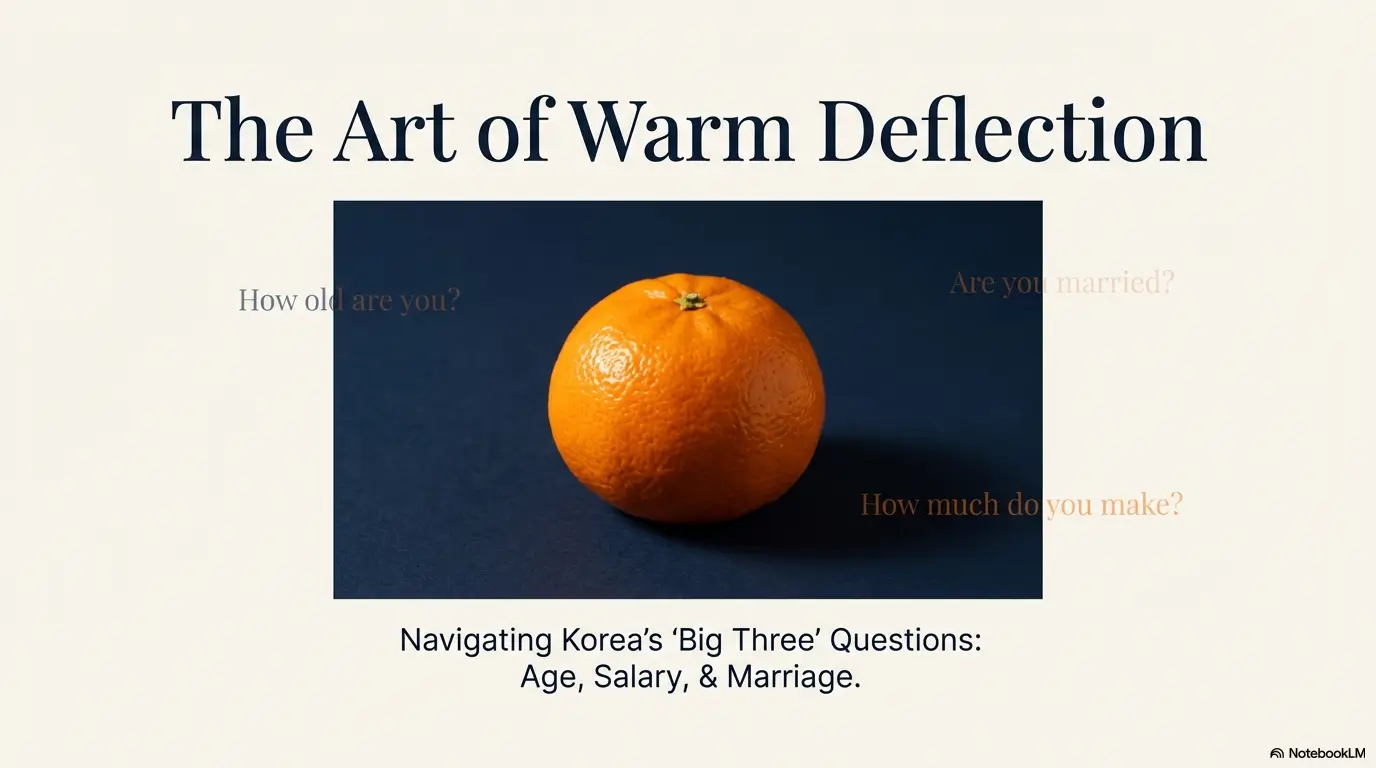
A tangerine appears in your hand like a peace offering, and then the questions arrive in quick succession: Korean small talk topics to avoid like age, salary, and marriage.
For many Anglo-American readers, it’s not the topic itself that stings. It’s the speed, the certainty, and the feeling that your private life just got pulled into the center of the table. Guessing in the moment risks two bad outcomes: oversharing you regret later, or sounding chilly when you were only trying to protect your boundaries.
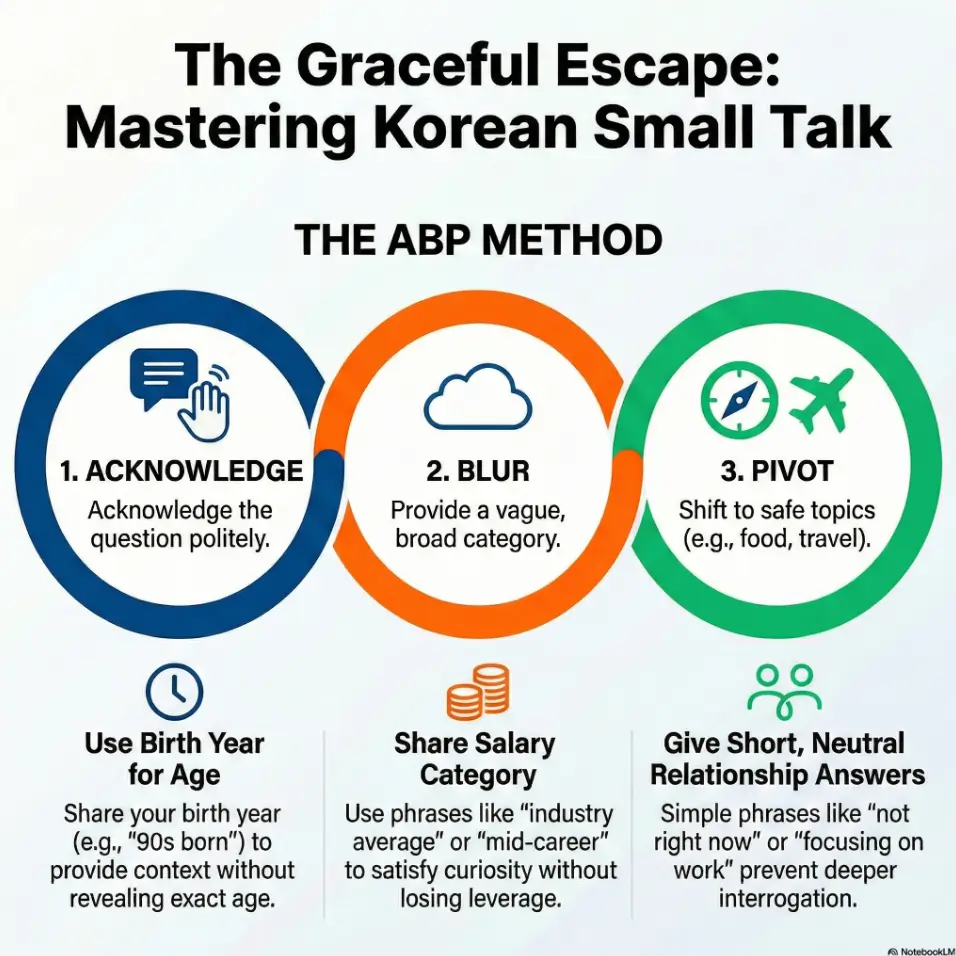
The Simple Formula: Acknowledge → Blur → Pivot
Stop improvising under social pressure. You don’t need perfect Korean; you need a calm tone and a clean redirect. This guide provides pocket-ready scripts for:
- First Meetings
- Workplaces
- Hoesik (회식) Dinners
- Meeting Parents
Pick your scripts once. Reuse them everywhere.
Contents — choose a section
Table of Contents
Who this is for / not for
For: US visitors, new hires, expats, exchange students, and spouses meeting Korean in-laws
A privacy boundary can be polite without a cover story. Choose the information you want to share and ask about the purpose of a question when it matters.
For: anyone who freezes when asked “How old are you?” or “When will you marry?”
Freezing is normal. Your cultural settings are doing their job. You’re not “too sensitive,” you’re simply calibrated to a different privacy default.
Not for: situations requiring legal/HR reporting (harassment, discrimination) or serious conflicts
This guide is for everyday social and workplace etiquette, not emergencies. If a question becomes coercive, retaliatory, or discriminatory, treat it as a different category and follow your employer’s reporting channels or professional advice.
- Assume good intent once, not forever.
- Use a repeatable script so you don’t improvise under pressure.
- Escalate only when it becomes repeated or high-stakes.
Apply in 60 seconds: Save one “warm deflection” line in your Notes app right now.
Age questions: What they mean in Korea (and why they happen fast)
The hidden purpose: speech levels, titles, and social “sorting”
In English, you can talk politely to a toddler, your boss, and your dentist using the same grammar. In Korean, the sentence itself changes based on relationship and context. So age often shows up early because it helps people choose how to speak and what level of formality to use. It can feel like “Why are we doing spreadsheets on our first hello?” but in Korea it’s often “Let me speak correctly to you.” If you want a practical crash course on titles and formality, keep Korean honorifics for tourists bookmarked for the moments when “polite” needs a real grammar setting.
One helpful modern nuance: Korea standardized the international age-counting system for official use starting June 28, 2023. In everyday conversation, you’ll still hear people reference “born in ’92” or use age casually, but the official shift has made the whole “How old are you exactly?” moment a bit more flexible in many settings.
Show me the nerdy details
Official age standardization took effect on June 28, 2023 for public administration and civil law contexts. In real life, conversational age can still be used socially, but many Koreans now default to “birth year” as an easier, less invasive shortcut.
When it’s normal: first meetings, group dinners, introductions
Typical moments you might hear it:
- First introductions at work or a friend-of-a-friend meet-up
- Group dinners (especially when choosing who pours drinks first)
- Situations where people are deciding whether to use titles, honorifics, or casual speech
Micro-anecdote: My first week in Seoul, someone asked my age before my coffee arrived. I felt rushed, like I’d been handed a pop quiz. Later I realized they were trying to choose the safest speech level, not steal my identity.
When it’s not: repeated probing after you’ve deflected once
If you already deflected and they keep pressing for exact numbers, that’s a different vibe. In polite terms: one ask can be social mapping. Repeated pushing becomes boundary-testing.
Polite response lines (age)
Soft + vague: “I’m in my late 20s/early 30s.”
Use when: casual, low-stakes, you don’t mind sharing a range.
Friendly deflect: “I’m around your age. What year were you born?”
Use when: they asked first and you want to shift to the less-precise “birth year” norm.
Pivot to context: “I’ve been in Seoul for a few months. How long have you been here?”
Use when: you want to move quickly into safe small talk.
Boundary, still warm: “I usually don’t share exact numbers, but I’m happy to chat about work/travel.”
Use when: you need a gentle line in a mixed group (colleagues + strangers) without sounding cold.
- Range answers feel normal to Americans and still help Koreans place context.
- Deflect once kindly, then upgrade to a boundary if needed.
- Your tone does 60% of the work.
Apply in 60 seconds: Pick one age line you can say without thinking and rehearse it once.
- Yes if it’s a first meeting and they ask once, casually.
- Yes if it’s needed to pick speech level (you can offer a range or birth year).
- No if they keep pushing after you deflect once.
- No if it’s tied to pressure, teasing, or leverage.
Next step: If it’s a “No,” switch to a boundary line + pivot immediately.
Salary questions: The “curiosity” that can cost you leverage
Why it comes up: hierarchy, lifestyle guesses, and practical planning
Salary talk in Korea can be surprisingly casual among friends and peers, sometimes framed as “helpful benchmarking” or curiosity about job fields. But in workplaces, it can also become a proxy for status and hierarchy. Either way, it’s a question with teeth: answer too precisely and you can accidentally give away leverage or invite comparisons you never asked for.
Micro-anecdote: A friendly acquaintance once asked my salary right after telling me where to get the best dumplings. I answered too specifically, then watched the conversation shift into a quiet mental ranking system I didn’t agree to join.
Workplace vs friends: same question, different stakes
- Friends: it may be bonding, career curiosity, or practical “Is that industry stable?” talk.
- Coworkers: it can trigger comparison, politics, or misinterpretation.
- Clients/vendors: it can turn into “How expensive are you?” disguised as small talk.
Here’s what no one tells you… salary talk can be a test of status, not intimacy
Sometimes the person isn’t trying to learn your number. They’re trying to learn your category: junior vs senior, “comfortable” vs “stretching,” stable vs uncertain. You can give them category without handing over digits. (This “category first” instinct also aligns with how Korean indirect communication often protects harmony without turning every moment into a confrontation.)
- Korea.net (Official): International age system takes effect (June 28, 2023)
- Seoul Metropolitan Government (EN): National law on standardizing international age
- Visit Seoul (Official): Etiquette guide for visitors
Polite response lines (salary)
General range: “It depends on bonuses, but it’s within the usual range for my role.”
Use when: you want to be cooperative without turning your paycheck into public art.
Company-safe: “I keep compensation private, but I’m comfortable.”
Use when: workplace setting, mixed company, or you want a clean boundary.
Redirect to role: “I’m focused on the work more than the numbers. What field are you in?”
Use when: you want to keep it friendly and steer into safe career talk.
If you must answer (lowest risk): share context, not a number (“I’m entry-level / mid-career / freelance.”)
Use when: you’re in a group where non-answer feels awkward, but number-sharing feels risky.
Show me the nerdy details
In negotiation psychology, giving precise numbers early can anchor future expectations and reduce flexibility. A category answer (“industry average,” “mid-career”) preserves warmth while keeping your bargaining position intact.
- Digits invite comparison and can weaken leverage.
- Category answers satisfy curiosity without future consequences.
- Redirect into role, industry, or career path.
Apply in 60 seconds: Decide your one-line “category answer” (e.g., “industry average for my level”).
- Work setting
- Mixed company
- Asker has leverage (boss/client)
Cost: 2 seconds of mild awkwardness.
Benefit: Protects leverage and privacy.
- Close friend
- Mutual benchmarking
- Low future risk
Cost: Some exposure.
Benefit: Builds trust if truly reciprocal.
Next step: If you hesitate, default to A. You can always share more later.
Marriage + dating questions: When “Are you married?” is just weather-talk
The cultural backdrop: timelines, family expectations, and “life progress” talk
In many Korean settings, relationship questions are less “confession booth” and more “life stage chatter,” especially among older generations. It can still feel like a spotlight, but it’s often intended as connection, not interrogation.
A marriage question may have several motives, but you do not need to decode them before declining. A brief boundary and optional topic change can be enough.
The double question: “Do you have a boyfriend/girlfriend?” + “When will you marry?”
This can come as a one-two combo. The key is to answer in a way that keeps your dignity intact and the atmosphere light, especially in group settings where you don’t want a dramatic freeze.
Let’s be honest… this can feel like a spotlight even when it’s meant warmly
If you’ve had complicated experiences around family pressure or privacy, these questions can land hard. Your goal isn’t to “win” the moment. It’s to keep the room comfortable without handing over your inner life.
Polite response lines (marriage/dating)
Neutral: “Not right now.”
Use when: you want the cleanest, shortest exit.
Light humor: “My schedule is dating me these days.”
Use when: 분위기 살리기 (keep the vibe), especially at dinners.
Future-vague: “Someday, maybe. I’m focused on work/study for now.”
Use when: you want to acknowledge the question without opening a follow-up tunnel.
Firm boundary: “I keep my personal life private, but thank you for asking.”
Use when: the question feels intrusive or repetitive.
- Long explanations invite debate.
- Short warmth + pivot keeps control of the topic.
- Humor works best when it’s gentle, not sharp.
Apply in 60 seconds: Pick your default: Neutral, Humor, or Boundary.
The graceful escape recipe: Acknowledge → Blur → Pivot (ABP)
Step 1, acknowledge: “Ah, I see” / “Good question”
Acknowledgment is the small bow before you close the door. It keeps you from looking dismissive, which matters in group harmony contexts. (If you want a broader “how to be polite without becoming a doormat” reference, Korean honorifics for foreigners pairs beautifully with ABP in real conversations.)
Step 2, blur: give a category, not a data point (range, stage, general vibe)
Blur means: “late 20s,” “industry average,” “not right now,” “I’m focusing on work.” You’re offering a shape, not a spreadsheet.
Step 3, pivot: ask them a safe question (food, travel, neighborhood, hobbies)
Pivot works best when it’s specific. Not “So… anyway.” Instead: “What neighborhood do you recommend?” or “What’s your go-to lunch place near here?”
Micro-scripts you can reuse anywhere
“That’s a bit personal for me, but I’m enjoying Korea a lot. What do you recommend around here?”
“I’m still figuring it out. How did you get into your job?”
“I don’t usually share that, but I’d love to hear about your favorite places in Seoul.”
Practical check: Use the specific questions below. A generic score, timer or prediction cannot establish another person’s intent or the right arrangement for every visit.
Power dynamics: When the asker is older, senior, or your client
Read the room: group dinner vs 1:1 vs office hallway
Power changes everything. The same question asked by a peer at a café can feel harmless, while the same question asked by a senior in a hallway can feel like a compliance quiz. Your goal: protect your future self.
Micro-anecdote: A senior once asked me a personal question in a corridor. I gave a careful, friendly non-answer and pivoted to work. Later, I was grateful. I didn’t hand them a “handle” they could twist later.
Choose your level: vague answer vs gentle boundary
- Low stakes: vague answer + pivot
- Medium stakes: category answer + pivot + smile
- High stakes: boundary line + pivot + exit line ready
When to pivot to respect: titles, shared topics, and appreciation language
If you need to preserve harmony, pivot into something that signals respect: work goals, learning, gratitude, or neutral recommendations. A classic move: ask for advice (food, neighborhoods, places to visit). It gives the other person a “good role” in the conversation: helper, guide, expert. (This is the same social physics you’ll notice in group chats too, so if your boundaries get tested online, KakaoTalk etiquette is a quiet power-up.)
High-stakes moments: Meeting parents, in-laws, or the company 회식 (dinner)
The “first impression” trap: oversharing to be liked
High-stakes dinners can make you perform like you’re auditioning for “Best Guest.” That’s when oversharing happens. You answer precisely because you want to seem open. But precision can turn into follow-up questions you didn’t plan for.
Illustrative scenario: At dinner, a guest declines to discuss salary and asks about another topic. This is a possible response, not a promise that every group will react warmly.
Later, walking home in the cold, I realized what went wrong: I tried to “prove warmth” with information. I could have proven warmth with tone, curiosity, and a pivot. The next dinner, I used ABP. The mood stayed light. I left feeling like myself again.
Safe conversation anchors: hometown, food, travel, studies, weather, sports, K-culture
- Food: “What’s your favorite place for noodles around here?”
- Travel: “If I had one weekend, where should I go?”
- Neighborhood: “Which area is best for cafés or walks?”
- Culture: “What show or music are you into these days?”
Exit lines that don’t sound like exits: “I’ll grab water” / “Let me say hello to everyone”
In group settings, the easiest boundary sometimes is movement. A polite mini-exit breaks the pressure without confrontation.
Common mistakes (and what to do instead)
Mistake 1: answering precisely under pressure (exact age, exact salary, exact timeline)
Precision feels “honest,” but it can create consequences. If your body tenses, that’s often your cue to blur.
Mistake 2: going cold or sarcastic (it reads harsher cross-culturally)
Even mild sarcasm can land like a slammed door. If you need humor, keep it gentle and self-directed (“My schedule is dating me”).
Mistake 3: apologizing too much (it invites follow-ups)
Excessive apology can sound like uncertainty, which some people interpret as an opening to push.
Mistake 4: pivoting without acknowledging (it can feel dismissive)
ABP exists for a reason. That first “acknowledge” keeps the social fabric intact.
Mistake 5: inconsistent stories (small inconsistencies get noticed)
In close-knit teams, inconsistencies travel fast. Another reason to keep details minimal: fewer details, fewer contradictions.
- Blurry answers are easier to repeat.
- Acknowledgment prevents accidental rudeness.
- Exit lines protect you when the room gets sticky.
Apply in 60 seconds: Choose one exit line you can use at dinners without guilt.
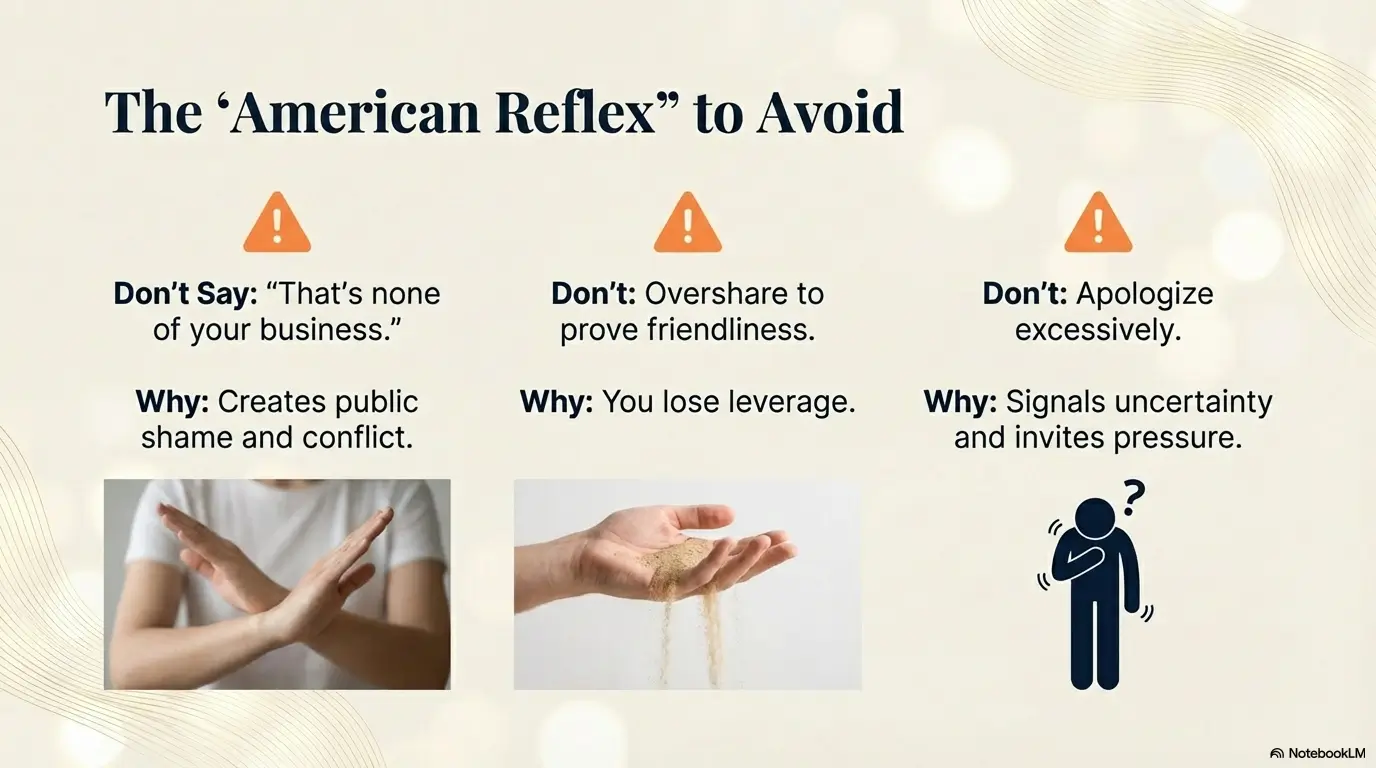
Don’t do this: The “American reflex” that backfires in Korea
“That’s none of your business” (too sharp for most contexts)
It may feel satisfying in your head, but it often lands as a public shaming moment, especially in groups.
“Why would you ask that?” (turns curiosity into conflict)
This frames the other person as morally wrong, which can escalate awkwardness fast.
Better alternative: “I’m a bit private about that, but…” + pivot
It protects your boundary while preserving social grace. Think: soft glove, strong hand.
What to say in Korean: Short, polite lines that save the vibe
Age deflection (Korean)
- “대략 비슷해요.” (Roughly similar.)
- “그건 조금 개인적인데요.” (That’s a bit personal.)
- “저는 90년대생이에요.” (I’m a 90s-born.)
Salary deflection (Korean)
- “연봉은 비공개로 하고 있어요.” (I keep my salary private.)
- “업계 평균 정도예요.” (Around industry average.)
Marriage/dating deflection (Korean)
- “아직이에요.” (Not yet.)
- “지금은 일/공부에 집중하고 있어요.” (I’m focusing on work/study.)
Let’s be honest… you don’t need perfect Korean, you need a calm tone + quick pivot
Your pronunciation can be imperfect. Your grammar can be simple. What matters most is emotional temperature: friendly, steady, unbothered. The pivot does the rest.
Keep a boundary while keeping the conversation moving
If someone asks about salary, you can say “그건 개인적인 이야기라서요” (That is personal), then offer a topic you are happy to discuss. For example, “일은 재미있어요. 요즘 어떤 일 하세요?” says the work is interesting and asks what they have been doing. You do not need to disclose an exact number to prove friendliness. The same boundary can be warm with a friend and firmer with someone who keeps asking.
A reader question: What if a polite deflection does not stop the question?
Repeat the boundary clearly: “그 이야기는 하지 않을게요” (I am not going to discuss that). You can change the subject or end the conversation without supplying a personal explanation.
Next step: Build your 3-line “Pocket Script” (and rehearse once)
Choose 1 line for age, 1 for salary, 1 for marriage
Do not over-engineer it. Choose lines you can say without sounding like you’re reading cue cards. Your “pocket script” should feel like you.
Practice the ABP flow out loud (10 seconds each)
Yes, out loud. Whisper it if you must. Your mouth needs rehearsal so your brain doesn’t panic at the table.
Save it in Notes so your brain doesn’t have to improvise mid-dinner
Micro-anecdote: The first time I saved a script, I felt silly. The second time I used it, I felt free.
“Good question.”
“Ah, I see.”
Goal: Keep warmth.
Range, stage, category.
No exact numbers.
Goal: Protect privacy.
Ask a safe, specific question:
food, travel, neighborhoods.
Goal: Move the conversation.
ABP sentence template: “That’s a bit personal for me, but I’m really enjoying Korea. What do you recommend around here?”
FAQ
Is it rude in Korea to ask someone’s age?
Often, no. Age can help Koreans choose the right speech level and titles. If it feels too personal, offer a range or birth-year style answer, then pivot.
Why do Koreans ask your age so early?
Because relationship context matters more to the language itself. Age helps people speak appropriately and place you in social context quickly.
What’s the most polite way to avoid answering my salary in Korea?
Use a category answer: “I keep compensation private, but it’s within the usual range for my role.” Then pivot to job field, industry, or a neutral topic.
Should I answer “Are you married?” when meeting Korean coworkers?
You can answer briefly (“Not right now”) and pivot. In group settings, short answers keep the mood light and prevent follow-up tunnels.
How do I deflect personal questions without seeming unfriendly?
ABP: acknowledge warmly, blur the details, pivot to a safe question. Your tone will communicate friendliness even when your content stays private. If you want more “safe-topic” anchors for awkward silences, keeping a few Korean BBQ phrases in your pocket can magically redirect dinner talk back to food.
What if my boss asks my age or marriage plans?
Keep it professional: boundary line + pivot to work. If it becomes repeated or pressuring, document it and consult your HR policy or a trusted advisor.
What should I say if someone keeps pushing after I deflect?
Repeat one boundary calmly (“I’m a bit private about that”) and use an exit line (“Let me grab water”). If pushing continues, create distance and change the setting.
Conclusion
Remember the opening moment: the tangerine, the smile, the sudden trio of questions. The secret isn’t finding the “perfect” sentence. It’s carrying a small, steady tool: ABP. Acknowledge the human, blur the data, pivot the topic. That’s how you stay warm without handing over your private life like a business card.
Your next step takes 15 minutes: write your 3-line pocket script (age, salary, marriage), rehearse it once, and keep one exit line ready for dinners. Do that, and you’ll stop improvising under pressure, which is where oversharing loves to hide. If you want an “official vibe check” for etiquette expectations in everyday Seoul life, pairing this with Korean templestay etiquette for foreigners can sharpen your instinct for when to lean in and when to blur.
Last reviewed: 2026-02-18
Practical example and reader question added October 20, 2026. Existing source dates are retained; this addition is not a fresh verification of every earlier claim.