

Master the Midnight Rhythm: The Korean Convenience Store Guide
At 11:47 p.m., a Korean convenience store feels like a tiny, fluorescent control room: fridge doors hissing, a microwave beeping in a language you don’t speak, and three people queuing with the calm of professionals.
Korean convenience store hacks aren’t about “secret snacks.” They’re about learning the store’s rhythm so you can eat well, heat food politely, and handle real-life errands without turning the counter into a panic scene.
The modern pain is specific: you want a cheap, decent meal at GS25 or CU, but you don’t want to block the microwave, fumble at the ramen station, or get surprised when a 1+1 tag doesn’t apply because the barcode doesn’t match.
- 🍜 DIY Food Combos: Repeatable, delicious, and budget-friendly.
- ⏲️ Microwave Etiquette: Pro-tips to keep you out of trouble.
- 📦 No-Cringe Parcel Workflow: Master 택배 (Standard) and 반값택배 (Half-price) shipping.
- 🏷️ Promo Math: Understanding deals so they actually behave at checkout.
Save the friction. Steal the flow. Move like you belong.
Table of Contents
Fast Answer: Korean convenience stores (GS25, CU, 7-Eleven, emart24) are mini cafeterias and mini post offices. The smartest “hacks” are simple: build a few reliable DIY combos (kimbap + ramen + egg, dumplings + cup 떡볶이, hot bar + rice), follow microwave etiquette (vent lids, don’t overfill, wipe splatter, queue politely), and learn parcel drop-off norms (label carefully, confirm phone number, keep your receipt/QR until delivery completes).
Store map in 90 seconds: what’s actually inside (and why it matters)
A Korean convenience store is small, but it’s densely packed with decisions. The trick is to scan the store like you’re reading a subway map: not everything matters, but three zones decide your whole experience. The first time I walked into a GS25 near a station, I spent 4 minutes pretending to “compare drinks” while actually trying to locate the microwave. Everyone else moved with the quiet confidence of people who’ve done this 1,000 times. You can borrow that confidence in one lap.
The “zones” you should scan first
- Chilled wall: kimbap, sandwiches, banchan-style sides, drinks, egg packs, yogurt.
- Hot bar: skewers, sausages, fish cake, fried snacks (availability varies by store and time).
- Ramen station: hot water + bowls + chopsticks, sometimes a little “assembly” counter.
- Microwave area: shared space with invisible rules you’ll learn once and use forever.
Micro-hack: read the tiny icons
Korean packaging is your co-pilot. Look for “전자레인지” (microwave) cues, peel or tear lines, and heating time labels. Also watch for the local decision accelerators: 1+1 and 2+1 promo tags. You’ll see people “shop with their eyes” in under 10 seconds because the tags do the math for them, and the item placement often nudges you toward a matching pair.
- Chilled wall = your “base” and “brightener.”
- Hot bar + ramen station = your “texture” and “warmth.”
- Microwave area = your etiquette moment.
Apply in 60 seconds: Walk one loop: chilled wall → hot bar → microwave/ramen station, then commit.
Show me the nerdy details
Convenience stores optimize for speed: products near the microwave are often “heat-and-eat” items with standardized packaging and predictable cook times. The signage and promo tags reduce decision time and cashier friction, which is why matching barcode/size matters for 1+1 and 2+1 deals.
DIY combo fundamentals: build meals that taste “planned,” not “panicked”
The secret to not eating a convenience-store meal that feels like a sad accident is a simple structure. When you follow a pattern, you stop wandering the aisles like a hungry ghost. I learned this the hard way after buying “three beige things” (chips, bread, and a sweet latte) and realizing my body wanted something that felt like a meal, not a crunch festival.
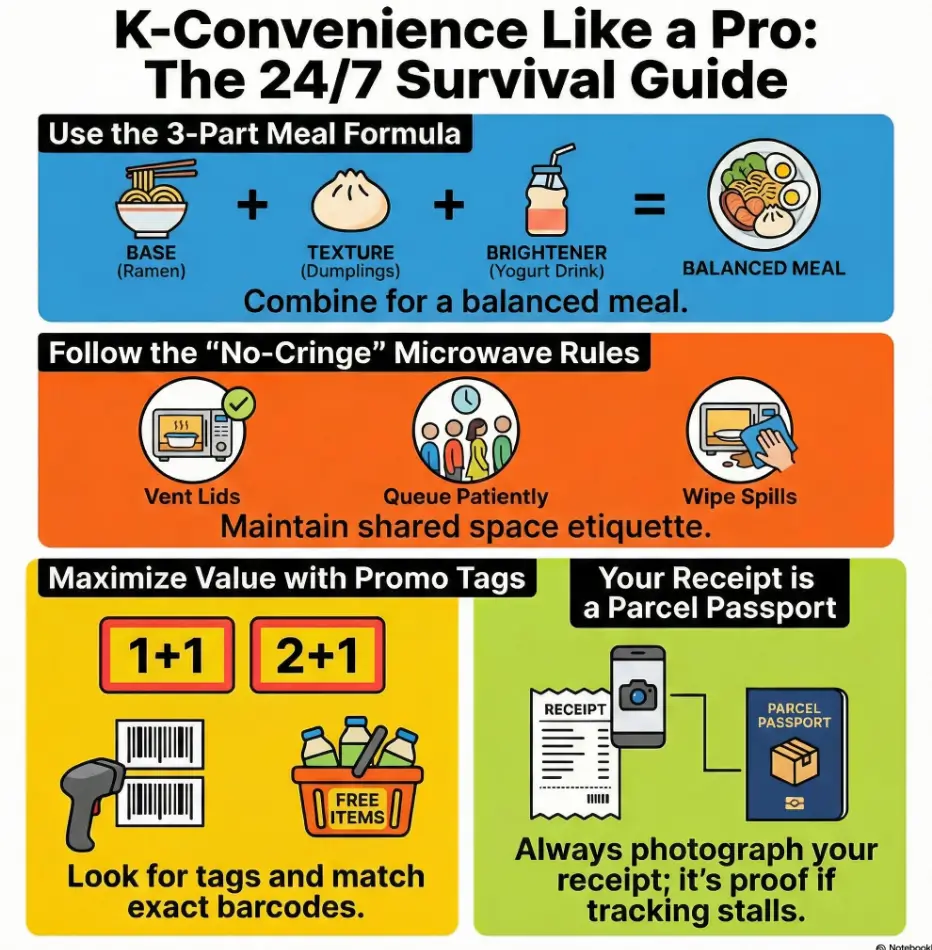
The 3-part formula (base + texture + “brightener”)
- Base: kimbap, 삼각김밥 (triangle kimbap), instant rice, ramen, 컵떡볶이 (cup tteokbokki).
- Texture: dumplings (mandu), hot bar skewer, fried chicken bites, seaweed snack.
- Brightener: yogurt drink, citrus soda, kimchi cup, pickled radish, iced Americano.
Curiosity-gap: the “one ingredient” that upgrades everything
The quiet MVPs are usually not the loud snacks. Look for soft-boiled egg packs, shredded cheese, and tuna-mayo items. They behave like “combo glue.” They mellow spice, add protein, and make your meal feel less like a solo act and more like a band that rehearsed once.
Mini calculator: build a cheap meal without guessing
Use this like a pocket rule, not a spreadsheet:
- Pick 1 base (the thing you’ll finish).
- Add 1 texture (the thing that makes it satisfying).
- Add 1 brightener (the thing that keeps you from feeling heavy).
Output: 3 items, 1 drink max, and you’re done. If you’re still hungry, double the base, not the snacks.
Neutral next step: Do one “3-item run” today and save your favorite combo in your phone notes.
7 “can’t-miss” Korean convenience store food combos (with exact grab lists)
These are not “influencer chaos combos.” These are operator combos: easy to assemble, hard to regret, and friendly to jet lag. Each one has a grab list so you can move fast, especially when the store is packed and you’re trying to not block the fridge door like a confused penguin with a backpack.
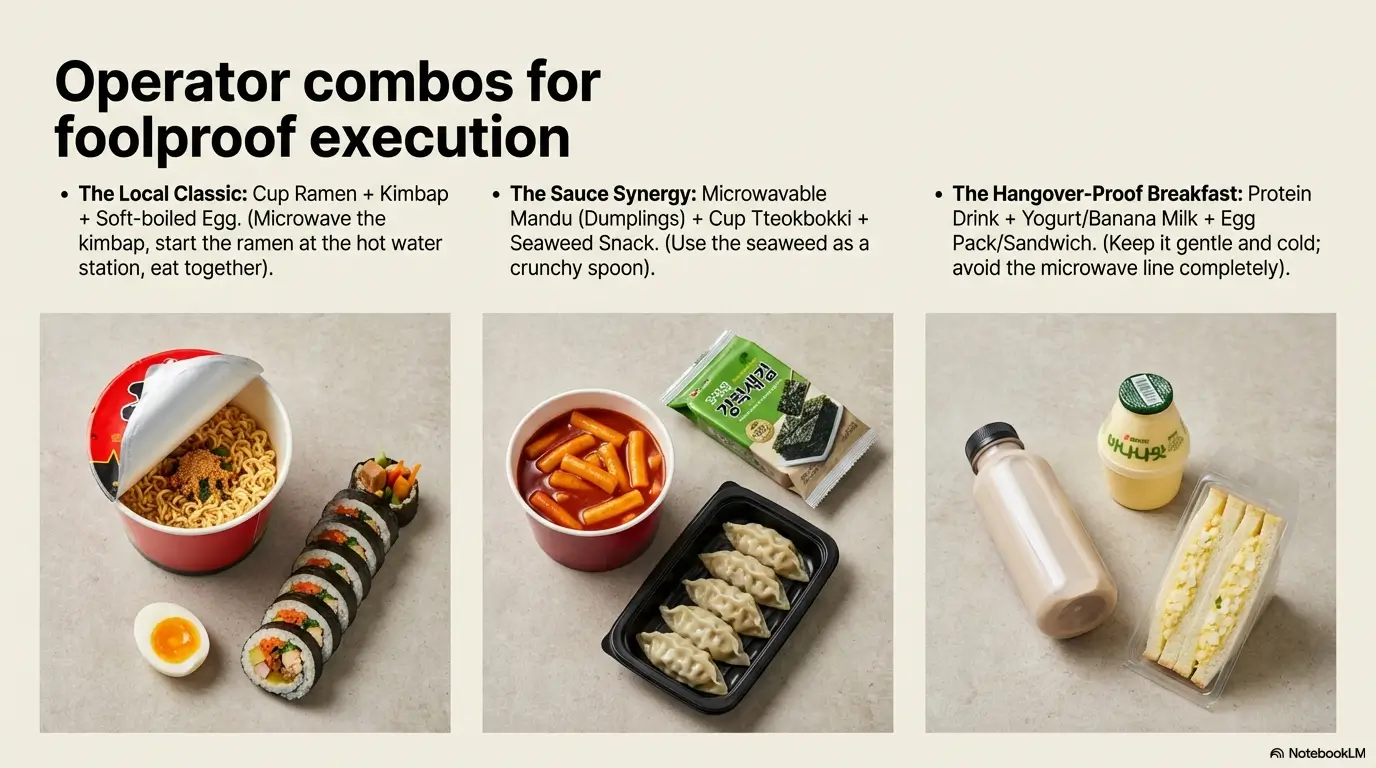
Combo 1: “Ramen + egg + kimbap” done the local way
Grab list: cup ramen + kimbap + egg (or cheese) + small drink.
Timing: Microwave the kimbap (follow label time). Start ramen at the hot-water station. Eat them together. If you want to look like you’ve lived here before, step aside after microwaving, not in front of it.
Combo 2: Dumplings + cup 떡볶이 (the sauce synergy)
Grab list: microwavable mandu + 컵떡볶이 + seaweed snack.
Texture fix: Use the seaweed as a crunchy “spoon.” It’s weirdly elegant, like improvised cutlery with vibes.
Combo 3: Triangle kimbap + instant soup cup (comfort in 5 minutes)
Grab list: 삼각김밥 + soup cup + yogurt drink.
Best for: late nights, train transfers, “I can’t decide.” Triangle kimbap is the quiet hero of indecision.
Combo 4: Hot bar skewer + instant rice (budget “plate” mode)
Grab list: 1–2 skewers + instant rice bowl + kimchi/pickles.
Pro move: Split into two meals if you’re roaming all day. I’ve done this between museum stops and felt like I’d hacked time itself.
- Pickles or yogurt make spicy/salty meals feel calmer.
- One drink is enough. Two drinks is a beverage subplot.
- Protein (egg, dumplings, chicken) prevents snack spirals.
Apply in 60 seconds: Add one brightener before you add another snack.
Combo 5: Convenience fried chicken + pickled radish + sparkling drink
Grab list: chicken cup/box + 치킨무 (pickled radish) + 탄산 (sparkling drink).
Great for: hotel-room dinners without delivery apps. This combo has “I am stable and fed” energy. If you want the next-level “I eat like a local” confidence, the same logic applies to restaurants too, especially when you learn the Korean banchan refill rules before you accidentally treat side dishes like unlimited private property.
Combo 6: “Hangover-proof” breakfast without cooking
Grab list: protein drink + yogurt or banana milk + sandwich or egg pack.
When your stomach is negotiating terms: keep it gentle and cold. Spicy breakfast is a bold lifestyle choice. If last night involved a little too much “cheers culture,” it can help to know how to refuse alcohol in Korea politely so tomorrow-you doesn’t have to do damage control with a yogurt drink.
Combo 7 (curiosity-gap): The “dessert that’s secretly a timer”
Grab list: ice cream + hot coffee or latte + one pastry.
Why it works: You pace your sugar. You don’t crash mid-walk. Also, it feels like a tiny reward for surviving your day in a new language. If your “survival day” includes ordering caffeine in a packed shop, you’ll love the calmer micro-rules in Seoul cafe etiquette.
Short Story: The microwave line that taught me Korean patience (120–180 words) …
It was one of those rainy evenings where your shoes give up halfway home. I ducked into a CU, grabbed kimbap and dumplings, and headed for the microwave like I’d been summoned by destiny. Except… there was a line. Not a dramatic line, just three people standing in a quiet, respectful arc that somehow felt more official than any rope barrier I’ve ever seen.
I did the classic foreigner move: hovered too close, trying to read the buttons while pretending I wasn’t impatient. A woman glanced at the splatter on the microwave door, grabbed a tissue, wiped it calmly, and stepped aside like it was choreography. I copied her: warmed my food, backed away, wiped my tiny mess, and suddenly the whole store felt friendlier. The hack wasn’t the food. It was the rhythm.
Microwave etiquette in Korea: the tiny rules that prevent big cringe
This is the part people skip online, which is wild because the microwave is where you become either “smooth traveler” or “main character with no situational awareness.” The rules aren’t complicated. They’re just… quietly enforced by the laws of shared space. Learn them once, and you’ll feel oddly relaxed every time you heat food.
Do this: the polite flow
- Pick your item and check the heating label (some packages are “open here” first).
- Queue with a little breathing room. Let the person in front finish their cycle.
- Vent lids or peel corners as indicated. Steam drama is avoidable drama.
- When it’s done, step aside to open, stir, or adjust. The microwave is not a lounge.
- If you spill, wipe it. Future you will thank past you.
Don’t do this: common microwave mistakes
- Heating sealed containers without venting. Steam will announce you to the room.
- Overfilling or stacking things so they slosh. Gravity always wins.
- Hovering inches from the door like it’s a reality show finale.
- Leaving spills. Someone will clean it, and that someone will feel feelings.
Let’s be honest… the microwave is a social test
If you can queue, vent lids, and wipe splatter, you’re basically honorary local for 3 minutes. Not “perfect Korean,” just “shared-space competent.” That’s a high-return skill. And if you ever need a quick “oops, sorry” in the moment, keep a few Korean apology phrases in your pocket so your body language doesn’t have to do all the translating.
Ramen station rules: hot water, bowls, and the “don’t touch that” zones
The ramen station is a beautiful public utility: hot water, bowls, lids, chopsticks, sometimes even a little counter. It’s also a place where your instincts might betray you. Think of it like a tiny communal kitchen. Your job is to take what you need, move smoothly, and leave it cleaner than you found it. The first time I used one, I blocked the counter while trying to open a packet with cold fingers. A gentle correction came in the form of someone waiting silently behind me, and I learned to “assemble off to the side” like it’s a rule of nature.
The clean method (fast + respectful)
- Grab a bowl and lid first. Set them on the counter.
- Open your ramen and toppings off to the side, not in the water line.
- Use provided utensils once. Don’t re-dip or double-handle shared tools.
- Dispose of wrappers properly. Some stores sort trash, some don’t, but “not on the counter” is universal.
Curiosity-gap: why some ramen tastes better at the store than at home
It’s the geometry and timing. The bowl shape holds heat evenly, the water is reliably hot, and you tend to eat it immediately instead of letting it sulk on your desk. Add a brightener (yogurt or citrus), and your brain registers “complete meal,” not “emergency noodles.” If you want to treat ramen night as “culture” instead of “damage control,” pair it with a little context on Korean street food so you can recognize flavors and spice styles without guessing.
Show me the nerdy details
Ramen texture is sensitive to water temperature and steep time. Using consistently hot water and eating right away reduces the “over-soft” window. If you add toppings, add them after water so powder dissolves cleanly before the broth gets crowded.
Parcel drop-off culture: turning a convenience store into your mini post office
This is the part that makes Korea feel like the future. Many convenience stores support parcel drop-off and pickup, including options like regular 택배 and “half-price” style services (반값택배) that are typically designed around store-to-store logistics. The vibe is simple: be prepared, be quick at the counter, and treat your receipt like a passport.
What you can do at many Korean convenience stores
- Parcel drop-off and pickup
- Returns (depending on platform and merchant)
- Sometimes: shipping supplies (tape, small boxes), or a kiosk to register shipments
Step-by-step: a “no Korean required” drop-off workflow
- Prep at home: package the item, tape it well, and write/print the address clearly. Add a reachable phone number. (If you’re still decoding Korean addresses, a Korean apartment move-in checklist can help you recognize the “real-life” fields you’ll keep seeing.)
- Check store options: look for signage like 택배 or a kiosk near the counter.
- In-store: if there’s a kiosk, follow prompts to register shipment and print a label/receipt.
- Counter handoff: present the parcel and the printed label/QR, then accept the receipt.
- After: keep the receipt until delivery completes. Take a quick photo as backup.
Don’t do this: parcel mistakes that cause delays (or awkward counter talks)
- Weak packaging. Tape matters more than you think.
- Wrong phone number. Notifications and pickup codes depend on it. (This is why sorting out Korean phone plans for Americans early makes everything else smoother.)
- Losing the receipt/QR. It’s your only breadcrumb if tracking stalls.
- Dropping off at the last minute. Cutoff times exist even if you don’t know them.
Here’s what no one tells you…
The receipt is your parcel passport. Treat it like a boarding pass until delivery completes. If your parcel ever “disappears,” that little slip is what turns panic into a solvable problem.
Eligibility checklist: are you “drop-off ready” in 60 seconds?
- ☐ Parcel is taped and sturdy (shake test: nothing rattles wildly).
- ☐ Address is legible (recipient name + phone number included).
- ☐ You can show a phone number that can receive messages.
- ☐ You have 2 minutes to stand at the counter without rushing staff.
- ☐ You’ll keep the receipt/QR until delivery completes.
Neutral next step: If you’re missing one box, fix it before you walk to the store.
Show me the nerdy details
Many parcel workflows hinge on a traceable identifier: a receipt number, barcode, or QR. Photos of the label and receipt can reduce “lost info” friction. Packaging quality matters because automated sorting and stacking can crush weak seams.
Promo math hacks: 1+1, 2+1, membership points, and the sneaky “barcode rule”
Promos are where travelers either feel triumphant or betrayed. The secret is that promos are often barcode-specific, sometimes size-specific, and sometimes “matching-only.” I once grabbed two similar-looking drinks, saw a 1+1 tag, and felt smug right up until the register politely charged me for both. The cashier wasn’t wrong. The barcode gods were simply unimpressed by my optimism.
How to not get surprised at the register
- Make sure the promo tag matches the exact item (flavor and size can matter).
- If it’s mix-and-match, there’s usually a sign indicating which group of items qualifies.
- When in doubt, take a quick photo of the promo tag. It’s your “why did this cost more?” evidence without drama.
Curiosity-gap: the fastest way locals spot deals in 10 seconds
They don’t read every shelf. They look for the promo tags first, then back-fill the item choice. In a busy store, this is basically shopping with a compass instead of a treasure map. (It’s the same “read the room first” logic you’ll see in Korean indirect communication too: signals first, words second.)
Decision card: When to chase a promo vs. when to ignore it
Neutral next step: Decide your goal before shopping: “save money” or “save time.” Then act accordingly.
Common mistakes (the greatest hits of avoidable regret)
This section is basically me handing you a small umbrella before it rains. None of these mistakes are catastrophic. They’re just the kind that make your day feel slightly harder than it needs to be, like wearing a backpack strap twisted for three hours and only noticing at dinner.
Food combo mistakes
- Buying too many “dry” items (all carbs, no contrast). Your mouth gets tired.
- Ignoring spice cues, then suffering in a hotel room with one sad bottle of water.
- Assuming everything is allergy-safe. Cross-contact can happen in shared prep environments.
Etiquette mistakes
- Eating at the microwave counter during rush. Step aside. Be elegant.
- Speakerphone calls in tiny seating zones. Sound travels like gossip. (If you live on KakaoTalk while traveling, the same “shared-space courtesy” carries over into KakaoTalk etiquette.)
- Treating staff like a concierge. Be concise, be ready, be kind. If you’re unsure what politeness level to use, a quick skim of Korean honorifics for tourists saves a lot of awkward improvisation.
Parcel mistakes
- Not writing a reachable phone number. Notifications fail, pickup turns into a quest.
- Packing liquids poorly. This is how a box becomes a tragedy.
- Dropping off right before cutoff and expecting instant movement.
Infographic: The 3-step “no-cringe” convenience store flow
1) Build (base + texture + brightener)
Pick 3 items. Stop. You’re done.
2) Heat (queue + vent + wipe)
Microwave, step aside, clean your tiny mess.
3) Ship (label + handoff + receipt photo)
Receipt = parcel passport until delivered.
- Brightener prevents heavy, regret-y meals.
- Wiping prevents shared-space tension.
- Receipt photos prevent parcel panic.
Apply in 60 seconds: Make “photo the receipt” your default habit.
FAQ
1) Can you use convenience store microwaves in Korea if you didn’t buy the food there?
Usually, microwaves are intended for items bought in that store. Some locations may be relaxed, but the “no cringe” move is to heat store-purchased items only. If you’re unsure, don’t gamble. Buy a small item (like water) elsewhere is not the point. Keep it simple: heat what you purchased there.
2) What are the best Korean convenience store food combos for a cheap lunch?
Start with the formula: base + texture + brightener. Popular, reliable lunches: ramen + kimbap + egg; dumplings + cup tteokbokki + seaweed; hot bar skewer + instant rice + pickles. Choose one that fits your mood and spice tolerance.
3) Is it rude to eat inside a Korean convenience store?
If the store has seating, it’s generally fine to eat there, especially items purchased in the store. The etiquette is about space: don’t block the microwave counter, keep your volume down, and clean up after yourself. If seating is tiny and the store is busy, consider taking food outside.
4) How do you heat kimbap or dumplings from GS25/CU without making a mess?
Follow the label time, vent packaging as indicated, and place items flat. After heating, step aside to open and adjust. If anything spills, wipe it immediately. That one habit makes you look instantly competent.
5) Do Korean convenience stores do parcel drop-off and pickup for everyone, including foreigners?
Many stores support parcel services broadly, but exact eligibility can vary by service type, store setup, and what the kiosk or carrier requires. The universal success factors are practical: correct phone number, legible address, solid packaging, and keeping the receipt/QR. If you hit friction, it’s usually missing information, not your passport.
6) What is “half-price delivery” (반값택배) and how is it different from regular shipping?
“Half-price” style services are often structured around store-to-store logistics: you drop off at one convenience store and the recipient picks up at another. It can be cost-efficient, but it changes the pickup behavior and timing. Think: cheaper and structured, not necessarily “door-to-door fast.”
7) What should I do if my convenience store parcel tracking hasn’t updated?
First, breathe. Then check the receipt/QR number, confirm the phone number is correct, and allow for processing windows (drop-offs right before cutoff can appear “stuck”). If it still doesn’t move, use the carrier’s tracking channel with your receipt details. This is exactly why you keep the receipt.
8) How do 1+1 and 2+1 promotions work at Korean convenience stores?
They usually apply to specific items, sizes, or barcode groups. “Looks the same” isn’t always “counts the same.” Match the promo tag carefully, and if you’re unsure, snap a photo of the tag before checkout to avoid surprises.
9) What’s the safest convenience store meal if you’re sensitive to spice?
Choose gentler bases like triangle kimbap, sandwiches, egg packs, and mild soup cups. Add a brightener like yogurt or a mild drink. Avoid unknown tteokbokki heat levels when you’re time-poor and far from your comfort zone.
10) What Korean convenience store items are best for breakfast on the go?
The “stable breakfast trio” is: protein drink + yogurt/banana milk + sandwich or egg pack. It’s quick, gentle, and doesn’t demand a microwave line when your brain is still booting up.
Conclusion
Here’s the curiosity-loop answer from the beginning: the real “hack” isn’t a secret snack combo. It’s learning the store rhythm so you can move through a tiny space smoothly, get fed cheaply, and do practical life tasks (like shipping) without friction. Once you’ve done one clean microwave cycle and one confident parcel handoff, the whole country feels about 3% less intimidating. That adds up.
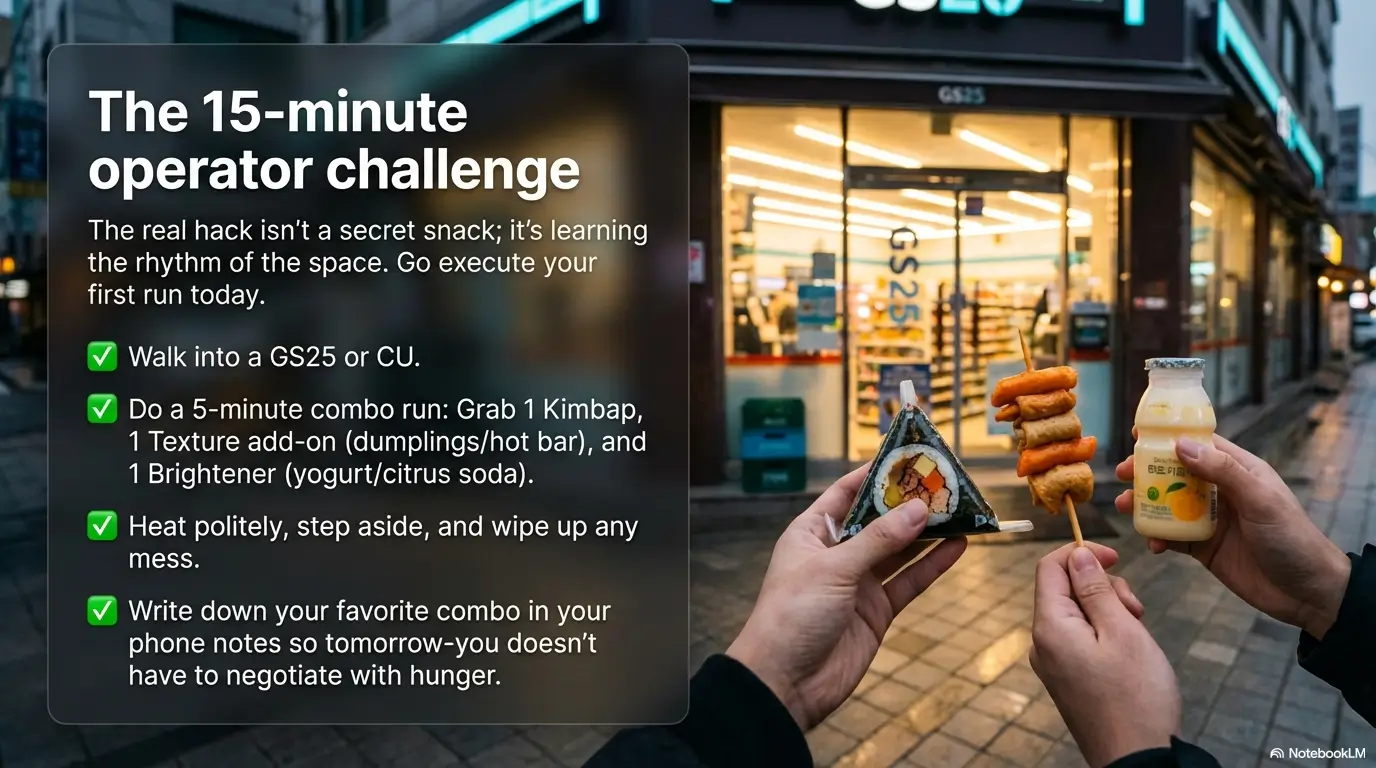
Your next step in 15 minutes: Pick one store near you (GS25 or CU is perfect). Do a 5-minute combo run: grab (1) kimbap, (2) one texture add-on (dumplings or hot bar), (3) one brightener (yogurt drink or citrus soda). Heat politely, keep the receipt, and write down your best combo so tomorrow-you doesn’t have to negotiate with hunger. And if you want a low-effort “night out” version of this rhythm, it’s basically the same muscle you use in a Korean PC bang guide: learn the flow once, then enjoy the convenience without friction.
Last reviewed: 2026-03-01