
Beyond the Shorthand:
Decoding the Korean Urban Identity
A Korean city can seem to arrive in your mind as a single emblem: steel, bibimbap, a harbor, a democratic uprising, a market street that somehow stands in for the whole place. That shorthand is useful, but it is also a beautiful little distortion. Why some Korean cities feel defined by one industry, food, or historical memory has less to do with folklore than with geography, industrial policy, migration, public ritual, and decades of repeated storytelling.
For Anglo-American readers, the friction is real. It is easy to treat Korean regional identity as branding, or to read every city through Seoul’s shadow, and miss how local economies, food traditions, and civic memory actually took shape. Keep doing that, and the map flattens into slogans.
This piece helps you read Korean cities with more precision: to see why Ulsan feels industrial, why Jeonju’s food identity travels so well, why Gwangju carries such moral weight, and why those labels are both true and incomplete.
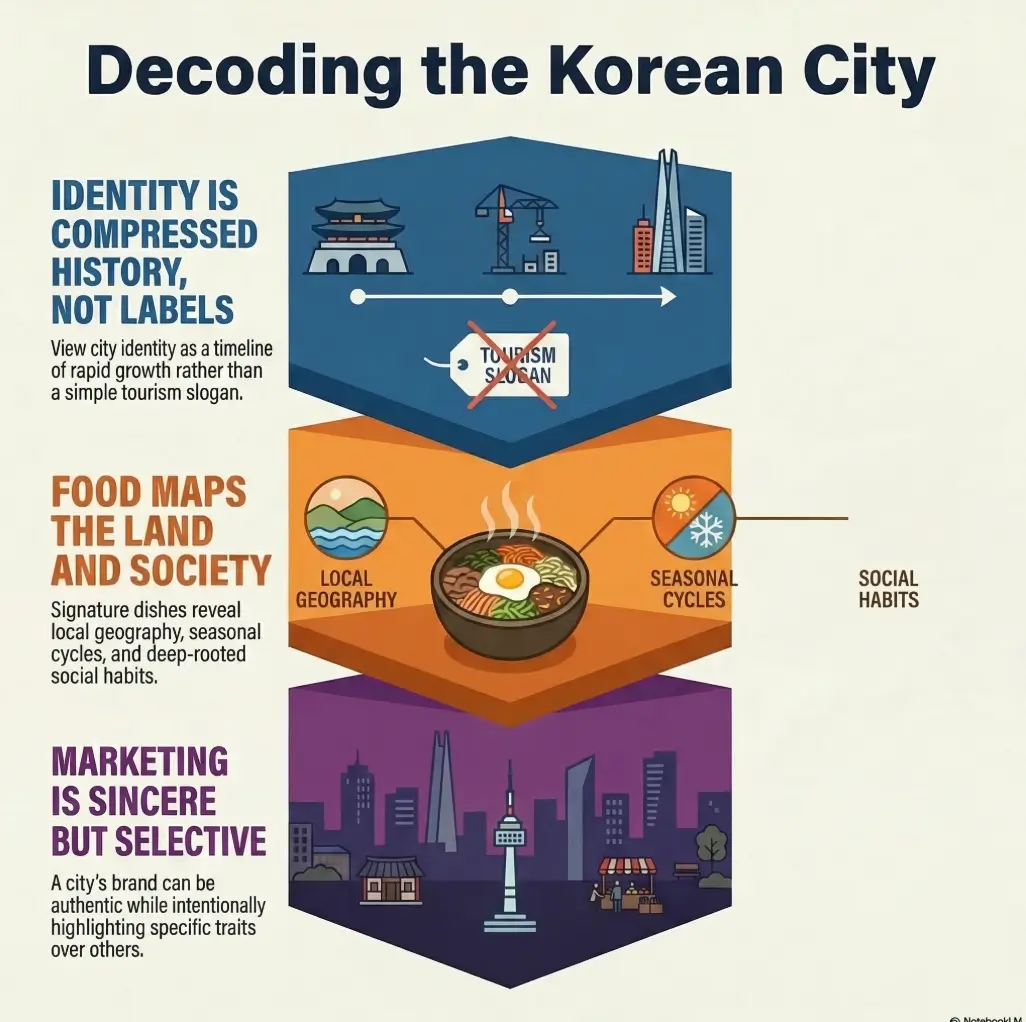
The method is grounded in a simple three-part lens: what a city made, what it ate, and what it chose to remember in public.
LOOK CLOSER. THE FULL CITY IS WAITING.
Fast Answer: Some Korean cities feel strongly associated with one industry, food, or historical memory because regional identity is shaped over time by geography, migration, state-led development, shared hardship, local pride, and repeated storytelling. What looks like a neat label is usually a compressed social history: part economy, part memory, part branding, and part survival.
Table of Contents
Who this is for / not for
This is for readers who want to understand why Korean cities feel so symbolically distinct
If you have ever wondered why one Korean city seems permanently linked to steel, another to bibimbap, another to democracy, and another to a certain market street or harbor, this piece is for you. It is built for readers who suspect that tourism slogans are only the outer wrapping paper.
This is for travelers, culture readers, and Korean studies beginners who want more than surface-level city slogans
You do not need a graduate seminar to follow the argument. You just need curiosity and a willingness to let a city be more than its postcard. I have had that experience myself more than once in Korea: arriving with one tidy mental label, then realizing by lunchtime that the place had already overflowed it. Readers who want a broader primer on how Korean culture works beyond the obvious surface will recognize the same pattern here.
This is for US readers trying to decode why one place gets linked to steel, another to kimchi, another to protest memory
American readers often understand this instinctively through shorthand cities at home. Detroit and autos. Napa and wine. New Orleans and jazz. But in Korea the compression can feel denser, because industrialization, war, democratization, and regional development happened with unusual speed. The OECD has repeatedly described Korea’s transformation as rapid and highly uneven across places, which helps explain why local identities hardened so visibly.
This is not for readers looking for a full city-by-city encyclopedia of Korea
This is a framework, not a census dressed as prose. The goal is to help you read Korean cities better. Once you have the method, you can apply it to Ulsan, Jeonju, Gwangju, Pohang, Andong, Busan, Mokpo, or places less internationally famous but no less layered. And if you later want to explore places that sit a little farther from the usual tourist beam, a guide to untapped Korean regional destinations makes a useful companion.
- Ask what the city made
- Ask what the city ate
- Ask what the city remembers in public
Apply in 60 seconds: Pick one Korean city name and write down the first thing it makes you think of. Then ask why that image won.
Start with the label: why one city gets reduced to one thing
A city can be larger than its reputation and still live under one shorthand
Human beings are ruthless little archivists. We like portable stories. A city with 1 million people, 50 neighborhoods, and 300 contradictions often gets shrunk into one carry-on-sized idea because that is easier to remember. Once a label sticks, it travels farther than nuance. A schoolbook line, a train station poster, a festival banner, a news report, and a family anecdote can do more identity work than a stack of municipal reports.
Repetition matters: the identity people hear most often becomes the identity they remember
There is nothing mystical about this. Repetition is infrastructure for memory. If a place is introduced over and over as the “steel city,” the “city of taste,” the “home of resistance,” or the “industrial capital,” the phrase begins to feel natural even when it leaves half the city in shadow. I once heard three different people describe the same city in Korea using nearly identical wording on the same day. That is when you realize identity is not just lived. It is rehearsed.
Industry, food, and memory each offer a simple story people can carry away
These three categories work especially well because they are concrete. Industry gives you skylines and payrolls. Food gives you flavor, festival, and easy repetition. Historical memory gives you moral weight. Together they form what I think of as a city’s public face: the version that can survive a brochure, a documentary voice-over, or a two-minute conversation with a stranger on a train.
Field-reading checklist: Is this city’s famous label deeply rooted or mostly recent?
- Yes/No: Is the label tied to geography such as port access, plains, mountains, or crops?
- Yes/No: Is it tied to a major employer, industrial complex, or state-led development era?
- Yes/No: Is it reinforced by museums, festivals, school memory, or public monuments?
- Yes/No: Is it repeated by outsiders as much as insiders?
Neutral next action: If you answer “yes” to at least three, you are probably looking at a durable identity, not a passing slogan.
Geography writes early: ports, plains, mountains, and river basins leave fingerprints
Port cities tend to build identities around trade, industry, and openness to outside influence
Ports are not just transportation nodes. They are personality machines. They bring goods, labor, new habits, languages, and urgency. Busan’s scale as a port city, for example, helps explain why it feels outward-looking, improvisational, and commercially dense. Port cities are often where the city begins to sound plural before it sounds polished.
Agricultural basins often become food-symbol cities because production and cuisine grow together
Food identity is rarely born in a branding meeting with bad coffee. It tends to emerge where landscape, labor, and preservation habits already have a long relationship. Rice plains, vegetable-growing regions, seasonal rhythms, and storage practices turn dishes into local signatures. A city becomes known for a dish not only because it tastes good, but because the ecology behind it stayed legible long enough to become tradition. That is also why pieces on Korean street food or the many regional kimchi variations tell you more than menu trivia. They quietly map climate, trade, and habit.
Mountain and inland regions can preserve stronger historical or cultural memory when industrial scale arrives later
Inland and mountainous regions often hold onto ceremonial, educational, or ancestral prestige longer, especially when the tempo of industrial expansion is slower. That does not make them untouched. It just means the memory layer may remain more visible. Places such as Andong feel this way to many visitors: not frozen, not quaint, but thick with retained cultural self-understanding.
Geography is not destiny, but it is stubborn. It sets the table early. Later politics and markets may rearrange the chairs, but the table still tells you something about what kinds of identities had room to grow.
Show me the nerdy details
Regional identity formation usually begins with path dependence. Once transportation access, crop patterns, and early trade routes shape a place’s economic role, later institutions tend to build on that existing logic instead of inventing a completely new one from scratch.
Industry leaves a louder echo than you expect
Factory concentration changes not just jobs but housing, schools, migration, and local pride
When a major industrial cluster lands in a city, it does more than create paychecks. It changes apartment construction, commuting patterns, technical education, diner conversations, marriage timing, civic confidence, and even the kinds of futures parents imagine for their children. The city starts speaking in shift schedules and freight logic. That is why industrial identity can feel so total. It is not confined to the factory gate.
A dominant employer can become the city’s unofficial biography
Take Ulsan. Even if you do not know the entire history, the outline is hard to miss. Britannica notes Ulsan’s concentration in automobiles, petrochemicals, and shipbuilding, and the city’s own English-language materials trace its rise to designation as a specific industrial zone in 1962. Once that kind of industrial mass gathers, the city begins to narrate itself through output, labor, and national contribution. People do not merely live there. They live inside an economic story with a very loud engine.
When industrial growth arrives fast, identity hardens fast too
Korea’s postwar development was famously compressed. The OECD has written about Korea’s rapid industrialization, urbanization, and widening gaps between urban and rural regions during the late twentieth century. In such conditions, local identity can condense quickly. A place that becomes steel-heavy or shipbuilding-heavy within a generation will often be remembered through that transformation for decades. Pohang and Ulsan make sense this way. Their industrial prominence did not just add an identity layer. It rearranged the hierarchy of all the others.
I remember riding into an industrial city in Korea just after sunset, when the lights of the plants made the horizon look almost theatrical. It felt less like arriving in a municipality and more like arriving in a national project. That feeling matters. Cities keep the emotional residue of the work that built them.
Infographic: The 3-layer engine of Korean city identity
1. Geography
Port, plain, mountain, basin, border, river, climate
2. Compression
Industrial policy, migration, war recovery, modernization speed
3. Retelling
Food festivals, memorials, museums, school memory, city branding
What the visitor sees: one famous symbol.
What is usually underneath: several decades of layered economic and cultural selection.
Decision card: When “industrial city” is a good reading vs a lazy reading
Use it when major employers, urban form, migration history, and public image all point the same way.
Slow down when the industrial label hides strong food culture, religious heritage, labor struggle, or coastal trade history.
Neutral next action: Before repeating the shorthand, ask what the label leaves out.
Food becomes civic language, not just dinner
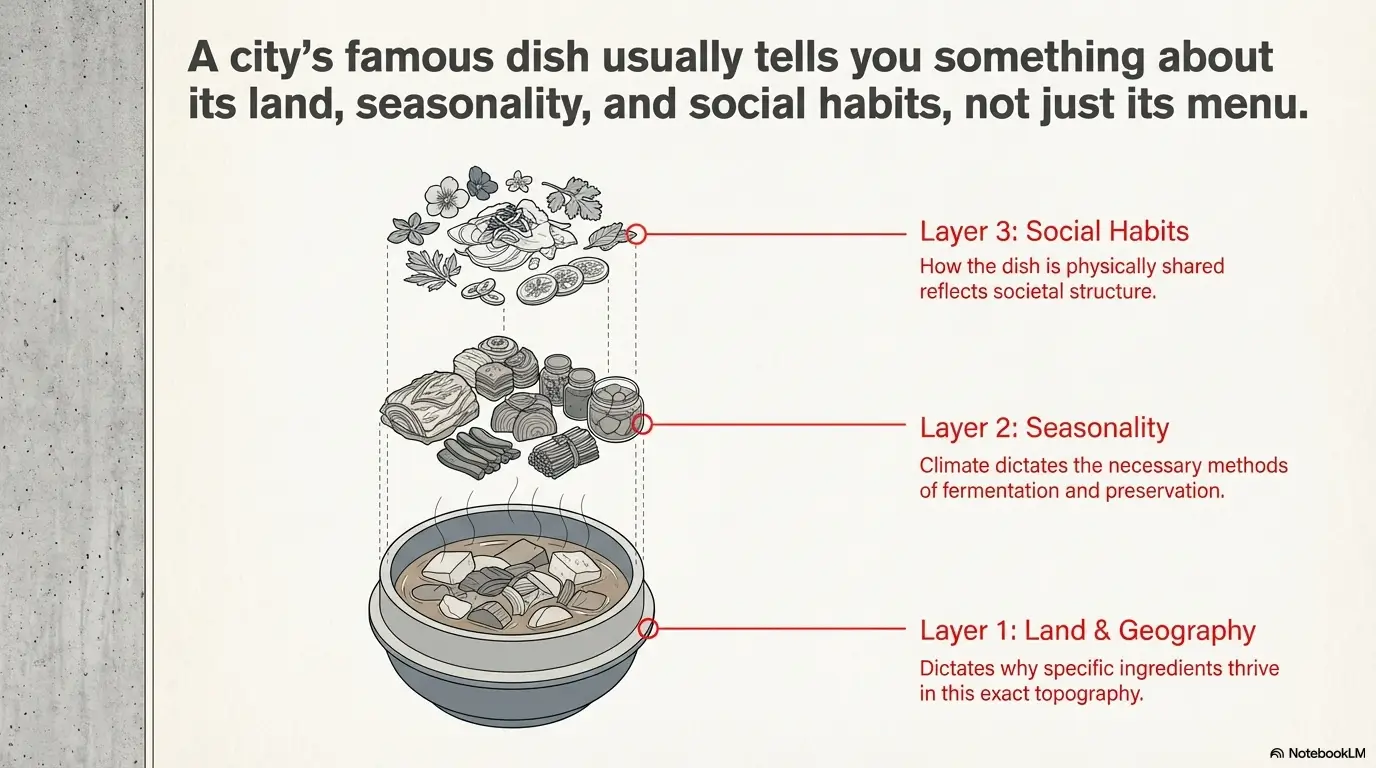
A regional dish often survives because it fits climate, crops, labor patterns, and preservation needs
Food identity is one of the most misunderstood parts of regional identity because outsiders often treat it like garnish. In fact, food is archive. It records what grew well, what stored well, what households could preserve, and what kinds of labor shaped daily life. If a region becomes famous for a dish, it is often because the ingredients, techniques, and social rhythms were sustainable there long before they became marketable.
Festivals, markets, and family businesses turn cuisine into a city signature
Once a dish becomes recognizable, institutions gather around it. Markets specialize. Restaurants compete. Local governments sponsor festivals. Family businesses become unofficial curators of memory. Jeonju is a good example of how a food city can consolidate identity around cuisine without being reduced entirely to it. Visitors may arrive for bibimbap, but they leave with an impression of old neighborhoods, hanok aesthetics, and a certain style of urban self-presentation. The dish opens the door. The city quietly rearranges the room. A thoughtful look at how hanok design shapes Korean space and feeling helps explain why food cities are often also architecture cities.
What begins as necessity often returns as heritage
UNESCO’s description of kimjang is useful here. It emphasizes not just kimchi as food, but the collective making and sharing practice as a social tradition that reinforces cooperation and seasonal belonging. That matters because it shows how a practical preservation habit can become a national and regional memory system. Food in Korea is often civic before it is merely culinary. It holds climate, labor, household hierarchy, and generosity in one bowl. You can feel a similar logic in essays on Korean banchan refill rules, where hospitality, abundance, and shared dining customs reveal far more than table etiquette.
I once stood in a market lane in late autumn, watching cabbages stacked like green moons, and it struck me that regional food identity is not simply about taste. It is about repeated public labor. A city remembers what it prepared together.
- Food identity often starts in necessity
- Festivals make it visible
- Hospitality turns it into civic pride
Apply in 60 seconds: When you hear a city-food pairing, ask what ingredients and preservation habits made it possible there.
Historical memory stays when the buildings change
Some cities are remembered less for what they make than for what they endured
Not every strong city identity comes from production. Some come from witness. Some from suffering. Some from resistance. In Korea, historical memory can define a place so powerfully that it becomes inseparable from civic self-understanding. The buildings may be renovated. The roads may widen. Coffee shops may colonize every corner with cheerful efficiency. But memory stays in names, anniversaries, museums, school narratives, and local speech.
Uprisings, colonial traces, war scars, and democratization struggles can define a city for generations
Gwangju is the most internationally legible example. Britannica’s entry on the Gwangju Uprising emphasizes the events of May 18 to 27, 1980 and the scale of participation and repression. But the deeper point is not merely that something happened there. It is that the event became a durable moral frame through which the city is still widely read. Historical memory can give a place a political and ethical identity that survives long after the immediate event has passed. This is one reason broader reading on Korean independence activists can sharpen the lens: public memory in Korea often travels through people as much as through monuments.
Memory becomes identity when schools, museums, rituals, and public speech keep retelling it
A city is not defined by memory only because the past occurred there. It becomes defined by memory because institutions keep telling the story. Memorial parks, museums, textbooks, anniversary ceremonies, civic language, and even ordinary family narration keep certain episodes awake. That retelling is not always neutral. It can be contested, reframed, or politically sharpened. But it remains powerful because it gives residents a vocabulary for dignity.
Short Story: A few years ago, I visited a Korean city with a famous historical burden and did the usual foolish thing first: I looked for the “main sights” before I listened for the city’s emotional weather. The streets were normal, which is to say full of convenience stores, buses, school uniforms, elderly walkers, and people carrying iced coffee with the serene determination of modern life.
Then I entered a memorial space and understood the mistake. Memory in Korean cities is often not loud at street level. It sits lower, like groundwater. You do not always see it immediately. But public ritual, local speech, and the shape of what gets commemorated tell you that the city has been carrying something for a long time. Once you notice that layer, the ordinary streets do not become less ordinary. They become more tender.
Here is the hidden engine: migration changes the story a city tells about itself
Rural-to-urban migration can transform a local economy into a regional myth
Migration is where identity gets rewritten in human handwriting. Korea’s twentieth-century urbanization moved people at enormous speed. Farmers’ children became factory workers, office workers, students, and city residents. That movement did not erase local identity. In many cases it intensified it, because cities had to absorb newcomers while also telling them what kind of place they had arrived in.
Newcomers often deepen city identity instead of diluting it
This seems backward at first. We imagine migration as blurring distinctiveness. But when a city receives new residents rapidly, it often amplifies the symbols that help social orientation. A clear industrial mission, a famous local dish, or a strong historical narrative gives people a common civic script. Identity becomes a handshake between old residents and new arrivals. It is a way of saying, “This is what this place has been, and perhaps what it still wants to be.”
A city’s “main thing” is often the result of who arrived, who stayed, and who left
The OECD’s writing on Korea’s regional development highlights not only rapid urbanization but also the thinning out of some rural communities. That matters because absence shapes identity too. A city can become known for one thing partly because other local possibilities weakened, migrated away, or lost institutional backing. When one story remains publicly funded, economically visible, and emotionally reusable, it grows louder. Silence is also an editor.
Mini calculator: How “compressed” is a city’s identity?
Count how many of these are true: 1) one industry dominates the city image, 2) one dish or food tradition is widely repeated, 3) one historical event is publicly memorialized.
Score 1: identity is broad and diffuse. Score 2: identity is visible but layered. Score 3: identity is highly compressed and easy for outsiders to stereotype.
Neutral next action: If the score is 3, spend extra time looking for what the city is trying not to lose.
Branding is not fake, but it is selective
Local governments and tourism boards often sharpen one identity because it is easier to market
Branding is usually accused of being shallow, but that is not quite right. Branding is more like editing. It selects, enlarges, and repeats. A city government has limited attention to work with. It cannot market all of local history at once. So it chooses what photographs well, translates easily, and carries emotional charge. One dish. One festival. One industrial achievement. One heritage district. One moral memory.
Festivals, slogans, mascots, and specialty streets can amplify one thread while muting others
Once selection begins, reinforcement follows. Streets are themed. Signage is standardized. Visitor itineraries are streamlined. Souvenirs become suspiciously unanimous. Before long, a city can feel as though it was born to symbolize the very thing it has merely decided to foreground. This is not always cynical. Often it is practical. Municipal budgets are real, competition for visitors is fierce, and clarity travels faster than complexity. Anyone who has read about regional festivals beyond Seoul will have seen how cities perform themselves into recognizability without necessarily lying.
The most visible city story is not always the fullest city story
The trick is not to dismiss branding, but to read it as one layer among several. A food festival may be deeply rooted and still incomplete. A heritage quarter may preserve real memory and still sideline labor history. An industrial slogan may be accurate and still mute the fact that the city also contains artists, retirees, students, care workers, and neighborhoods untouched by the famous image.
I have learned to treat city branding in Korea the way I treat family legends. They are rarely false. They are just edited for retelling.
Show me the nerdy details
Place branding works because it reduces cognitive load for outsiders and aligns institutions internally. The trade-off is representational loss. The more portable the message, the more likely it is to under-describe daily life.
Let’s be honest… sometimes the famous identity is partly performance
Some place brands are deeply rooted, but others are polished for visitors and investors
This is where many essays become unnecessarily pious. So let us avoid that. Yes, some city identities are ancient, embodied, and sturdy. Others have had a fresh coat of varnish applied in the last 10 or 20 years because investment, tourism, and inter-city competition demand a cleaner sales pitch. That does not make them fake. It makes them strategic.
A city may repeat one symbol because it is economically useful, not because it tells the whole truth
A city facing demographic pressure, industrial slowdown, or metropolitan overshadowing may lean harder on a recognizable identity because ambiguity does not attract buses, conferences, or attention. Strong symbolic branding can function like a bright scarf in a crowded room. It says: notice me first, nuance later.
The gap between lived city and marketed city is where the real story begins
For readers, travelers, and writers, that gap is precious. It is where you stop consuming a city and start encountering it. The best questions emerge there. Why this symbol and not another? Who benefits from its repetition? Which neighborhoods live inside the famous story, and which sit just outside it? Every good city essay begins when the brochure stops being enough.
- Roots matter
- Editing matters too
- The gap between them is analytically useful
Apply in 60 seconds: Compare the city’s official tourism image with what residents or local businesses emphasize.
Don’t flatten the map: the biggest mistake is treating regional identity like folklore wallpaper
One famous food does not explain an entire local culture
A dish can open a city but cannot finish it. You do not understand Jeonju because you ate bibimbap once, any more than you understand Louisiana because you tasted gumbo at an airport. Food is a clue, not a verdict.
One factory does not mean everyone works in that industry
Industrial cities are full of teachers, teenagers, nurses, office workers, migrants, service staff, grandparents, artists, and people who feel barely connected to the industry outsiders keep using to summarize their home. A city’s famous sector may dominate its skyline or tax base without narrating every resident’s life. Outsiders forget this because symbols behave like floodlights. They make some things glaring and other things invisible.
One historical event does not erase everyday life, contradiction, or change
This is especially important with memory cities. Places associated with grief or resistance are still places where children practice piano, people argue about parking, and someone is always buying fruit. To flatten a city into its trauma is another form of not seeing it. Respect means holding both truths at once: the city remembers, and the city continues.
Common mistakes
Mistaking tourism branding for complete historical identity
The most visible story is not always the deepest one. Treat official branding as an introduction, not a verdict.
Assuming every Korean city developed along the same modernization path
They did not. Ports, industrial zones, agricultural centers, border regions, and cultural capitals moved through modernity on different schedules and with different pressures.
Treating regional food as a charming side note rather than an economic and climatic archive
Food is evidence. It carries information about crops, labor, seasonality, preservation, and hospitality. That becomes easier to see once you pay attention to traditions such as Korean temple cuisine, where landscape, restraint, religion, and locality meet on the plate.
Reading local pride as provincialism instead of place-based memory
Sometimes what outsiders call excessive pride is a community defending continuity against erasure. That is not always reactionary. Sometimes it is grief wearing a neat jacket.
Comparing Korean cities only through Seoul’s lens
Seoul is not a neutral measuring stick. The closer you treat Seoul as the default, the easier it becomes to misread other cities as merely lesser, quieter, older, or incomplete. They are often operating with different civic logics entirely.
Reader’s comparison list: what to gather before judging a city label
- The city’s most repeated public symbol
- Its major industries across at least 2 generations
- One local food tradition and its ingredient logic
- One public memory site, museum, or annual ritual
- What residents say when asked what outsiders miss
Neutral next action: Once you have all five, compare the marketed city with the lived city.
Here’s what no one tells you… strong city identity can be a survival strategy
A recognizable identity helps cities compete for attention, investment, and visitors
Big capitals pull gravity. Smaller or non-capital cities need magnets of their own. A memorable identity helps a place stay legible in national imagination. It improves recognition, anchors festivals, supports local businesses, and gives outsiders a reason to come. In an age of demographic anxiety and fierce competition for attention, legibility is not trivial. It is economic oxygen.
Local memory can protect dignity in places overshadowed by larger metropolitan centers
A city does not hold tightly to its symbolic identity only because it is proud. Sometimes it does so because it refuses to be dissolved. Identity can become a form of civic self-defense. “We are the city of this” may sound simplified from the outside, but from within it can mean, “We are not forgettable. We were here. We mattered. We still do.”
A city sometimes holds tightly to one symbol because it fears being forgotten without it
That fear is not imaginary. When younger residents leave, when industries decline, or when tourism markets flatten local complexity into a few saleable images, symbolic clarity can feel like insurance. It is not always elegant. But it is often understandable. Cities, like families, sometimes grip the heirloom they can still name.
I find this one of the most moving parts of regional identity in Korea. The label is not only a simplification. Sometimes it is a lifeline.
Don’t do this: avoid reading Korean regional identity as fixed or old-fashioned
City identity evolves as industries decline, food culture globalizes, and younger residents reinterpret heritage
No city remains identical to its own legend. Young residents film old markets on new phones. Industrial cities add museums and green spaces. Heritage cities become start-up friendly. Food traditions are remixed, exported, and Instagrammed into strange new costumes. None of this automatically destroys authenticity. It changes the terms on which authenticity is negotiated.
Historical memory can intensify, soften, or be politically reframed over time
Public memory is alive. It can become more central during anniversaries or political conflict, then recede from daily conversation without disappearing. It can be formally recognized, softened for tourism, sharpened by activism, or reinterpreted through art and education. This is why city identity should be read as a process, not a relic.
What felt permanent in one decade may feel curated in the next
That is not failure. It is life. A strong city identity is often a moving braid of old material and new performance. The key is to ask whether the braid still has roots in lived memory and local practice, or whether it has become mostly decorative. Usually the answer is mixed, which is exactly why the subject is interesting. The same tension appears in essays on Korean traditional dance forms and Korean geomancy in architecture, where living tradition keeps renegotiating its modern costume.
Read the layers together: industry, food, and memory often overlap
A port city can also be a food city because trade shapes taste
Ports circulate ingredients as well as goods. Fisheries, storage methods, trade routes, and migrant habits reshape local eating. That is one reason coastal identity in Korea often feels both economic and culinary at once.
An industrial city can carry labor history that becomes civic memory
Industry does not stay economic forever. Over time it grows memory, conflict, pride, and even ritual. Workers’ neighborhoods, company housing, labor struggles, and generational mobility all leave marks on how a city tells its own story.
A historical city can still reinvent itself through cuisine, festivals, and contemporary branding
Memory cities are not museums with bus timetables. They also experiment. They host events, redesign public space, and package local identity for new audiences. The point is not to decide whether a city is “really” one thing. The point is to see how several layers keep negotiating for the front of the stage.
This closes the curiosity we started with. Korean cities feel defined by one thing not because they are simple, but because many decades of geography, compression, retelling, and institutional reinforcement have taught one symbol to speak louder than the others. The city is still plural. You are just hearing the strongest microphone first.

FAQ
Why do Korean cities seem more symbolically distinct than many US cities?
Partly because Korea’s industrialization, urbanization, war recovery, and democratization were historically compressed. When change happens quickly, local roles can become highly visible and strongly narrated. The symbolic outlines harden fast.
Is a city’s famous food usually tied to local agriculture and climate?
Often, yes. Not always perfectly, and not always exclusively, but regional dishes usually have roots in what could be grown, preserved, traded, or prepared sustainably in that area. Food identity is rarely random.
Why are some Korean cities associated with protest, resistance, or democratization?
Because historical memory can become a durable civic identity when public institutions, schools, museums, anniversaries, and local storytelling keep certain events central. Gwangju is the clearest example for many readers.
Are these city identities historically accurate or mostly tourism marketing?
Usually both, in different proportions. Most strong city brands have a real historical or geographic core. But branding edits that reality, selecting what is easiest to communicate and most useful to promote.
How did industrial policy shape local identity in modern Korea?
State-led development concentrated certain industries in particular places, which changed employment, migration, infrastructure, and civic self-image. Cities such as Ulsan and Pohang are hard to understand without that policy backdrop.
Why do some smaller Korean cities have stronger symbolic branding than larger ones?
Because symbolic clarity does not always track population size. Smaller cities may lean more heavily on one recognizable identity to compete for visitors, investment, and national attention.
Does generational change weaken regional identity in Korea?
Not necessarily. It often changes the style of identity rather than erasing it. Younger residents may reinterpret local pride through design, social media, entrepreneurship, or new cultural packaging.
How should US travelers read local city identity without stereotyping it?
Use the famous symbol as a starting clue, not a final answer. Ask what history, geography, and institutional repetition made that symbol dominant. Then look for what daily life adds that the slogan leaves out.
Next step
Pick one Korean city you think you already understand and trace its identity through three lenses: economy, cuisine, and public memory
Do this within the next 15 minutes. Choose one city. Write down the single label you associate with it. Then test that label against three questions: What economic structure helped make it famous? What food or everyday practice carries local memory? What event, institution, or public ritual gives the place moral or emotional weight? If you do this once, carefully, the map of Korea starts to look less like a list of slogans and more like a field of layered biographies.
The point is not to become suspicious of every city label. The point is to become smarter about how labels are made. A city can be genuinely proud of steel, genuinely proud of bibimbap, genuinely shaped by democratization memory, and still be larger than all of those things. That is why these identities feel so vivid. They are not decorative stickers. They are compressed negotiations between land, labor, story, and survival.
Last reviewed: 2026-03.