

Mastering the Threshold: The Art of Korean Shoe Etiquette
The difference between a smooth visit and a faintly awkward one in Korea is often about three seconds long: the pause at the door. For foreigners, taking shoes off in Korean homes and clinics sounds simple until you are balancing a bag, reading the room, and realizing the rules are not always identical from one threshold to the next.
That is where people usually go wrong. They assume every clinic works like a Western medical office, or they hesitate too long at a home entrance and turn a small courtesy into a memorable stumble. Keep guessing, and you risk starting the visit with the one mistake everyone notices before a single proper conversation begins.
This guide helps you read Korean shoes-off etiquette the practical way: how to spot entrance cues fast, why clinics vary by building, and the essential “sock strategy” many visitors forget until it is too late.
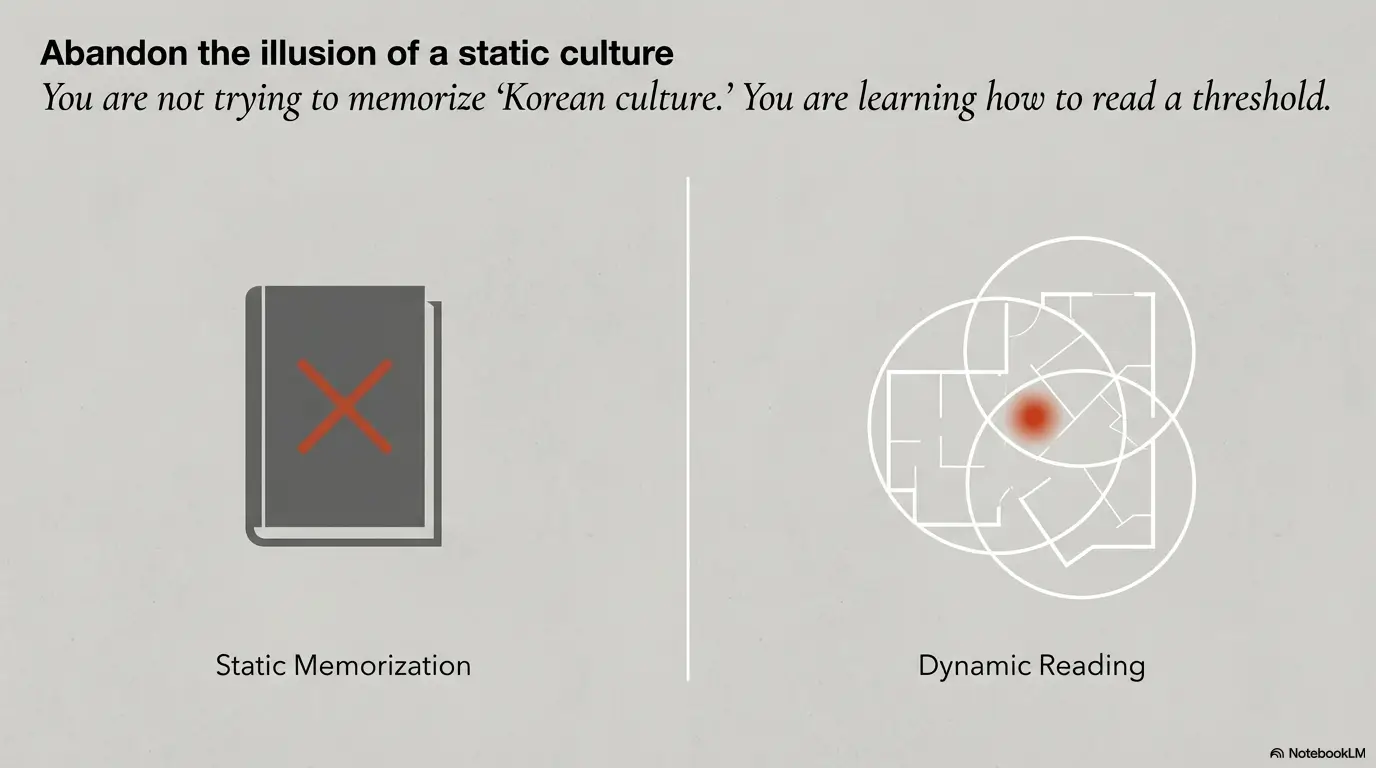
The approach here is grounded in real threshold cues and official guidance, not vague cultural mystique. Because the doorway tells you more than people think, and the floor tells you even more.
Table of Contents
Start Here First: Who This Is For / Not For
This guide is for the traveler who has been invited to dinner, the exchange student meeting a tutor’s family, the foreign resident dropping by a neighbor’s apartment, and the international patient trying to avoid an awkward clinic entrance. It is also for people who do not want a grand theory of Korean culture, only a practical answer that works under fluorescent lights with a tote bag sliding off one shoulder.
Who this is for
US travelers visiting Korean homes for dinner, holidays, tutoring, or social calls. Foreign residents, exchange students, and expats navigating everyday etiquette in Korea. International patients visiting Korean clinics, pediatric offices, dental practices, rehabilitation rooms, dermatology clinics, and smaller specialty practices. Readers who want to avoid awkward first impressions without turning every doorway into a philosophy exam.
Who this is not for
This is not a legal code for every building in Korea. It is not medical advice. It is not a guarantee that every clinic or guesthouse follows one national script. Think of it as field guidance: what usually happens, what good visitors notice, and how to recover if you get it wrong.
- Homes usually lean strongly toward shoes off.
- Clinics vary by building, room, and treatment zone.
- The fastest path is observation first, action second.
Apply in 60 seconds: Before your next visit, glance at your socks and choose shoes you can remove without staging a wrestling match.
At the Door: Why Shoes Off Is About More Than Clean Floors
For many foreigners, shoe removal looks like a cleanliness rule. It is that, yes, but it is also something quieter. In many Korean homes, the floor is not a dead surface. It is part of ordinary life. People sit on it, stretch on it, fold laundry on it, place bags on it, and let children spill their small empires across it. Heated flooring deepens that sense of the floor as lived space rather than mere transit lane. So the threshold between outside and inside does a surprising amount of social work.
Floor culture changes the meaning of “inside”
Once you notice how much domestic life happens close to the floor, the rule starts to make emotional sense. Outdoor shoes carry the street inward. That is not just dirt. It is weather, grit, transit residue, and the anonymous film of public life. Taking shoes off says, very simply, “I understand that this space is different.”
Respect shows up before words do
I have seen people win a room with one small gesture and no Korean beyond hello. I have also seen a perfectly polite guest lose the first five seconds because they stepped forward like they were entering a hotel corridor. The point is not moral panic. It is that in many Korean settings, attentiveness is visible before speech. The doorway is the first test, and thankfully it is an easy one. The same quiet attentiveness also matters in other first-contact situations, from greetings to how you hand over money gifts and business cards politely.
Small gestures often carry outsized weight. When your language is limited, your awareness becomes your accent.
Let’s be honest…
Most embarrassing moments do not happen because someone never heard the rule. They happen because the person half-knew it, hesitated, then shuffled into a posture that looked like a customs dispute with one sneaker hovering midair. Doorways can do that. They turn normal adults into confused flamingos.
Decision card: Is this a shoes-off space?
When A: Private home, raised floor, visible shoes, slippers nearby. Default: Remove shoes immediately.
When B: Large hospital, full commercial lobby, staff in outdoor shoes, no threshold cues. Default: Keep shoes on until a room or sign suggests otherwise.
Neutral action: Pause for two seconds and let the room answer before your feet do.
Entrance Signals: How to Tell in Three Seconds Whether Shoes Come Off
This is the practical heart of the whole matter. Most of the time, you do not need anyone to explain the rule. The entrance explains it. Korean spaces are often generous with clues, but those clues live low to the ground. If you walk in while looking only at faces, wall décor, or the reception desk, you can miss the message entirely.
Look for the split-level entrance first
A lowered entry area is one of the clearest signals in a home. You step into a lower section with outdoor shoes, then step up to the main floor after removing them. That raised interior is not a decorative quirk. It is the room whispering, “Street stops here.”
Check for lined-up shoes or house slippers
When you see several pairs of shoes gathered at the entrance like quiet witnesses, the case is usually closed. Slippers, a shoe rack, or a shallow mat near the step all reinforce the same message. Even when the host is relaxed, the architecture may still be strict.
Read the material underfoot
Wood, warm vinyl, mats, and softer indoor surfaces often nudge you toward shoe removal. By contrast, commercial tile, hospital corridors, and full public lobbies more often allow shoes. Not always, but often enough that it is a useful first filter.
Notice whether the rule changes by zone
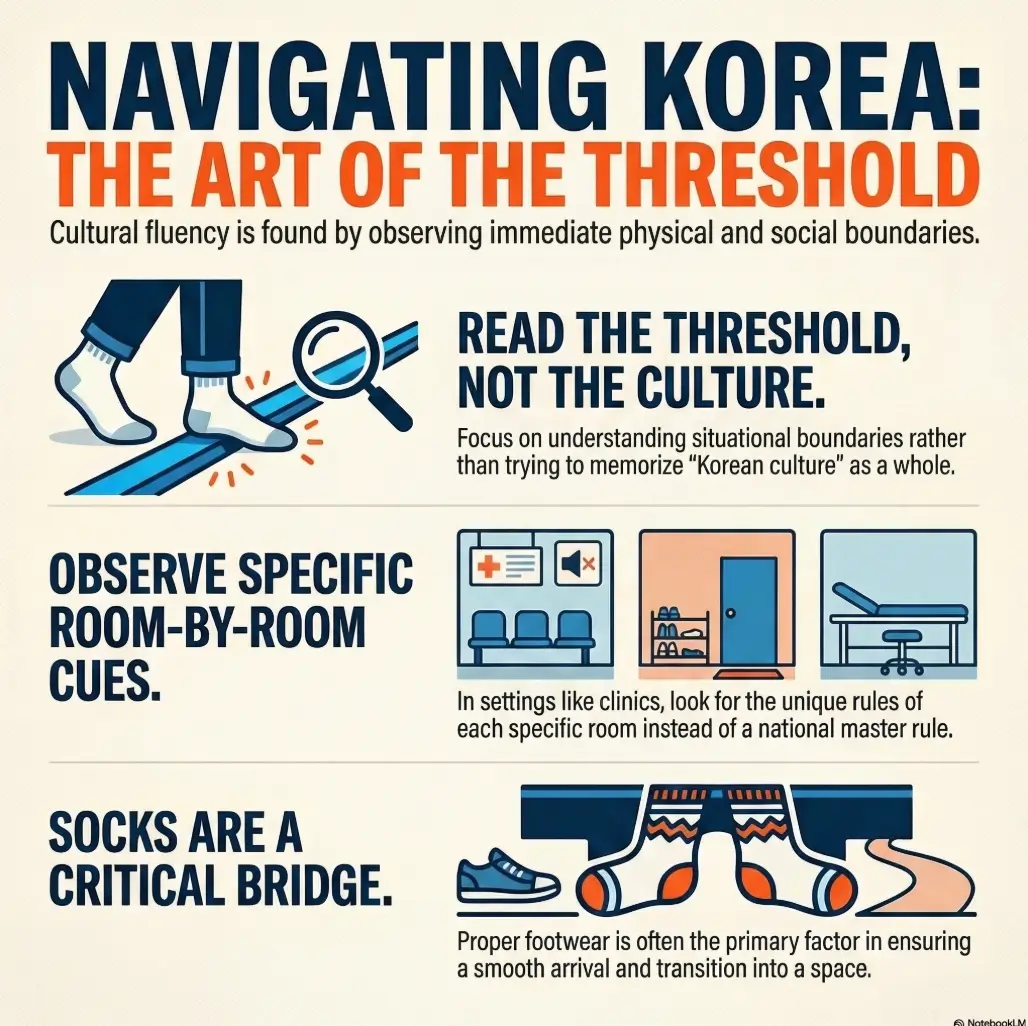
Some spaces behave like mixed weather. The reception area can be shoes-on, while the treatment room becomes shoes-off. This is common in specialized clinics, rehabilitation areas, child-centered spaces, or treatment rooms where the floor is part of the care environment. Read each zone separately. That room-by-room mindset also helps explain why Korean clinics can feel so fast and efficient without always feeling identical from one practice to the next.
I once watched a visitor miss every obvious signal while staring heroically at a receptionist’s face, trying to perform confidence. Confidence is lovely. At Korean entrances, however, humility has better eyesight.
Show me the nerdy details
Threshold design does cultural labor. A recessed entry, a shoe cabinet, or a raised floor creates a behavioral cue without needing a sign. In environmental psychology terms, the space reduces ambiguity by making the “correct” action feel physically legible. That is why doorway confusion tends to happen when one or more cues are missing, mixed, or unfamiliar to the visitor.
Korean Homes: What Hosts Usually Expect and What Guests Miss
Private homes are the clearest shoes-off zone. Apartments and houses in Korea usually expect outdoor shoes to come off at the entrance, whether the visit is long, short, formal, casual, festive, or gloriously last-minute. Korea Tourism Organization’s English visitor guidance says travelers often need to remove shoes before entering a house, which aligns closely with what visitors encounter in daily life.
Homes are the clearest shoes-off zone
If you are visiting for dinner, a holiday, tutoring, tea, or even a brief drop-off, assume shoes come off. The “I’m only here for a minute” defense rarely helps. In fact, short visits can make shoe removal even more expected, because there is less practical reason to keep outdoor shoes on. This becomes especially useful during family-centered holidays, when expectations around arrival can feel even more loaded, as in Seollal etiquette for foreigners or Chuseok etiquette for foreign guests.
Socks become part of your etiquette
This is the part guidebooks often tuck away like a guilty secret. Once your shoes come off, your socks become visible social equipment. Nobody expects couture hosiery. They do, however, appreciate clean, intact, reasonably presentable socks. A hole at the big toe can feel louder than a bad joke.
Here’s what no one tells you…
The real anxiety is rarely “Do I remove my shoes?” It is “What exactly have I brought to this moment under the heading of socks?” The answer should ideally not be a faded gym tragedy. If you might visit someone’s home, clean socks are the cheapest dignity upgrade you can buy.
In Korean homes, the default is simple: remove your shoes, place them neatly, and move on without drama.
Eligibility checklist: Are you ready for a Korean home visit?
- Yes/No: Are your socks clean and intact?
- Yes/No: Can your shoes come off in under 15 seconds?
- Yes/No: Are you ready to pause at the threshold instead of striding in?
- Yes/No: Can you place shoes neatly rather than abandoning them like exhausted wildlife?
Neutral action: If you answered “no” twice, fix shoes and socks before you leave home.
Clinics in Korea: When Shoes Stay On, When They Come Off, and Why It Varies
This is where foreigners get tripped up, because “clinic” sounds singular but behaves plural. Large hospitals and modern medical centers in Korea often operate like other commercial healthcare buildings, with shoes staying on in public areas. Samsung Medical Center’s English inpatient guidance, for example, describes ward etiquette, visitation rules, and cleanliness standards in a conventional hospital framework rather than a general shoes-off rule for the whole facility.
Big hospitals and modern medical centers often keep shoes on
If you enter a major hospital or international medical center, you will usually see staff, patients, and visitors moving through corridors in ordinary outdoor shoes. The building is organized like a public medical facility, not a domestic threshold. In those spaces, there is little point importing home logic too early.
Smaller clinics may switch expectations by room
Now the plot thickens. In smaller clinics, pediatric offices, dental spaces, rehabilitation rooms, skin clinics, and treatment rooms with mats or heated floors, shoe rules may change once you move past reception. The outer area can function like a standard clinic, while the inner room functions more like a controlled, floor-based zone.
The rule may change inside the same clinic
Reception area: shoes on. Inner treatment room: shoes off. Slipper zone: do what the staff indicates. This is not inconsistency so much as layered space. Different rooms serve different needs. Some rooms are designed around equipment and chairs. Others are designed around treatment beds, floor seating, children, or surfaces kept cleaner and calmer.
I have seen visitors become surprisingly indignant here, as though the room has violated a treaty by changing the rule halfway through. It has not. It has merely become itself.
- Large hospitals often keep shoes on in public areas.
- Small clinics may change rules by zone or treatment room.
- Staff guidance outranks your assumptions.
Apply in 60 seconds: At clinics, watch one local patient or staff member before you cross the inner doorway.
Don’t Freeze at the Threshold: What to Do If You’re Not Sure
When uncertainty hits, people often choose the worst option: freezing in place while trying to project composure. The better move is almost embarrassingly modest. Pause, scan, and mirror. That tiny sequence solves more social situations than a dozen memorized etiquette facts.
Pause, scan, then mirror
Look down before you look proud. Observe what other people are doing. Is there a shoe area? A change in floor level? Slippers? A staff member motioning inward? Two calm seconds can spare you two minutes of flustered recovery.
Use one simple question
“Should I take my shoes off?” is elegant because it is short, clear, and humble. It signals consideration, not ignorance. In clinics, it is especially useful because the rule may genuinely vary by room, and staff would usually rather answer one quick question than clean up a small avoidable misunderstanding. If you need a gentle verbal recovery after guessing wrong, knowing a few Korean apology phrases that actually sound natural can help smooth the edges.
If language feels thin, gestures still work
Point lightly to your shoes, tilt your head, and ask. Even a partial phrase plus the gesture usually lands. In low-language moments, politeness is often half choreography. This is also where a basic grasp of Korean honorifics for foreigners or the softer logic of Korean indirect communication can make the whole exchange feel more graceful.
Mini calculator: How much embarrassment risk are you carrying?
Score yourself 1 point each for: unclear entrance, hard-to-remove shoes, questionable socks.
0 points: You are gliding. 1–2 points: Pause and mirror carefully. 3 points: You are one doorway away from an avoidable little opera.
Neutral action: Lower your score before the visit if you can.
Don’t Do This: Common Mistakes Foreigners Make at Korean Entrances
Most mistakes are not catastrophic. They are just memorable in the wrong direction. The good news is that the error pattern is repetitive, almost charmingly so, which means it is easy to avoid once you know the script.
Walking past the threshold “just for a second”
This is a classic. Someone thinks, “I’ll just step in quickly and sort it out.” Unfortunately, that quick step is often the step that matters. In homes especially, even one or two steps onto the raised floor with outdoor shoes can read as careless.
Standing on the raised floor in half mode
One shoe off, one shoe on, body twisted, bag slipping, host waiting. It is the diplomatic-crisis pose. Commit earlier. If the signals say shoes off, move into the action with calm decisiveness and get it over with.
Assuming clinics follow one national rule
Korea is consistent in principle but varied in layout. Some clinics feel like small public medical offices. Others feel almost domestic in certain rooms. Treat each clinic as a little ecosystem rather than a copy of the last one you visited.
Making the correction too large
Another common mistake is social overcorrection. A brief apology plus immediate adjustment is graceful. A long speech about cultural differences, your hometown habits, and the philosophy of shoe etiquette is not. Doorway errors do not improve with a TED Talk.
Fast rule: When unsure, slow your feet, not your sincerity.
Sock Strategy: The Tiny Detail That Saves Big Embarrassment
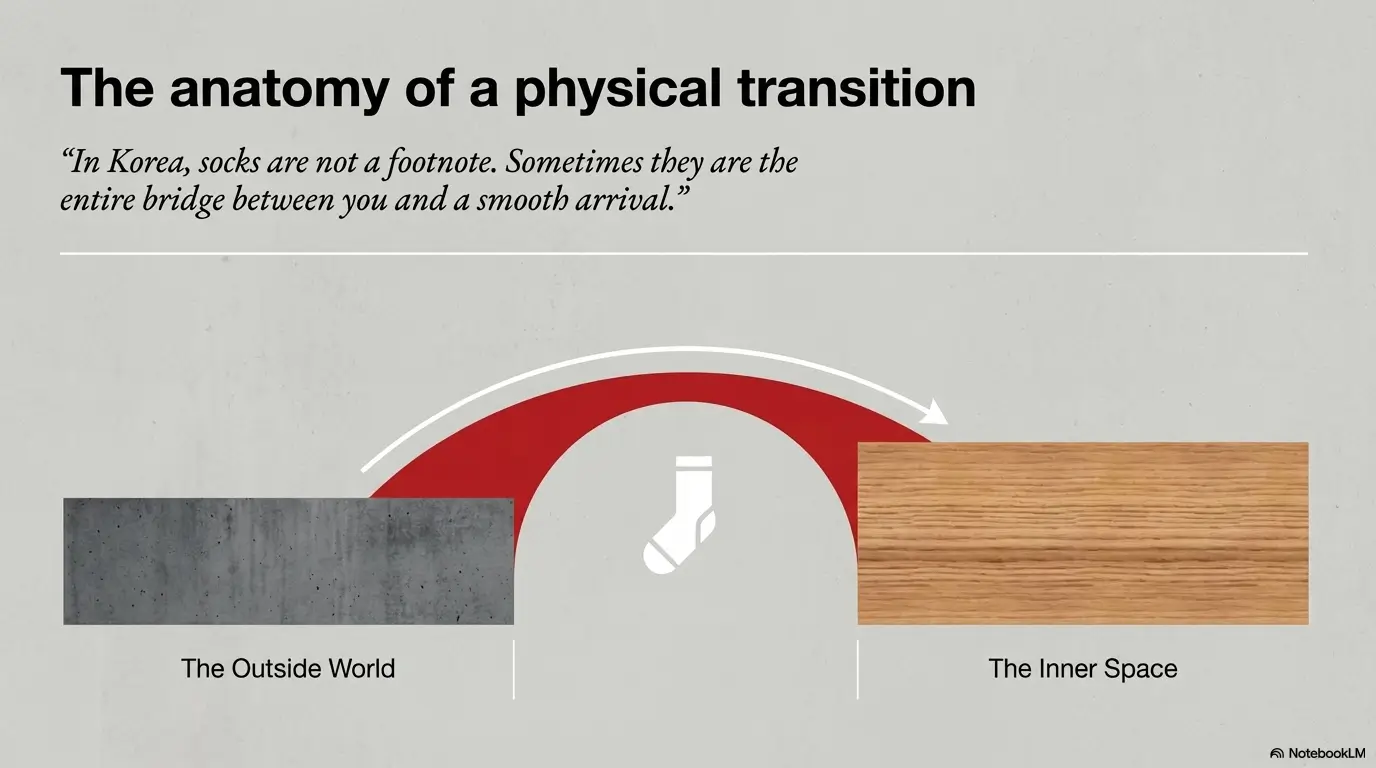
It feels faintly ridiculous that socks deserve a full section. Yet here we are, because socks are the hidden hinge of this entire topic. Travelers plan outfits, gifts, routes, reservations, and translation apps, then lose the moment to threadbare ankle socks that look as though they have survived a small fire.
Wear clean, intact socks if you might visit a home
This is the quiet insurance policy most travel guides forget. Neutral, clean socks work in almost every situation. They do not need to be fashionable. They need to avoid telling an accidental story about neglect.
Pack easy-on, easy-off footwear
Slip-ons, loafers, clean sneakers with quick removal, or shoes that do not require a theatrical knot-untying session will save time and dignity. Heavy boots, complex straps, and lace labyrinths turn a polite entrance into a performance art piece.
Bare feet are rarely the elegant fallback
Some visitors assume removing shoes means going barefoot feels more natural. Usually it does not. In many settings, socks or provided slippers feel smoother and more considerate. Bare feet can read as overly casual, especially when the host or clinic has a clear indoor system in place.
I learned this lesson in the most ordinary way possible: by once packing beautifully for a visit and forgetting that the truly public part of my outfit would be the socks I had treated like an afterthought. Clothing can impress from across the room. Socks must survive close-up diplomacy.
- Choose clean, intact socks.
- Wear shoes that come off quickly.
- Do not rely on barefoot improvisation.
Apply in 60 seconds: Put one spare pair of presentable socks in your bag on travel days.
Slippers, Bathrooms, and Other Indoor Plot Twists
Once shoes come off, you might imagine the problem is solved. Not always. Indoor footwear in Korea can branch into a surprising little taxonomy. House slippers, bathroom slippers, clinic slippers, or socks-only zones may all coexist. The logic is not mystical. It is spatial. Different indoor areas have different expectations.
House slippers are not always optional décor
If slippers are offered, use them unless the host clearly suggests otherwise. Some homes prefer socks on heated or soft flooring, while others like slippers for general movement in common areas. Follow the lead you are given.
Bathroom slippers may be separate
This is one of those wonderfully specific cultural details that catches first-time visitors off guard. In some homes or older settings, bathroom slippers are for the bathroom only. Wearing them into the main living area is the kind of tiny mistake that nobody dies from but everybody remembers.
One pair does not rule the kingdom
Outdoor shoes, house slippers, bathroom slippers, clinic slippers. It can feel, for a moment, like a small empire of footwear with its own constitution. Do not panic. The actual rule is simple: use what belongs to the zone you are in, and return it when you leave.
Short Story: The Slipper Detour
On one winter visit, a foreign friend did everything right at the entrance. Shoes off, posture calm, socks impeccable. It was a small triumph. Ten minutes later, though, he wandered to the bathroom, came back wearing the bathroom slippers like a man who had conquered etiquette once and assumed the kingdom was now his.
Nobody scolded him. The host just glanced down with the soft expression adults reserve for a child who has worn a saucepan as a hat. He noticed, froze, laughed, apologized, and changed them immediately. The moment passed because he corrected it lightly. That is the useful lesson. In Korea, many small mistakes are not fatal. They simply ask for quick awareness and a modest repair. Drama is usually the only part that truly lingers.
Social Reading: How to Recover Gracefully If You Get It Wrong
Every culture has a forgiveness window. Korean social life often gives you one, especially if your mistake is obviously unintentional and your response is quick, calm, and respectful. The recovery matters almost as much as the slip.
Correct quickly, not dramatically
If you realize you entered with shoes on, stop, apologize briefly, and fix it. That is usually enough. Most people do not need a long explanation. They need the action repaired.
Do not over-explain
A lengthy speech about how things work in the United States rarely helps. It tends to make the moment heavier, not lighter. Social grace is often measured by how gently you repair a mistake, not by how fully you narrate it.
Recovery is part of etiquette too
This is the comforting part. Etiquette is not perfection. It is responsiveness. A visitor who notices, adapts, and moves on often leaves a better impression than someone who was initially correct but oddly rigid about it. That same principle quietly governs other interactions too, including how to handle personal questions in Korea without turning stiff or defensive.
Polite recovery script: “Sorry,” step back, remove shoes, continue. That is the whole aria. No encore needed.
Visit-prep list: what to gather before comparing home vs clinic etiquette
- Type of visit: private home, small clinic, large hospital, guesthouse
- Expected layout: apartment entry, lobby, reception desk, treatment room
- Your gear: easy-off shoes, clean socks, small bag, translation app
- Your fallback phrase: “Should I take my shoes off?”
Neutral action: Save that phrase in your phone before your next visit.
Common Mistakes
Some errors repeat so often they deserve their own short map. Think of these not as moral failures but as avoidable frictions.
Mistaking “no sign” for “no rule”
In Korean homes, the absence of signage does not mean the absence of expectation. Domestic spaces often assume you can read the entrance itself.
Waiting for explicit permission
Hosts may assume you already know to remove your shoes. If you keep standing there, smiling bravely at the step like it contains a hidden exam, you create uncertainty where none was needed.
Treating all clinics like Western doctor’s offices
Some do operate that way. Many do not, at least not in every room. The closer a room gets to floor-based treatment, children, or soft controlled surfaces, the more likely expectations may shift.
Forgetting that socks are part of presentation
Travelers iron shirts and polish shoes, then reveal the actual problem only after the shoes come off. Etiquette has a sly sense of humor.
Wearing difficult shoes on a visit day
Laces, tight boots, and elaborate straps create unnecessary friction at the exact place where you want your movement to look calm and natural.
| What competitors usually do | How this guide handles it |
|---|---|
| Treat shoe removal as a cute travel oddity | Frames it as a practical threshold behavior tied to floor culture, respect, and room cues |
| Focus only on homes | Separates homes, hospitals, small clinics, and room-by-room variation |
| Repeat “take shoes off” without detail | Adds sock strategy, slipper logic, entrance-reading, and graceful recovery |
| Ignore embarrassment triggers | Addresses hesitation, bad socks, wrong slippers, and mixed clinic zones |
Before You Visit: A Simple Mental Checklist That Prevents Most Awkwardness
You do not need a grand cultural briefing before every outing. A short internal checklist is enough. In practice, the best visitors are not the most knowledgeable. They are the most adjustable.
Ask yourself these five things
Is this a private home or a small clinic? Do I see a lowered entrance or shoe area? Are there shoes or slippers already at the doorway? Are my socks presentable? Can I pause and mirror before moving forward?
The best default
In Korean homes, assume shoes come off. In clinics, assume you need to read the room. That single distinction will rescue you from most avoidable mistakes. It also pairs well with broader Korea survival habits, whether you are navigating solo dining in Korea without feeling awkward or learning how public politeness shifts across different kinds of spaces.
Infographic: The 10-Second Korea Threshold Decision Map
1. What space is this?
Private home or apartment? Start with shoes-off assumption.
2. What does the entrance say?
Raised floor, shoe rack, lined-up shoes, slippers = remove shoes.
3. Is this a clinic?
Lobby may be shoes-on; treatment room may not be. Read each zone.
4. Still unsure?
Ask: “Should I take my shoes off?” Then mirror calmly.
For general travel health preparation, the CDC’s South Korea traveler page advises visitors to practice usual precautions and notes current vaccine and destination health guidance, which is useful context if a clinic visit is part of your trip rather than a surprise errand.
FAQ
Do foreigners always have to take shoes off in Korean homes?
Usually, yes. In most Korean homes, outdoor shoes come off at the entrance unless the host clearly says otherwise. If you are unsure, the safest move is to pause and ask.
Do you take shoes off at Korean clinics?
Sometimes. Large hospitals and major medical centers often keep shoes on in public areas, while smaller clinics or certain treatment rooms may ask for shoe removal depending on the room setup and treatment style.
What if nobody tells me what to do?
Check the entrance first. Look for a lowered entry area, lined-up shoes, slippers, or a clear change in flooring. If nothing is obvious, ask briefly before stepping in.
Is it rude to ask if shoes should come off?
No. Asking politely is almost always better than guessing wrong. A short question shows attentiveness, not incompetence.
Can I stay barefoot after removing my shoes?
You can, depending on the setting, but clean socks are usually the safer and smoother choice. In homes and clinics alike, socks often feel more polished than bare feet.
Why is shoe removal such a big deal in Korea?
Because indoor cleanliness, floor use, and respect for shared space are closely connected. In many homes, the floor is part of everyday life, not just a place your feet pass over.
Are slippers always provided?
Not always. Many homes and some clinics offer them, but not every place does. That is why presentable socks and easy-off shoes matter so much.
What happens if I accidentally walk in with shoes on?
Most people will understand if you correct yourself quickly and politely. The recovery is usually more important than the initial slip.
Do luxury hotels or big international hospitals follow the same rule?
Not usually in public areas. These spaces tend to signal their expectations more clearly and often function as shoes-on environments unless a specific room indicates otherwise.
Next Step
The hook at the beginning was simple: what do you do in that tiny pause at the door? By now the answer should feel less mysterious. In a Korean home, assume shoes come off. In a clinic, read the room. Look low, notice the threshold, use the cues, and let your socks carry their quiet share of the burden.
The most useful next step takes less than 15 minutes. Build your own “Korea entry habit” now: set aside one pair of clean socks for visit days, choose shoes that come off quickly, and save one sentence in your phone: “Should I take my shoes off?” That tiny preparation prevents a remarkable amount of awkwardness later. Etiquette, at its best, is not a museum of rules. It is a way of making other people’s spaces easier to enter, and your own presence easier to welcome. Once that doorway habit becomes natural, many other pieces of daily life in Korea start feeling easier too, from reading social signals to understanding the quieter rhythm of KakaoTalk etiquette in everyday communication.
Last reviewed: 2026-03.