
The Quiet Logic of the Korean Table
A Korean soup meal can look almost suspiciously modest to an Anglo-American diner: one bowl, a bowl of rice, two or three small side dishes, and not much visual drama. Yet that quiet table is often a full meal in Korea, not a prelude, not a placeholder, and not something waiting for a “real entrée” to arrive.
If you were taught to judge dinner by plate size, visible protein, or sheer spectacle, Korean soup can register as too light or incomplete. But keep reading it that way, and you miss the actual logic of the meal.
This post decodes the structure around the bowl—rice, banchan, broth depth, and eating rhythm—to show you why “simple” feels deeply sufficient. We follow the table, not the stereotype. Because once you stop judging the bowl by itself, the whole meal starts making sense.
Table of Contents
Start Here: Why “Too Simple” Is the Wrong Lens
What Americans often see first: one bowl, not enough food
Most Americans are trained, visually, to read meals through obvious cues. Size. Protein. Plate coverage. A large entrée announces itself. A sandwich stacked tall feels “worth it.” A bowl of soup, by contrast, often belongs to the category of prelude. It is what comes before the real meal. So when a Korean table presents soup near the center, many visitors unconsciously translate it through that older grammar and think: where is the rest?
I have watched this happen in real time. A friend visited Korea, sat down in front of guk, rice, kimchi, and two small banchan, then gave me the look every host recognizes. The look said, politely, “Should I wait for the main dish?” The main dish was already there, steaming like a calm person who had no need to introduce itself twice.
What Koreans are actually seeing: a complete meal structure
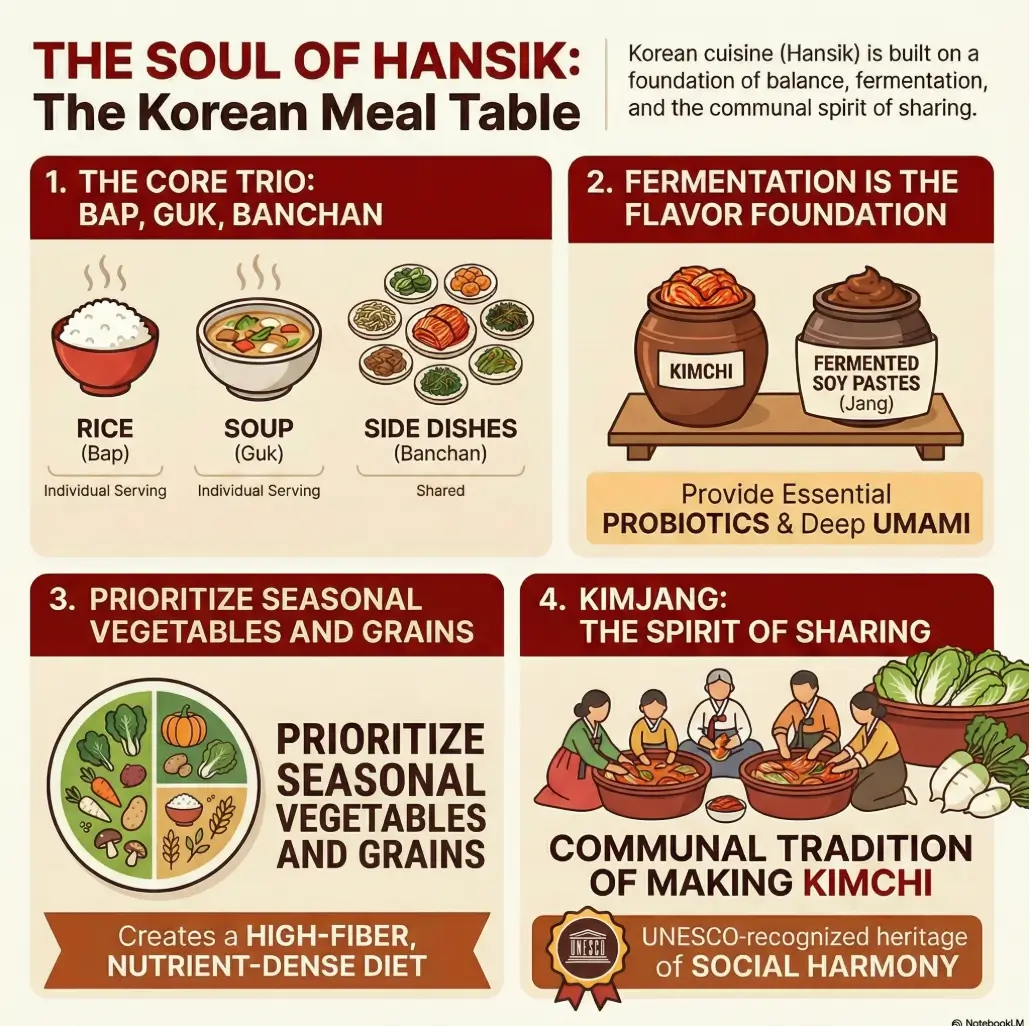
That is the crux of it. In many Korean contexts, the structure itself is the meal. Korea.net’s English-language overview of Korean food describes a pattern in which the staple and side dishes are distinct but interdependent. The Korean Food Promotion Institute goes even further in its English materials on home-cooked meals, explaining that the everyday table is fundamentally composed of bap and banchan, and that even a simple three-side-dish setting can feel balanced and whole.
This matters because visual simplicity is not evidence of nutritional, social, or emotional smallness. A Korean diner is not waiting for the table to become theatrical. They are reading completeness through familiar components: warm soup, rice, seasoning, bite contrast, temperature contrast, salt balance, and a pace that builds satisfaction instead of flashing it.
Why visual minimalism can hide functional abundance
Some meals are extroverts. They enter the room in a red coat and announce themselves from across the hallway. Korean soup meals are often introverts with excellent boundaries. They do not perform “plenty” by height or spectacle. They perform it through fit. A spoon of rice, a sip of broth, a bite of kimchi, a soft cube of tofu, a sliver of fish cake, a second spoon of rice. The abundance is in the loop.
That is why “too simple” is the wrong lens. It treats drama as proof of value. Korean everyday food often has other ambitions. It wants to be warm, steady, digestible, shareable, and compatible with ordinary life. Those are not lesser ambitions. They are the architecture of dinner on a Tuesday.
- The visual unit is not the true eating unit
- Rice and side dishes are part of the fullness equation
- Everyday meals in Korea often aim for completeness, not spectacle
Apply in 60 seconds: The next time you see Korean soup served with rice and banchan, count all three as one meal instead of grading the bowl by itself.
The Real Meal Is the System, Not the Bowl
Rice changes the equation more than most visitors expect
Rice is not wallpaper. This is the first correction many foreign readers need. In some American contexts, rice reads like a side. In Korea, it often functions as the anchor. A spoonful of plain rice does something subtle but powerful: it carries salt, heat, spice, and fermented intensity from the other parts of the table. It stretches flavor. It steadies the palate. It makes repeated bites feel coherent rather than chaotic.
That is why a soup that might seem “light” in isolation becomes satisfying in practice. The rice is not decorative carbohydrate confetti tossed in for manners. It is structural. One reason gukbap and similar dishes feel so complete is that rice and soup are designed to talk to each other, not merely coexist on the same tray.
Banchan turns soup from a dish into a meal set
The second hidden engine is banchan. A few small side dishes can be visually modest and functionally huge. Kimchi supplies acid, heat, fermentation, and appetite. Namul may bring sesame oil, softness, or a little bitterness. Fish cakes, pickled radish, braised potatoes, or seasoned greens add contrast. Together, they make each return to the soup feel newly calibrated.
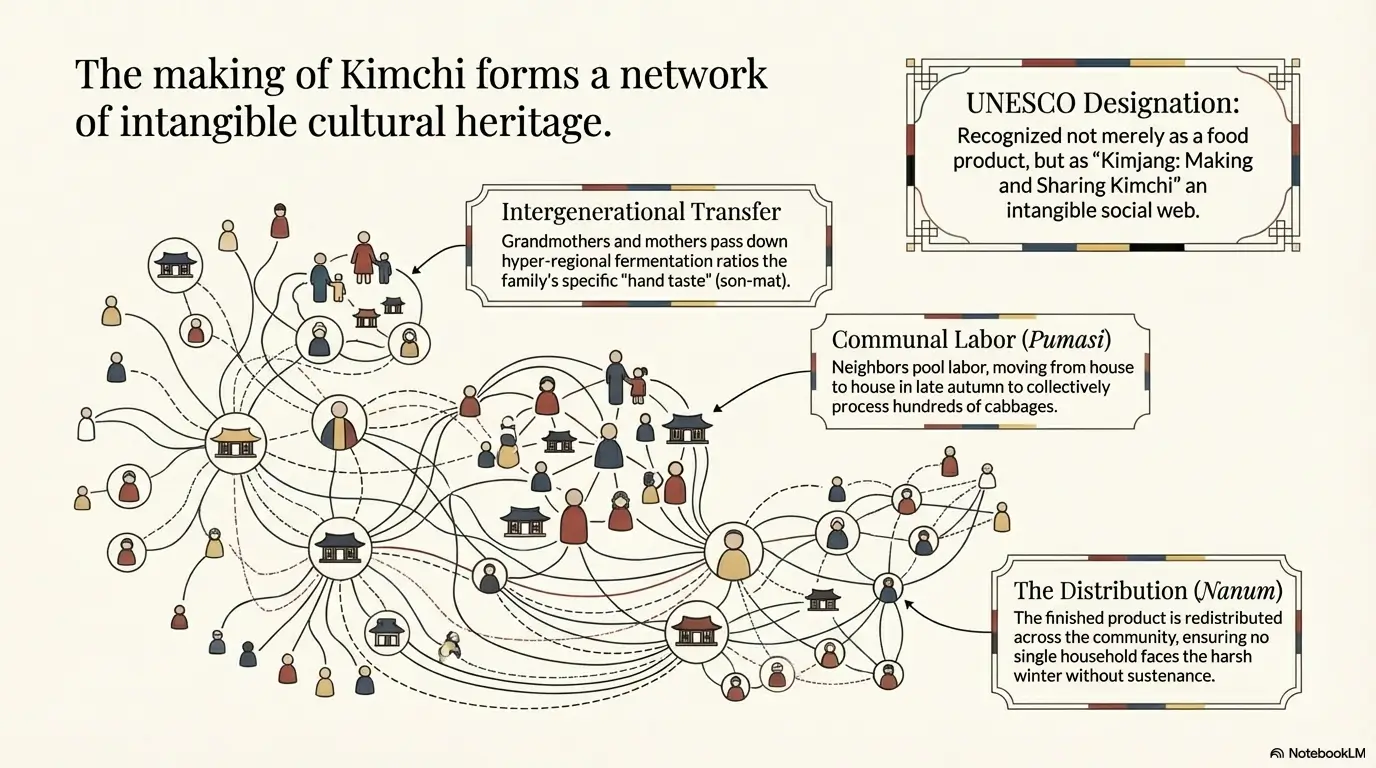
This is one reason UNESCO’s English page on kimjang is such an interesting clue. It describes kimchi as an essential part of Korean meals across class and region. That one sentence explains a great deal. When a side dish is not optional garnish but a culturally expected element, the meal logic changes. The diner is not just consuming a broth. They are moving through a system of relationships. If you want a narrower look at how side dishes behave in real dining situations, Korea’s table rhythm becomes even clearer once you understand Korean banchan refill rules.
Broth, solids, and side dishes work as one eating rhythm
Here is where the Western habit of counting visible chunks can mislead. A Korean soup meal often creates fullness through sequence, not just density. A bite of rice. A sip of broth. A side dish. A return to the soup. The alternation slows the pace. Warmth signals satiety earlier. Salt and acidity keep appetite awake without requiring huge volume. Even a modest amount of meat, tofu, radish, egg, or noodles can feel bigger when eaten in a repeating cycle rather than a single concentrated burst.
Once, after a long train ride in winter, I ate a plain radish soup with rice and two side dishes. Nothing about it was photogenic. If Instagram had been grading dinner, it would have been sentenced to life in obscurity. But halfway through, the body understood something the eye had missed. The meal was not trying to impress me. It was trying to restore me. It succeeded.
| Signal you see | Most likely category | Neutral next move |
|---|---|---|
| Soup arrives with rice and several banchan | Full meal | Read the whole table before judging portion size |
| Soup comes before grilled meat or a larger shared spread | Starter or supporting dish | Wait for the pacing of service to reveal the meal logic |
| Soup and rice are combined or clearly meant to be eaten together | Meal core | Notice how the broth and rice are designed to complete each other |
Neutral action: Use context, not bowl size, to decide what role the soup is playing.
Show me the nerdy details
Korean table logic often depends on complementary roles rather than one oversized centerpiece. Rice can dilute intensity, broth can restore moisture and warmth, and banchan can create sensory variation with very small amounts of food. That repeated alternation changes both perceived satiety and pacing.
Who This Is For / Not For
This is for: US readers curious about Korean food culture, travel, or everyday meals
If you have ever stared at a Korean meal and felt a quiet mismatch between what you saw and what everyone else at the table seemed to feel, this article is for you. Maybe you are traveling. Maybe you live near a Korean restaurant and want to understand the logic behind what is served. Maybe you are dating into a Korean family and have realized that asking “Is that all?” is a social risk best avoided before lunch.
This is for: people who have looked at guk, tang, jjigae, or seolleongtang and thought, “That’s it?”
This is especially for readers whose confusion is sincere, not snarky. Food misunderstanding is often just category confusion wearing a fake mustache. You are not wrong for noticing the meal looks different from what you expected. You are simply carrying one map into another country and wondering why the roads refuse to line up.
This is not for: readers looking for a technical culinary taxonomy of every Korean soup category
We are not going to build a museum exhibit labeling every soup family with forensic precision. That can be useful, but it is not the real puzzle here. The deeper question is cultural: why does a table that looks modest to some people feel obviously complete to others?
This is not for: people expecting restaurant-review rankings rather than cultural explanation
If you want a “top 12 best Korean soups in Seoul” list, there are many cheerful corners of the internet ready to serve you that immediately. This piece is more interested in perception than hype. We are trying to repair the lens, not only praise the menu.
- Yes: You want to understand everyday Korean meals more accurately
- Yes: You tend to judge meal size by plating and visible protein
- Yes: You have felt confused by why Koreans call a soup meal “complete” so easily
- No: You are only looking for a chef-level taxonomy of soup categories
- No: You want ranked recommendations, not cultural interpretation
Neutral next step: Keep reading if your goal is to understand the table logic, not just collect dish names.
Looks Can Mislead: Why Korean Soup Reads “Small” to Foreign Eyes
Western meal cues often reward size, plating, and visible protein
In much of the US, restaurant culture has trained diners to trust abundance that can be photographed in one frame. A burger towers. A steak occupies. A burrito arrives with acreage. Soup often enters as a supporting act unless it is visibly loaded or specifically branded as hearty. So when a Korean soup arrives in a black bowl with steam rather than swagger, it risks being underrated before the spoon has even touched it.
The eye loves proof. But the eye is a slightly dramatic employee. It often demands a bonus for volume and a spotlight for meat. Korean food culture frequently asks the diner to let other senses vote.
Korean meal cues often reward warmth, completeness, and compatibility with rice
Warmth matters more than many outsiders realize. Temperature is not just comfort. It changes pacing, appetite, and the body’s sense of being cared for. A warm soup beside hot rice can feel more substantial than a colder, larger plate because it creates continuity. Nothing is fighting the rest of the table. Everything belongs to the same sentence.
Compatibility matters too. Korean meals are often designed to be eaten in combination. One thing compensates for another. A salty side dish expects plain rice. A rich broth expects something sharp nearby. A fermented bite expects warmth to return after it. That creates a style of abundance that is relational rather than singular.
Why “simple” and “insufficient” are not the same thing
There is a difference between plain and empty, between restrained and weak, between humble and inadequate. Korean soup meals are often simple in a way that comes from refinement, not lack. They have already edited out what is unnecessary. The goal is not maximum novelty per square inch. It is to make something dependable enough to eat repeatedly without fatigue.
I remember once buying an expensive pastry in New York that was roughly the size of an optimistic wallet and somehow less filling than a Korean breakfast of soup, rice, kimchi, and egg. The pastry had branding. The Korean meal had function. One was a performance. One was breakfast.
Not Just Broth: What’s Quietly Doing the Heavy Lifting
Stock depth, fermentation, and slow extraction create invisible richness
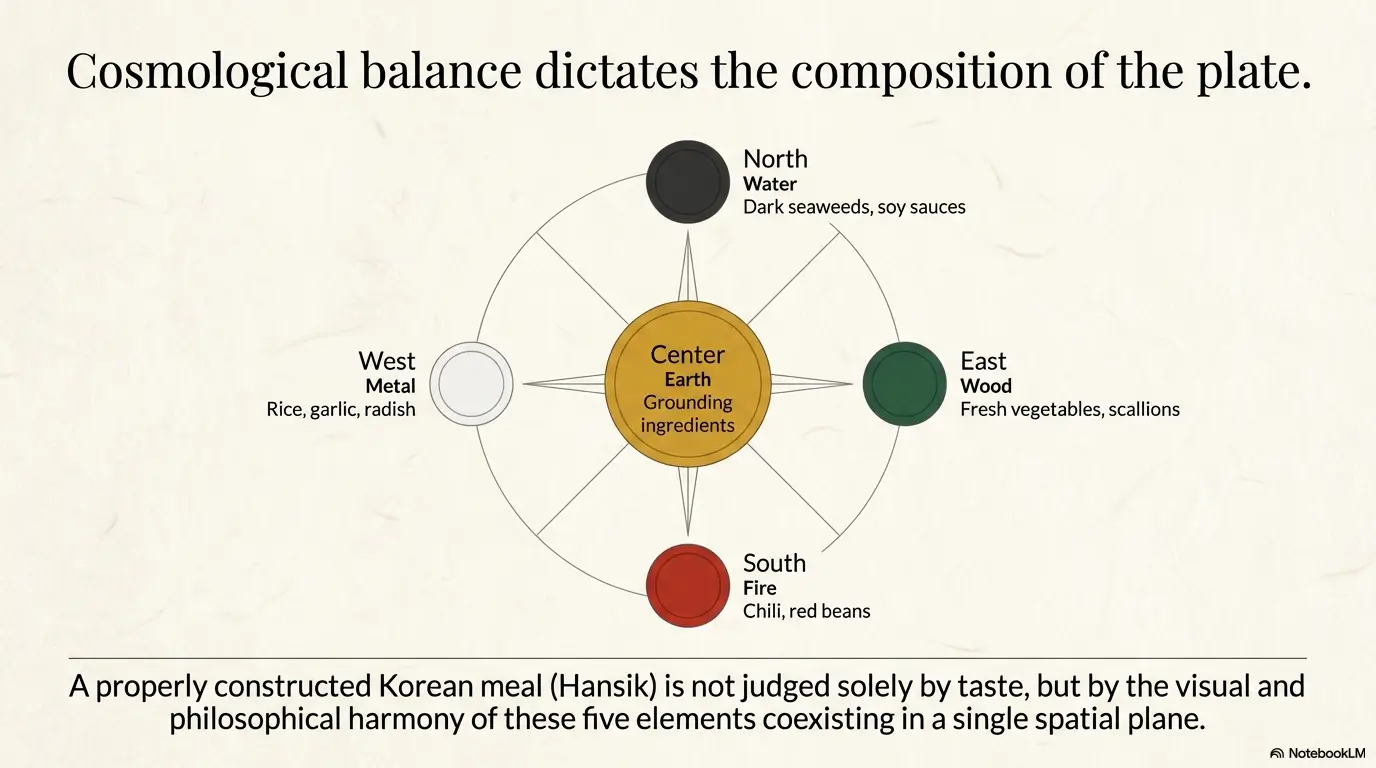
One reason Korean soup can look plain while feeling substantial is that much of the work is invisible. Broth is chemistry wearing an apron. Bones, anchovies, kelp, radish, beef, soybean paste, garlic, scallions, and long simmering times can create depth that is not obvious from a snapshot. A milky broth like seolleongtang or a clearer beef radish soup may not advertise complexity with fireworks, but the body often reads that complexity just fine.
Fermentation deepens the effect. Kimchi, doenjang, gochujang, and other fermented building blocks can make a meal feel nutritionally and sensorially denser than it appears. This is one reason a table with a “simple” soup and “small” side dishes can still feel emotionally large. Flavor does not always need bright costumes. Readers who want to wander further into Korean food as a cultural system might also enjoy this look at Korean royal cuisine, where meal structure matters just as much as ingredients.
Texture matters as much as ingredient count
Fullness is not only about calories. It is also about mouthfeel, variety, and pace. Soft tofu, slippery glass noodles, tender radish, chewy rice cakes, shredded beef, slippery seaweed, crisp kimchi, wilted greens with sesame oil, crunchy sprouts. Korean meals often build satisfaction through small texture shifts. The diner keeps receiving enough change to stay engaged.
That texture rhythm matters more than people expect. A bowl with five dramatic ingredients can feel less satisfying than one with three well-balanced textures eaten across the table.
Mild-looking soups can still be deeply sustaining
This is the part that surprises newcomers most. A pale soup can feel restorative in a way a heavily seasoned dish does not. Mildness is not a confession of weakness. It can be an invitation to notice stock, balance, softness, and calm. Korean food has plenty of boldness, obviously. But everyday soup often earns loyalty through steadiness.
There is a kind of wisdom in food that does not shout. It resembles an older relative who never gives TED Talks and yet has kept an entire family emotionally upright for decades.
- Invisible labor can produce visible satisfaction
- Texture variety expands the feeling of fullness
- Mildness can signal restoration, not blandness
Apply in 60 seconds: When evaluating a Korean soup, ask what depth is happening in the broth and on the side dishes before calling it “simple.”
Wait, There’s a Social Rule Here Too
In Korea, soup is often built for regular life, not performance
A lot of misunderstanding comes from reading Korean food through the logic of tourism, novelty, or restaurant marketing. But most beloved Korean meals were not invented to audition for social media. They were shaped by routine. Workday hunger. Winter cold. Family tables. Tight schedules. People coming home tired and wanting something that feels human again.
When a culture builds meals for ordinary life, the design priorities change. Reliability moves up the list. Digestibility matters. Ease of sharing matters. The ability to serve grandparents, children, and distracted office workers at the same table matters. Soup excels at these jobs. It is not glamorous because glamour is not the assignment.
Everyday food is expected to comfort first and impress second
This is a social rule more than a culinary one. Comfort is not an accidental bonus in many Korean soup meals. It is often the point. The meal may be expected to settle the stomach, warm the body, create familiarity, and carry memory. When food has these duties, “plain” can become a compliment. Plain means trustworthy. It means you know where you are.
I think of the meals people remember from hard weeks. Rarely are they the most elaborate. They are the ones that arrived without argument, like a hand on the shoulder. Soup does that well. Korean culture knows it, even when the bowl looks visually unassuming.
A meal can be humble without being nutritionally or emotionally “small”
Humility in food often gets mistranslated by cultures that equate expense or spectacle with care. But care can look like consistency. It can look like the right temperature. It can look like a bowl that asks very little of a tired person except that they sit down and begin.
That is one reason home-style Korean soup is easy to underestimate and hard to forget. It may not flatter the camera. It flatters the life actually being lived.
Common Mistakes Americans Make When Reading a Korean Soup Meal
Mistake 1: judging fullness by what is in one bowl only
This is the biggest mistake and the most innocent. It is like trying to evaluate an orchestra by interviewing only the oboe. The bowl matters, yes. But Korean meal logic often distributes substance across the table. When you judge only the soup, you miss the system.
Mistake 2: ignoring rice as if it were optional background
Rice is not a neutral extra that happened to wander into the frame. It is a core partner in the meal. Remove it, and you have changed the dish’s intended function. Keep it, and the meal often makes much more sense.
Mistake 3: treating side dishes like garnish instead of part of the meal
If you come from a dining culture where small dishes are mostly decorative or occasional, banchan can be misunderstood as accessory rather than architecture. But in many Korean meals, the side dishes are the turnstiles through which flavor keeps moving. They are part of why the meal stays satisfying. That misunderstanding shows up in other food-adjacent contexts too, including the social assumptions behind why Koreans ask if you ate, where food often carries care more than literal menu inquiry.
Mistake 4: assuming mild flavor means low substance
Some soup meals are intentionally gentle. That does not mean they are nutritionally empty, emotionally empty, or culturally unimportant. A calm flavor profile can be one sign that the meal is meant to be eaten often, not once for applause.
Mistake 5: confusing restaurant spectacle with home-style satisfaction
Newcomers often understand Korean food first through barbecue, fried chicken, loaded street food, or dramatic stews. Those are real parts of the cuisine. But they can distort expectations. Everyday Korean meals are often far less theatrical and far more representative of how people actually eat. For that reason, the cultural jump from flashy restaurant culture to ordinary meals can resemble the gap described in guides to solo dining in Korea, where the experience makes more sense once you stop importing the wrong social script.
Count the number of meal components present:
- 1 point for rice
- 1 point for soup or stew
- 1 point for each meaningful banchan, up to 3
Interpretation: 1–2 points often reads like a partial meal. 3–5 points usually means the table is functioning as a full Korean meal, even if the visual drama is low.
Neutral action: Score the whole table before making a portion judgment.
Don’t Do This: The Fastest Ways to Misunderstand Korean Soup
Don’t compare it only to Western soup-as-starter logic
This is the most tempting shortcut because it feels efficient. It is also the quickest way to flatten the meal into the wrong category. Not all cultures assign soup the same role. In many Korean contexts, soup belongs to the central grammar of the meal. It is not just an opening sentence.
Don’t expect every full meal to center a large piece of meat
American diners are often taught that legitimacy arrives wrapped around a visible protein centerpiece. Korean meals can certainly feature meat, sometimes generously. But meal completeness is not always organized around that kind of display. A meal can be filling because it is balanced, warm, fermented, seasoned, and properly paced, not only because it contains one heroic cut of beef posing for the camera.
Don’t mistake restraint for poverty, blandness, or lack of care
This one matters because it touches dignity as much as dining. Some outsiders misread modest everyday meals as signs of scarcity or culinary underdevelopment. That is a category mistake with a passport. Restraint can reflect taste, practicality, tradition, or a desire for repeatable comfort. Some foods are built not to stun but to stay.
At a Korean table, the quietness of a soup can carry intention. The bowl says: I know what job I came here to do. It says this with the confidence of someone who has paid taxes on time for thirty years.
Show me the nerdy details
Cross-cultural meal interpretation often fails because diners apply one culture’s “main dish” signals to another culture’s meal architecture. In Korean food, completeness may be distributed among staple, broth, and side dishes rather than concentrated in a single plated centerpiece.
Everyday Logic: Why Soup Works So Well in Korean Daily Life
It is fast to serve, easy to share, and practical across generations
One powerful reason soup persists as a full meal in Korea is logistical elegance. It scales well. One pot can serve several people. The table can be adjusted without reinventing dinner. Children can eat it. Older adults can eat it. Tired adults with low patience for chewing can eat it. This is not glamorous reasoning, but it is the kind that survives generations.
That practicality also makes soup culturally sticky. Foods that fit household rhythm tend to endure. They do not need a publicist. They just need to work every day.
It suits solo meals, family tables, and workday eating alike
Another strength is flexibility. Soup can feel intimate when eaten alone and communal when shared. It can be assembled quickly for one person or stretched across a family table. It can support breakfast, lunch, or dinner depending on the household and the dish. That versatility is one reason soup occupies such a natural place in Korean daily life. It moves easily between private need and collective routine.
It fits weather, digestion, routine, and household rhythm
Climate and bodily comfort matter too. Korea experiences real seasonal swing, and warm soup answers winter with direct competence. But even beyond cold weather, soup often feels easier on the stomach, especially when the rest of life is noisy. A large fried meal can feel like an argument. A well-made soup often feels like diplomacy.
There is also the simple fact that regular food culture rewards repeatability. You can love a spectacular meal and still not want it three times a week. Soup, especially when varied through ingredients and side dishes, can remain dependable without becoming exhausting.
- It scales from solo eating to family tables
- It supports comfort, routine, and digestibility
- It remains adaptable across generations and seasons
Apply in 60 seconds: Judge the meal not only by appearance, but by how well it fits the daily life it was built for.
Let’s Be Honest: Sometimes the Simplicity Is the Point
A “plain” soup can be the most trustworthy meal of the day
There is a quiet relief in food that does not demand excitement from you. Korean soup meals often succeed precisely because they are legible. You know how to eat them. You know what they are trying to do. You can arrive tired, sad, overworked, mildly sick, under-slept, or simply bored of overdesigned food, and the bowl will still meet you halfway.
That is not culinary laziness. It is maturity. At a certain point in life, many people stop asking whether a meal is thrilling and start asking whether it is reliable. Soup answers the second question beautifully.
Repetition creates comfort, not boredom, in many Korean households
In cultures shaped strongly by routine meals, repetition can become a form of reassurance. Familiarity lowers decision fatigue. It creates memory grooves. The body begins to associate certain flavors and temperatures with safety, home, or the end of the workday. What an outsider calls repetitive, an insider may call stabilizing.
I think this is one of the hardest things for travel content to explain, because novelty sells and routine does not. But routine is where culture lives most honestly. Nobody builds a civilization out of tasting menus alone.
Familiar food often matters more than novelty when life is busy
This is perhaps the most human point in the whole article. People do not always want surprise. Often they want return. They want the meal that asks the fewest questions. Soup is very good at that. It is one reason a humble bowl can carry more affection than a more expensive dish with better lighting.
A student from the US once told me that her first Korean breakfast made her nervous. It was seaweed soup, rice, kimchi, and one small egg dish. She thought she would be hungry in an hour. She ate politely, still half-convinced she needed emergency toast. But the rhythm changed her mind.
The warm soup slowed her down. The rice made the salty bites feel rounded. The kimchi kept each return to the spoon alive. By the end, she was not stuffed in the American holiday sense, but she was steady, warm, and unexpectedly full. Later that day she laughed at herself. “I realized,” she said, “I was judging the meal like a photograph, not like a meal.” That sentence has stayed with me because it explains so much more than breakfast.
Here’s What No One Tells You About “Fullness”
Fullness in Korean food culture is sensory, emotional, and habitual
Fullness is not a purely mathematical event. It is partly physical, yes, but also sensory and learned. Temperature affects satiety. Pace affects satiety. Habit affects satiety. If you grew up eating warm rice and soup as the center of a meal, your body may read that combination as reassuringly complete. If you grew up expecting a large plated entrée, you may initially distrust a different format even when it nourishes you perfectly well.
This is why cross-cultural eating can feel strange without anyone doing anything wrong. The body has memory. Meals are not only fuel; they are repeated agreements between culture and appetite.
Steam, temperature, pacing, and side dishes change perceived satiety
A hot meal slows you down. Steam signals comfort before the first bite. Side dishes create interval and contrast. Rice stretches savoriness. All of this can make a meal feel larger after eating than it looked before eating. There is almost a small magic trick here, except it is not magic at all. It is design.
You can see versions of this in many food cultures, of course. But Korean soup meals often rely on it with unusual confidence. The meal does not panic and over-explain itself. It trusts the body to catch up.
The meal may feel bigger after eating than it looked before eating
That delayed recognition is the signature experience many newcomers report. At first glance: not much. Midway through: this is working. Fifteen minutes later: why am I so satisfied? The answer is that fullness was assembled rather than displayed.
Bowl only. High risk of misunderstanding.
Bowl + rice. Better, but still incomplete.
Bowl + rice + 1–2 banchan. Now the meal logic starts to appear.
Add pace, warmth, and texture contrast. Much closer to real experience.
Read the meal as culture, routine, and care. This is the insider lens.
Neutral action: Move at least to Tier 3 before deciding the meal is “too simple.”
Beyond Calories: What the Meal Is Really Offering
Continuity, care, and routine are part of the value
One limitation of food analysis from the outside is that it often reduces meals to ingredients or macros alone. Those matter. But what many Korean soup meals offer is also continuity. They connect the diner to ordinary life, to family habit, to a sense that someone before you has made this many times and knows exactly why it helps.
That kind of value is difficult to quantify and easy to feel. It is the difference between a meal that merely appears on the table and one that seems to arrive carrying memory in both hands.
Soup meals often carry memory, region, and household identity
Different households, regions, and seasons naturally shape soup traditions. The point is not that every Korean meal is the same. It is that many soup meals participate in a recognizable cultural logic: they are ordinary enough to belong to daily life and meaningful enough to carry identity. A house may be remembered by its doenjang-jjigae. A hometown may be remembered by a particular broth. A family morning may be remembered by seaweed soup on birthdays. In that sense, the meal belongs to the same larger story as Korean city identity, where place and daily habit quietly shape what people feel at home with.
The bowl may be modest, but the cultural meaning is not
This is why dismissing the meal as “just soup” misses something important. The bowl may look quiet, but its role can be large. It can hold habit, affection, practicality, and a whole philosophy of what dinner is supposed to do for a person.
Modern eating culture often flatters excess. Korean soup meals often flatter fit. And fit, in the long run, is usually the more durable kind of wisdom.
Anchor of the meal. Balances salt, spice, and broth.
Warmth, hydration, stock depth, comfort, and pace.
Acid, texture, fermentation, contrast, appetite.
Sip, bite, return. Satisfaction is assembled over time.
Common Misreadings by Travelers, Students, and Newcomers
Why first impressions often underrate Korean home-style meals
Travelers tend to meet a cuisine first through highlights. The shiny things. The grilled things. The things recommended with ten exclamation marks. Then they encounter the ordinary and assume it is lesser because it is less marketable. But home-style food is often where the culture is most legible. It tells you what people trust when nobody is trying to impress them.
Students and newcomers often make a second mistake: they think unfamiliarity is evidence of deficiency. If the meal does not match their old signals for “proper dinner,” they suspect something is missing. Usually what is missing is not food. It is context.
How restaurant marketing can distort expectations of “real” Korean food
Restaurant marketing, especially abroad, tends to emphasize what travels well visually: Korean barbecue, fried chicken, bubbling red stews, giant cheese pulls, dramatic platters. Again, these are real and delicious. But they can quietly teach foreigners that Korean food must be bold, abundant, and camera-ready to be authentic. That is a false syllabus.
The quieter foods often carry the deeper everyday truth. If you understand why a soup table matters, you understand something more durable than a list of “must-try” dishes. The same pattern appears when people learn tipping in Korea or Seoul cafe etiquette: what seems “normal” at first glance is often just one culture’s habit pretending to be universal.
Why some of the most loved meals are the least photogenic
Photogenic and beloved are not synonyms. Some meals are adored because they heal a bad day, settle the stomach, travel well in memory, or remind people of home. Korean soups often excel here. They may be the least glamorous object in the room and the most emotionally useful.
- Restaurant spectacle is not the whole cuisine
- Home-style meals reveal everyday cultural logic
- Context closes the gap between “plain” and “complete”
Apply in 60 seconds: When traveling or ordering, ask yourself whether you are looking at a celebratory dish or an everyday meal built for routine life.
Next Step: Try Reading the Table Before You Judge the Bowl
At your next Korean meal, count the rice, soup, and side dishes as one unit
If this article has one practical job, it is to give you a better first glance. Do not start with the bowl alone. Start with the whole table. Rice, soup, kimchi, and supporting side dishes form the real unit of meaning. Once you do that, the meal often stops seeming incomplete.
Notice whether the meal feels incomplete before eating or only looks incomplete
This is the tiny experiment I recommend. Before you eat, notice your visual assumption. Then eat at a normal pace. Notice how you feel ten minutes later. Many people discover that the “smallness” was optical more than bodily. The meal looked quiet, but the experience was not small at all.
Use this single shift in perspective to understand Korean food more accurately
The curiosity loop from the beginning closes here. The soup still looked simple because, visually, it was simple. But it remained a full meal because the table around it, the rhythm of eating, and the culture shaping it were doing more work than your eye first knew how to see. Once you learn to read that system, Korean everyday meals stop feeling puzzling and start feeling beautifully logical.
Try this within the next 15 minutes if you can: pull up a photo of a Korean soup meal or think back to the last one you saw. Count the rice. Count the banchan. Ask what role warmth and repetition are playing. That one shift can turn “That’s it?” into “Now I see why that is enough.” The broader skill is similar to reading Korean politeness or Korean indirect communication: the visible surface matters, but the real meaning lives in the structure around it.
Last reviewed: 2026-03.
FAQ
Why is soup considered a full meal in Korea?
Because it is often served as part of a complete eating structure that includes rice and banchan. In many Korean contexts, the meal is defined by the whole table, not by whether one bowl looks dramatic on its own.
Is Korean soup different from soup in the US?
Sometimes yes, especially in role. In the US, soup is often treated as a starter or supporting dish. In Korea, soup frequently sits closer to the center of the meal and is expected to be eaten with rice and side dishes.
Do Koreans usually eat soup with rice?
Very often, yes. Rice is a key partner for many soup meals. It balances stronger flavors, stretches satisfaction, and helps create the familiar rhythm that makes the meal feel complete.
Why do Korean meals look small but feel filling?
Because fullness is often assembled through several components: soup warmth, rice, side dishes, texture contrast, fermentation, and pace. The table can feel bigger after eating than it looked before eating.
Are side dishes part of the meal or just extras?
They are part of the meal. In many Korean settings, banchan are not garnish. They add salt, acid, spice, texture, and rhythm, helping the whole table function as a complete meal.
Why do some Korean soups seem plain at first?
Because visual simplicity can hide broth depth and cultural purpose. A pale or mild soup may still offer long-simmered stock, soothing warmth, and a role built around comfort and repeatability rather than spectacle.
Is Korean soup meant for comfort more than presentation?
Often, yes, especially in everyday home-style contexts. Many soup meals are designed to comfort, steady, and fit real life. Presentation matters less than warmth, reliability, and how well the meal works with rice and side dishes.
Why do foreigners often misunderstand Korean everyday meals?
They often apply different meal rules. If you expect a large entrée with visible protein as proof of a “real meal,” a Korean soup table can seem too modest. Once you understand the full table structure, the logic becomes much clearer.