

The Geometry of Grip: Mastering Korean Metal Chopsticks
Korean metal chopsticks can make perfectly competent adults look like they’ve just been issued unfamiliar fingers. That is not because they are impossible. It is because they expose bad chopstick mechanics faster than wood ever does.
For many readers, the frustration arrives in one of two places: a Korean restaurant where the banchan is slippery, or a home meal where the stainless-steel pair feels oddly flat and narrow. People often assume the utensil is badly designed, but the reality is simpler: you are missing the cultural logic that makes Korean dining feel effortless.
This guide moves past the “mystical” and focuses on the practical:
- Grip mechanics and flat-sided ergonomics
- The spoon-and-chopsticks coordination system
- Common beginner errors and real-world practice foods
No romanticized myths. No embarrassed-tourist tropes. Just the mechanics of how it starts feeling normal.
Table of Contents
Why Metal Feels Harder Before It Feels Normal
The real friction problem is not just “slippery”
Most beginners describe Korean metal chopsticks with one frustrated word: slippery. Fair enough. But that word hides the real problem. The trouble is usually not that the food launches itself into orbit like a tiny cucumber torpedo. It is that metal gives you less forgiveness. A wooden pair can quietly absorb a clumsy grip. A metal pair behaves more like an honest mirror. It shows your mechanics back to you with almost rude clarity.
That is why two people can pick up the same piece of rolled omelet and have completely different experiences. One person is moving the top stick with small, controlled finger motion. The other is squeezing both sticks together from the wrist like they are trying to tame a stapler. Same tool. Different result.
Why flat, narrow Korean chopsticks change the learning curve
Korean chopsticks are often flatter and slimmer than the rounder or thicker chopsticks many foreigners first learn on. That changes leverage. It changes the feeling in the fingers. It also changes how much margin you get when your grip is slightly off. A narrow profile can feel elegant once you know what you are doing. Before that, it can feel like writing your name with a silver bookmark.
I still remember the first time I tried a flat metal pair in a restaurant after years of wooden takeout chopsticks. I assumed my confidence would transfer. It did not. The first slice of radish slid away with the chilly dignity of someone declining small talk. That was useful, though. It taught me that familiarity with “chopsticks in general” is not the same thing as comfort with this specific utensil.
Why first impressions go wrong faster in restaurants than at home
Restaurants magnify awkwardness. You are hungry. Someone is watching, or you think they are. The dishes are glossy. The bites are shared. You reach for a slippery mushroom or kimchi strip too soon, grip harder, and then the whole hand gets tense. Once tension arrives, control leaves through the back door.
The first bad meal creates a false story: “I’m bad at Korean chopsticks.” Usually the better story is, “I started with the wrong foods, in the wrong setting, with the wrong amount of force.” That is not a personal failing. It is just poor onboarding.
- Less friction means technique matters earlier
- Flat shape changes leverage and feel
- Restaurant pressure makes tense gripping worse
Apply in 60 seconds: Hold one chopstick still and practice moving only the top stick five times before your next meal.
Not a Design Flaw: Why Koreans Still Prefer Metal Chopsticks
Hygiene, durability, and table culture all matter
To outsiders, metal chopsticks can look like a national prank that somehow got out of hand. Why choose the utensil that feels harder? Because from inside the culture, the calculation is not absurd at all. Metal is durable, reusable, easy to wash thoroughly, and deeply normalized. It fits the cadence of a Korean table the way a familiar bowl does: not flashy, just expected.
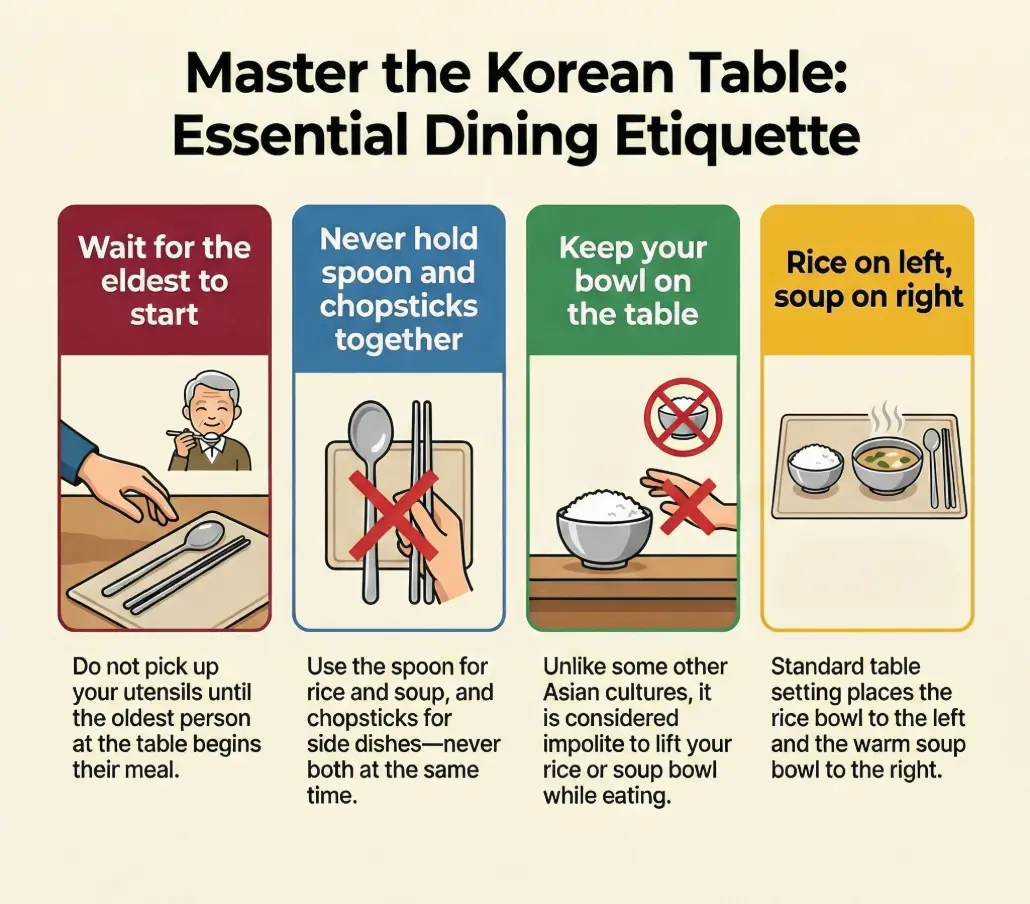
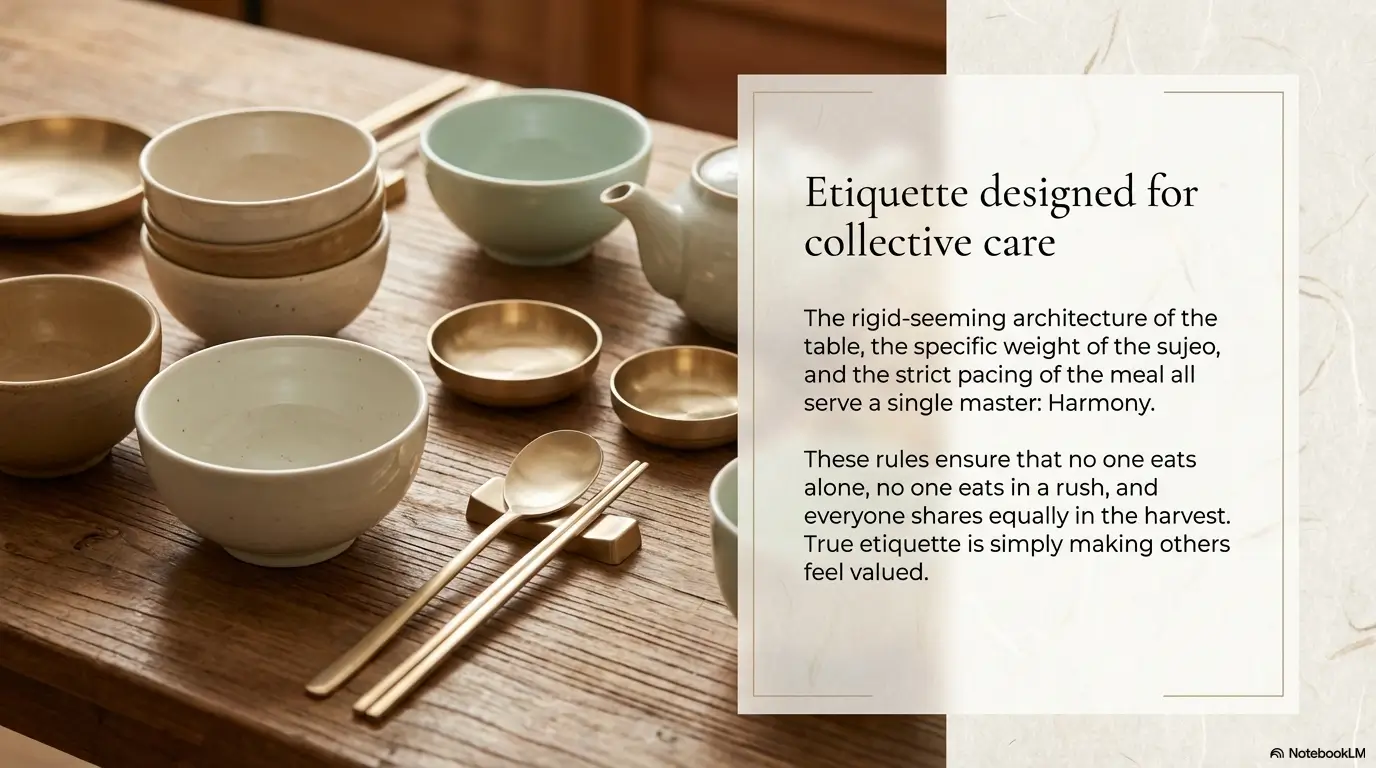
Korea.net notes that Korean meals are commonly organized around a paired spoon-and-chopsticks set called sujeo. That point matters because many foreigners judge the chopsticks as if they are meant to do the whole meal alone. They are not. The spoon is part of the system.
Why the spoon-chopsticks pairing changes how they are used
This is one of those small cultural details that clears a surprising amount of fog. In many Korean meal settings, the spoon handles rice and soup, while chopsticks are used for side dishes and other shared foods. If you come from a habit where chopsticks are expected to scoop rice, shovel noodles, chase every bite, and generally perform acrobatics all night, then Korean metal chopsticks can seem underhelpful. They are operating inside a different division of labor.
The National Folk Museum of Korea and Korean dining etiquette guides reflect how spoon and chopsticks appear together in Korean table settings, not as rivals but as a matched pair. Once you see that, the utensil stops looking incomplete.
Here’s what many Americans miss: chopsticks are only half the utensil system
Imagine judging a bicycle by riding only the front wheel. That is roughly what happens when someone treats Korean chopsticks as a standalone gadget. The utensil belongs to a meal structure with rice, soup, stew, banchan, shared dishes, and bite-sized pacing. The spoon takes pressure off the chopsticks. The chopsticks gain precision because they are not required to be little shovels.
That is why calling them “badly designed” usually says more about the observer’s assumptions than the utensil itself. The question is not, “Can these chopsticks do every job?” The better question is, “What jobs are they actually meant to do here?” This becomes even clearer once you understand why soup still counts as a full meal in Korea, where utensil roles follow the structure of the table rather than the preferences of one diner.
Decision Card: When the problem is the tool vs the system
When it feels like a tool problem: “These chopsticks are too slippery.”
When it is often a system problem: You are forcing chopsticks to handle rice, soup, and oversized bites that the spoon or smaller portions would solve.
Neutral next action: Try one full Korean-style meal with both spoon and metal chopsticks before deciding the utensil is the problem.
Grip First, Force Last: How Koreans Actually Hold Them
The top stick moves, the bottom stick anchors
This is the principle that changes everything. One chopstick stays relatively stable. The other does the moving. Beginners often animate both sticks at once, which turns the whole thing into a tiny fencing match. Once both sticks drift, alignment breaks and food escapes.
The lower chopstick usually rests against the base of the thumb and ring finger. It should feel secure, not strangled. The upper chopstick is controlled mainly by the index and middle finger, with help from the thumb. When that top stick opens and closes cleanly, picking up food becomes far less dramatic.
Why finger control matters more than squeezing strength
People often assume metal chopsticks require stronger hands. In practice, they require more precise movement. Grip that is too loose loses food. Grip that is too tight loses dexterity. The sweet spot is modest pressure with good alignment. Think violin bow, not bolt cutter.
I have watched beginners improve fastest when they stop trying to crush the food into obedience. The meal is not a hostage situation. A slice of tofu does not respond well to panic. Small, calm movement beats force almost every time.
Let’s be honest: most beginners are white-knuckling the whole meal
The awkward truth is that many first-timers are using chopsticks with the emotional intensity of someone defusing a bomb. Their shoulders rise. Their wrist stiffens. Their face says, “I used to have dignity.” At that point, the problem is no longer just utensils. It is full-body tension.
The fix is boring and effective. Relax the shoulder. Lower the elbow. Keep the bottom stick still. Move only the top stick. Take smaller bites than your pride wants. Your pride can sit down and have some water.
Show me the nerdy details
Flat stainless chopsticks change the sensory feedback in your fingers because the contact surfaces and weight distribution feel different from thicker wooden pairs. That does not make them objectively “harder” in every context, but it does make alignment errors more obvious. In motor learning terms, many beginners are practicing the wrong variable by increasing grip force instead of isolating top-stick motion.
- Do not move both sticks equally
- Too much force kills precision
- Relaxed posture improves fingertip control
Apply in 60 seconds: Practice opening and closing the top stick ten times without picking up food yet.
The Table Teaches the Hand: Why Korean Food Changes the Technique
Side dishes, shared plates, and smaller bites reward precision
Korean meals often involve multiple side dishes, shared plates, and many small selections across the table. That encourages a style of eating built around precision rather than scooping power. You are not always trying to conquer a mountain of one sticky entrée. You are selecting, lifting, and placing smaller bites with some care.
This matters because precision-based eating feels very different from chopstick use centered on lifting big clumps of noodles or carrying rice directly to the mouth. Korean chopsticks make more intuitive sense when the meal is broken into varied, smaller targets: egg roll slices, fish cake pieces, spinach namul, tofu cubes, seasoned bean sprouts. It also explains why rules around Korean banchan refill etiquette make sense only when you see the whole table as a shared system rather than a collection of private plates.
Why rice is usually eaten with a spoon, not balanced with chopsticks
One of the biggest friction points for foreigners is rice. Many arrive expecting chopsticks to do the rice work because that is what they have seen elsewhere. In Korean dining etiquette, rice and soup are commonly eaten with a spoon. That instantly changes the burden on the chopsticks. They do not need to become construction equipment.
Guides to Korean dining manners commonly note this separation of roles, along with other etiquette details such as not lifting the rice bowl to the mouth in the same way common in some other dining traditions. That difference is not small. It changes the whole choreography of the meal.
Why metal chopsticks make more sense inside the Korean meal structure
Once the spoon handles rice and soup, metal chopsticks get to specialize. They become precise, quick, and quite elegant for the actual tasks asked of them. It is a bit like criticizing a chef’s knife because it is not good at peeling oranges. Wrong job, wrong complaint.
That is also why some foreigners improve suddenly when they stop practicing random “Asian food” and start practicing a Korean-style plate. The table itself teaches the hand. Use the spoon for rice. Use the chopsticks for side dishes. Reduce bite size. Suddenly the utensil stops feeling like a dare.
Eligibility checklist:
- Do you use a spoon for rice and soup in practice meals? Yes / No
- Are your practice bites small enough for one clean lift? Yes / No
- Are you practicing with at least 3 firm foods before slippery foods? Yes / No
Neutral next action: If you answered “No” twice or more, your technique probably needs a better meal setup before it needs more effort.
Why Foreigners Find Them Slippery So Fast
Wood builds confidence through friction, metal exposes weak technique
Wood is generous. It has a kind of soft-spoken patience. It lets a beginner get away with more. Metal has fewer manners. It offers less surface friction, so any wobble, overgrip, or poor alignment is revealed early. That is why people often feel “good at chopsticks” until the material changes.
This is not unlike switching from a forgiving rental bike to a faster road bike. The second one is not evil. It just tells the truth more quickly.
Flat edges can feel less forgiving than rounder chopsticks
The flat profile of many Korean chopsticks can surprise people used to rounder or thicker styles. Flat edges are not automatically worse, but they feel different in the hand. Beginners may place their fingers awkwardly, hold too high, or lose the sense of where the tips are pointing. That can make even an easy food feel strangely slippery.
Some Korean media and cultural explainers specifically highlight the distinctive flat shape as part of what makes Korean chopsticks feel unique. Foreigners are not imagining the difference. They are just often interpreting it too dramatically.
Restaurant pressure makes people grip harder and move worse
There is also a social reason metal chopsticks feel worse fast: embarrassment compresses learning. Nobody wants to be the person who drops the japchae mushroom three times while pretending not to care. Under social pressure, people grip harder, breathe shallower, and start rushing. That sabotages fine motor control.
Here is the strange comfort: the more self-conscious you feel, the less diagnostic that meal becomes. A bad first restaurant experience does not prove the utensil is beyond you. It mostly proves you were learning in public while hungry. That is not a fair exam. The same thing happens in other corners of Korean social life, where context matters more than surface behavior and nerves can make simple actions feel heavier than they really are.
Mini Calculator: Are you making the meal harder than it needs to be?
Add 1 point for each: slippery restaurant food, empty stomach, people watching, oversized first bite.
0 to 1 points: You are testing technique fairly.
2 to 4 points: Your environment is probably exaggerating the difficulty.
Neutral next action: Re-test at home with easy foods before judging your actual skill.
Don’t Do This: The Beginner Errors That Make Metal Chopsticks Feel Impossible
Clamping too tightly and losing fine control
The number-one beginner mistake is squeezing harder when things start slipping. This feels logical. It is usually the opposite of helpful. Overgripping makes the hand rigid, and rigid hands are bad at subtle motion. You end up pinching with panic rather than guiding with precision.
Holding too high and reducing leverage
When beginners hold the chopsticks too far up the shaft, they lose control at the tips. The whole setup becomes floaty and weak. A lower grip tends to improve leverage and tip awareness. Not down at the very bottom, of course. This is dinner, not drumline. But far too high is a quiet saboteur.
Chasing large or glossy foods too early
Some foods are terrible teachers on day one. Noodles, glossy mushrooms, kimchi strips, and slippery pickles can make decent technique feel broken. That is not because you are hopeless. It is because your practice curriculum is chaotic. Most people would learn faster with tofu cubes and omelet slices than with an immediate duel against a wet noodle bundle.
Here’s what no one tells you: your first practice foods may be sabotaging you
Skill learning depends on manageable wins. If every early attempt ends in escape, splash, or public humiliation, the hand learns tension before it learns control. A better sequence is boring in the best way: dry, firm, small, forgiving foods first. Then medium difficulty. Then slippery items.
I learned this backward, naturally. I once tried to prove my competence by going straight for glossy japchae. The noodles responded by behaving like silk wires dipped in sass. Five minutes later, I was eating with the solemn concentration of someone repairing a watch in a canoe. That was not character-building. That was poor sequencing.
- Relax your hand before increasing pressure
- Hold lower for better leverage
- Start with stable, bite-sized foods
Apply in 60 seconds: Put away the noodles and practice with three tofu cubes instead.
Start With These Foods: What Is Actually Easier to Pick Up
Best beginner bites for Korean metal chopsticks
If you want fast progress, start with foods that reward clean alignment and modest pressure. Good beginner foods include:
- Cut omelet or gyeran-mari slices
- Firm tofu cubes
- Cucumber rounds or half-moons
- Fish cake pieces
- Blanched spinach bundles that are not too wet
These foods are small enough to manage, firm enough to grip, and forgiving enough that one imperfect angle does not ruin everything.
Why noodles and slick pickles are not day-one practice food
Noodles require timing, lift control, and a tolerance for chaos. Slick pickles and glossy kimchi pieces require steadier tip alignment than most beginners have. Starting there is like learning to parallel park in a storm because you once drove through a suburb. Technically related, emotionally disastrous.
How texture changes your odds more than chopstick material
This is the point many people miss. Texture often matters more than material. A beginner can feel competent with metal chopsticks and tofu, then defeated with wood chopsticks and glass noodles. Material matters. Texture matters more than people expect. So when someone says, “I can’t use Korean chopsticks,” it is worth asking, “On what food?” before accepting the verdict. Readers who are new to Korean meals sometimes get faster traction by first understanding the texture logic of Korean street food and small shared bites, rather than treating every dish as the same kind of chopstick challenge.
| Practice Tier | Food Type | Why It Works or Fails |
|---|---|---|
| Tier 1 | Omelet slices, tofu cubes | Stable shape, forgiving texture |
| Tier 2 | Fish cake, cucumber, mushroom pieces | Moderate grip challenge, good control practice |
| Tier 3 | Kimchi strips, glossy greens | More slip and twist |
| Tier 4 | Japchae, noodles | High coordination demand, messy for beginners |
Neutral next action: Practice one meal at Tier 1 before moving up a level.
It Is Not About “Korean Hands”: The Myth That Confuses Beginners
Why familiarity beats anatomy
One of the laziest explanations beginners tell themselves is some version of, “Maybe Koreans just have different hands for this.” They do not. What they usually have is earlier exposure, more repetitions, and a meal structure that teaches the skill naturally. Familiarity, not anatomy, is doing most of the work.
This matters because the myth quietly discourages practice. It turns coordination into destiny. That is convenient if you want to quit, but not if you want to improve.
How repetition rewires coordination faster than people expect
Fine motor skills feel foreign until they do not. Repetition has a sneaky way of making yesterday’s impossible thing become next week’s unremarkable thing. The first ten minutes can be humiliating. The fifth meal often feels less dramatic. The tenth can feel weirdly normal.
That is how most everyday skills work. You do not become a pianist because your fingers were born sentimental. You become one because the motions stop being strangers.
The cultural mistake of turning practice into mystery
There is also a cross-cultural error here. Foreigners sometimes frame Korean chopsticks as a mysterious national talent instead of a learned household habit. That makes the culture sound more exotic than understandable, which is not respectful and not useful. Better to say: this is a normal skill inside a specific utensil system, and you can learn it too.
Short Story: A friend of mine once declared, after one difficult restaurant meal in Seoul, that Korean chopsticks were “engineered by a committee of elegant sadists.” It was a memorable line, if not a fair one. The next weekend, we set a plain table at home: one spoon, one pair of metal chopsticks, rice, mild soup, tofu cubes, cut omelet, and cucumber. No glossy noodles. No audience.
No performance pressure. For the first five minutes, he still looked like he was trying to pick up moonlight. Then something changed. The bottom stick stayed put. The top stick started doing less but doing it better. By the end of the meal, he was not graceful exactly, but he was calm, and calm was the whole threshold. A month later he told me the biggest surprise was not that metal chopsticks had become easy. It was that they had stopped feeling strange. The foreign thing was no longer the utensil. It was the memory of feeling defeated by it.
Common Mistakes
Treating Korean chopsticks like thicker Chinese or Japanese ones
A familiar-looking utensil can fool you into using an old method that does not transfer cleanly. Korean metal chopsticks often ask for slightly finer positioning and more honest top-stick control than a thicker wooden pair. If you copy your old grip without adjustment, frustration arrives early.
Ignoring the spoon and forcing chopsticks to do every job
This is one of the most common and least discussed mistakes. If the meal structure gives rice and soup to the spoon, take the hint. When you insist on making chopsticks do all the work, you are turning a paired system into a solo performance it was never meant to be.
Practicing only with difficult foods
People love to test themselves on hard mode immediately, then declare the entire method impossible. This is very human. It is also terrible training. Difficulty should rise gradually. That is true for weights, languages, musical instruments, and utensils.
Copying the look of the grip without understanding the mechanics
You can imitate the silhouette of a good grip and still move both sticks badly. Visual copying helps less than people think unless you understand what each finger is meant to do. A clean-looking grip with poor motion is just elegant confusion.
Show me the nerdy details
Motor learning improves when the task is decomposed into controllable sub-skills. For chopsticks, those sub-skills are anchor stability, top-stick motion, bite sizing, and food selection. Mimicking hand appearance without these sub-skills leads to shallow imitation rather than functional coordination.
Quote-Prep List: What to gather before comparing your skill honestly
- The food you practiced on
- Whether you used a spoon for rice and soup
- Whether you were at home or in a restaurant
- Whether you moved only the top stick
Neutral next action: Compare your results only after you control those four variables.
Who This Is For / Not For
This is for curious diners, culture readers, travelers, and K-food beginners
If you are interested in Korean dining etiquette, restaurant confidence, or just want to stop dropping banchan in front of your friends, this is for you. It is also for readers who want a grounded explanation instead of a culture-as-spectacle performance. It pairs especially well with a broader understanding of useful Korean BBQ phrases and everyday table behavior, where confidence often comes from knowing the rhythm of the meal as much as the vocabulary.
This is for people embarrassed by slippery metal chopsticks in public
Embarrassment is a real part of the learning experience here. A lot of people are not just trying to understand the utensil. They are trying not to look clumsy. That emotional layer deserves to be acknowledged because it shapes how fast you tense up and how badly you perform.
This is not for readers looking for rigid etiquette policing or “one correct” national stereotype
Korean dining has norms, but everyday life is full of variation. Homes differ. Restaurants differ. People differ. The goal here is not to create a cartoon rulebook or a national stereotype in a pressed collar. It is to explain why the utensil feels different and how to adapt respectfully. If you want a wider lens on how hierarchy and table behavior interact, Korean seating hierarchy offers a useful companion piece.
Practice That Works: How to Get Comfortable Without Looking Awkward
Use short sessions, not long frustrated meals
Ten focused minutes can teach more than a full stressed dinner. Practice is better when the hand is fresh and the ego is not already in flames. Short sessions help you keep the grip relaxed and the attention clean.
Practice with dry, firm foods before slippery banchan
Set yourself up with a practice plate that feels almost too easy. Omelet, tofu, cucumber, fish cake. Then graduate to slightly wetter foods. Then try glossy dishes. Build success in layers. This is not glamorous, but it works with the quiet stubbornness of a good habit.
Build control first, speed later
Speed is a show-off variable. Ignore it at first. Fast beginners are often just tense beginners with lucky moments. Controlled beginners become competent faster because their movement is repeatable.
Let’s be honest… nobody looks elegant during minute three of learning
This may be the kindest thing to remember. Everyone looks a little strange while learning a new motor skill. The difference is that some people call that shame, and some people call it Tuesday. Choose Tuesday. And if you are practicing alone because you feel awkward dining in public, there is a gentle logic to that too, especially in a culture where solo dining in Korea has its own codes, freedoms, and small anxieties.
- Keep sessions short
- Choose stable foods first
- Measure progress by control, not elegance
Apply in 60 seconds: Plan one 10-minute home practice meal instead of testing yourself at a busy restaurant.
The Bigger Cultural Point: Why the Utensil Feels Different Because the Meal Is Different
Korean chopsticks belong to a system, not a standalone gadget
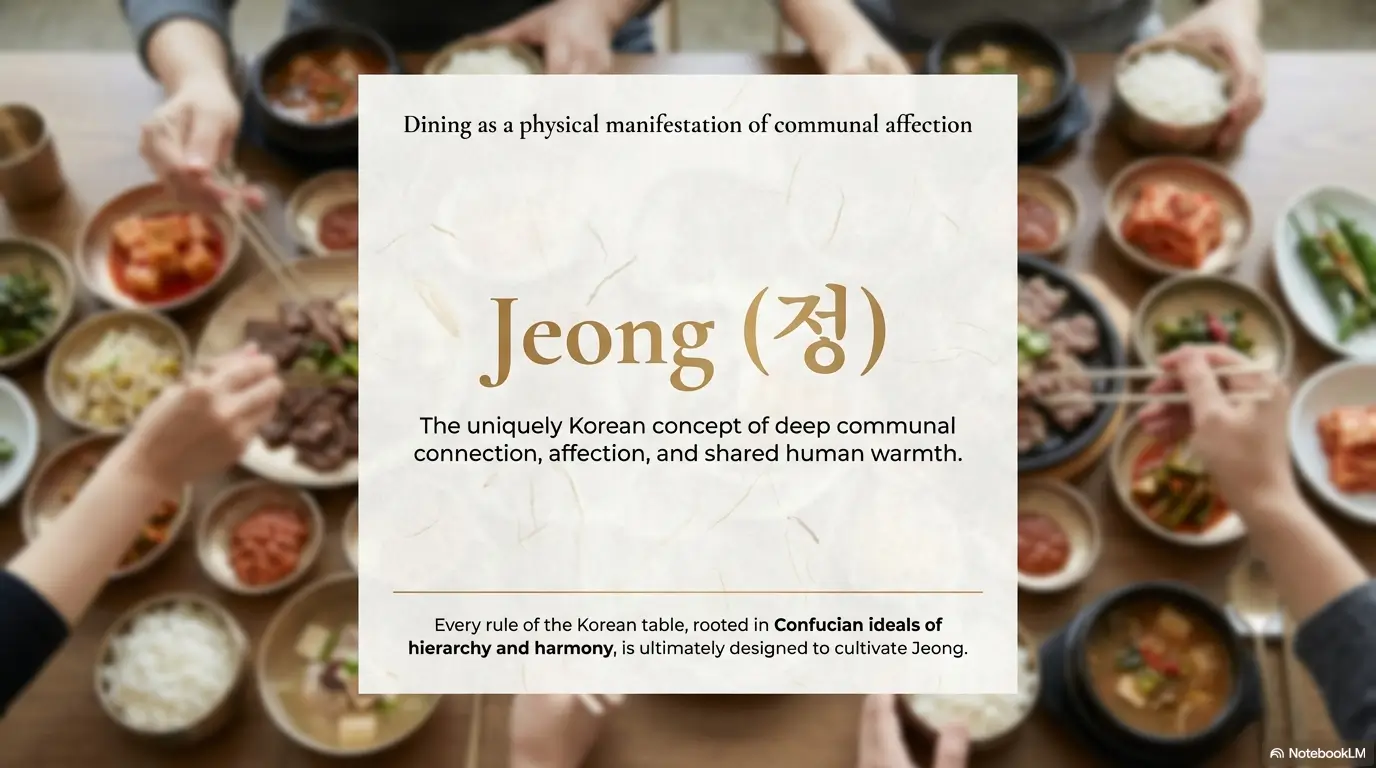
The deeper point is cultural, not mechanical. Korean chopsticks are part of a table logic. They sit next to a spoon. They move through side dishes. They live in a meal structure that distributes tasks across utensils. When foreigners isolate the chopsticks from that structure, they often misread the tool.
Why foreigners often judge the tool without seeing the table logic
This happens all the time in travel and food writing. We encounter one part of a practice, remove it from its context, and then call it inefficient. The problem is not curiosity. Curiosity is welcome. The problem is judging before the system becomes visible.
Michelin’s Korean etiquette guide and Korean cultural sources alike point to the spoon-and-chopsticks pairing and to dining norms that differ from neighboring traditions. That context matters because it keeps the explanation grounded instead of theatrical. The same pattern appears in other everyday misunderstandings, such as why Koreans ask whether you have eaten, where behavior that looks odd from the outside becomes perfectly legible once the social context comes into focus.
What “slippery” really means when context is missing
When people say Korean chopsticks are slippery, they are usually describing three things at once: lower friction, unfamiliar shape, and a mismatch between the utensil and the meal assumptions they brought with them. That is why the word feels true but incomplete. The chopsticks may be slippery. The bigger issue is often that the user is asking them to behave like a different utensil in a different food culture.
Infographic: Why Korean Metal Chopsticks Feel Different
Step 1
Spoon handles:
Rice
Soup
Stew broth
Step 2
Chopsticks handle:
Banchan
Shared dishes
Small precise bites
Step 3
Beginner mistake:
Using chopsticks for everything
Taking oversized bites
Gripping too hard
Result
What feels “slippery”:
Low friction + wrong task + public pressure
Next Step
Eat one Korean-style practice meal at home with a spoon, metal chopsticks, and three easy side dishes such as cut omelet, tofu cubes, and sliced cucumber, then focus only on grip and bite size, not speed
If you want the fastest useful shift, do not wait for a restaurant test. Set up one quiet meal at home. Use a spoon for rice and soup. Use metal chopsticks only for small side dishes. Keep the bottom stick still. Move only the top stick. Choose easy foods. Ignore elegance. Ignore speed. You are building a relationship with the tool, not auditioning for a historical drama.
This closes the curiosity loop from the beginning. Korean metal chopsticks feel slippery not because they are a cultural puzzle box, and not because Koreans possess some secret tendon geometry. They feel slippery when they are pulled out of the meal logic that makes them make sense. Put them back in that logic, and much of the difficulty softens.
Within 15 minutes, you can run a fair experiment. One spoon. One pair of metal chopsticks. Three easy side dishes. Small bites. Calm hand. That is enough to replace a vague frustration with a real answer.
Last reviewed: 2026-03-26.
FAQ
Why are Korean chopsticks made of metal instead of wood?
Metal chopsticks are associated with long-standing Korean dining habits and are valued for durability, reusability, and easy cleaning. The more important practical point for modern diners is that they are used as part of a paired spoon-and-chopsticks system rather than as the only utensil.
Are Korean metal chopsticks harder to use than Japanese or Chinese chopsticks?
They can feel harder at first, especially for beginners used to thicker or higher-friction chopsticks. The flatter shape and lower friction often expose technique problems faster. That does not mean they are impossible. It means the learning curve is more honest.
Why do foreigners say Korean chopsticks are slippery?
Usually because metal has less friction, the chopsticks are flatter and narrower than expected, and many beginners grip too hard or choose difficult foods too soon. Social pressure in restaurants also makes coordination worse.
Do Koreans really use spoons for rice instead of chopsticks?
Very often, yes. In many Korean dining settings, the spoon is used for rice and soup, while chopsticks are used for side dishes and other foods. That division of labor is one of the biggest reasons Korean metal chopsticks make more sense in context.
Are Korean chopsticks flatter than other chopsticks?
Many Korean chopsticks are noticeably flatter than the rounder styles some foreigners first learn on. That shape affects feel, leverage, and the margin for small grip mistakes.
Is there a correct Korean way to hold metal chopsticks?
There is a broadly functional method rather than one theatrical “perfect” pose. The main rule is that the bottom stick stays relatively stable while the top stick moves. Good control matters more than looking elegant.
Can beginners learn metal chopsticks quickly?
Yes, especially if they practice with easy foods at home, use a spoon for rice and soup, and focus on calm control instead of speed. Many people improve much faster once they stop using noodles and slippery foods as their first test.
Why do metal chopsticks feel harder in restaurants than at home?
Restaurants add pressure, hunger, speed, and often more slippery foods. Those factors make beginners grip harder and move worse. A quiet home practice meal is a much fairer test.
Do Koreans struggle with slippery foods too?
Of course. Some foods are simply trickier than others. Familiarity makes the tool feel normal, but nobody becomes physically exempt from glossy noodles or a stubborn mushroom.
Are Korean chopsticks supposed to feel uncomfortable at first?
For many beginners, yes. That initial discomfort usually comes from unfamiliar shape, lower friction, and using the wrong meal strategy. Once the spoon-and-chopsticks pairing clicks, the discomfort often shrinks quickly.