

Beyond the Blade: Understanding the Logic of the Korean Table
The first time many Anglo-American diners see table-side scissors at a Korean meal, the reaction is almost automatic: not curiosity, but a tiny internal siren. It looks like a breach of etiquette when, in reality, it is often a sign that the meal is working exactly as intended.
That gap matters, because “why Koreans cut food with scissors at the table” is not really a question about scissors. It is a question about Korean dining etiquette, shared dishes, Korean barbecue, and the table logic behind sujeo, the spoon-and-chopsticks system many visitors misunderstand at first.
In Korea, table-side scissors are commonly used in casual dining to portion shared foods such as grilled meat, kimchi, noodles, and some stews into easier bite-size pieces. The practice is generally normal, practical, and socially accepted when the setting and dish call for it.
Keep guessing, and you risk misreading a perfectly normal custom as rude, unsanitary, or unsophisticated. This guide helps you read the table correctly, understand when scissors are normal, and avoid the kind of small cultural mistake that can make a relaxed meal feel strangely tense.
Because the tool is not the story. The meal is.
And once you see the logic, the whole table starts to make sense.
Fast Answer: In Korea, cutting food with scissors at the table is normal in many casual dining settings, especially for grilled meats, noodles, kimchi, and some stews. It is not rude or unsanitary when done properly. Instead, it reflects a practical, shared dining culture where food is often portioned in real time for easier eating, faster serving, and smoother table flow.
Table of Contents
First Reaction, Wrong Frame: Why It Looks Strange to Americans
Western table rules taught you that scissors belong in the kitchen
Most American diners grow up with a quiet map of what belongs where. Knives may come to the table. Scissors do not. We absorb that rule so early that it feels like nature, when it is really just training with a good tailor and a stern grandmother standing behind it.
I still remember the first time I saw scissors placed beside a tabletop grill. My brain did not say, “useful.” It said, “someone forgot to finish prep.” That reaction was sincere, and also wrong.
In Korea, the table often includes preparation as part of eating
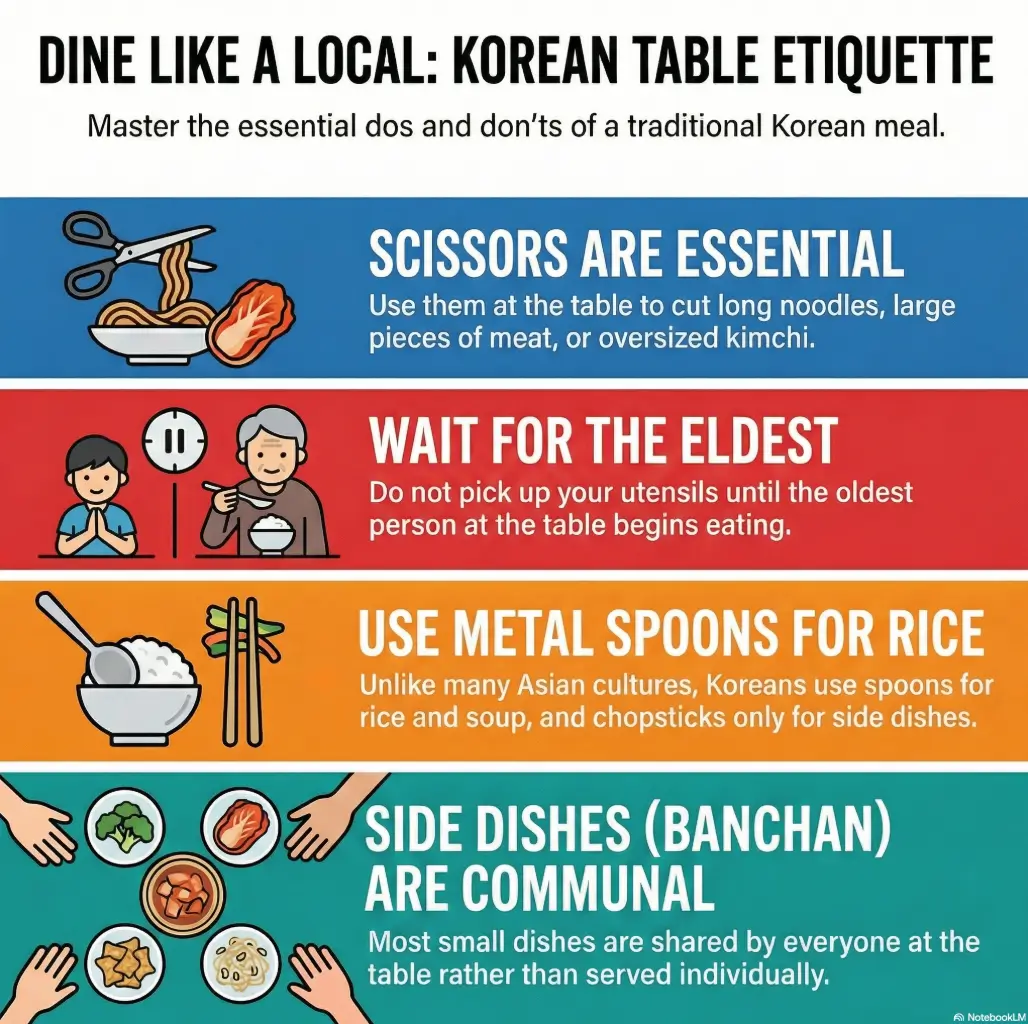
Korean dining, especially in casual and shared settings, often treats the table as a live working surface. The meal is not always fully portioned in the kitchen and then presented as a finished composition. It is frequently completed at the table through grilling, turning, cutting, ladling, wrapping, and sharing. The Seoul tourism authority’s etiquette guide also points travelers toward a different utensil system altogether, noting basics such as using a spoon for rice and soup and not planting utensils upright in rice. That is a hint that the rules are not random. They come from a different operating system.
The discomfort is cultural, not evidence that something is “wrong”
That first jolt does not mean the practice is rude, dirty, or careless. It usually means you are measuring one culture with another culture’s ruler. And rulers are wonderful until you try to measure soup with them.
- American frame: table = finished serving zone
- Korean casual-dining frame: table = serving plus real-time portioning zone
- Result: the same tool can look improper in one frame and perfectly sensible in the other
- Korean casual dining often blends serving and final portioning
- Different utensil habits signal a different dining logic
- Initial discomfort is not proof of bad manners
Apply in 60 seconds: When you see scissors at a Korean table, pause before judging and ask what job the dish still needs.
What’s Really Happening: Cutting Is Part of Serving, Not Just Cooking
Shared dishes change what tools need to do
Once food is shared, the question changes. The issue is no longer “what looks elegant on a single plate?” The issue becomes “how do we make this hot, slippery, communal dish easy for everyone to eat now?” In that setting, scissors are not a weird substitute for a knife. They are a fast, low-fuss portioning tool.
Table-side cutting helps portion food quickly and evenly
Think of samgyeopsal on a grill, long strands of noodles in a bubbling pot, or sheets of kimchi that are delicious but mildly rebellious. Someone has to turn those into bite-size portions. Scissors do that with surprising precision. A few quick snips, and the table moves forward instead of waiting for a plate-by-plate ceremony.
At one meal in Seoul, I watched the oldest uncle at the table cut grilled pork into neat pieces without interrupting a single sentence of conversation. No flourish. No speech. Just three soft snips and everyone kept eating. The tool vanished into the rhythm of the meal.
The goal is ease of eating, not ceremony
This is the part outsiders often miss. Korean dining is not necessarily trying to put on a Western performance of refinement. It is often trying to keep the food hot, manageable, shareable, and pleasant. Practicality is not the enemy of manners here. Quite often, it is the vehicle. If you want to see this logic in its most famous form, it helps to know a few Korean BBQ phrases and table cues before the meat ever hits the grill.
- Is the dish shared by two or more people? Yes / No
- Is the food long, slippery, grill-cooked, or awkward to portion? Yes / No
- Is the setting casual rather than ceremonial? Yes / No
- Is someone at the table already managing the food in real time? Yes / No
Neutral next step: If you checked at least 3 “Yes” boxes, scissors will usually read as normal rather than shocking.
Show me the nerdy details
The utensil logic matters more than the object itself. Korean dining widely uses a spoon-and-chopsticks set, not the fork-knife default common in the United States. Official visitor guidance for Seoul explicitly notes spoon use for rice and soup. That shared-table design helps explain why an extra cutting tool can appear when a dish needs quick portioning. The meal is being optimized for group flow, not plated symmetry.
Where It’s Normal: The Dishes That Commonly Invite Scissors
Korean barbecue meats cut into bite-size pieces at the grill
This is the famous example for a reason. Thick or long strips of meat are often cut over the grill so pieces cook evenly and can be picked up easily. In casual barbecue houses, this is so ordinary that the real surprise is when a foreign diner stares at the scissors like they have just seen a cello in a laundromat.
Long noodles and glass noodles trimmed for easier sharing
Long noodles may be lovely in theory and highly annoying in a crowded shared pot. In dishes that are meant to be served communally, trimming noodles can make the difference between smooth eating and a table-wide wrestling match.
Kimchi, pancakes, and stew ingredients cut at the table
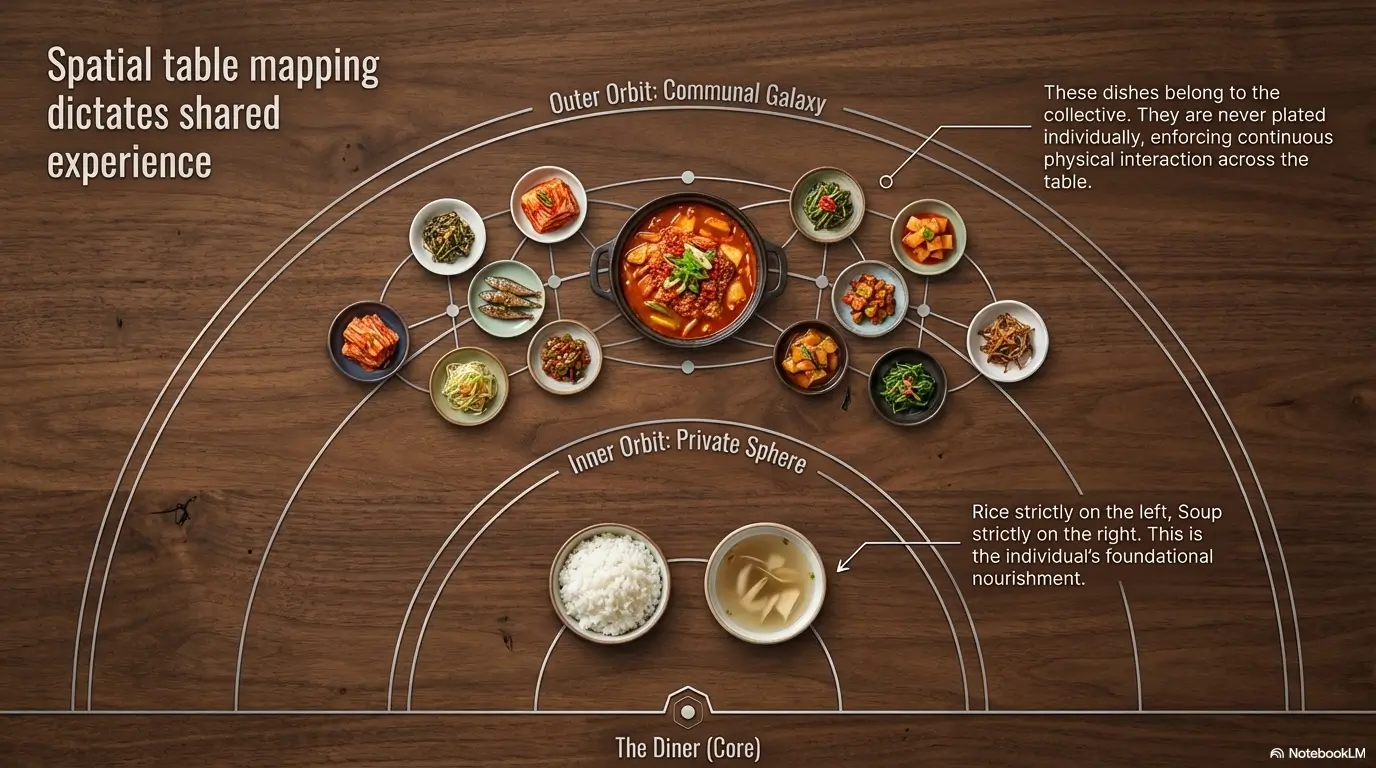
Large leaves of kimchi, strips of fish cake, and components in bubbling stews are all fair game in many casual spots. The aim is not to mutilate the dish. It is to make it workable. Official VisitKorea material on Korean meals also emphasizes that Korean restaurant tables commonly arrive with multiple side dishes and stews, which helps explain why portioning and handling tools matter so much in real time. The same shared-dish logic also explains why Korean banchan refill rules can feel so different from what many American diners expect.
Casual pub foods and delivery dishes where speed matters
You may also see scissors with fried or sauced dishes that are easier to share once cut. The pattern is simple: if a food is communal, messy, and improved by bite-size serving, scissors are not an eccentric guest. They are staff. In more everyday settings, that practical streak also shows up in things like Korean delivery etiquette, where the system is built around speed, function, and smooth group use.
Korean BBQ, shared grilled meat, tabletop cooking
Stews, noodles, kimchi, fish cake, pancakes
Casual pub dishes, delivery food, heavily sauced share plates
Formal tasting menus, plated fine dining, ceremonial meals
Not Everywhere, Though: When Scissors Are Normal and When They Aren’t
Everyday restaurants versus highly formal dining
This is where nuance finally gets to wear a nice coat. Yes, scissors are normal in many Korean dining situations. No, that does not mean every Korean meal features them or that every table invites the same level of hands-on management.
At a casual barbecue restaurant, scissors feel routine. At a refined course meal where the kitchen has already shaped each plate, whipping them out would feel as misplaced as asking for a leaf blower in a library.
Why home meals and casual spots allow more tool flexibility
Homes and casual restaurants tend to be governed by function, comfort, and habit. If the family knows a dish is easier to share after a few snips, they will not pause for an imaginary tribunal of Western plating standards. The meal is there to be eaten well, not to audition for a silverware pageant.
The setting matters more than the object itself
That is the heart of it. A tool does not carry a universal moral charge. A spoon is normal for rice in Korea and less central in some neighboring dining cultures. Official Seoul guidance makes exactly that point in practical form by telling visitors to use the spoon for rice and soup. The setting creates the meaning. The same principle applies to all kinds of Korean social settings, from the table to Seoul cafe etiquette, where the room quietly tells you how to behave if you are willing to notice it.
| Situation | Best move | Why |
|---|---|---|
| Casual BBQ, stew, noodles | Observe first | The table often has a built-in rhythm |
| Formal or business meal | Wait and follow lead | Hierarchy and pacing matter more |
| You are hosting or confused | Ask one calm question | Curiosity reads better than overconfidence |
Neutral next step: Match your behavior to the formality of the meal, not to your first emotional reaction.
The Real Logic: Why Scissors Beat Knives in These Moments
Faster cuts in crowded shared-dish settings
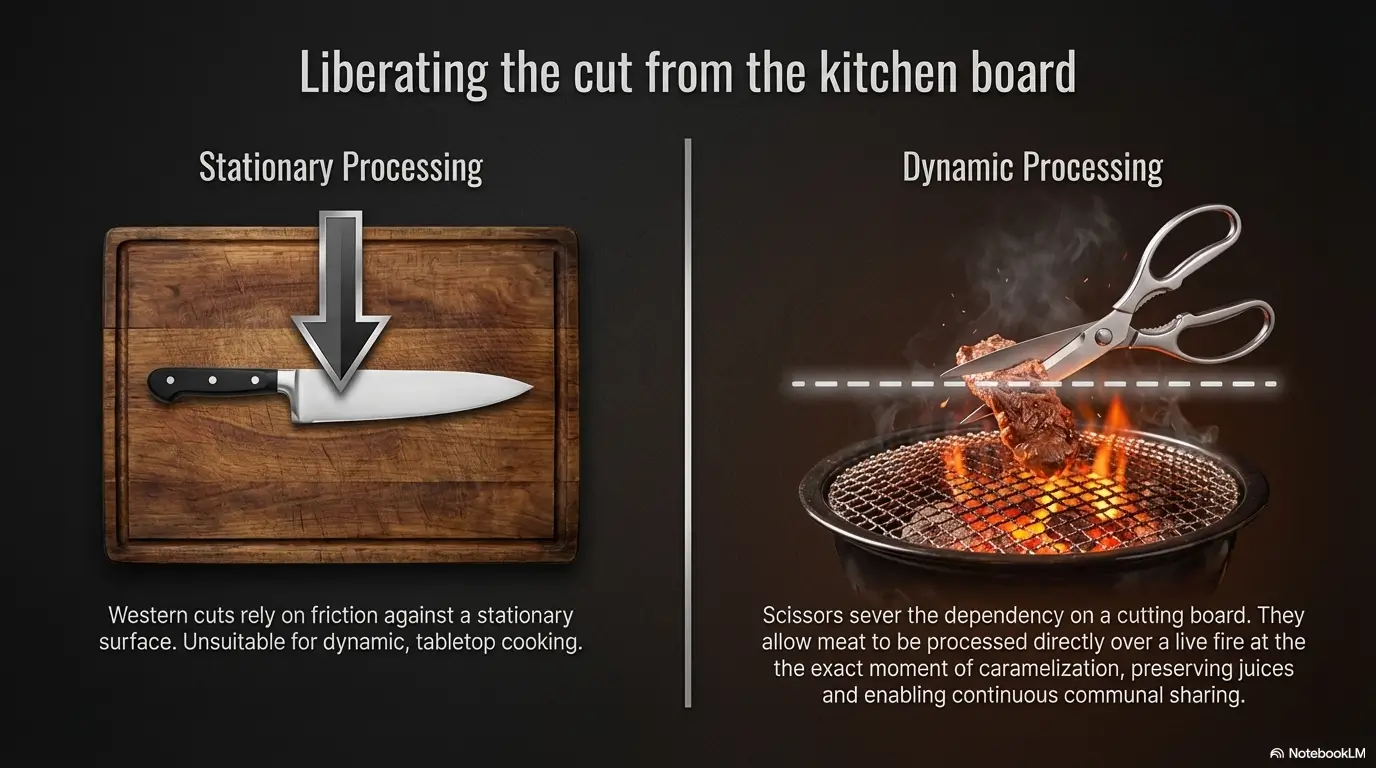
Scissors are fast, especially when the food is already on a grill, in a pan, or in a communal pot. They let the cook or host cut without dragging the item onto a plate, finding a stable surface, and performing a little knife ballet that nobody requested.
Better control for slippery, cooked, or sauce-coated foods
Many foods at Korean tables are not neatly obedient. They are glossy, hot, elastic, or tucked between other ingredients. Scissors can snip with less sliding and less collateral damage. They are not more civilized. They are simply better at certain textures.
Easier portioning without dragging food across plates
That matters more than it sounds. In a shared setting, clean portioning is a courtesy. You are not showing off technique. You are reducing hassle for everyone else. Efficiency, in this context, can be manners wearing work boots.
Once, at a bustling late-night restaurant, I watched a server cut kimchi in under 5 seconds while balancing three other tasks and somehow maintaining the calm of a train conductor. A knife would have made the scene longer. The scissors made it invisible.
Let’s Be Honest… It Feels “Unsophisticated” Only If You Import the Wrong Standard
Formality is not the same thing as respect
There is a peculiar trap in cross-cultural dining: we confuse what looks formal to us with what communicates respect to everyone. That confusion causes all kinds of unnecessary little disasters. A person can follow every Western-looking gesture at the table and still misunderstand the social logic of the meal completely.
Korean dining often rewards usefulness over performance
Shared dishes, synchronized eating, attention to elders, utensil order, and not disrupting the flow often matter more than performing an imported idea of elegance. Michelin’s Korea guide, while discussing Korean dining etiquette, emphasizes practical rules around utensils and table rhythm rather than theatrical presentation. That should tell us something. It also overlaps with broader ideas of Korean politeness, where respect often appears through timing, awareness, and social ease rather than through one fixed visual style.
Efficiency at the table can itself be good manners
This is the hinge point. If one quick cut makes food easier to share, less messy to handle, and more accessible to everyone at the table, that can be a form of respect. Not glamorous respect. Not candlelit respect. Just sturdy, useful respect.
I have seen travelers relax the moment they realize Korean dining is not asking them to perform perfection. It is asking them to pay attention. That is a much kinder exam.
- Respect is not identical to Western-looking polish
- Useful actions can be better manners than decorative ones
- Korean dining often prizes rhythm, sharing, and attentiveness
Apply in 60 seconds: Replace the question “Does this look refined?” with “Does this help the group eat comfortably?”
Hygiene Question First: Are Table Scissors Considered Clean and Acceptable?
Restaurant scissors are part of the serving toolkit, not random household items
The American concern here is understandable. To many outsiders, scissors carry office-supply energy. In Korean restaurants, though, food scissors are typically part of the restaurant toolkit, used specifically for food service. They are not conceptually different from tongs, ladles, or grill shears just because their silhouette startles you.
Why the concern makes sense to Americans
Because Americans are trained to separate “food tools” from “general tools” more visually. A chef’s knife says kitchen. Scissors often say wrapping paper, shipping tape, or that one drawer everyone fears. So yes, the hygiene question is natural. It is not insulting to wonder. It only becomes awkward if you assume the answer without reading the setting.
Clean handling matters more than whether the tool is a knife or scissors
Sanitation depends on cleaning and handling practices, not on whether a cutting edge comes in one blade or two. If the restaurant is reputable and the scissors are clearly part of service, the tool itself is not a red flag. What matters is what would matter anywhere: cleanliness, staff practice, and the general standard of the restaurant.
I once saw a nervous visitor whisper, “But are those… kitchen scissors?” with the solemn tone usually reserved for ghost sightings. They were. The meal proceeded. Nobody perished. The pork was excellent.
Give yourself 1 point for each answer of “yes.”
- Shared dish? +1
- Casual restaurant or home meal? +1
- Food is long, hot, slippery, or grill-cut? +1
Result: 0 to 1 = pause and observe. 2 = probably normal. 3 = very likely normal.
Neutral next step: Use the score to guide your confidence, not to overrule what the actual table is doing.
Don’t Misread This: Using Scissors Does Not Mean Korean Dining Is “Casual About Etiquette”
Tool choice can be flexible even when manners are not
This is where many quick explainers collapse into mush. They say, “Koreans use scissors, so etiquette must be relaxed.” Not quite. Korean dining often has clear rules about utensil use, timing, elder respect, and how one behaves in shared meals. Official guidance for Seoul visitors includes straightforward examples: use a spoon for rice, do not leave utensils sticking upright in rice, and place them back properly. That is not a careless culture. That is a structured one.
Shared-dish culture still has structure, rhythm, and respect
Who starts first, who serves, how you handle communal dishes, whether you create inconvenience for others, whether you make a spectacle of yourself, whether you bulldoze ahead before reading the table. These things matter. The scissors do not erase that structure. They sit inside it. In some meals, that social rhythm is also shaped by age and position, which is why understanding Korean seating hierarchy can quietly improve the entire dining experience.
Practical does not mean careless
Practicality is often a discipline, not a downgrade. A Korean table can be direct, efficient, and still deeply mannered. The mistake is assuming that visible utility means invisible standards.
I have seen meals where almost nobody spoke about etiquette, yet everyone obeyed it. That is usually how living traditions work. They are not recited like policy documents. They are felt in the pacing.
- Utensil flexibility can coexist with strong manners
- Shared meals still follow rhythm and hierarchy
- “Practical” is not the same as “careless”
Apply in 60 seconds: Read the table for respect markers, not just for which metal object appears.
Who This Is For and Who It Is Not For
For travelers, expats, date-night diners, and K-food beginners who do not want to misjudge the table
If you are heading into your first Korean barbecue meal, visiting Seoul, dating someone Korean, or just trying not to turn dinner into an anthropology panic spiral, this is for you. The goal is not to turn you into a mini lecturer at the table. The goal is to help you avoid easy misunderstandings.
For culture-curious readers trying to understand the logic behind the custom
Maybe you are not anxious. Maybe you are simply curious. Good. Curiosity is the best seat at this table. It allows you to see the difference between novelty and function, and between stereotype and actual social practice.
Not for readers looking for a universal rule that applies to every Korean meal
If you want a single sentence that covers every household, every restaurant, every generation, and every region, this article will disappoint you in the healthiest possible way. Korea is not one dinner table. No honest guide should pretend otherwise.
One of the most useful travel habits I ever learned was to replace “What is the rule?” with “What does this particular table consider normal?” That question has saved me from many elegant mistakes.
Common Mistakes: What Foreign Diners Often Get Wrong
Assuming scissors at the table are rude by default
This is the headline mistake. People see an unfamiliar tool and leap straight to judgment. The truth is duller and more helpful: the tool is usually there because the food and format make it useful.
Treating one restaurant experience as the rule for all of Korea
One barbecue restaurant in Busan does not become the constitution. One sleek fine-dining room in Seoul does not either. Korea contains formal meals, casual meals, home meals, drinking food, family traditions, and plenty of variation between generations.
Confusing practicality with lack of etiquette
This is the deeper version of the same error. Outsiders sometimes think, “If it looks utilitarian, it must be informal in every sense.” That is not how many Korean tables work.
Waiting too long to cut food that is meant to be shared immediately
This one is less philosophical and more logistical. Some foods really are meant to be cut and distributed quickly. Waiting too long can make the table awkward, especially if one person is holding up a shared dish because they are still deciding whether the scissors pass a private aesthetic review.
I once sat with two American visitors at a Korean barbecue restaurant. The meat had cooked beautifully. The server placed scissors beside the grill and moved on. One visitor froze. The other laughed nervously and asked whether the restaurant had “run out of knives.” For about three seconds, the table went quiet in that very specific way only dining confusion can produce.
Then the Korean friend beside us picked up the scissors, cut the pork into neat, bite-size pieces, tucked the tool down, and carried on talking as if nothing notable had happened. That was the lesson. The scissors were not the event. The meal was. The tool existed to keep the meal moving, to make the food easy to share, and to spare everyone a clumsy performance. Once that became clear, the tension dissolved like steam off the grill.
Don’t Do This: The Table Behaviors That Actually Read as Awkward
Grabbing the scissors dramatically like a novelty prop
Please do not turn them into the star of the evening. No photo shoot. No “Whoa, this is crazy.” No stage-monologue about how your hometown would never allow such chaos. The more ordinary you treat ordinary things, the smoother cross-cultural dining becomes.
Cutting everything without reading the pace of the table
Not every item needs your enthusiastic intervention. Sometimes one person is already managing the grill. Sometimes an elder or host is leading. Sometimes the food is better left intact. Tools do not grant authority.
Correcting locals based on your home-country etiquette
This should not need saying, yet travel has always been generous with plot twists. Do not correct people in their own dining culture because the practice collides with your inherited rulebook. That move rarely lands as sophistication. It lands as a minor act of table colonialism wearing polished shoes.
Turning a normal practice into a spectacle
The aim is participation, not commentary. A calm diner learns faster than a theatrical one.
- Watch before acting
- Follow whoever is already managing the dish
- Ask simple questions if needed
- Save the cultural TED Talk for later
Here’s What No One Tells You… Scissors Also Change the Social Flow of the Meal
One quick cut can make a shared dish easier for everyone
This is the quiet social genius of the practice. A shared meal can stall when a food is too large, too hot, or too awkward to divide. One quick cut removes friction. The table keeps moving. Nobody has to perform struggle with a smile.
Table-side cutting often signals care, hosting, and attentiveness
In some situations, the person cutting is not just “doing prep.” They are caring for the table. They are making the food easier to eat, easier to distribute, and less messy for others. Seen that way, the scissors can function almost like a host’s invisible hand.
The tool can quietly support generosity at the table
That is why the practice often feels normal once you stop staring at it. It supports generosity without announcing itself. There is something lovely about a custom that solves a problem without demanding applause.
I have noticed that the most gracious people at shared meals are often the least performative. They refill, cut, turn, serve, and pass without ever making a fuss. The scissors are part of that quiet choreography.
If You’re Invited Out: How to Respond Without Looking Lost
Watch who handles the scissors first
This is the simplest move and the best one. Observation beats theory. If a host, elder, or the person tending the grill picks them up, you already have your answer about whether their use is normal in that moment.
Follow the rhythm of the group before jumping in
If the meal is moving quickly, let rhythm teach you. If the table is more reserved, slow down and mirror that energy. Korean dining etiquette often cares about timing and relational awareness as much as about specific tools.
When to help, when to wait, and when to simply eat
Help when the table clearly expects shared participation. Wait when someone is already in charge of the dish. Simply eat when your intervention would create more noise than value. It sounds obvious when written down, but in live dining, people often forget and turn “helpfulness” into a contact sport.
A calm, curious attitude beats performative expertise
A gentle question such as “Should I cut this?” or “Would you like me to help?” usually lands far better than pretending you already know every rule. Curiosity is a door. Performance is a wall. In fact, a lot of cross-cultural friction at the table works like other everyday Korean interactions, where reading tone matters just as much as words. That is why guides to Korean indirect communication and Korean personal questions etiquette often feel surprisingly relevant once dinner conversation begins.
- Watch the first person who handles the dish
- Read the table’s speed and hierarchy
- Ask briefly instead of improvising loudly
Apply in 60 seconds: Before touching any shared tool, count to 10 and see who naturally leads the table.
FAQ
Is it rude to cut food with scissors in Korea?
No, not in many casual Korean dining settings. It is commonly accepted for foods like barbecue meat, kimchi, noodles, and some shared dishes. Context matters. In casual settings, it often reads as practical rather than rude.
Why do Korean restaurants use scissors instead of knives?
Because scissors can be faster and easier for portioning hot, slippery, or shared foods directly at the table. They work especially well over grills, pans, and communal dishes where a knife would add extra steps.
What foods are commonly cut with scissors at the table?
Korean barbecue meats, kimchi, long noodles, fish cake, pancakes, and ingredients in some stews are common examples. The shared and bite-size nature of the meal often drives the choice.
Are the scissors only for meat?
No. Meat is the most famous example, but scissors may also be used for kimchi, noodles, or other foods that become easier to share once trimmed.
Is this normal in Korean homes too?
It can be, especially in practical home settings where the goal is convenience and shared eating. But households vary, and not every meal or family uses scissors in the same way.
Do fancy Korean restaurants also use scissors?
Usually less often. In more formal or highly plated settings, the kitchen may do the portioning before the food reaches the table. The more formal the meal, the less likely scissors are to be part of the visible service.
Is it sanitary to use scissors at the table?
It can be, provided the scissors are part of the restaurant’s food-service toolkit and are properly cleaned. The sanitation question depends on handling and restaurant standards, not on whether the tool looks unfamiliar to outsiders.
Should foreigners ever ask for a knife instead?
You can, but it is often unnecessary. In many casual Korean settings, the scissors are the intended tool. A better first move is to watch the table and follow what is already normal there.
Next Step: One Simple Way to Read the Table Correctly
On your next Korean meal, watch the dish before judging the tool
That is the cleanest next step. Not “memorize 40 rules.” Not “become an expert in utensil anthropology before dinner.” Just watch the dish. Is it shared? Is it still being managed at the table? Is someone portioning it for others? Then the scissors are probably not the story. They are a supporting actor.
Ask yourself whether the meal is built for sharing, speed, and bite-size serving
If yes, the logic of the practice becomes clear. Korean meals often prioritize communal ease over individual plating theater. Official travel guidance and Korean dining references consistently point to a table culture organized around spoon-and-chopsticks use, shared dishes, and specific etiquette around handling food. Scissors fit comfortably into that broader pattern when a dish needs them. In some cases, that bigger pattern even reaches beyond the meal itself, into everyday expressions of care such as why Koreans ask if you ate, where food becomes social language as much as nourishment.
Use observation first, then etiquette second, and assumptions last
That may be the whole lesson in one line. Observation first. Etiquette second. Assumptions last. If you do that, the curious little shock of seeing scissors at the table turns into something better than trivia. It becomes a glimpse into how another dining culture solves real problems gracefully.
And that closes the loop from the opening question. The scissors are not there because Korean dining forgot refinement. They are there because many Korean meals define refinement differently: less performance, more care; less display, more flow; less anxiety, more eating.
- Was the restaurant casual, family-style, or formal?
- Was the dish shared or individually plated?
- Who handled the cutting: server, host, elder, or anyone?
- Was the food easier to eat after cutting?
- Did the table treat the scissors as routine?
Neutral next step: Use these five clues before making a sweeping statement like “Koreans always do this” or “Koreans never do this.”
In the next 15 minutes, you can do one very practical thing: save this rule in your head for your next Korean meal. If the dish is shared, hot, awkward to portion, and the table treats cutting as part of serving, do not panic when the scissors appear. Read the rhythm, follow the lead, and let the meal teach you what belongs where.
Last reviewed: 2026-03.