
Decoding the Korean “Maybe”
A lot of cross-cultural confusion begins with a tiny word that looks harmless on the page. In Korean conversation, “maybe” often does not signal open uncertainty at all.
It can function as a soft refusal, a social cushion, or a polite way to keep the room from cracking. That is exactly where many Anglo-American readers get tripped up. You hear a vague but warm reply, assume the door is still open, and keep waiting for clarity that never arrives.
Meanwhile, the real message has already passed by in tone, delay, hierarchy, and the absence of any concrete next step. Keep misreading Korean “maybe” this way, and you do not just lose time. You risk awkward follow-ups and bruised expectations.
This guide helps you read Korean indirect communication more accurately across work, dating, friendship, and family. Learn how nunchi changes interpretation and how to respond without forcing bluntness where the culture prefers grace.
Stop translating the word in isolation, and start tracking what actually moves forward. That is where the meaning lives.
Fast Answer: In many Korean contexts, “maybe” does not function as a neutral sign of indecision. It often works as a polite buffer that protects harmony, preserves dignity, and avoids the blunt force of a direct no. Foreigners misread it when they listen for literal certainty instead of social intent. The real skill is learning to hear hesitation, delay, vagueness, and context as meaning, not noise.
Table of Contents
Korean “Maybe” First, or the Whole Conversation Tilts Sideways
Why a literal translation creates the wrong emotional map
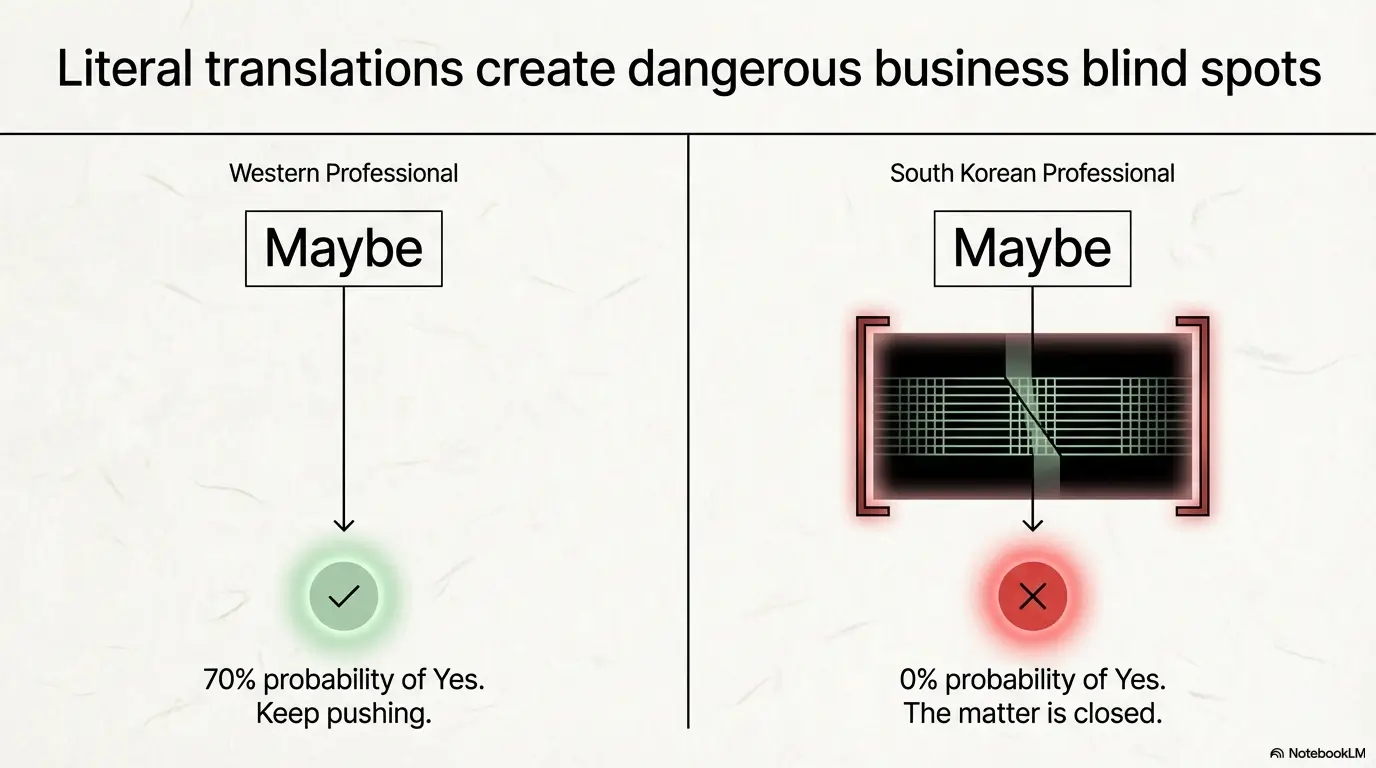
English often trains listeners to treat words like legal documents. “Maybe” means uncertainty. “Yes” means yes. “No” means no. Clean, crisp, blessedly boring. But Korean conversation often asks you to read more than the word itself. Cultural Atlas notes that South Korean communication is generally indirect, that speakers may understate their point, and that meaning is often carried by tone, posture, pauses, and implication rather than blunt wording. It also notes that flat refusals are often avoided in order to maintain harmony and protect face.
When “maybe” sounds open but is already quietly closing the door
I learned this the slightly embarrassing way many foreigners do. Someone once told me, with a very kind face, “Maybe next time.” I walked away thinking there might be a next time. There was not. No follow-up, no new date, no thread of energy continuing forward. The sentence looked open on paper, but in real life it had already folded itself shut.
The real question is not “Are they unsure?” but “What are they protecting?”
That is the better question because it moves you from dictionary logic to social logic. Sometimes the speaker is protecting your feelings. Sometimes they are protecting their own comfort. Sometimes they are protecting hierarchy, group peace, or future cooperation. The point is not verbal fog for its own sake. The point is a softer landing.
- Listen for social intent, not just literal wording
- Assume context may carry half the meaning
- Watch what happens after the sentence
Apply in 60 seconds: The next time you hear a vague answer, pause and ask yourself what concrete action, if any, moved forward.
Soft Refusal Decoded: What Korean “Maybe” Is Actually Doing
How indirect language protects the relationship, not just the message
When foreigners hear indirectness, they sometimes assume evasion. In practice, the function can be much gentler. Cultural Atlas explicitly describes indirect communication, thoughtful pauses, and refusals softened to preserve politeness and avoid loss of face on either side of the exchange. That matters because the social goal is not merely accuracy. It is a survivable conversation.
Why preserving comfort can matter more than verbal precision
There are cultures where being direct is considered respectful because it is efficient. There are other cultures where being too direct can feel like shoving a chair backward in a quiet room. Korea often leans toward the second pattern, especially when age, rank, awkwardness, or future contact are involved. A neat answer may be less important than a graceful one.
When ambiguity is not confusion, but courtesy in formal clothes
That does not mean every vague phrase is noble. Some are lazy. Some are avoidant. Some are simply human. But many are not meant to deceive. They are meant to soften friction. Think of it as conversational upholstery. The furniture is still there. It just has less exposed wood.
Quick distinction: soft refusal is not the same as fake uncertainty. Soft refusal says, “I do not want to make this harsh.” Fake uncertainty says, “I want to keep you on the hook.” The first is often cultural courtesy. The second is a character flaw. Do not confuse them too quickly.
Show me the nerdy details
In higher-context communication, meaning is distributed across wording, timing, nonverbal cues, shared expectations, and status. That means translation at the sentence level can be accurate while interpretation at the interaction level is still wrong.
Decision card: When A vs B
A: Real uncertainty. You hear a tentative reply plus a concrete next step, a date, or a sincere attempt to revisit.
B: Soft refusal. You hear a warm but vague reply with no calendar, no proposal, and no momentum.
Neutral next step: wait for one concrete action before treating it as genuine openness.
Who This Is For, and Who May Be Reading Too Much Into It
Best for expats, travelers, coworkers, students, and people dating across cultures
If you live in Korea, work with Korean colleagues, date across cultures, study Korean, or just spend enough time in Korean social spaces to keep a mental corkboard of “What did that answer even mean?”, this topic matters. Small misunderstandings here do not always explode. They just create quiet confusion, repeated follow-ups, and a faint feeling that everyone but you got the memo.
Useful for anyone confused by vague replies, delayed plans, or polite non-answers
Maybe you have received “We’ll see,” “Later,” “It might be difficult,” or “Let me check.” None of those automatically means rejection. But all of them can function as social cushioning when direct refusal would feel too heavy. If you have been treating every soft reply as an invitation to keep pushing, this article is your escape hatch.
Not for readers looking for a rigid formula that turns every “maybe” into “no”
This is the part where nuance climbs onto the stage and asks for decent lighting. No single phrase always means the same thing. Personality matters. Region matters. Age matters. Relationship matters. A shy person and a senior manager may both sound indirect for different reasons. So we are building a decision frame, not a decoder ring sold by a wizard in a parking lot.
Eligibility checklist:
- Do you keep hearing warm but vague replies? Yes / No
- Do plans often fail to become concrete? Yes / No
- Do you wait for a direct “no” that never comes? Yes / No
- Do you feel rude when you ask again? Yes / No
If you answered “yes” to at least 2, this framework will probably save you time and dignity.
Neutral next step: test your interpretation against follow-through, not wording alone.
The Hidden Signal: Why “Maybe” Can Mean Refusal Without Saying Refusal
Why Korean speakers may avoid a direct no even when the answer is settled
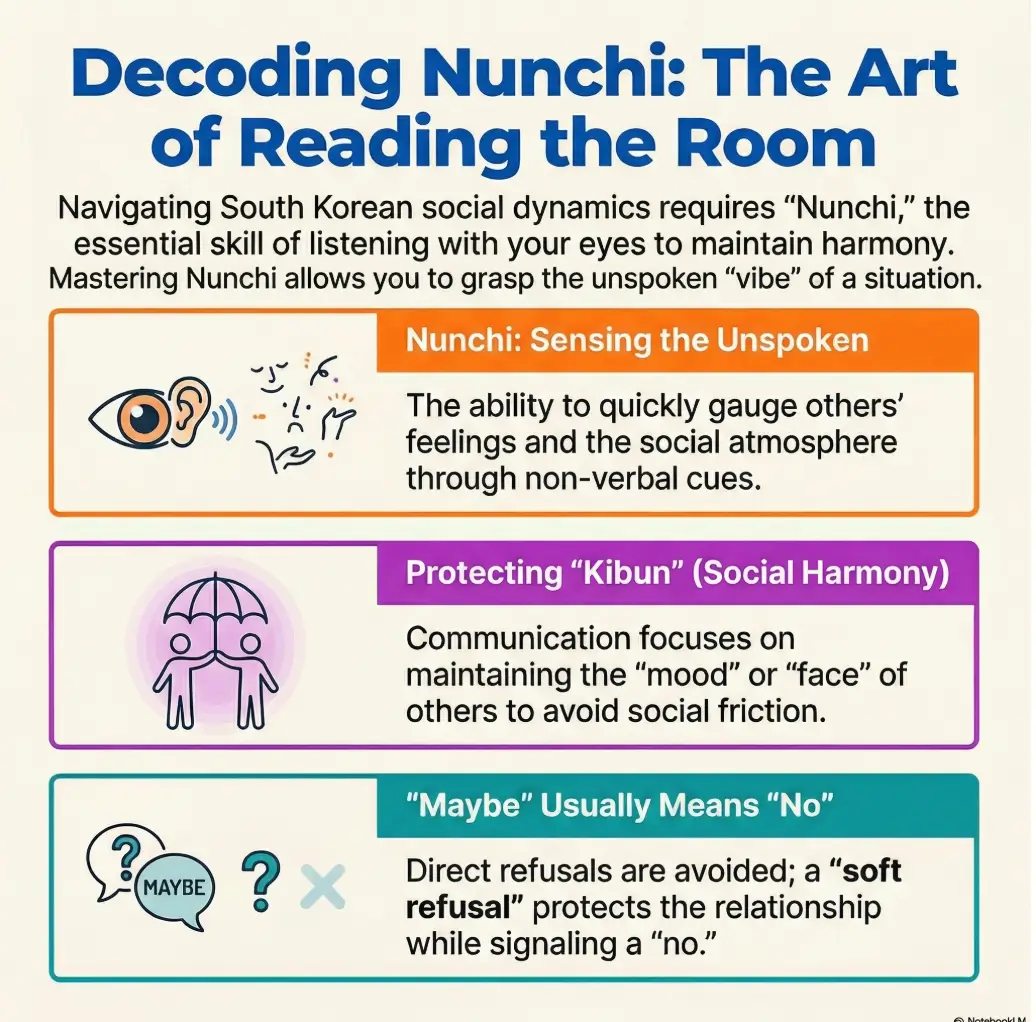
One helpful clue comes from the Korean idea of nunchi, often explained as sensing another person’s mind or the social atmosphere even when it is not stated outright. The National Institute of Korean Language’s dictionary defines nunchi as the ability to understand someone’s mind or situation even though they have said nothing, and its verb form describes realizing another person’s feelings or intentions. Korea.net also describes nunchi as the subtle ability to assess what others think or feel.
How tone, timing, and follow-through reveal more than the word itself
That matters because in a culture where unstated meaning matters, “maybe” often acts less like a factual report and more like a social bridge. Tone can make it feel gentle. Delay can make it feel unlikely. Follow-through tells you whether the bridge leads anywhere. If it does not, the sentence was probably never meant as an open door.
What sounds indecisive in English can sound considerate in Korean
I once watched a foreign coworker press for clarity after a vague answer. He was not aggressive. He was just trying to be efficient. The Korean colleague smiled, nodded, and became even vaguer. It was like trying to catch fog with chopsticks. The more he pushed, the less information he got. That is the strange little comedy here: force often reduces clarity instead of increasing it.
Don’t Translate Word-for-Word, or You Will Miss the Point
Why English hears uncertainty where Korean may be signaling restraint
Literal translation has a seductively clean face. It promises certainty. It whispers, “Just convert the word and move on.” But social meaning does not travel in neat little suitcases. A translated sentence may be accurate at the lexical level and wrong at the human level. That is why foreigners often leave Korean interactions feeling confused even when they understood every word.
The trap of treating language as dictionary math instead of social choreography
Think of language less as math and more as choreography. The same step can mean invitation in one dance and dismissal in another. Korean often expects the listener to notice spacing, timing, energy, and the shape of the room. This is where many foreigners get stuck. They are listening to nouns and verbs while the real message is happening in rhythm.
Here’s what no one tells you: politeness often hides in the gaps
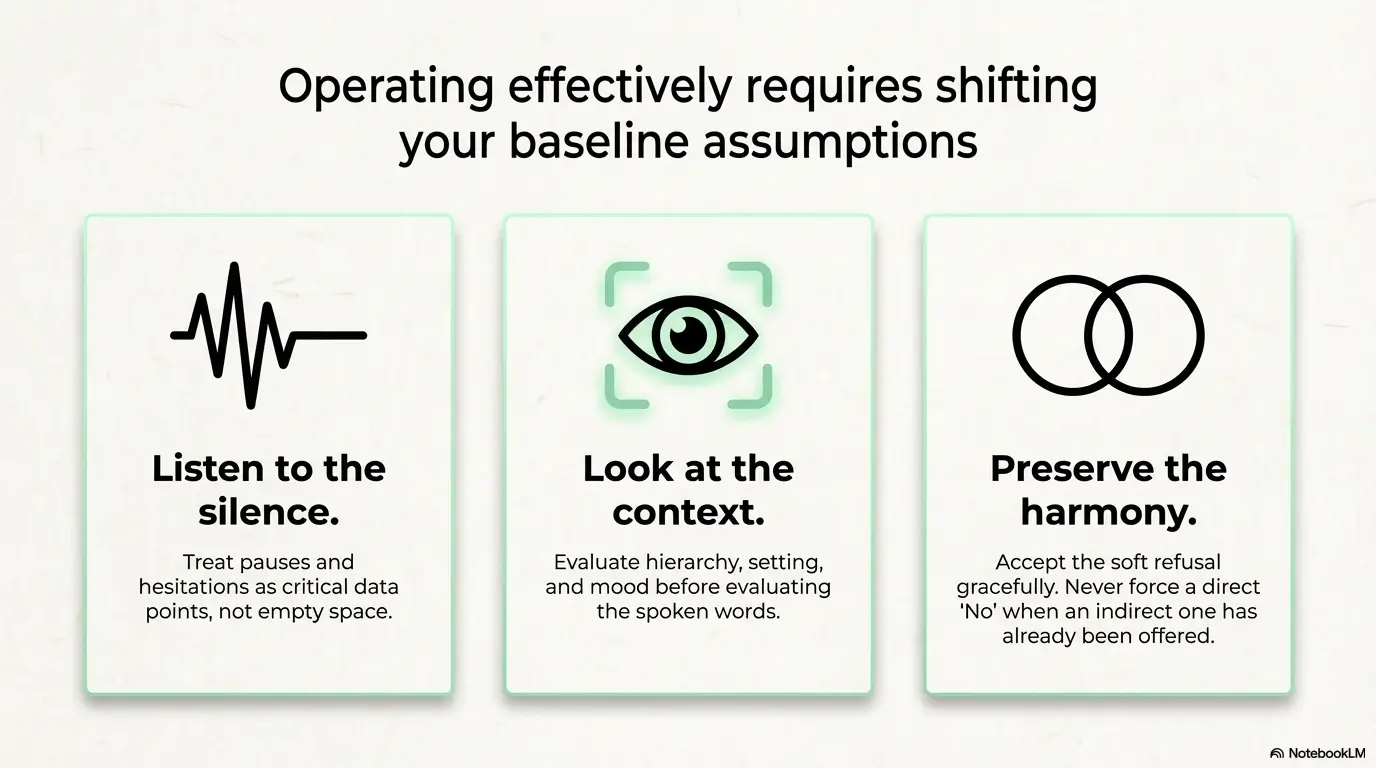
The gaps matter. The pause before the reply. The hedging phrase. The smile that feels polite rather than eager. The lack of a suggested next step. None of this is mystical. It is practical. The listener is being asked to join the labor of interpretation instead of outsourcing everything to explicit wording.
- Literal meaning tells you the sentence
- Context tells you the intention
- Follow-through tells you the truth
Apply in 60 seconds: Rewrite the reply in plain English based on behavior, not wording: “No plan offered” is often more accurate than “Maybe later.”
Mini calculator: interpretation score
Add 1 point for each of the following: no date offered, no follow-up, repeated delay.
0–1: could be genuine uncertainty. 2–3: likely soft refusal.
Neutral next step: wait for them to add one concrete detail before investing more effort.
Social Context Changes Everything: Work, Dating, Friendship, and Family
At work, “maybe” may protect hierarchy, face, and future cooperation
In professional settings, direct refusal can feel risky because the relationship continues after the moment. You still have Monday. You still have Slack. You still have the meeting where everyone pretends to enjoy the coffee. Cultural Atlas notes that hierarchy and status shape South Korean communication, and deference to authority can influence how directly people speak. If you want a wider lens on how rank changes everyday behavior, this also overlaps with Korean seating hierarchy and the social signals it quietly teaches.
In dating, “we’ll see” can soften rejection without public embarrassment
This is where foreigners often get hopeful and then haunted. A pleasant message, a warm reply, a soft “maybe,” and suddenly the heart starts decorating a room that has not been rented. In dating, gentle vagueness can be a way to avoid hurting someone directly. It is not always manipulative. Sometimes it is simply the culturally gentlest exit available.
Among friends, vagueness may postpone conflict rather than invite debate
Friendship is not immune. People sometimes avoid direct no’s with friends because they want to keep the mood light or postpone disappointment. I have seen this around dinners, trips, and group invitations. One friend says, “Maybe, I’ll check.” Nobody presses. Everyone somehow understands. The foreigner in the group, meanwhile, is updating a shared spreadsheet like a dedicated little raccoon of logistics.
In family settings, indirectness can signal care, duty, or discomfort all at once
Family language can be especially layered because love, obligation, age, and habit all pile into the same sentence. A parent may not say “no” directly because they do not want to sound unkind. An adult child may not answer directly because refusing elders can feel uncomfortable. The same soft phrase can carry affection, reluctance, and social duty at the same time.
Coverage tier map: where context matters most
- Tier 1: Casual acquaintance. Soft refusal is common and low-cost.
- Tier 2: Friendship. Vague replies may protect mood and group harmony.
- Tier 3: Dating. Warmth can coexist with low intention.
- Tier 4: Work. Hierarchy and future cooperation increase indirectness.
- Tier 5: Family. Duty, affection, and discomfort may all be folded together.
Neutral next step: judge the reply by the norms of the setting, not by one universal rule.
Common Mistakes Foreigners Make When Hearing Korean “Maybe”
Mistake one: treating politeness as open negotiation
This is the big one. A soft answer is heard as the start of bargaining. So the listener explains more, offers alternatives, sweetens the pitch, circles back, and accidentally makes the interaction heavier. In their mind, they are being helpful. In the speaker’s mind, a boundary that was meant to land softly has now been invited into overtime.
Mistake two: pushing for clarity too fast and making the moment heavier
Direct follow-up questions can be useful, but timing matters. Ask too hard, too soon, and the conversation may stiffen. The speaker may respond with even more vagueness, not because they are trying to deceive you, but because the social pressure just went up. A blunt request for certainty can make them responsible for your disappointment in a way they were trying to avoid.
Mistake three: assuming vagueness means dishonesty rather than relational caution
Sometimes foreigners moralize too quickly. “Why not just say no?” Because communication norms are not universal, and bluntness is not always the moral high ground. In some settings, directness feels honest. In others, it feels needlessly sharp. You do not have to love that difference to benefit from understanding it. That broader pattern also shows up in everyday topics like Korean personal questions etiquette, where intent and social comfort matter more than literal phrasing alone.
Mistake four: waiting for a direct no that may never come
This is the time thief. You wait. You reread. You interpret a warm tone as a future possibility. A week passes. Then two. The conversation has already ended, but you are still standing at the bus stop, emotionally speaking, convinced another route might arrive. Sometimes the kindest thing you can do for yourself is hear the soft boundary before the calendar proves it.
Infographic: How to Read Korean “Maybe”
1. Hear the phrase
“Maybe,” “We’ll see,” “It might be difficult”
2. Check the context
Work, dating, friendship, family, age, rank
3. Look for action
Date offered, question asked, next step proposed
4. Decide gently
No action = likely soft refusal. Action = possible openness.
Let’s Be Honest… Sometimes the “Maybe” Is Already a No
Repeated delays, no concrete rescheduling, and foggy phrasing are not neutral signs
There is a point where nuance becomes denial with a pretty scarf. One delay is normal. Two can happen. But repeated delays with no concrete attempt to reschedule usually mean the answer is not alive anymore. You do not need a courtroom-level confession. The pattern is enough.
Why silence after a soft reply often carries the answer forward
Cultural Atlas notes that silence can function as a purposeful, polite part of communication rather than a void. That matters because after a soft refusal, silence itself can continue the meaning. The original sentence may have been gentle, but the lack of renewed effort often tells you the real status of the invitation. If that piece feels culturally unfamiliar, it helps to read more about how silence works differently in Korean conversation.
When hope survives longer than the invitation itself
Short Story: A friend once invited a Korean acquaintance to coffee three times over six weeks. The replies were lovely. Truly museum-grade lovely. “Maybe after this busy week.” “Let’s see when things calm down.” “I’ll let you know.” Each message felt civilized, warm, almost promising. My friend kept treating every reply like a seed. But there was never a date, never a counteroffer, never even a “How about next Thursday?”
By week six, the truth had become quiet but obvious: the relationship was being protected, not advanced. Nothing cruel had happened. No one had lied in the dramatic sense. The misunderstanding came from assuming warmth meant momentum. It did not. The real answer had been there all along, stitched into delay, vagueness, and the missing calendar.
- Polite tone can coexist with refusal
- Repeated delay usually matters more than hopeful wording
- No counteroffer is often the loudest clue
Apply in 60 seconds: Re-read the last three messages and underline every concrete action. If there are none, stop treating it as active interest.
What the Listener Misses: Clues That Matter More Than the Word
Specificity versus vagueness: concrete next steps usually mean real openness
If the person suggests a date, asks when you are free, proposes an alternative, or gives a reason tied to a future action, that is qualitatively different from “maybe later.” Specificity is social investment. Vagueness is often social cushioning.
Speed versus drift: prompt engagement often signals genuine interest
Prompt replies are not everything, but they are something. A person who wants to keep the possibility alive usually adds motion. Even a busy reply can contain energy: “This week is bad, but next Tuesday after 6 works.” Drift, by contrast, is the slow leak of intention.
Energy versus courtesy: warm tone alone is not commitment
This is where many foreigners get tricked. A kind message feels encouraging because in some English-speaking settings, warmth often accompanies genuine openness. In Korean interaction, warmth can also be the wrapper around a boundary. Lovely wording does not automatically mean the box contains a yes.
Here’s what no one tells you: the calendar often speaks louder than the sentence
That may be the most useful single rule in this article. Trust the calendar. If no date appears, if no alternative is offered, if no action materializes, treat the warmth as relational care rather than logistical momentum. The sentence may say “maybe,” but the schedule is often already saying “no.”
Show me the nerdy details
Conversation analysts often distinguish between lexical content and interactional outcome. In plain English: what people say matters, but what the exchange actually moves toward matters more.
Don’t Corner the Speaker: How to Respond Without Creating Awkwardness
Better follow-ups that leave room for dignity on both sides
The goal is not to become suspicious. It is to become graceful. Good follow-ups reduce pressure while inviting clarity. Try things like, “No worries at all, just let me know if another time works,” or, “Totally okay if now’s not a good time.” These phrases create an exit ramp. Exit ramps are social mercy.
How to confirm gently without demanding a courtroom answer
If you truly need clarity, make the question easy to answer without embarrassment. “Should I assume this week won’t work?” is often better than “So is that a no?” The first protects both sides. The second turns the moment into a fluorescently lit interrogation room, which almost nobody enjoys. The same instinct appears in Korean apology phrases and other polite formulas that soften friction without pretending nothing happened.
When to step back instead of pressing for certainty
Sometimes the most culturally fluent move is to stop. Not dramatically. Not bitterly. Just cleanly. I have had moments where backing off immediately improved the relationship. The room exhaled. Nobody lost face. Oddly enough, that is sometimes when genuine contact returns later, because the conversation was allowed to remain humane.
Response-prep list: what to gather before you follow up
- Your real goal: clarity, rescheduling, or closure
- One low-pressure wording option
- A willingness to accept a soft boundary
Neutral next step: send one gentle follow-up, then let behavior answer the rest.
Why Competence Here Feels Like Emotional Intelligence, Not Language Mastery
Fluency is not enough when cultural rhythm changes the meaning
You can know the grammar and still miss the room. That is not failure. It is simply the limit of language study when culture is doing half the speaking. Korea.net has described nunchi as the subtle ability to assess another person’s mindset or mood, and the National Institute of Korean Language’s dictionary definition similarly centers understanding someone’s mind or situation without them spelling it out. That is why competence here feels closer to emotional intelligence than vocabulary accumulation.
Why socially accurate listening builds trust faster than perfect grammar
Foreigners sometimes aim so hard for correct speech that they neglect correct listening. But socially accurate listening is a trust magnet. When people feel that you understand not just their words but their comfort level, conversations get easier. Your Korean may still be imperfect. Your timing may still wobble.
Yet people often feel more relaxed around someone who can hear boundaries gently. That is closely tied to broader ideas of Korean politeness and knowing when restraint communicates more than fluency.
The deeper lesson: communication is often negotiated through comfort, not clarity
This is the quiet philosophical heart of the matter. Many of us are raised to believe that clarity is always the highest virtue. Often it is. But in real human life, comfort is not trivial. It can be the bridge that keeps a relationship intact when a blunt answer would leave a bruise. Once you understand that, Korean “maybe” stops looking slippery and starts looking socially strategic.
- Language skill helps
- Context skill matters more
- Respectful restraint often wins trust fastest
Apply in 60 seconds: Replace the question “What did they literally say?” with “What relationship outcome were they trying to preserve?”
FAQ
Does Korean “maybe” always mean no?
No. Sometimes it really does mean uncertainty, scheduling difficulty, or a need for more time. The difference is usually revealed by whether the person adds a real next step, concrete detail, or renewed effort.
How can I tell the difference between real uncertainty and soft refusal?
Look for commitment markers. A date, a counteroffer, a follow-up question, or a self-initiated check-in usually suggests genuine openness. Repeated delay without specifics usually suggests soft refusal.
Is indirectness considered polite in all Korean settings?
Not uniformly. Personality, generation, region, workplace culture, and relationship all matter. But indirectness, deference, and attention to face are common enough in Korean social life that foreigners benefit from expecting them, especially in formal or delicate situations.
Why do Korean coworkers avoid saying no directly?
Often to preserve harmony, respect hierarchy, and keep future cooperation smooth. A blunt refusal can create unnecessary friction in a relationship that must continue after the immediate request.
Is this about language level, personality, or culture?
All three. Culture shapes what feels polite. Personality shapes how strongly someone uses indirectness. Language level shapes whether you can hear the cues. The safest assumption is that all three are braided together.
What should I say when someone gives me a vague answer?
Try a low-pressure follow-up: “No worries at all. Just let me know if another time works.” If you need clarity, ask gently: “Should I assume this won’t work for now?” Then accept the answer, including the quiet one.
Can direct foreigners accidentally seem rude without meaning to?
Absolutely. Not because directness is bad in itself, but because a push for explicit clarity can feel socially heavy in moments where the other person is trying to keep things light and respectful.
Does age or hierarchy change how soft refusal is expressed?
Often yes. Hierarchy can increase indirectness because the social cost of bluntness is higher. This is especially true in workplaces, formal settings, or interactions involving elders.
Next Step: Test Meaning by Looking for Commitment, Not Vocabulary
Watch for one concrete sign: a specific time, action, or follow-up
If you remember only one thing from this article, let it be this: stop over-reading the word and start watching for commitment. A specific time, a proposed action, a real follow-up, a counteroffer, a self-initiated message. These are the coins of actual intention. Everything else may be politeness, uncertainty, or social cushioning.
If the reply stays warm but noncommittal, treat it as a gentle boundary
That does not mean taking offense. It means recognizing dignity when it appears in a soft form. Some of the healthiest cross-cultural communication happens when we learn to accept a boundary before it has to harden. There is a quiet maturity in that. You save your energy. They keep their comfort. The relationship, if it matters, survives without unnecessary scraping.
One practical habit: stop asking “What did the word mean?” and start asking “What moved forward?”
That question closes the loop from the beginning of this piece. Korean “maybe” feels confusing only if you demand that meaning live entirely inside the word. Often it does not. Often it lives in what the speaker is protecting, what the context permits, and whether anything actually advances after the sentence lands.
Within 15 minutes, you can use this framework on one real conversation in your own life: reread the exchange, mark every concrete commitment, and separate warmth from momentum. That tiny audit will tell you more than a hundred anxious re-translations ever could. If you want to keep widening your ear for these softer signals, it also helps to study everyday patterns in KakaoTalk etiquette, Korean phone call culture, and the pressure-lowering logic behind Korean honorifics for foreigners.
Last reviewed: 2026-03.