

Beyond the Aesthetic: Decoding the Logic of the Korean Café
A Korean café menu can look deceptively small and still tell you half a city’s mood. One strawberry shortcake in March, one chestnut tart in October, one sold-out sign by late afternoon, and suddenly you are no longer looking at dessert alone. You are looking at timing, branding, and a very particular kind of customer psychology.
That is where many Anglo-American readers misread Korean café culture. From the outside, seasonal desserts and limited menus can seem overstyled or built mainly for Instagram. In practice, they turn menu rotation into a tool for repeat visits, visual identity, and low-risk freshness.
Miss that, and the whole café experience looks random when it is actually tightly choreographed.
This post helps you read Korean cafés more accurately, whether you are a traveler, food writer, or simply curious. We move past the postcard version and the cynical version to find the logic hiding in plain sight.
Table of Contents
The Real Question: Why This Feels So Different in Korea
It is not just about dessert
Many US readers first notice the visual drama. The cake looks immaculate, the glass case feels curated, and the menu shifts with the calendar like a wardrobe change. It is tempting to conclude that Korean cafés are simply more aesthetic, more theatrical, or more trend-hungry. That is partly true, but it is also incomplete. What you are seeing is a tighter relationship between food, timing, and identity.
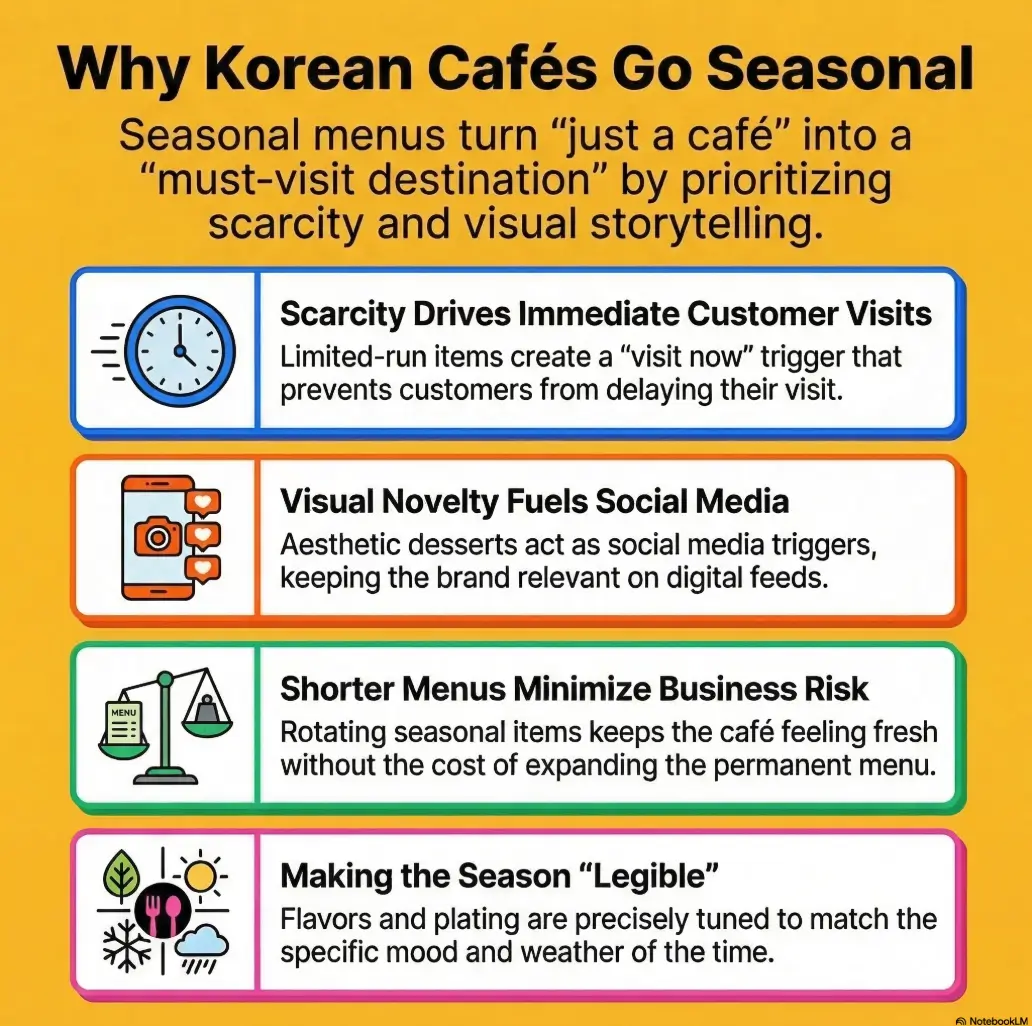
In a lot of Korean cafés, dessert does four jobs at once. It sells flavor, yes. But it also signals season, differentiates the shop, creates urgency, and gives repeat customers a reason to come back. In that sense, the dessert menu behaves less like a fixed catalog and more like a monthly conversation. The pastry case is not merely stocked. It is staged.
It is about timing, identity, and repeat visits
Constructed example: A café’s strawberry dessert appears in many customers’ photos. That illustrates visibility, not a measured share of demand or proof that the fruit was locally grown.
That matters because Korean urban café culture often depends on repeat traffic more than sheer menu breadth. A regular who visits two or three times a month does not need thirty permanent desserts. They need one or two reasons to feel that this week’s visit is different from last week’s. Novelty, when done well, functions like a soft bell. Not loud, just enough to pull people back.
Why US visitors often read it as “extra” at first
US café culture often trains people to value consistency. The comfort comes from knowing your order will be there next Tuesday, next month, and in some chains, next winter too. Korean cafés often borrow a different pleasure: the comfort of timeliness. That difference can make the whole system feel “extra” to an outsider, as though the dessert is trying too hard. But what looks like excess is often precision. The menu is matching a moment, much the way different Korean neighborhoods and cities signal personality through their own local identity.
- They mark time in a visible way
- They give regulars a reason to return
- They make the brand feel alive, not static
Apply in 60 seconds: The next time you look at a Korean café menu, ask what changed recently, not only what is available.
Who This Is For / Not For
This is for
- US travelers curious about Korean café culture
- Expats trying to understand local food trends
- Food and culture bloggers covering Korea
- Readers wondering why menus change so often
This is not for
- Readers looking for a full business finance breakdown of Korean cafés
- Professional pastry operations advice at an industry level
- A city-by-city café directory or ranking list
This article sits in the practical middle. It is for the curious traveler, the observant expat, the writer trying not to flatten another culture into a single cliché, and the person who has stared at a sold-out sign with a mild sense of betrayal. It is not an academic paper, and it is not a spreadsheet in an apron. It is a field guide for reading the room.
- Yes: You want practical context for why Korean café menus rotate so often.
- Yes: You care about customer psychology, branding, or travel culture.
- No: You need industrial pastry costing, labor ratios, or deep franchise economics.
Neutral next step: Read this as a culture-and-behavior guide, not a trade manual.
Seasonal Means Signal: Dessert as a Calendar, Not Just a Product
Strawberry season is a social season too
If you want the cleanest example, start with strawberries. In Korea, strawberry desserts often arrive with the energy of a parade disguised as whipped cream. Their appeal is not mysterious. The fruit is bright, photogenic, broadly loved, and tied to a familiar seasonal rhythm. But the deeper point is that strawberry season is not only agricultural. It is social. Customers expect it, look for it, and talk about it as a temporary chapter rather than a permanent shelf item.
A visitor may arrive expecting a seasonal item that is no longer offered. Check the café’s own current notice instead of assuming a social-media photo describes today’s stock.
Chestnut, sweet potato, fig, and melon each carry a mood
Not every seasonal ingredient carries the same emotional texture. Strawberries lean cheerful and romantic. Chestnut feels quieter, autumnal, slightly nostalgic. Sweet potato can read cozy and domestic. Fig feels a little grown-up, a little expensive, as if the menu started listening to chamber music. Melon often arrives with freshness, color, and summer clarity. These ingredients do not just change flavor. They change atmosphere.
That is one reason menu rotation matters so much. A café can shift its emotional register without renovating the entire space. Replace one tart, one cream cake, and one beverage garnish, and suddenly the room tells a new story.
Limited desserts help cafés mark time in a highly visual way
Menus in Korean cafés often work like calendars you can eat. The rotating display helps customers feel the passage of time in a city where trends move quickly and repetition can feel stale. This is especially powerful because it is visible. A dessert case does not announce season in abstract terms. It performs it in color, texture, and arrangement.
That visual timing also suits a culture of short-form documentation. People do not merely remember that it was strawberry season. They post it. They archive it in camera rolls. They attach dates and places to it. A seasonal dessert becomes part memory, part receipt, part tiny museum label.
Show me the nerdy details
From an operations point of view, seasonal dessert rotation can function as low-cost menu signaling. A café does not need to redesign all recipes to communicate freshness. Small, visible changes in garnish, featured fruit, color palette, and display composition often do the branding work of a much larger menu overhaul. That is why a narrow rotating selection can feel more dynamic than a permanent menu with thirty items.
Scarcity Sells: Why Limited Menus Create Urgency So Well
A short menu can feel more desirable than a long one
There is a strange little magic in restraint. A menu with six carefully chosen items can feel more deliberate than one with twenty-three. In Korean café culture, that sense of curation matters. When customers see a short seasonal line, they often interpret it as care rather than limitation. Fewer items can suggest tighter standards, better execution, and less waste. The shop feels edited.
I have learned this the hard way. A broad menu promises freedom, but it often produces a tired form of indecision. A short menu says, gently but firmly, we have already done some of the choosing for you. That can be oddly relieving, especially in a city day full of options.
“Available now” beats “always available” in trend-driven café culture
Scarcity sharpens attention. A dessert that exists for two weeks invites action in a way an all-year item rarely does. This does not mean customers are gullible. It means timing changes behavior. “Available now” carries a pulse. “Always available” carries convenience. Both have value, but they do different work.
In trend-sensitive café districts, limited items also give people a socially legible reason to visit. You are not just grabbing cake. You are catching the seasonal release before it vanishes. Even when the taste difference is modest, the timing difference can be decisive. Human beings, after all, are often less rational than the menu designer and more sentimental than the economist.
Here’s what no one tells you…
Limited menus do not only create hype. They also reduce decision fatigue and make a café feel curated rather than crowded. That is a quieter advantage, but an important one. A smaller menu can help first-time visitors order faster, ask fewer anxious questions, and feel that the shop knows itself. There is relief in entering a place that appears to have an opinion.
| When this works | What customers feel | Trade-off |
|---|---|---|
| Long stable menu | Reliability and comfort | Can feel static over time |
| Limited seasonal menu | Urgency and discovery | Risk of sell-outs and disappointment |
Neutral next step: Judge the menu by the experience it is trying to create, not by item count alone.
Instagram Logic: The Dessert Has to Photograph Before It Gets Eaten
Visual design matters almost as much as flavor
In many Korean cafés, desserts are built for a two-stage life. First, they must read instantly from a display case or phone screen. Then they must reward the actual bite. This is not necessarily superficial. It is simply modern hospitality adapted to camera culture. The customer does not encounter dessert only at the tongue. They meet it first through sight, context, composition, and shareability.
That changes design choices. Height matters. Glaze matters. Cream edges matter. Cross-sections matter. A slice of cake must signal itself in under two seconds, which is approximately the lifespan of many modern attention spans and at least half of mine before coffee.
Seasonal color palettes help cafés stay culturally current
Seasonal desserts make color strategy easy. Spring permits pale pinks, fresh whites, soft greens. Autumn welcomes chestnut brown, muted orange, cream, and gold. Summer can turn toward melon, citrus, mint, and translucent textures. Winter often embraces darker tones, deeper chocolate, and comforting density. These are not only flavor cues. They are visual rhythms that let a café feel in step with the wider mood.
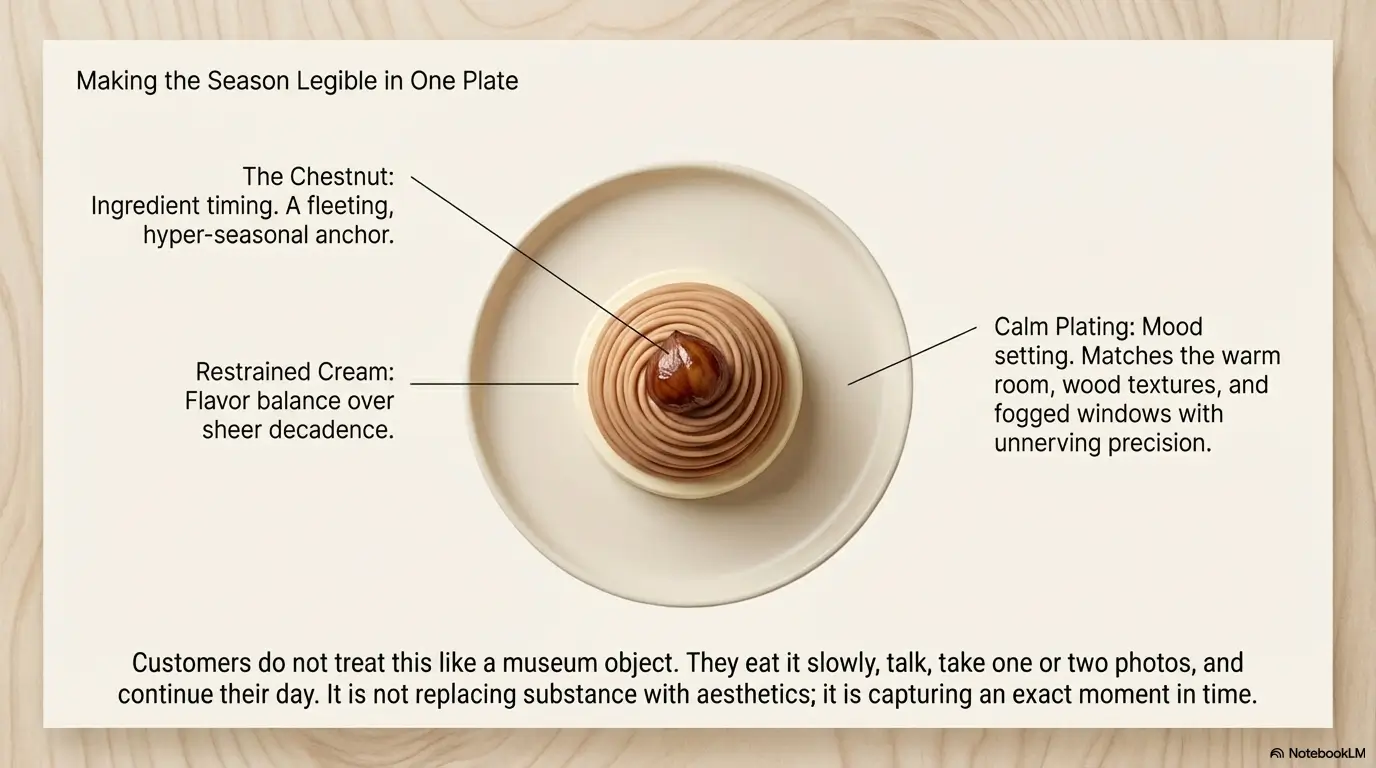
For customers, this means the menu aligns with the room. A spring dessert in a bright, minimal interior feels coherent. A chestnut tart beside warm wood and low autumn light feels nearly inevitable. The visual system closes ranks around the product.
Why one pretty tart can market the whole shop
A single standout dessert can do the work of a campaign. It becomes the object that appears in photos, short videos, stories, recommendations, and location tags. People do not need to photograph the whole menu. One tart, one cake, one seasonal parfait can become the face of the café for a month.
That is why limited desserts can matter beyond direct sales. Even a customer who orders a basic latte may have arrived because the shop’s seasonal item kept surfacing online. The tart becomes a lure. The café becomes a destination. The rest of the menu benefits from the halo, especially in places where knowing basic Seoul café etiquette helps visitors settle into the experience instead of hovering awkwardly at the counter.
- Display-case impact matters
- Color tells customers what season they are in
- One hero dessert can market the whole shop
Apply in 60 seconds: When you see a viral Korean café dessert, ask what role it plays for the whole brand, not just the pastry case.
Brand World First: Cafés Are Selling a Mood, Not Just a Menu
A seasonal dessert helps define the café’s personality
Some cafés sell coziness. Some sell minimal calm. Some sell nostalgia, polished retro, or airy metropolitan neatness. Seasonal desserts help each place express that identity in edible form. A café with a quiet Scandinavian mood may interpret strawberry season very differently from a maximalist dessert bar. One might do a restrained cream sponge with precise fruit placement. Another might build a towering shortcake that looks like it arrived from a small celebration. Same season, different brand voice.
That is why seasonal menus matter even when multiple cafés feature similar ingredients. The ingredient is only the vocabulary. The dessert is the accent.
Menu changes keep the space feeling alive
Interior design is expensive. Menu rotation is cheaper. If a café wants to feel current without renovating chairs, repainting walls, or changing tableware every quarter, it can refresh its emotional atmosphere through seasonal food and beverage design. The display case becomes a low-cost stage set. The room seems to change because the focal objects have changed.
A seasonal menu can change a café’s presentation even when the room stays the same. Whether that improves the visit depends on the actual food, price and the customer’s preferences.
The dessert often completes the interior concept
This is the part many outside readers miss. In some Korean cafés, the dessert is not an accessory to the interior. It is the final component that makes the interior legible. A seasonal menu can echo the palette, temperature, and emotional tone of the space. The result is not just a nice room with pastries. It is a unified atmosphere.
That unity matters because customers are not buying calories alone. They are buying a small experience package: room, plate, cup, light, timing, memory. Limited menus help that package feel curated rather than generic.
Local Ingredients, Local Rhythm: Why Timing Matters Behind the Counter
Some ingredients genuinely peak by season
Not every seasonal dessert is pure poetry and marketing confetti. Some of it is simply practical. Fruit quality changes. Texture changes. Availability changes. Pricing changes. Even when cafés are not deeply farm-to-table in the romantic sense, ingredient windows still shape what is easiest to feature beautifully and consistently.
When a fruit is at its most appealing, a café can let the ingredient do more of the work. That matters in dessert, where freshness is visible. A tired strawberry is not merely less sweet. It is less convincing. It weakens flavor and photography in one blow, which is a rude level of efficiency.
Smaller menus can protect consistency and waste control
Menu breadth sounds generous until you are the one trying to keep ten perishable components looking perfect. Smaller rotating menus can help cafés manage freshness, quality, and waste. If a shop focuses on a handful of seasonal items, it can buy with more clarity and use ingredients across several desserts or drinks without stocking a carnival of barely moving inventory.
That does not make every limited menu noble. But it does mean there is often an operational intelligence hiding behind the prettiness. A compact menu can be easier to execute well. In food, that usually matters more than ambition. The same practical intelligence appears in other corners of everyday life too, from Korean convenience store habits and product turnover to the brisk efficiency visitors notice in why Korean clinics are so fast.
Let’s be honest…
Not every “seasonal” item is purely about freshness. Sometimes it is also about storytelling, sourcing convenience, or trend alignment. A café may use seasonal language partly because it sounds timely and emotionally resonant. That is not automatically deceptive. Often it reflects the mixed reality of hospitality, where customer expectation, supplier rhythm, and brand narrative all share the wheel.
The smartest way to read this is not cynicism but proportion. Some items are strongly ingredient-led. Others are season-themed rather than season-dependent. Most live somewhere in the middle.
Practical check: Use the specific questions below. A quick score or a visual impression cannot establish the right choice for every person or setting.
Trend Cycles Move Fast: Korean Café Culture Rewards Freshness in Ideas
A static menu can start to feel stale surprisingly quickly
In fast-moving urban consumer culture, repetition can lose charm quickly. This does not mean people are incapable of loyalty. It means loyalty is often fed by change. A café that never refreshes its visual or menu cues may still survive, but in trend-sensitive areas it risks feeling sleepy. Not bad. Just slightly paused while the sidewalk keeps moving.
Korean café culture is particularly good at making freshness visible. That can show up in packaging, plating, collaboration items, interior micro-updates, or limited dessert releases. The menu becomes part of a rhythm of renewal. Customers come to expect that pulse.
New desserts give regular customers a reason to return
Regulars rarely need a moral lecture about why they should come back. They need a reason that feels small, pleasant, and timely. A new dessert is perfect for this. It offers novelty without demanding a major decision. You are not joining a membership or booking a tasting menu. You are stopping by for the fig roll cake before it disappears.
I have done this myself with embarrassing obedience. I told myself I was merely “passing by,” then found myself ordering a seasonal item I had already seen online three times. Free will is real, probably, but pastry marketing does test the edges of the theorem.
Limited runs let cafés test demand without full commitment
From a business perspective, limited runs are also a safe experiment. A café can test flavor combinations, pricing, visual direction, and customer response without enshrining an item forever. If the dessert lands well, it may return next year. If not, it exits gracefully under the forgiving umbrella of seasonality.
This is one of the least romantic reasons limited menus persist, and one of the most important. Rotation gives cafés flexibility. Flexibility, in hospitality, is almost always worth more than bravado.
- Tier 1: Stable classics only. Best for habit and routine.
- Tier 2: Classics plus one seasonal item. Gentle freshness.
- Tier 3: Several rotating desserts tied to season. Strong return-visit logic.
- Tier 4: Fast trend turnover and photo-forward design. High buzz, higher volatility.
Neutral next step: Notice which tier a café seems to live in before judging its menu strategy.
Not Just Marketing: Why Customers Expect Novelty Now
Regulars often visit for discovery, not only comfort
There is a quiet but important shift here. In some café cultures, the main reward is consistency. In many Korean cafés, the reward often includes discovery. Customers still want quality and comfort, of course. But they also want a small surprise, a fresh detail, a new seasonal expression that turns an ordinary visit into something mildly memorable.
That expectation shapes the whole menu system. Rotation is not merely something cafés impose on customers. It is also something customers have come to anticipate. When novelty becomes part of the hospitality contract, static menus can begin to feel emotionally underfurnished.
Familiar base, rotating specials is the quiet formula
The clever move is not total chaos. Most strong cafés do not reinvent themselves every week like a novelist with deadline panic. They hold onto a stable core and layer specials on top. That balance lets customers have both reassurance and novelty. A trusted latte remains. The seasonal tart changes. The room stays coherent. The experience feels alive.
This formula explains why limited menus work so well. They do not need to replace everything. They only need to refresh the part customers look at most closely.
Novelty has become part of the customer experience
For many younger and trend-aware customers, novelty is not a bonus anymore. It is part of value. The item’s temporary nature, photogenic design, and seasonal fit all contribute to whether it feels worth the visit. That may sound modern to the point of absurdity, but there is nothing uniquely frivolous about it. Human beings have always cared about timeliness, rarity, and ritual. Social media simply accelerated the tempo, much as it has in wider discussions of contemporary Korean culture and everyday lifestyle signaling.
Illustrative scenario, not a reported event: Two friends visit for a seasonal chestnut dessert after checking its availability. One enjoys the flavor and the other prefers a simpler cake. A shared promotion can bring customers in without guaranteeing the same experience for everyone.
Don’t Misread This: Common Mistakes Foreign Readers Make
Mistake 1: Assuming limited menus are only a gimmick
Sometimes they are gimmicky. But “gimmick” is too blunt a tool for the whole category. Limited menus can also reflect real ingredient timing, waste control, brand design, and customer expectation. To dismiss them all as hype is to miss the layered logic underneath.
Mistake 2: Thinking a small menu means weak capability
In many contexts, a small menu suggests focus. It can mean the café knows what it does well and has chosen not to dilute the experience. Breadth is not the only marker of skill. Restraint can be a form of confidence.
Mistake 3: Confusing aesthetic value with superficial value
A dessert that is visually considered is not automatically shallow. In café culture, presentation is part of hospitality. The plate, light, and texture contribute to the experience. That does not excuse bad flavor, but it does mean beauty is not irrelevant fluff floating above the “real” product.
Mistake 4: Expecting the US café model to map neatly onto Korea
This may be the biggest mistake of all. Café culture is local even when espresso machines are global. The US model prizes some things more heavily. Korea often prizes others. Neither system is morally superior. They are built around different rhythms of customer behavior, urban life, and social display. That mismatch shows up in other everyday interactions too, from why tipping in Korea works differently to the softer cues inside Korean phone call culture.
- Limited does not always mean gimmicky
- Small can mean focused, not underdeveloped
- Visual care is often part of the product itself
Apply in 60 seconds: Swap the question “Is this extra?” for “What problem is this menu trying to solve?”
Don’t Do This: What Café Tourists Get Wrong When Ordering
Do not arrive late and expect every seasonal item to remain
Limited means limited. Sometimes that scarcity is dramatic, but often it is just arithmetic. Certain desserts are made in finite batches, especially when assembly or freshness matters. Arriving at 5 p.m. and being shocked that the café’s star item is gone is a little like showing up to a concert after intermission and demanding the overture. Charming in theory, not effective in practice.
Do not assume bestsellers stay year-round
If a seasonal item becomes beloved, many foreign visitors assume it will naturally be promoted to permanent status. Not always. Its appeal may depend precisely on its temporary return. A strawberry cake in January creates one feeling. The same cake in July may feel ordinary or even a little tired.
Do not judge the whole café from one sold-out dessert
A sold-out dessert can result from demand, a small production run or a supply constraint. It is not enough evidence to diagnose hype or management quality. Choose a backup or another day without assigning a hidden motive.
Why scarcity changes customer behavior before you even order
Scarcity shapes planning. People check social media. They arrive earlier. They ask staff about availability. They treat the visit as mildly time-sensitive. This alters the whole customer experience before the first bite. The café becomes a place you catch at the right moment, not only a place you happen to enter.
- Does the café use phrases like seasonal, limited, today only, or sold out?
- Are the featured items shown prominently on recent social posts?
- Do photos suggest one “hero” dessert driving visits?
Neutral next step: Use these clues to manage expectations, especially if you are making a special trip.
The Hidden Business Logic: Limited Menus Keep Risk Smaller
Fewer items can mean tighter execution
Behind the charm sits a practical truth: every menu item creates complexity. Ingredients, prep labor, display space, training, consistency, and waste all increase with breadth. Limited menus reduce that burden. A café can focus on getting a smaller number of items beautifully right, which often matters more than offering exhaustive choice.
This is one reason a seasonal system can be smart even for shops that look highly aesthetic. Beauty may get the attention, but operational simplicity often keeps the lights on. Or at least keeps the cream stable and the sponge from despair.
Seasonal specials help test price tolerance and demand
Temporary items also help cafés learn. Customers may accept a higher price for a special dessert if the timing, design, and ingredient story feel strong. Limited runs reveal what customers value, what they photograph, what they reorder, and what they ignore. That data may be informal, but it is still useful. A pastry case can become a quiet research lab.
Short-run desserts can create buzz without permanent overhead
This may be the cleanest business argument of all. A short-run item can generate attention, pull in visitors, and refresh a brand without committing the café to permanent inventory and production complexity. That flexibility is especially attractive in a competitive market where customer attention shifts quickly.
It also explains why limited menus are likely to remain common. They offer a rare bargain: stronger story, sharper urgency, and smaller long-term commitment.
- They reduce operational complexity
- They let cafés test demand safely
- They create buzz without permanent burden
Apply in 60 seconds: When a seasonal item appears, read it as both product and experiment.
Why This Matters to US Readers: What It Reveals About Korean Consumer Culture
Speed of trend adoption shapes food culture too
US readers often approach Korean café culture as a cute side note to travel. But the menu tells a broader story about Korean consumer behavior. Trend adoption can be quick. Aesthetic literacy is high. Product freshness is often interpreted visually as much as materially. Consumers do not merely buy an item. They buy participation in a current moment.
This helps explain why limited menus make cultural sense beyond the café sector. They fit a wider environment where fashion, beauty, pop culture, retail, and dining all move in visible cycles of refresh and reinterpretation.
A café visit is often part taste, part atmosphere, part documentation
For many customers, the café experience includes taste, conversation, setting, and documentation. None of these cancels the others out. A person can genuinely enjoy the flavor and still care whether the plate looks beautiful on camera. Modern life is full of mixed motives. We drink coffee, seek comfort, perform identity, and make memories all at once. The café simply makes that braid easier to see.
Seasonal menus reflect a broader culture of freshness and reinvention
At their best, seasonal menus reveal a cultural preference for renewal without total rupture. The café stays itself, but it changes enough to feel awake. That balance is appealing because it mirrors how many people want life to feel: familiar, but not frozen. Predictable, but not deadened.
The key idea is simple: the dessert is not only sold. It is timed, framed, and remembered.
Common Mistakes
Treating all Korean cafés as one category
Some cafés are deeply trend-led. Others are stable neighborhood shops with modest seasonal changes. Some are dessert-forward destination spaces. Others are drink-first with a few rotating pastries. Flattening them into one national type is tempting and inaccurate.
Assuming every seasonal dessert is rooted in old tradition
Some seasonal ingredients connect to long-standing preferences or familiar harvest rhythms. But many limited desserts are modern hybrids shaped by social media, urban branding, and global café aesthetics. Tradition and trend often coexist on the same plate.
Overlooking the role of social media in menu strategy
Customers do not just encounter the café at the door. They meet it through posts, maps, recommendations, and short videos. Seasonal menus are ideal for this environment because they create recurring reasons to talk about the same place in new ways.
Forgetting that repeat traffic matters more than one-time curiosity
A café does not survive on your one dramatic visit alone. Repeat customers matter. Limited menus support that rhythm by giving regulars a reason to return. What feels like ornamental change from the outside may be a practical retention tool from the inside.
That returns us to the original question. Korean cafés care about seasonal desserts and limited menus because those menus solve several problems at once. They create urgency. They refresh brand identity. They make ingredient timing visible. They help customers feel that a visit is attached to a moment, not merely to a purchase.
FAQ
Why do Korean cafés change desserts so often?
Because frequent menu rotation helps create urgency, reflect ingredient seasonality, and keep regular customers interested. A changing menu also lets cafés stay visually fresh without rebuilding the entire business around constant expansion.
Are seasonal desserts in Korea actually seasonal, or just marketing?
Usually both. Some items are tied to real ingredient windows, while others use seasonal themes to create mood and relevance. The most useful way to read them is not as pure authenticity or pure hype, but as a blend of flavor, timing, and storytelling.
Why are limited menu items so popular in Korean cafés?
They feel exclusive, timely, and worth seeking out. That sense of temporary availability increases both social sharing and in-person visits. It also gives regular customers a reason to return without requiring the café to become a giant all-things-to-all-people menu.
Do Korean cafés focus more on appearance than taste?
Appearance matters a great deal, but that does not mean taste is secondary. In many cafés, presentation is part of the product experience. The best places treat beauty as a layer added to solid flavor, not a replacement for it.
Why do strawberry desserts seem so dominant in Korean café culture?
Strawberry season combines strong visual appeal, broad popularity, and a built-in sense of anticipation. The fruit is instantly legible in photos, emotionally associated with a specific seasonal mood, and flexible across cakes, tarts, drinks, and parfaits.
Is this different from US café culture?
Yes, often. US cafés frequently lean more heavily on consistency and staple menus, while many Korean cafés place stronger emphasis on novelty, theme, and short-cycle menu refreshes. Both models can work well, but they reward different customer expectations.
Are limited menus mainly for younger customers?
Younger trend-sensitive customers often amplify them online, but the appeal of seasonal exclusivity reaches much wider than one age group. Plenty of customers simply enjoy the feeling of eating something that belongs to this month and not the next one.
Do all Korean cafés operate this way?
No. Some prioritize classic drinks and stable pastry programs, while others lean hard into seasonal and limited-run strategies. The trend is especially visible in urban, design-conscious, and destination-style cafés, but it is not universal.
Next Step
Pick one Korean café menu online and look for three clues
Check for a seasonal ingredient, a limited-time phrase, and a dessert designed to match the café’s visual identity. That trio usually reveals whether the menu is being built for taste alone or for return visits, mood, and shareability too. You can do this in under 15 minutes. Open one menu, one recent social feed, and one map listing. Look for repetition. If the same dessert appears as product, image, and conversation, you have found the shop’s current center of gravity.
What competitors usually do
- Treat seasonal desserts as a cute trend with shallow explanation
- Reduce the topic to Instagram aesthetics alone
- Repeat generic headings like benefits or popularity
- Ignore the business logic behind menu rotation
- Miss the gap between US expectations and Korean café culture
How this interpretation avoids it
- It explains the cultural, visual, and operational logic together
- It connects scarcity to customer psychology and repeat traffic
- It treats the dessert as product, signal, and business tool at once
- It reads the topic through a US-reader lens without flattening Korean context
The hook at the beginning was simple: why does one strawberry cake seem to carry so much weight in a Korean café? Now the answer is less mysterious. It carries timing, mood, marketing, identity, and a reason to come back soon. The seasonal dessert is not extra decoration on top of café culture. In many places, it is the pulse of the whole system.
Your next move: choose one café, read its menu like a calendar, and ask what it wants you to feel right now. That single question will tell you more than a hundred generic travel tips. And if your trip extends beyond coffee stops, it pairs naturally with a broader South Korea itinerary for first-time visitors or even a practical look at Korean street food culture when you want to compare how timing and trend work outside the café world.
Last reviewed: 2026-03.