
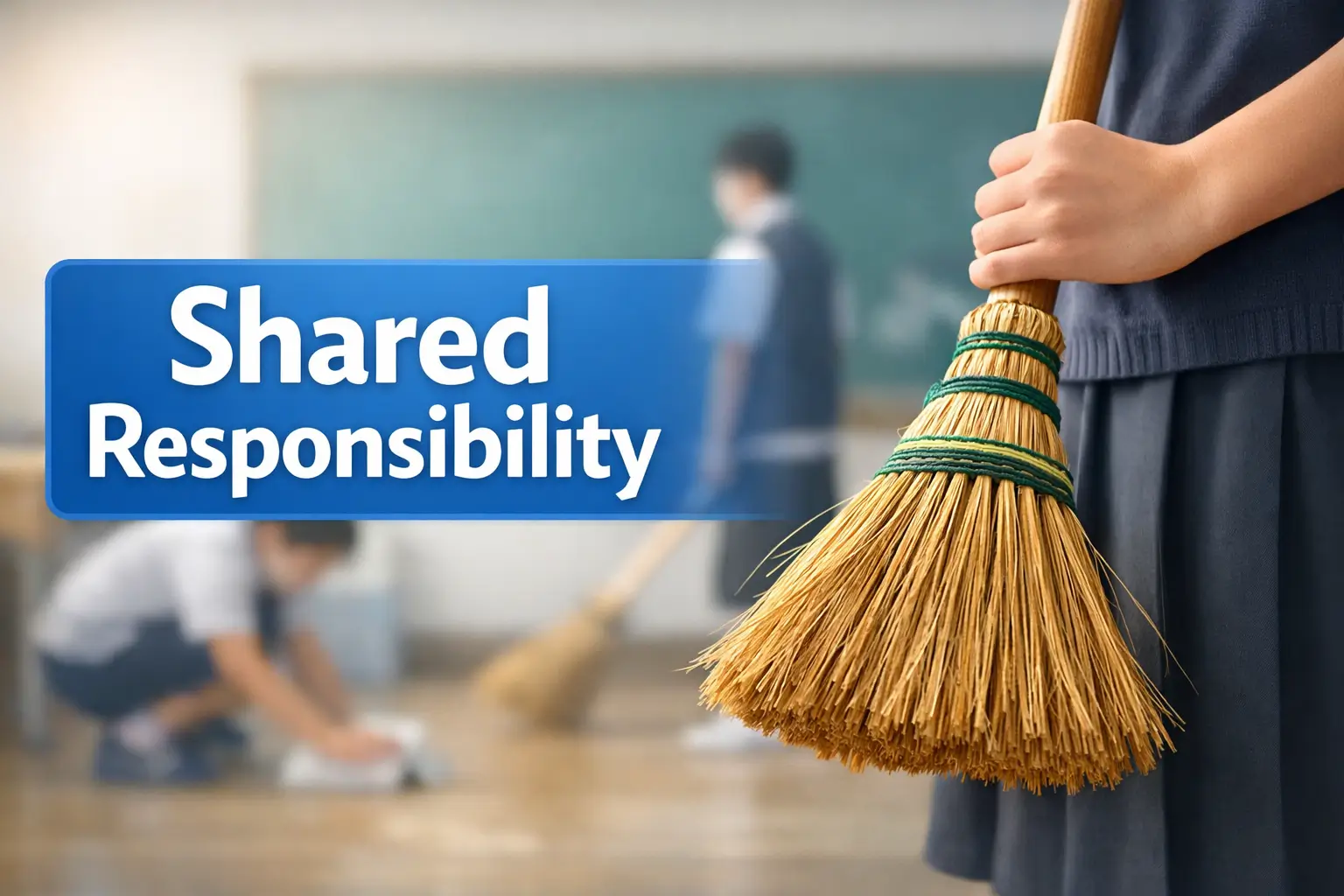
For many Anglo-American readers, Korean school cleaning time feels strange for exactly one reason: the broom is in a student’s hand, not an adult worker’s. That image can trigger the wrong conclusion fast.
Korean school cleaning time is usually a short, routine part of the school day in which students help tidy classrooms and nearby shared spaces as an ordinary practice of shared responsibility, not as a theatrical punishment and not as a replacement for all school cleaning staff.
The confusion is modern and predictable. Americans tend to read the scene through labor, staffing, and fairness. Korean schools often frame it through classroom culture, communal space, and group responsibility.
Get that wrong, and you miss what the ritual is actually teaching.
This post helps you see the practice clearly: what student cleaning usually looks like, why it exists, where outsiders overreact, and how Korean school culture gives the routine its meaning. You will leave with a sharper explanation that is useful for parents, teachers, exchange students, and culture-curious readers alike.
The task is small.
The social logic is bigger.
And once you see that, the whole hallway looks different.
Fast Answer: How Korean school cleaning time works and why students do it themselves comes down to routine, responsibility, and group culture. In many Korean schools, students help clean classrooms and shared spaces as part of the normal school day. The point is usually not free labor or punishment. It is to reinforce shared responsibility, social order, and respect for communal space in a way many US readers may find unfamiliar at first.
Contents — choose a section
Table of Contents
Start With the Surprise: Why Students Clean the School at All
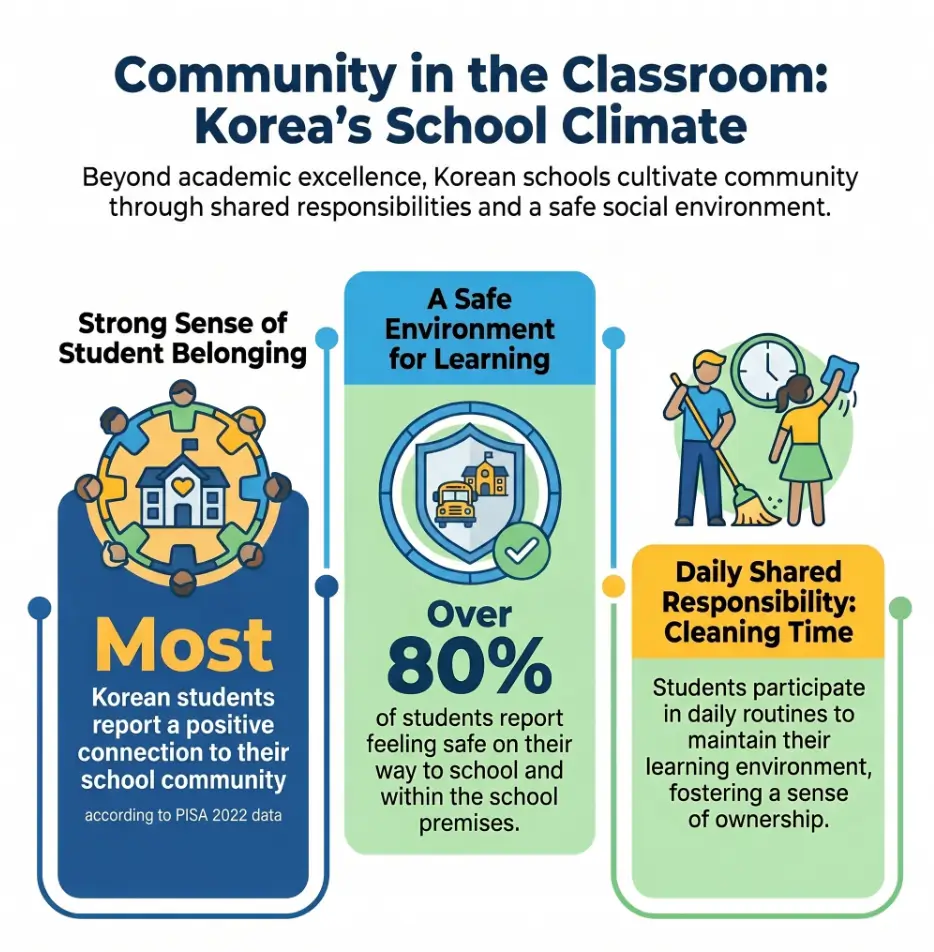
For many US readers, the shock is not the mops. It is the expectation.
When Americans picture school cleaning, they often imagine custodial staff, after-hours maintenance, or a disciplinary consequence. Korean school cleaning time can feel strange because it begins from a different premise: the classroom is not only a place students use, but also a place students are expected to help maintain. That does not mean Korean schools have no cleaning staff. It means the daily rhythm often leaves visible room for student participation.
Cleaning time is usually built into school life, not treated like an unusual event
The practice lands differently once you realize it is routine. In one recent guide prepared by the Gyeonggido Office of Education for native English teachers, a sample elementary schedule includes classroom cleaning in the late afternoon, with students doing classroom tidying and cleaning before going home. That matters because it frames cleaning as part of school life rather than a dramatic exception.
The deeper question is what schools think students are learning when they wipe, sweep, and organize
This is the real hinge. The cleaning itself is small. The lesson attached to it is larger. Korean education language often emphasizes responsibility, respect, cooperation, and community-minded habits. The Ministry of Education’s recent curriculum language still leans toward self-direction, character, and community competence, which helps explain why a small repetitive task can be treated as educational rather than purely operational.
Seen this way, the broom is not the point. The point is whether children should experience shared upkeep as part of ordinary belonging.
- The task is usually ordinary, not ceremonial
- The lesson is tied to shared space and responsibility
- The meaning sits in the norm, not the mop
Apply in 60 seconds: When you encounter a school custom from another country, ask what value the routine is trying to rehearse.
What Cleaning Time Actually Looks Like in a Korean School Day
When it usually happens and how long it tends to last
In many schools, cleaning happens near the end of the day. It is often short. Think minutes, not a heroic home-renovation episode. The recent Gyeonggido Office of Education guide gives one example of elementary students cleaning and tidying the classroom from 2:30 p.m. to 2:50 p.m. before dismissal. School schedules vary by grade, region, and school culture, but the larger pattern is the same: this is a bounded routine, not an endless shift.
Which spaces students commonly clean, from classrooms to hallways and stair areas
The most common image is the classroom itself: straightening desks, sweeping floors, emptying small trash, wiping surfaces, and getting the room ready for the next day. Depending on the school, students may also handle nearby hallways, staircase zones, or assigned corners. Bathrooms are where foreign readers often raise an eyebrow. Some schools may have students help with limited bathroom tidying, while others leave that work largely to staff. There is no single national script stamped onto every building.
How class-based assignments make the routine feel structured rather than chaotic
Usually, there is some assignment logic. A class, a group, a rotating duty list, or a few designated student roles keep the routine from becoming a tiny civic apocalypse. Korean school life often runs on visible structures: duty rosters, classroom jobs, line order, group tasks, small signals of who does what and when. Cleaning time fits that texture. It feels less like “children spontaneously clean” and more like “a classroom runs on agreed participation.” That same visible structure appears in other parts of school culture too, from South Korean school lunch culture to how students learn the daily grammar of waiting, serving, and moving together.
Infographic: A simple version of how cleaning time often flows
Class ends. Students shift from lesson mode to wrap-up mode.
Groups or individuals take zones, tools, or simple tasks.
Sweep, wipe, straighten, collect, organize.
The goal is readiness, not perfection worthy of a hotel inspector.
Mini calculator: How much time does this actually take?
If a class spends 10 to 20 minutes on cleaning each school day, that is roughly 50 to 100 minutes a week.
That number helps explain the scale. It is a routine slice of school life, not a second job.
Neutral next step: Use the time estimate to avoid overreacting to the practice as if students are scrubbing buildings for hours.
Not Janitors, Not Punishment: What Foreign Readers Often Get Wrong
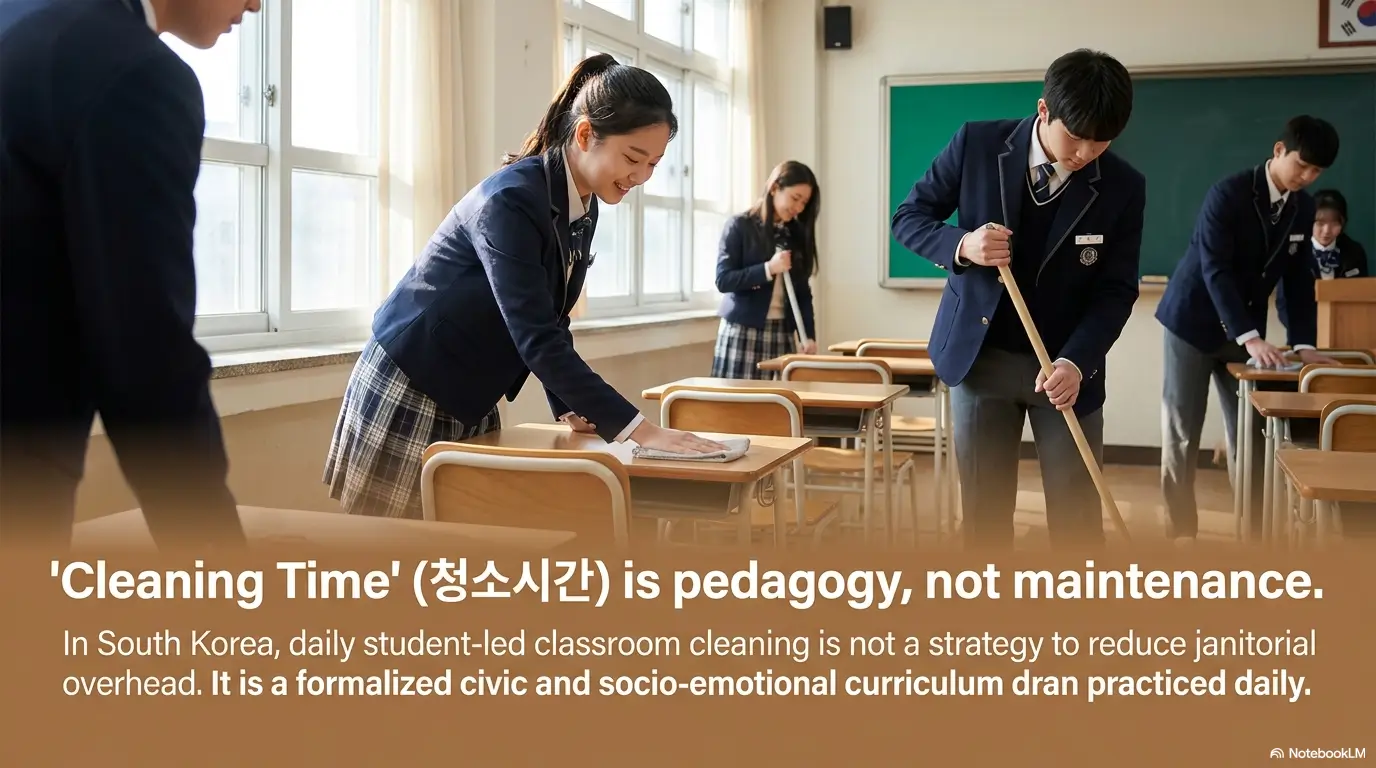
Student cleaning is usually framed as participation in shared upkeep, not staff replacement
This is one of the most important clarifications. Korean schools do employ adults who handle maintenance and cleaning tasks. In fact, Seoul education materials and public-facing school discussions plainly acknowledge school cleaning workers and the labor they do. So the existence of student cleaning should not be read as proof that schools simply offload everything onto children.
Why outsiders can misread discipline, routine, and community as something harsher than intended
Americans often walk into this topic carrying a legitimate question about labor, fairness, and institutional responsibility. That question is reasonable. But it can produce a distorted reading if it assumes that every required student task is automatically punitive. Korean schools are full of routines that look stiff from the outside and mundane from the inside: class monitors, shoes, seating order, greetings, homeroom identity, scheduled tidying. A routine can be strict without being cruel. It can also be ordinary without being noble. The same interpretive gap appears in other customs too, such as Korean shoe etiquette and the way status, order, and space quietly organize behavior.
Here’s what no one tells you: the meaning lives in the norm, not just the task
If you ask a Korean adult about cleaning time, the answer is often not delivered with fanfare. That is part of the point. Customs with real cultural weight often arrive in plain clothes. Nobody strikes a gong and announces, “Children, now we enact the philosophy of shared civic burden.” The desks just get straightened. The floor gets swept. And the social message settles quietly into the body through repetition.
That quietness is why foreigners sometimes miss the meaning, then overcorrect in the other direction. They see only a chore, or they see only a virtue. Usually it is both smaller and more interesting than that.
Who This Helps: Who This Is For and Not For
Best for US readers trying to understand Korean school culture beyond drama scenes and viral clips
If your reference points are K-dramas, reaction videos, or one heated social-media thread, this topic can feel more dramatic than it really is. This guide helps by slowing the camera down. It is for readers who want to understand the logic underneath the practice, not just the surface image of kids holding brooms.
Helpful for parents, teachers, exchange students, and culture-curious readers
Parents often ask whether the custom is exploitative. Teachers wonder whether it builds ownership or merely complies with tradition. Exchange students want to know whether they will be expected to join. Culture readers simply want the practice translated into values they can recognize. All of those questions are worth asking, and all of them need more than a one-line answer.
Less useful for readers looking for one fixed rule that applies to every Korean school
This is where people get grumpy. They want the cleanest possible sentence: “All Korean schools do X.” Real school systems refuse to cooperate with that fantasy. Age level matters. Region matters. Leadership matters. Old habits linger in some places and soften in others. A culture article that pretends otherwise is not being helpful. It is polishing a coin until both sides disappear.
Eligibility checklist: Is this article the right lens for you?
- Yes: You want to understand the practice in cultural context
- Yes: You are comparing Korean and US school norms carefully
- Yes: You are open to variation, not hunting for a single rigid rule
- No: You want a one-sentence moral verdict and nothing else
Neutral next step: If you fit the first three, keep reading with “interpretation before judgment” as your operating rule.
Responsibility First: Why Schools Want Students to Do It Themselves
Cleaning becomes a visible lesson in shared ownership of space
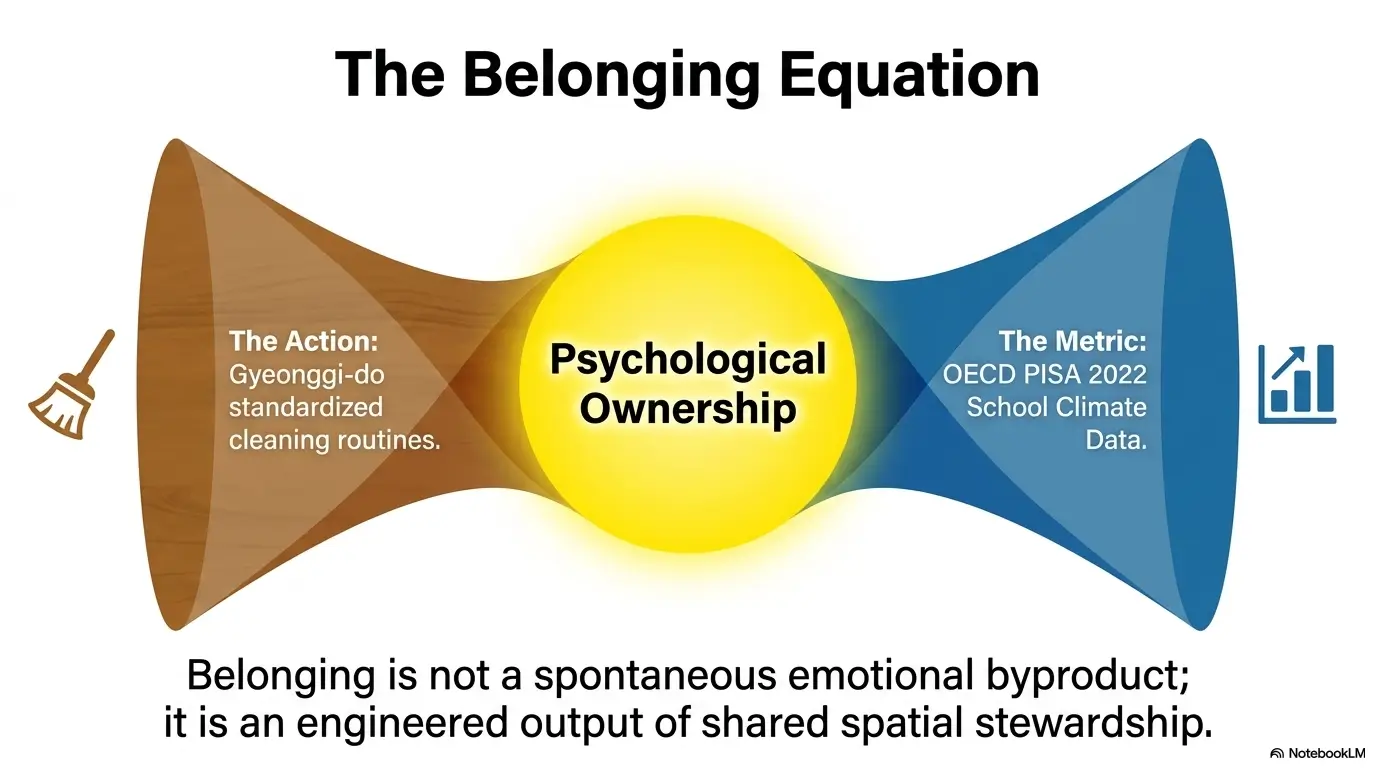
One of the most practical reasons for student cleaning is that it turns responsibility from an abstract sermon into a physical habit. “Respect your environment” is a thin sentence until somebody has to pick up the paper on the floor. Once that happens, the message gains elbows. Children do not just hear that common spaces matter. They experience the small inconvenience of caring for one.
Why small repeated chores can carry moral meaning in school culture
Education systems often rely on repetition to make values sticky. The Korean Ministry of Education continues to describe school life in terms that include responsibility, respect, cooperation, and community competence. Cleaning aligns neatly with that moral grammar because it is visible, repeatable, low-cost, and hard to fake. You can nod earnestly about community for ten minutes. It is harder to disappear when your group is expected to straighten the room. Readers who want to see how this same moral grammar appears outside school may notice echoes in everyday Korean politeness, where respect is often enacted through small visible behaviors rather than loud declarations.
The hidden lesson is often about noticing mess before someone else is forced to handle it
This may be the most culturally revealing point of all. Student cleaning suggests that a mess is not a private mistake floating in space. It becomes someone else’s burden if you do not deal with it. That is a social lesson, not just a hygiene lesson. In many cultures, adulthood quietly begins when you start noticing the labor behind order.
In an illustrative classroom routine, students might straighten chairs and collect rubbish as practical tasks. Whether participants experience that as responsibility, inconvenience, or something else varies. This example is not a classroom observation or evidence that cleaning produces a particular moral outcome.
Show me the nerdy details
From an educational design perspective, cleaning time works because it combines low cognitive load with repeated social reinforcement. The task is simple, visible, and collective. That means compliance is easy to observe, peer norms are easy to establish, and the habit can be attached to broader school values like cooperation, respect, and readiness. The routine is also cheap in administrative terms: it requires little specialized equipment, no formal testing, and only a few minutes of schedule space.
- Students touch the consequences of mess directly
- Responsibility moves from slogan to habit
- Shared space becomes a moral classroom too
Apply in 60 seconds: When explaining this custom to someone else, swap the phrase “free labor” for “shared upkeep lesson” first, then add nuance.
Group Logic Matters: How Cleaning Reflects Korean Classroom Culture
Homeroom identity and collective responsibility shape how chores are distributed
Korean school life has long placed strong emphasis on the class as a social unit. Even as education changes, that group structure remains noticeable. Students belong not only to a school, but very practically to a homeroom, a class identity, a small daily collective. Cleaning fits that framework because it is easier to say “our class handles this” than “some invisible adult will fix it later.” That class identity also helps explain why customs like Korean school uniform culture often carry more social meaning than foreign readers expect.
Why doing your part signals reliability inside a tightly shared daily environment
In cultures where group rhythm matters, reliability is not an abstract virtue. It is legible behavior. Did you show up? Did you help? Did you leave the room ready for everyone else? These are tiny signals, but school culture is built from tiny signals. One reason the practice feels coherent in Korea is that it matches a broader habit of evaluating whether a person contributes smoothly inside shared systems.
Let’s be honest: this makes more sense once you see how group life works in school
American readers sometimes resist this because it sounds like conformity dressed in neat indoor shoes. And sometimes, to be fair, there is a conformist edge. But there is also something plainer: when a class spends most of the day together, shares meals, shares instructions, shares transitions, and moves through common routines, the expectation of shared maintenance no longer looks random. It looks of a piece.
OECD reporting on Korea continues to describe Korean students as having relatively strong school belonging compared with OECD averages, and that broader context helps explain why group-based routines can feel normal rather than alien inside the school day.
Decision card: Two ways to read the same broom
| Reading A | Reading B |
|---|---|
| Labor frame Who is doing the work that adults should do? | Community frame How does the routine train shared responsibility? |
| Useful for asking fairness questions | Useful for understanding school culture questions |
Neutral next step: Hold both frames at once. The practice makes less sense when you allow only one.
Don’t Assume Too Fast: Why This Is Not the Same as US School Chores
The American frame of labor, fairness, and school staffing changes how the practice is interpreted
Americans often approach this through staffing logic first. Who is paid to clean? What is the line between education and labor? Is this appropriate? Those are fair questions, and they are shaped by local expectations about school institutions. In the US, asking students to clean the room daily as a formal routine would strike many families as unusual or even suspect. So the emotional reaction is not irrational. It is culturally patterned.
Why the same act can feel educational in one culture and questionable in another
A child wiping down a desk can be read in at least three ways: as maintenance, as character-building, or as institutional cost-shifting. Which meaning dominates depends on the society around the action. Korean school cleaning time tends to be interpreted through school community, discipline, order, and responsibility. US readers often route it through labor and school-resource questions first. Same broom. Different moral weather.
Understanding the practice requires comparing values, not just comparing tasks
This is why culture writing can go sideways so quickly. People compare the visible act without comparing the invisible values attached to it. If you compare only the task, the practice may look eccentric or unfair. If you compare the surrounding assumptions about group life, shared space, and daily routines, it begins to make social sense even when you do not personally prefer it. That same method helps with other Korean norms too, whether you are decoding Korean seating hierarchy or the softer pressure hidden inside everyday forms of deference.
That is usually the mark of good cultural understanding: not instant agreement, but clearer interpretation.
Common Mistakes US Readers Make When Interpreting Korean School Cleaning Time
Mistake one: assuming every student is scrubbing the whole school every day
This is the cartoon version. In reality, the routine is often limited, short, and structured. Students usually handle classrooms or assigned nearby areas, not the entire institution in some bleak Dickens-with-disinfectant tableau. The scale matters. Once you shrink the imagined burden to its actual size, the custom becomes more intelligible.
Mistake two: treating all Korean schools as identical across region, level, and era
School culture changes. A senior high school in one region may feel stricter than an elementary school somewhere else. Some schools preserve old routines firmly. Others soften them. Some administrators care intensely about order. Others are more relaxed. The mistake is not only factual. It also blocks real understanding because it assumes culture is a frozen block instead of a living system with local variation.
Mistake three: confusing communal routine with humiliation or punishment by default
Could a school routine be misused? Of course. Any routine can be. But that possibility is different from the default meaning of the custom. School cleaning in Korea is usually not staged as shame. It is typically ordinary, collective, and repetitive. Once outsiders load it with punishment symbolism, they often stop seeing what students inside the system actually experience: another scheduled part of the day, sometimes annoying, sometimes normal, occasionally bonding, rarely cinematic.
A useful rule here is almost laughably simple: resist building your conclusion from the most dramatic clip available online. Culture goes off-key when the loudest example becomes the standard score.
Don’t Romanticize It Either: What the Practice Does Not Automatically Prove
Student cleaning does not magically create perfect character or flawless respect
It would be lovely if ten minutes with a dustpan reliably produced saintly citizens. Life, with its usual bad manners, declines to cooperate. A routine can encourage responsibility without guaranteeing it. Students can clean reluctantly. They can cut corners. They can resent the task. They can also learn something useful from it anyway. Human beings are gloriously inconsistent like that.
Why nostalgia can distort the real mix of routine, reluctance, and habit
Adults often remember school customs through a soft filter. The hallway glows a little. The windows shine. The moral lesson suddenly appears more elegant than it felt on a sleepy Thursday afternoon. But students living inside the routine may experience it more plainly: this is the thing we do before we go home. Not every tradition needs a halo to have meaning.
A meaningful tradition can still feel ordinary, boring, or uneven to students living inside it
This is the healthiest middle position. The practice can matter culturally without being adored by everyone. It can teach something without producing miracles. It can function as a sign of communal life while still being unevenly enforced and unevenly felt. Good interpretation leaves room for boredom. Boredom, after all, is where many real institutions live.
- Cleaning time does not prove moral superiority
- Students may feel duty, indifference, or mild annoyance
- Ordinary routines can still carry cultural weight
Apply in 60 seconds: Replace “This proves Korean schools are better” with “This reveals a different model of everyday responsibility.”
The Social Lesson Beneath the Broom: What Students May Actually Learn
How cleaning can train attention to shared consequences
A room does not become messy by philosophy. It becomes messy because people move through it and leave traces. Cleaning time teaches that traces remain. Someone has to deal with them. That lesson sounds basic because it is basic. Yet many durable civic habits are built from exactly that sort of modest repetition.
Why repetition turns abstract values like respect into visible behavior
Respect is hard to measure in speech because people can say almost anything. Routine is less slippery. Did you help restore order? Did you leave your environment usable for the next person? Those are visible behaviors. A school does not need to make a grand speech every afternoon when the practice itself carries the message.
The lesson may be less about cleanliness than about not leaving the burden to others
This is where the custom becomes philosophically interesting. The deeper teaching may not be “keep things spotless.” It may be “do not assume someone else should absorb the consequences of your use.” That is a social ethic. It applies to rooms, queues, public transport, workplace culture, and family life. Once you see that, the practice stops looking quaint and starts looking like one small way institutions rehearse adulthood. In that sense, it belongs to the same family of social cues as Korean indirect communication, where consideration often hides inside what is left unsaid as much as what is spoken.
Illustrative Scenario: The last ten minutes
Constructed illustration, not a reported event: a fictional narrator once watched the end of a Korean school day unfold with almost no drama at all. That, oddly enough, was the memorable part. Chairs scraped back. A few students reached for brooms without ceremony. One wiped the window ledge. Another straightened a crooked line of desks with the weary competence of a person who has done this before and has no intention of turning it into a moral documentary.
A teacher stood nearby, not barking like a movie principal, just watching the room come back into shape. The mood was not reverent. It was practical. Mildly tired. A little chatty. One student laughed because someone had swept dust into the wrong corner and another gave him a look that translated perfectly across languages: not again. In less than a quarter of an hour, the classroom had shifted from lived-in to ready. What stayed with me was not the cleanliness. It was the shared assumption that the reset belonged to the people who had occupied the space.
Variations Matter: How Schools, Ages, and Contexts Change the Experience
Younger students and older students may experience the routine differently
Elementary students may encounter cleaning as one more guided classroom habit among many. Older students may experience it with more efficiency, more indifference, or more irony. Adolescents have a remarkable talent for doing something routinely while pretending they are above it. That talent is global. The age difference matters because the educational meaning can shift as students mature.
School type, leadership style, and local culture can shape how strict or relaxed it feels
Some schools are tightly organized, with clear duty assignments and visible expectations. Others are looser. A teacher’s style also matters. One teacher may frame cleaning as practical teamwork. Another may make it feel formal and rule-driven. A school’s local culture can either sharpen the communal message or drain it into mere compliance.
Why modern Korean schools may preserve the practice while changing its tone
Contemporary Korean education is not frozen in amber. The official language around schooling has shifted toward student agency, well-being, self-direction, and broader competencies, even while older group-based habits remain visible. OECD reporting on Korea also places student belonging and school climate within wider conversations about student well-being. That means the future of practices like cleaning time may be less about simple disappearance and more about tone: softer, more student-centered, less moral thunder, same basic habit. Readers tracing this broader transition may also find it useful to compare how older institutions adapt in areas like Korean campus clubs or the way orientation rituals introduce newcomers to group life.
In other words, the custom can survive while the soundtrack changes.
FAQ
Do all Korean students clean their schools?
No single sentence covers every school. Many Korean schools have student cleaning routines, but the exact practice varies by school, age level, local norms, and administrative style.
How often does cleaning time happen in Korean schools?
Often daily or near-daily in some form, especially as part of end-of-day classroom reset. The duration is usually short, often measured in minutes rather than long blocks.
Do Korean schools still hire janitors or cleaning staff?
Yes. Student cleaning does not mean adults do not handle maintenance and cleaning work. The student routine usually exists alongside adult staff responsibilities, not as a total replacement.
Is school cleaning meant as discipline?
Usually no. It is more often treated as ordinary shared upkeep built into the school day. That said, any routine can feel stricter or more relaxed depending on the school environment.
Do students clean bathrooms too?
Sometimes limited bathroom tidying may be part of student duties in some schools, but this varies. Many readers assume this is universal when it is not. Classroom and nearby shared spaces are the safer general description.
Do students resent doing it?
Some probably do, at least on certain days. Others may find it normal. A tradition can be meaningful without being beloved. Teenagers remain teenagers, even when holding cleaning cloths.
Is this common only in Korea, or in other Asian countries too?
It is not unique to Korea. Other countries, including Japan, have well-known student cleaning traditions too. But you should not collapse all of Asia into one school-culture bucket. Each country has its own history, tone, and institutional logic.
What does student cleaning reveal about Korean ideas of community and responsibility?
At minimum, it suggests that school can be treated as a shared environment where responsibility is rehearsed through routine. The cultural lesson is less “children should clean” than “common space belongs to everyone who uses it.”
Explain the cleaning task before assuming the student knows it
A new student may need a demonstration of which area to clean, which supplies to use, and where to put equipment afterward. Ask the teacher who supervises the activity and what to do if a task is inaccessible or unfamiliar. A classroom routine should not require a child to handle an unexplained chemical, sharp object or other hazard. Report a concern through the school’s designated contact instead of asking the child to resolve it alone.
| Focus | What to check |
|---|---|
| Instruction | Area, equipment and a clear demonstration. |
| Supervision | Know which adult can answer questions. |
| Adjustment | Raise access or safety concerns before the task. |
A reader question: What if my child cannot do the assigned task?
Explain the practical limitation privately and ask about an appropriate alternative. Clarifying the task and support needed is more useful than assuming the same routine applies identically to every child.
Next Step: Watch the Practice Through Culture, Not Just Through Chore Logic
Read one more Korean school routine through the same lens of group norms, duty, and daily structure
By now, the original surprise should look different. Students clean in many Korean schools not because the nation has discovered a mystical relationship with mops, and not because children are secretly operating the facilities department. They clean because the school day has historically made room for a routine that links shared space to shared responsibility. That is the curiosity loop we opened at the start, and this is where it closes: the practice makes more sense when you read it as social training embedded in ordinary time.
Compare cleaning time with lunch, classroom etiquette, or study hall to see the wider pattern
The best next move is comparative, not judgmental. Put cleaning time next to other Korean school routines such as class-based identity, lunch order, classroom etiquette, or supervised study habits. The pattern becomes easier to see. Korean school life often treats daily structure as a teacher in its own right. For readers building that wider map, pieces like Korean hagwons for foreign families and Korean university orientation can help show how group expectations continue beyond the classroom doorway.
In the next 15 minutes, you can do one practical thing: write down the three values this routine seems to rehearse most clearly. For many readers, the list will come out something like this: responsibility, cooperation, and respect for shared space. Once you have those words, the broom stops looking random. It becomes a clue.
Quote-prep list: What to gather before comparing school cultures in writing
- One description of the routine itself
- One explanation of the value the routine teaches
- One caution about variation across schools
- One note on how outsiders commonly misread it
Neutral next step: Use those four pieces before making a sweeping cultural claim.
- Routine explains more than outrage does
- Variation matters more than stereotypes do
- Cultural meaning lives in the surrounding norms
Apply in 60 seconds: The next time you describe this custom, include both the practical routine and the social logic in the same sentence.
Last reviewed: 2026-04.
Practical example and reader question added October 20, 2026. Existing source dates are retained; this addition is not a fresh verification of every earlier claim.