
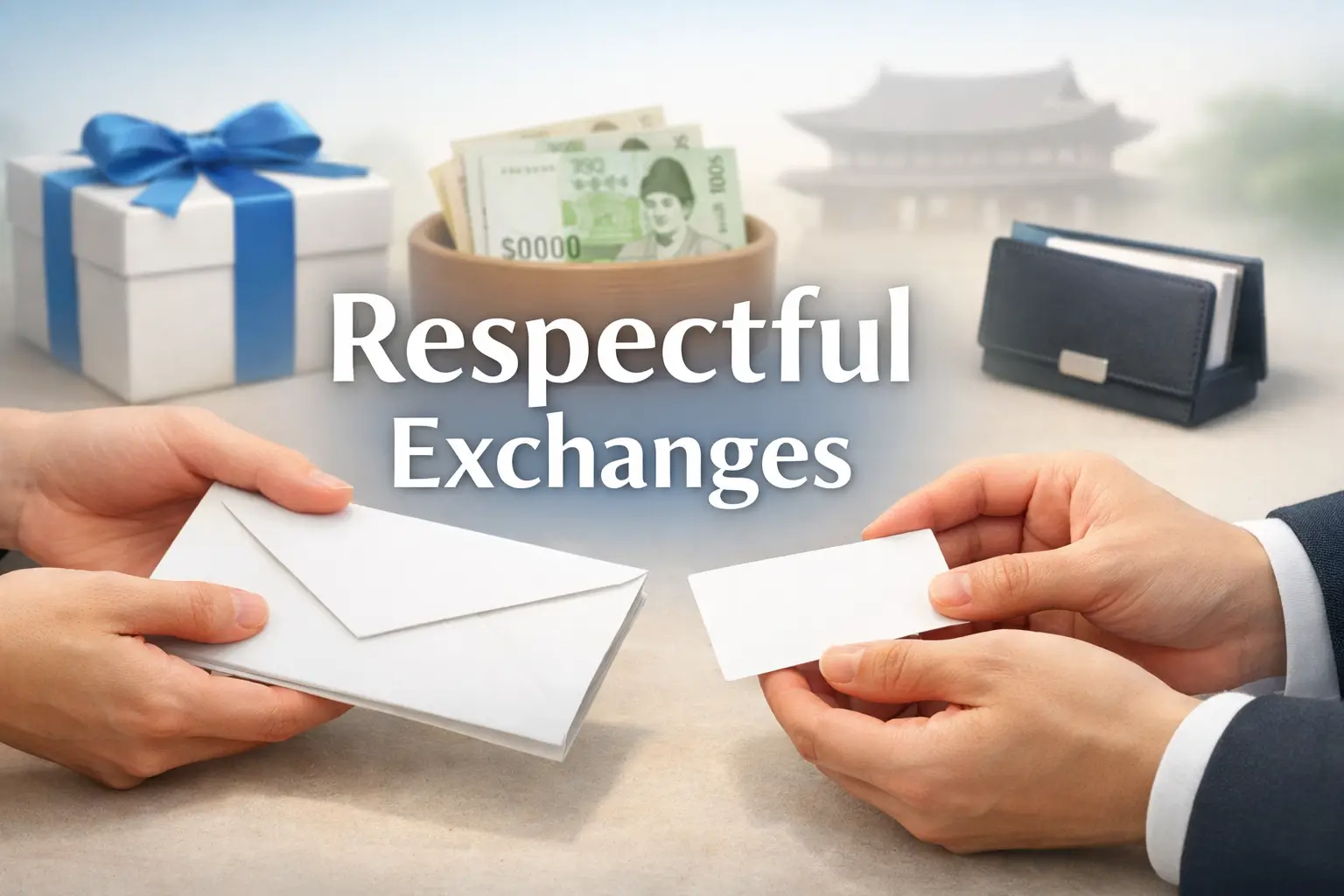
Mastering the Art of the Exchange
South Korea etiquette around handing money, gifts, and business cards politely is not as mysterious as anxious travelers fear, but it is far less forgiving of rushed, one-handed autopilot than many Americans expect.
“The awkward moment usually is not a major cultural blunder. It is a tiny signal: a card shoved away too fast, loose cash passed like change at a parking meter, or a host gift offered while you are still checking your phone.”
In Korea, small exchanges often carry more social weight than the object itself. This guide helps you read the room, use the safest defaults, and handle cash envelopes and business cards with calm rather than choreography.
Navigate hierarchy and first-meeting manners.
Learn what gets looser with peers and friends.
Understand what Koreans notice almost instantly.
The method here is practical, not theatrical: watch the context, slow the pace, and use visible respect.
Table of Contents
Start here first: who this is for / not for
This guide is for Americans and other international visitors who want a reliable, low-drama default for Korea. Travelers. Students. Business visitors. People meeting a partner’s parents for the first time and suddenly feeling that their hands have become suspiciously large and stupid. It happens.
It is especially useful if you are walking into one of these scenes:
- a family visit where you may offer fruit, dessert, or a small gift
- a business meeting where business cards matter in the opening minute
- a restaurant or café moment where someone repays you, receives repayment, or hands over something meaningful
- a ceremony, holiday visit, wedding, or funeral where formality quietly rises
This is not a legal guide, a corporate compliance memo, or a luxury-gifting manual for heavily regulated industries. If you work in banking, defense, pharma, public procurement, or another high-control setting, internal policy may be stricter than ordinary etiquette. In everyday life, though, the practical question is smaller and more human: what makes you look considerate rather than careless?
I learned this the unglamorous way. Years ago, I saw a visitor hand a small thank-you gift across a table with one hand while fishing a phone out of his pocket with the other. Nobody gasped. Nobody fainted. The room merely cooled by two degrees. Korean etiquette often works like that. The signal is subtle, but everyone feels it.
- Use both hands when in doubt
- Keep the item neat and visible
- Slow the moment down by one beat
Apply in 60 seconds: Practice handing a notebook or envelope with both hands and a small nod.
Safest default first: the two-hand rule that prevents most awkward moments
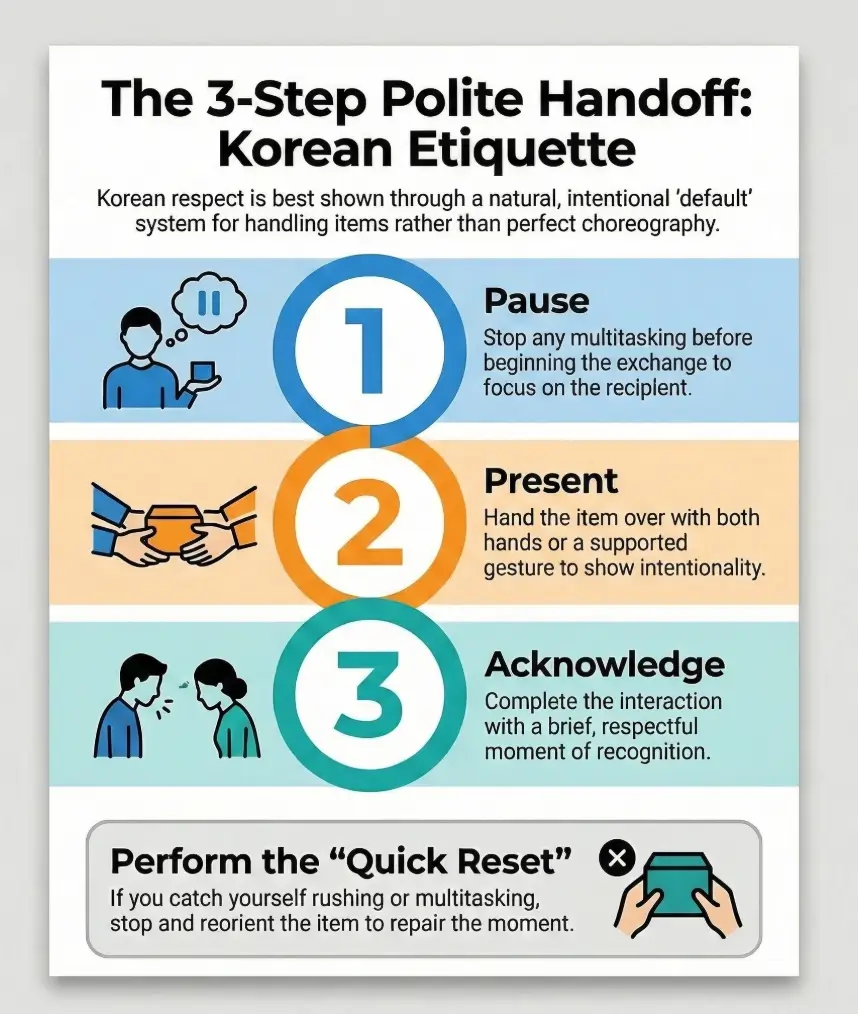
If you remember only one technique, make it this: present the item with both hands, or with one hand while the other lightly supports your wrist or forearm. In South Korea, that reads as respectful in a wide range of situations, especially with elders, senior colleagues, hosts, or people you have just met.
Why does this matter? Because the object is not just an object in that second. It becomes a small social message. A business card says, “This is who I am.” A gift says, “I prepared this for you.” Money, even when ordinary, says, “This exchange has weight.” The hand position tells people whether you understand that weight.
Both hands are the safest starting point in these moments:
- first meetings
- meeting someone older than you
- handing over money in an envelope
- giving or receiving a gift
- exchanging business cards in a formal setting
One-handed exchange is not always scandalous. Among close peers, younger people, or casual everyday situations, one hand may happen naturally. But the trouble for visitors is that you often do not know the real formality level until you are already in the room. So the wiser move is “formal first, relax later.” That is not stiffness. That is good situational engineering.
A small note from business protocol helps here too. The U.S. International Trade Administration’s South Korea business-travel guidance still highlights business cards and gifts as meaningful parts of local business customs, which is another way of saying that presentation is not decorative. It is part of the meeting itself.
My favorite version of this rule is beautifully boring: if your body language looks neat, calm, and slightly deliberate, you are probably doing fine. Etiquette is often just choreography for showing care.
Make the exchange visible. Do not toss, slide, or multitask.
Use both hands, or support one wrist with the other hand.
Make eye contact, nod lightly, and let the other person receive it fully.
Money etiquette decoded: when cash feels normal, when it feels too casual
Cash in Korea is not automatically rude. The question is not “cash or no cash?” The question is context, packaging, and tone. Handing loose bills like you are settling a poker debt can feel abrupt. Handing money calmly, often in an envelope, can feel thoughtful and entirely normal.
Cash commonly makes sense in several situations:
- repaying someone who covered a meal or taxi
- family occasions and holiday giving
- weddings and funerals, where cash envelopes are especially familiar
- small contributions or practical support within a family or close social circle
The envelope matters because it changes the emotional texture of the exchange. Loose bills say “amount.” An envelope says “intention.” That may sound poetic for a rectangle of paper, but etiquette often lives in packaging. Even a plain, clean envelope can make the same amount of money feel more respectful.
At weddings and funerals, formality rises. Cash gifts are common, and the container, timing, and handling matter more. This is not the moment for a dramatic speech, a crumpled bill fold, or a cheerful tap on the shoulder. Keep it quiet, composed, and appropriately subdued to the event. If you want the occasion-specific nuances, it helps to read a dedicated guide to Korean wedding cash gift etiquette or the practical customs around Korean condolence money.
I once watched someone count bills in front of the recipient before tucking them into an envelope. It was not evil. It was merely the social equivalent of dropping a spoon in a string quartet. Do your sorting beforehand.
| Situation | Better move | Why |
|---|---|---|
| Casual repayment to a close peer | One neat handoff, ideally with two hands | Practical, low ceremony |
| Holiday or family occasion | Envelope | Feels intentional and respectful |
| Wedding or funeral | Envelope, calm presentation | High-formality context |
Neutral next step: Keep one plain envelope in your bag before family visits or ceremonies.
Show me the nerdy details
Why does an envelope help so much? Because it removes visual mess, hides the counting process, and frames the exchange as deliberate rather than improvised. In etiquette terms, it lowers friction by reducing exposure, speed, and casualness all at once.
Gift moment strategy: the handoff matters almost as much as the gift
A gift in Korea does two jobs. It carries the object itself, yes, but it also carries your sense of timing, social awareness, and restraint. The wrapping, the handoff, and the atmosphere around it all matter. The goal is not theater. The goal is grace.
The cleanest approach is usually this:
- hold the gift neatly with both hands
- offer it with a short, modest phrase
- do not narrate the gift like a late-night shopping channel
- let the recipient receive before you explain
When should you offer it, at the start or the end of a visit? In many everyday cases, either can work. At the start can be convenient and clear, especially when visiting a home. At the end can feel gentler in some social situations, especially if the visit is more relational than ceremonial. The smartest move is to read the scene: if the gift is clearly a host gift, earlier often makes sense. If it is more personal or symbolic, later can feel less interruptive.
Neat wrapping does quiet social labor before you speak. It says you prepared. It says this was not grabbed in a fluorescent panic ten minutes ago. We have all lived that panic, of course. I once bought a host gift so quickly that the clerk wrapped it with the solemn expression of a paramedic. Even then, the wrapping saved me.
Do not force the person to open the gift immediately. In Korea, recipients may open gifts later rather than on the spot, especially if they want to avoid looking greedy, emotional, or performative. That is normal. It is not a sign they dislike it. It is often a sign they are protecting the modesty of the moment.
Best mini-script: “This is a small gift for you.” That kind of modest phrasing usually lands better than “I got you something amazing.” Let the gift breathe. The same instinct helps during major holidays too, especially if you are learning Seollal etiquette for foreigners or trying to navigate the quieter rhythms of Chuseok etiquette for foreigners.
Business cards first impressions: this tiny rectangle is doing bigger cultural work
In many American settings, a business card is a piece of paper with a short life expectancy. It gets glanced at, pocketed, and eventually fossilizes in a bag beside a pen that does not work. In South Korea, especially in formal business settings, the card can carry more symbolic weight than that. The exchange is part introduction, part status cue, part sign that you know how to pay attention.
The safest method is wonderfully simple:
- present the card with both hands
- orient it so the other person can read it easily
- receive their card with both hands as well
- look at it for a few seconds before putting it away
That pause matters. It tells the other person that the card is not debris. You have registered their name, title, and role. In formal meetings, setting the card neatly on the table rather than instantly shoving it into a pocket can also help. A pocket is sometimes practical, of course, but immediate stuffing signals haste or indifference in a context where first impressions are built from very small bricks.
I have seen nervous visitors overcompensate by studying the card as if it contains encrypted prophecy. That is not necessary either. Two or three seconds of real attention is enough. This is a moment for calm recognition, not forensic science.
The U.S. Commerce Department’s business-culture materials also emphasize business-card protocol more broadly in cross-cultural settings, and Korea is one of the places where that advice pays off quickly. Cards are not magic. They are just unusually loud little rectangles.
- Offer it neatly, facing the recipient
- Receive it with visible attention
- Do not pocket it instantly in formal meetings
Apply in 60 seconds: Practice turning your card outward before handing it over.
Age and hierarchy signals: what people notice before they notice your words
Korean social life still pays more attention to age and hierarchy than many Americans expect. Not in every room, not with robotic rigidity, and certainly not in exactly the same way across generations. But enough that it matters. That is why the same handoff that feels fine with a younger peer can feel slightly off with an older relative, professor, host, or senior executive.
Here is the useful rule: the greater the age gap or status gap, the more valuable visible formality becomes. You do not need to become a ceremonial crane. You just need to add a little structure. Two hands. A calmer pace. A small nod. A bit less verbal swagger.
With peers or younger Koreans, the atmosphere may be looser. One-handed exchanges happen. Casual tones happen. Digital payment and modern work culture have relaxed many moments. But visitors get into trouble when they assume “younger” means “nothing matters.” It usually means “less strict,” not “social gravity deleted.” That logic overlaps with broader guides to the Korean age system explained and the practical side of using Korean honorifics for foreigners without sounding robotic.
I remember a dinner where the youngest person at the table was the most relaxed, while the oldest person said almost nothing and noticed everything. That is often how hierarchy works: not as a loud rulebook, but as a quiet layer beneath the surface.
- Is this your first meeting?
- Is the person significantly older?
- Is the setting ceremonial, professional, or family-important?
- Is the item meaningful, such as a gift, envelope, or business card?
Neutral next step: If you checked even one box, start more formal and relax only if the other person clearly does.
Don’t wing it: common mistakes Americans make without realizing it
The biggest mistakes are rarely dramatic. They are tiny American habits that feel efficient at home and careless in Korea. That is why people miss them. They are not trying to be rude. They are running familiar software in a different social operating system.
The most common slips look like this:
- handing something over one-handed while the other hand stays in a pocket
- sliding a gift, cash, or business card across a table
- continuing to chew, text, or rummage while making the exchange
- taking a business card and putting it away without reading it
- turning the handoff into a loud joke, performance, or mini-stand-up set
The pocketed hand is especially revealing. In many American contexts it reads as relaxed. In more formal Korean contexts, it can read as sloppy or insufficiently attentive, especially when combined with one-handed passing. Sliding items across the table has a similar problem. It removes the exchange from the realm of acknowledgment and turns it into something closer to a receipt printer malfunction.
Another mistake is insisting too much. Visitors sometimes think politeness means dramatic repetition: “No, no, please, really, please take it.” One soft insistence may be fine. Turning the moment into a wrestling match with wrapping paper is not. Modesty and calm usually outperform pressure.
I once saw a business card land on a table face-down and then get flipped with a coffee spoon. Nobody said a word. Everyone remembered it. Korean etiquette can be very forgiving, but it is also a superb recording device.
Let’s be honest… most etiquette mistakes are really pace mistakes
People often think etiquette failure is about the wrong hand. More often, it is about the wrong speed. Americans, especially in busy urban or business settings, are trained to move fast, talk while moving, and complete exchanges with efficient blur. In Korea, many handoff moments improve when you shave off speed and add presence.
This means:
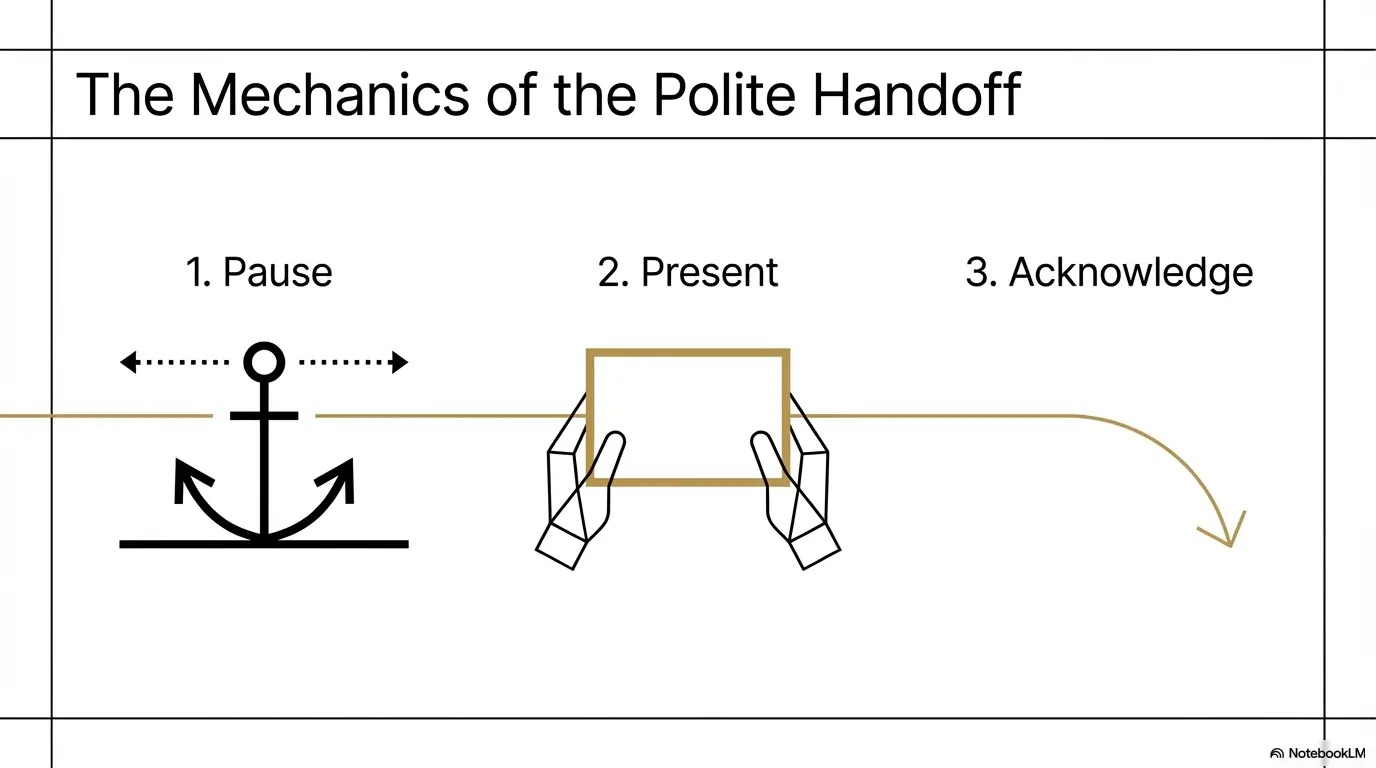
- pause before the handoff
- make the object visible
- let the other person register what is happening
- finish the exchange before you do the next thing
That half-second pause does a lot of work. It gives your hands time to coordinate. It gives your face time to soften. It gives the other person time to receive without chasing your movement. In etiquette terms, pace is often the hidden architecture of respect.
I learned this while paying back a friend in Seoul after a rushed meal. My first instinct was pure American caffeine: wallet out, bill forward, done. Then I caught myself, used both hands, and slowed down. The difference was maybe one second. The feeling changed completely. The exchange looked less like “debt settled” and more like “thank you, I remember.” The same principle shows up outside gifting too, whether you are learning Seoul café etiquette or figuring out the slower social signals inside Korean phone call culture.
Eye contact and a small nod help, too. Not a theatrical bow that looks borrowed from a historical drama. Just enough acknowledgment to say you are here, not elsewhere. Etiquette is rarely about grandeur. It is about friction reduction with a conscience.
Show me the nerdy details
When a handoff goes badly, the problem is often stacked micro-signals: speed, divided attention, bad angle, poor timing, and no acknowledgment. Fixing even two of those variables can dramatically improve how respectful the same exchange feels.
Don’t overcorrect: the polite move should not become a performance
There is a second trap after casualness, and it is almost comical: overcorrection. Some visitors become so aware of etiquette that they start moving like they are auditioning for “International Guest, Episode 7.” The bow becomes too deep. The smile becomes too strained. The two-hand gesture turns into an operatic flourish. This can feel just as awkward as underdoing it.
The most respectful version of Korean etiquette for a visitor is usually modest, quiet, and proportionate. You are trying to show care, not cosplay expertise. A gentle nod is better than an exaggerated bow. A neat presentation is better than ceremonial choreography. Calm beats spectacle almost every time.
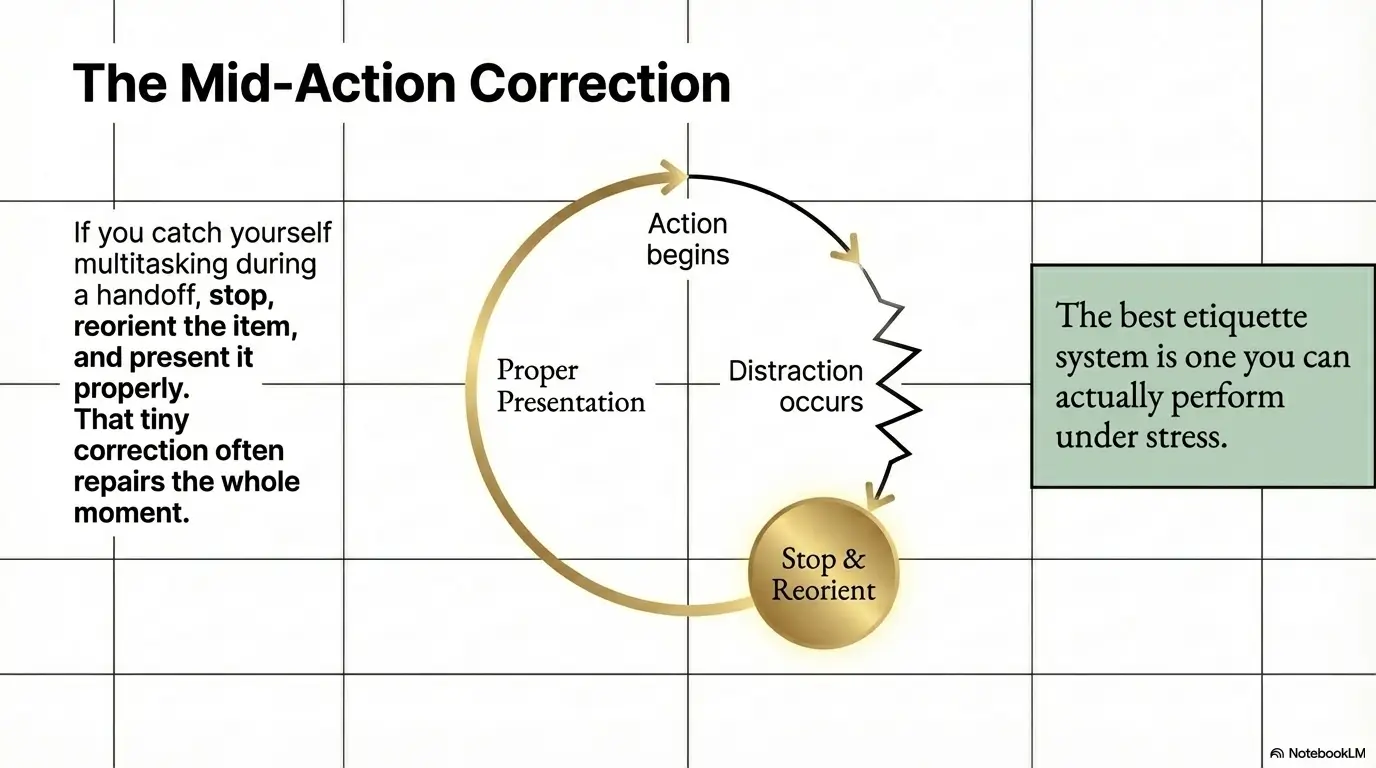
If you realize mid-moment that you used the wrong hand, do not panic. You can lightly correct by steadying the item with the second hand, or simply continue politely and make the next moment better. Most people prefer a smooth recovery over visible self-punishment. Nothing makes a small etiquette slip feel bigger than acting as though you have just toppled a diplomatic monument.
My rule of thumb is this: if your politeness feels a little quieter than your anxiety, you are in the sweet spot. The goal is not to disappear into the culture perfectly. The goal is to stop your habits from getting in the way of your respect.
- A small nod is enough
- Correct lightly, do not dramatize
- Quiet formality beats theatrical effort
Apply in 60 seconds: Rehearse one calm two-handed handoff without bowing at all, then add only a slight nod.
Here’s what no one tells you… receiving well matters as much as giving well
Visitors usually study how to give. The quieter failure happens when they receive badly. A respectful exchange has two halves. If someone offers you money, a gift, or a business card and you accept it casually, you undo some of the care they just extended.
Receiving well in Korea usually means:
- use both hands if the moment is formal
- look at the item briefly rather than whisking it away
- show appreciation with a nod, thanks, or warm acknowledgment
- avoid making the item disappear instantly into a bag or pocket
This matters especially with business cards. Read it for a second. With gifts, do not rip into the wrapping unless invited by the situation. With money, especially in an envelope, accept it carefully and put it away respectfully rather than flicking through it on the spot.
There is a beautiful symmetry here. Good receiving tells the giver, “I recognize the effort behind this.” That is why even a small item can feel socially large. In a culture where visible care counts, receiving is not passive. It is participatory.
A memory comes back to me here: a host once handed tea to everyone at the table. One guest accepted hers while still scanning her phone. The host smiled exactly the same as before. Yet the room shifted. We do not always offend through what we say. Sometimes we offend by failing to arrive. Knowing a few Korean apology phrases can help with recovery, but better receiving prevents the need for them in the first place.
- One clean envelope for cash occasions
- A simple card holder if you expect business cards
- A gift bag or neat wrapping if bringing a host gift
- A short thank-you phrase you can say without scrambling
Neutral next step: Put these items together once and keep them ready for the next important interaction.
Context changes everything: office, family home, restaurant, and ceremony are not the same stage
One reason etiquette feels confusing is that there is no single Korea setting. A startup office in Seoul, a university lab, a partner’s family home, a holiday dinner, and a condolence visit do not share the same social temperature. The right move changes with the room.
In an office meeting, business cards deserve attention, and the opening exchange may be more structured. Gifts, if any, should be modest and clearly appropriate. Professional tone matters more than sentiment.
In a family home, host gifts are common and often warmly appreciated. Fruit, dessert, or another modest gift can work well. Present it neatly, usually early in the visit, and let the host control whether it gets opened immediately.
In a restaurant, repayment and passing items can feel looser, but not lawless. If the other person is older or the meeting has hierarchy built into it, formality still helps. A casual room does not erase respect. It merely lowers the volume.
In ceremonial contexts, such as weddings, funerals, milestone family events, and holiday greetings, casual habits become more expensive. Envelopes, tone, and posture matter more. So does not making the moment about yourself. For those rooms, a fuller primer on Korean funeral etiquette for foreigners can save a lot of anxious guesswork.
| Tier | Typical setting | Recommended style |
|---|---|---|
| Tier 1 | Close peer, casual outing | Relaxed but still attentive |
| Tier 2 | New friend, teacher, host | Two hands preferred |
| Tier 3 | Business meeting, parents, elder | Clear formality, slower pace |
| Tier 4 | Wedding, funeral, formal visit | Envelope or neat presentation, restrained tone |
Neutral next step: Before the event, identify the tier and match your pace and hand use to it.
Short Story: The fruit box at the apartment door
A friend once invited an American graduate student to meet her parents during a holiday weekend. He spent far too long worrying about vocabulary and almost no time worrying about his hands. At the apartment door, he was carrying a handsome fruit box in one arm while trying to remove his shoes, greet the father, and not trip over the threshold. The result looked like a travel documentary about mild panic.
He started to pass the gift one-handed, caught himself, shifted, steadied it with both hands, and offered it with a small “This is for you.” The father took it calmly. The mother smiled. Nobody graded him on elegance. What mattered was visible care and quick adjustment. Later, the student confessed that he had expected a mysterious, impossible code. What he found instead was something much more merciful: if you show that the moment matters, people usually meet you halfway.
Small recovery scripts: how to fix an awkward handoff without making it bigger
Even careful people fumble. Your gift may snag on a bag handle. Your business card may come out upside down. You may forget the second hand and remember it half a beat late. That does not end the interaction. The repair is usually small.
The best recovery strategies are these:
- correct quietly in real time if it is easy to do so
- use a brief apology if the moment really needs one
- do not keep apologizing after the correction
In English, something simple works well:
- “Sorry, let me give that properly.”
- “Excuse me, here you are.”
- “Thank you, and sorry about that.”
Easy Korean phrases can soften the moment without sounding melodramatic:
- “죄송합니다” for “I’m sorry”
- “감사합니다” for “Thank you”
- “작은 선물이에요” for “It’s a small gift”
- “잘 부탁드립니다” in business settings as a polite phrase of goodwill, though not as a direct correction for every situation
Use them lightly. A good correction is like fixing a crooked picture frame. Straighten it and move on. The longer you stare at it, the stranger the room becomes.
I have recovered from this kind of slip with a tiny laugh at myself and a quick reset. That usually works better than delivering an apology speech grand enough for constitutional reform.
Next step: practice one respectful default before your next real interaction
By now, the curiosity loop from the beginning should feel pleasantly smaller: no, you do not need perfection. You need one respectful default that works in most rooms. Here it is again, sharpened and ready:
- Pause
- Use both hands
- Make eye contact
- Offer or receive calmly
- Acknowledge with a small nod or thanks
That sequence covers far more ground than people think. It works for gifts. It works for business cards. It works for money in an envelope. It even works as a recovery tool when you feel yourself rushing.
The most practical preparation is almost comically simple. Keep one clean envelope and one slim card holder ready. Rehearse the sequence once at home. Yes, really. It takes less than five minutes, and it removes the fumbling layer that causes most awkwardness. That is a far better use of energy than memorizing twenty fragile rules you will forget under pressure.
There is also wisdom in this travel rule: be slightly more formal than you think you need to be, then relax if invited. That posture is generous. It protects the other person from having to absorb your casualness first. It is social courtesy with shock absorbers. That principle also travels well into other everyday situations, from tipping in Korea to the softer rules of Korean delivery etiquette, where context quietly decides what feels normal.
- Practice one calm default sequence
- Carry an envelope and card holder
- Start formal, then relax if the room does
Apply in 60 seconds: Rehearse handing over a folded note or card with both hands three times before your next meeting or visit.
Before you go, one more grounded reminder. Korea Tourism Organization resources and official trade guidance can help with travel and business context, but etiquette still lives in real rooms with real people. The winning move is not cultural overconfidence. It is alert kindness.
FAQ
Do you always need to use both hands in South Korea?
No. You do not always need to use both hands in every casual moment. But it is the safest and most respectful default in first meetings, formal settings, interactions with older people, and exchanges involving gifts, money, or business cards.
Is it rude to hand money with one hand?
Not automatically, especially among close peers in casual situations. Still, one-handed cash handoffs can feel too casual in more formal or age-sensitive contexts. If you want the safest choice, use both hands or support one wrist with the other hand.
Should you use an envelope when giving cash in Korea?
Very often, yes. An envelope makes the exchange look more deliberate and respectful, especially for family events, holidays, weddings, funerals, or any moment with social weight. It also avoids the awkwardness of loose bills.
Do Koreans open gifts right away in front of you?
Not always. Many people may wait and open the gift later, especially if they want to avoid seeming greedy or making the moment too performative. Do not read delayed opening as rejection.
What is the polite way to receive a business card in Korea?
Receive it with both hands when the situation is formal, look at it for a few seconds, and avoid stuffing it away instantly. In a meeting, placing it neatly on the table for a while can signal respect and attention.
Is bowing required when handing over a gift or card?
No deep bow is required for most visitors. A small nod is usually enough. Overdoing the bow can look more awkward than helpful. Modest formality works better than dramatic imitation. If you want to separate practical courtesy from stage-drama body language, it helps to see the broader context in a guide to Korean bowing and jeol.
Are younger Koreans less strict about hand etiquette?
Often yes, but that does not mean etiquette disappears. Younger people may be more relaxed, especially among peers, but many still notice signals of attentiveness and respect. Casual does not mean careless.
What should Americans avoid doing with business cards in Korea?
Avoid taking the card without looking at it, folding it immediately, writing on it in front of the person unless clearly appropriate, or jamming it into a back pocket the second you receive it. Those moves can signal indifference.
So here is your honest 15-minute next step. Put one envelope in your bag. Put your cards in a holder if you use them. Then rehearse one two-handed handoff in your kitchen or hotel room before the real interaction. It may feel faintly ridiculous. That is fine. Many useful things begin in private looking a little ridiculous. By tomorrow, it will simply look natural.
Last reviewed: 2026-03.